lore / Folklore
Baba Yaga Explained: The Witch of Slavic Folklore
Who Baba Yaga is in East Slavic folklore, from her chicken-legged hut and flying mortar to Vasilisa, disputed origins, scholarly interpretations and the John Wick misconception.
Topics: Slavic folklore, mythology, fairy tales, witches
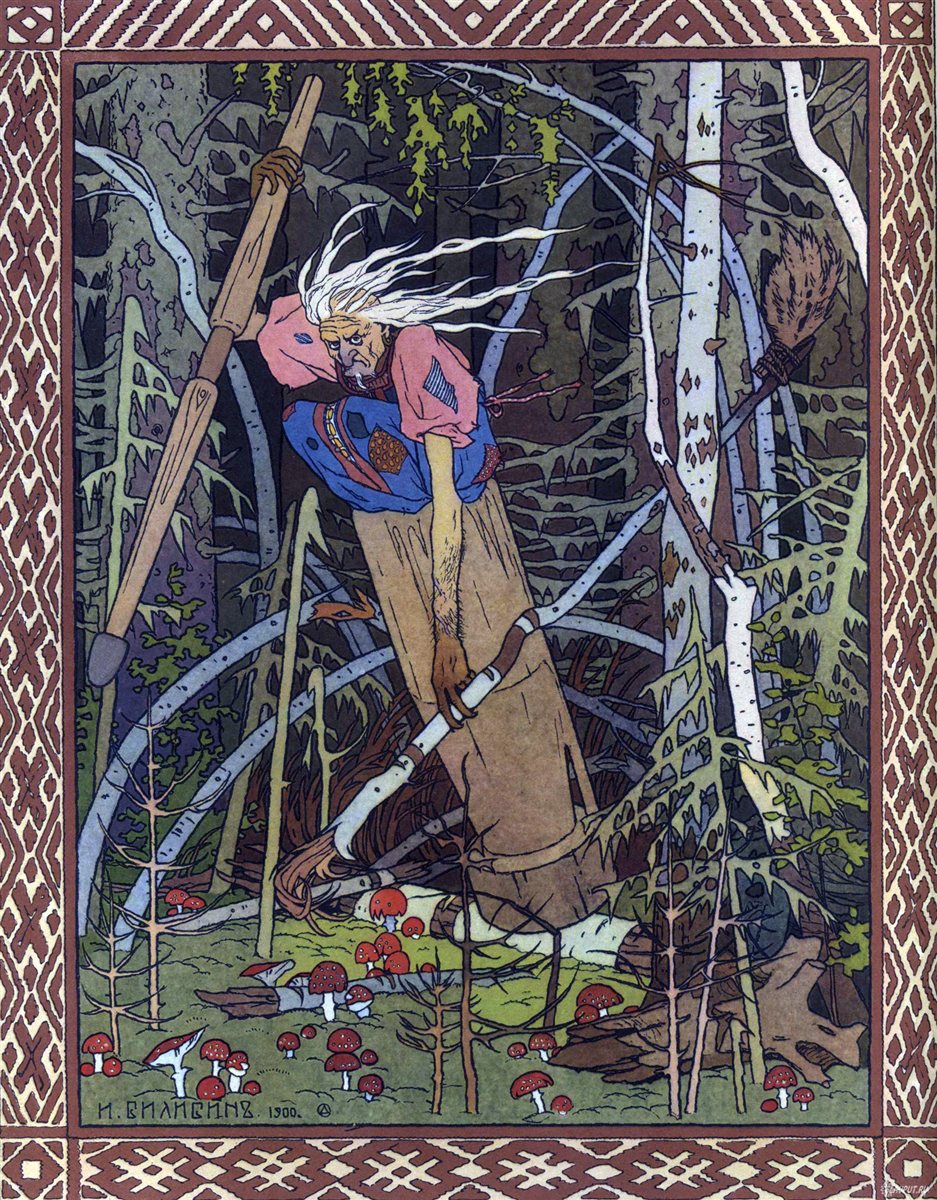
Ivan Bilibin, Baba Yaga from Vasilisa the Beautiful (1900) / Public Domain via Wikimedia Commons
Who Is Baba Yaga?
Baba Yaga is one of the best-known figures in East Slavic folklore: an old supernatural woman who lives deep in the forest, travels in a mortar, and appears in stories as both a threat and a source of help.
Calling her simply an “evil witch” misses much of what makes the character distinctive. In some tales she threatens, kidnaps or eats people. In others she feeds a visitor, gives directions, provides a magical horse or object, or tests a hero before sending them onward. Sometimes several Baba Yagas appear in the same story.
That inconsistency is not a flaw that later writers need to fix. It is part of the folklore.
Modern descriptions also tend to combine details from many different tales into one standard image: the hut on chicken legs, the fence of bones, iron teeth, the mortar and pestle, the broom, the enormous nose and the “bony leg.” All are genuine motifs associated with Baba Yaga, but they do not appear together in every traditional story.
When Does Baba Yaga First Appear in Writing?
The first clear textual reference usually cited by scholars appears in Mikhail Lomonosov’s 1755 Russian Grammar. Baba Yaga is listed among figures from Slavic tradition and, unlike several deities in the same comparative scheme, is given no Greco-Roman equivalent.
That does not mean Lomonosov invented her in 1755. His brief reference makes sense only if readers already knew the name.
Popular prints called lubki also preserve early visual versions of Baba Yaga. One famous print shows her riding a pig while confronting a bizarre “crocodile.” The dating and political interpretation of individual surviving prints are not always secure, so they should not be used to construct an exact origin story. What they do show is that Baba Yaga had a life outside the later nineteenth-century fairy-tale collections.
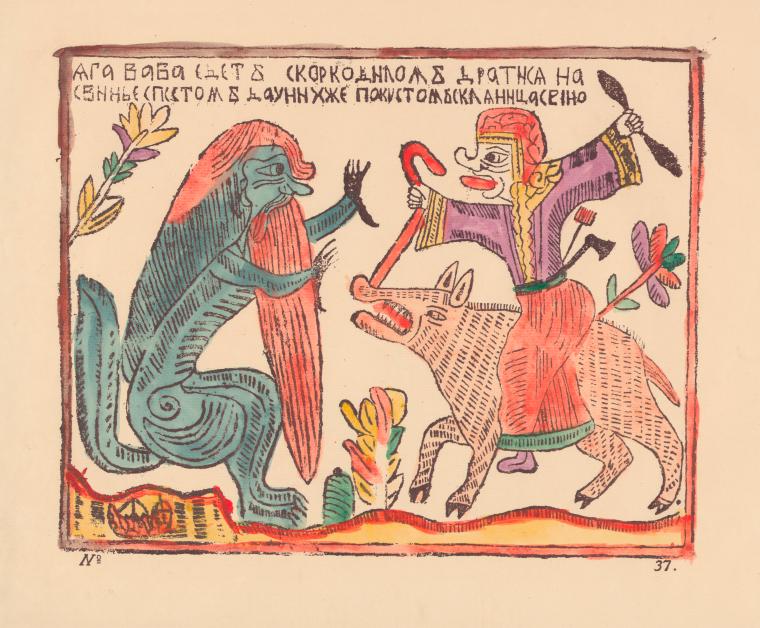
Russian lubok depicting Baba Yaga riding a pig and confronting the Crocodile. The surviving print’s exact date is uncertain. Unknown artist / Wikimedia Commons / Public Domain Mark. Source.
By the late eighteenth century she was appearing in literary works, including material by Vasilii Levshin and Dmitry Gorchakov. Her most influential body of traditional narratives, however, came from Alexander Afanasyev’s collections of Russian folk tales, published from 1855 to 1863.
Afanasyev did for Russian tale collecting something broadly comparable to what the Brothers Grimm had done in German-speaking Europe: he assembled a huge corpus from oral and manuscript sources. His collections are indispensable, but they are still nineteenth-century publications. They do not give us a direct transcript of what people supposedly believed in a distant pagan past.
What Does the Name “Baba Yaga” Mean?
The first half is much easier than the second.
Baba can mean an old woman or grandmother in Slavic languages, although its tone changes by language, period and context. It can be affectionate, neutral or insulting.
Yaga is much harder to explain. Scholars have proposed many etymologies, and no single solution has won universal acceptance.
Related words cited in discussions of the name include Polish jędza, terms connected with fear, anger or illness in other Slavic languages, and older proposals linking the word with serpents. Alexander Afanasyev himself explored a connection with Sanskrit ahi, “snake,” but that is only one theory among many.
For an English-language article, the safest answer is simple: the meaning of Baba is relatively clear; the origin of Yaga remains disputed.
The Hut on Chicken Legs
Nothing signals Baba Yaga faster than her hut.
In many tales it stands in a forest and rests on chicken or bird-like legs. The hero may have to command the hut to turn so its entrance faces them. Later art has made the building look almost like a walking animal, but traditional descriptions vary.
The famous fence made from human bones and skulls is especially memorable in Vasilisa the Fair. In a nineteenth-century English translation of Afanasyev’s tale, the fence is made of dead men’s bones, skulls sit on top, and grotesque human body parts form the gate hardware. The skulls later glow and provide light.
That is powerful imagery, but it should not be treated as an architectural checklist for every Baba Yaga tale.
Was the Hut Originally a Grave House?
This is one of the most repeated claims online, and it needs caution.
Vladimir Propp and later scholars connected Baba Yaga’s hut with the boundary of the otherworld, initiation and death. Other researchers have compared the elevated structure with historical burial practices, raised storehouses or buildings supported on stumps and roots.
Those comparisons are interpretations, not a solved origin.
A recent scholarly re-examination of the chicken-legged hut notes that numerous explanations have been proposed and criticizes attempts to make any one historical building type account for all of the hut’s strange features, including its animal legs and ability to turn.
So the burial-house theory is worth discussing. It just should not be presented as “what the hut really was.”
Why Does Baba Yaga Fly in a Mortar?
Baba Yaga’s traditional vehicle is even stranger than her house.
She is commonly described traveling in a large mortar, using a pestle and sweeping behind herself with a broom or brush. In Vasilisa the Fair, her approach is accompanied by violent noise in the forest before she emerges riding in the mortar, driving herself with the pestle and sweeping away her traces.
These are ordinary household tools transformed into supernatural equipment. Scholars have offered symbolic readings involving domestic labor, transformation, fertility, death and ritual, but those meanings are not stated by the tales themselves.
The important distinction is between motif and interpretation:
- Mortar, pestle and broom: traditional Baba Yaga imagery.
- A specific hidden ritual meaning behind them: scholarly or modern interpretation.
What Does Baba Yaga Look Like?
There is no single canonical portrait.
Traditional descriptions may give her:
- a bony leg
- iron or frightening teeth
- an enormous nose
- an aged or grotesque body
- a body stretched across the stove or hut
- an uncanny ability to smell a human visitor
In several tales, Baba Yaga reacts to the arrival of a hero by commenting on a “Russian scent” or the smell of Russian flesh. Folklorists have sometimes interpreted this as evidence that she belongs to the realm of the dead and therefore detects the living as something alien.
Again, the first part comes from the tales. The second is an interpretation.
Illustrator Ivan Bilibin helped fix the modern visual image of Baba Yaga around 1900. His famous Vasilisa the Beautiful illustrations show an emaciated old woman crouched inside a mortar while moving through a dense forest. Those images remain among the most recognizable depictions of the character.
Baba Yaga in Vasilisa the Fair
One of the most useful stories for understanding Baba Yaga’s ambiguity is Vasilisa the Fair.
Vasilisa’s cruel stepfamily sends her into the forest to obtain fire from Baba Yaga, apparently expecting her to die. When Vasilisa reaches the witch’s domain, she sees the bone fence, glowing skulls and mysterious horsemen associated with day, sun and night.
Baba Yaga threatens to eat her if she fails a series of impossible household tasks.
But Baba Yaga does not simply attack her.
Vasilisa completes the tasks with supernatural help from a doll given to her by her dying mother. Baba Yaga honors the terms of the encounter and eventually allows her to leave with a skull containing supernatural fire.
This is why describing Baba Yaga only as a cannibalistic villain is inadequate. She is terrifying, but she also operates according to conditions that can be met.
Helper, Villain or Tester?
The same ambiguity appears across other tales.
A hero seeking a distant kingdom, magical bride or enemy may encounter Baba Yaga and receive food, directions or a magical helper. In other stories, children must escape her attempts to cook or devour them.
Folklorist Vladimir Propp is central to modern analysis of this pattern.
In Morphology of the Folktale (1928), Propp argued that characters in wonder tales can be understood through the functions they perform in the story rather than as psychologically consistent individuals. Baba Yaga often fills the role of the donor: the figure who tests a hero and then supplies information or a magical object needed for the next stage of the journey.
In other narratives she acts as an antagonist.
This helps explain why asking whether Baba Yaga is “good or evil” produces a poor answer. Traditional storytelling did not require every appearance of Baba Yaga to fit one moral biography.
Propp, Death and Initiation
Propp went further in Historical Roots of the Wonder Tale.
He interpreted Baba Yaga’s forest hut as a threshold to another world and connected elements of the tales with hypothetical initiation rituals. The hero enters an isolated space, faces danger, is tested and emerges equipped for a transformed state or a journey beyond the ordinary world.
The oven and threatened devouring could, in this model, echo symbolic death and rebirth.
It is an influential interpretation, but it is still Propp’s historical theory. We do not possess evidence showing that Baba Yaga stories are straightforward records of one ancient Slavic initiation ceremony.
That distinction matters because modern retellings often turn an academic hypothesis into a supposedly proven secret origin.
Was Baba Yaga an Ancient Slavic Goddess?
There is no good historical evidence that a pre-Christian cult worshipped a deity called Baba Yaga.
No securely identified ancient temple, inscription or ritual text establishes her as a goddess. The figure enters surviving textual documentation much later.
That does not mean scholars are forbidden from comparing her with goddesses, death figures, maternal archetypes or pre-Christian religious motifs. Such comparisons have a long history. Some modern pagan and spiritual traditions also reinterpret Baba Yaga as an earth mother, death goddess, wise woman or embodiment of wilderness.
Those are interpretations and modern religious uses, not documentation of an ancient cult.
The careful answer is therefore:
Could Baba Yaga preserve very old motifs? Almost certainly. Can we prove she was once a specific worshipped pagan goddess who was later demoted into a witch? No.
Is Baba Yaga Only Russian?
No, although the version most familiar to English-language readers comes largely from Russian and East Slavic tale collections.
Andreas Johns’s major study of the character treats Baba Yaga as part of the folklore traditions of Russia, Ukraine and Belarus.
Across the wider Slavic world there are figures with related names or overlapping traits, but it is risky to place all of them into a single neat family tree.
Ježibaba
Ježibaba appears in Czech and Slovak traditions and is often translated or compared with Baba Yaga. The names and motifs overlap, but local traditions have their own histories. It is better to describe Ježibaba as a related or comparable West Slavic witch figure than to declare that she is simply “the Czech Baba Yaga.”
Baba Roga
Baba Roga is found in South Slavic folklore, including Croatian and neighboring traditions. She frequently functions as a frightening old woman or child-scaring figure. Folklore research shows real similarities with the broader family of frightening Slavic “baba” figures, but some scholarship specifically warns against treating Baba Roga and Russian Baba Yaga as identical.
Regional folklore is messy. That is a strength, not a problem to flatten away.
Baba Yaga and the Western Witch
Baba Yaga is often called a witch in English because it is the closest familiar category, but she does not fit neatly into the stereotype created by early-modern European witch trials.
Traditional Baba Yaga tales do not require her to have signed a pact with Satan, attended a witches’ Sabbath or received powers from the Christian Devil. She belongs to fairy-tale and folk narrative rather than to one fixed demonological system.
That makes her closer to an autonomous supernatural hag, ogress, helper and boundary figure than to the historical stereotype of the Satanic witch.
Does Baba Yaga Eat Children?
Sometimes.
Cannibalism and the threat of being cooked are genuine Baba Yaga motifs. Some stories place children in direct danger; Vasilisa explicitly says Baba Yaga eats people.
But “Baba Yaga is a monster who always eats children” is another simplification.
She also interacts with adult heroes, gives advice, supplies magical objects and sends travelers toward their destination. In some tales the visitor survives by completing tasks or following rules rather than defeating her in battle.
Her frightening reputation is real. So is her usefulness.
Why Does John Wick Call Him Baba Yaga?
The John Wick films helped introduce the name to a huge modern audience, but their use of it is linguistically misleading.
The first film frames Baba Yaga as a terrifying nickname associated with the idea of the boogeyman. In actual folklore, Baba Yaga is not a generic Russian word meaning “boogeyman.” She is a specific female supernatural figure.
Russian also has separate words for child-frightening bogey figures, including babay, babayka and buka.
And baba itself refers to a woman, often an old woman or grandmother depending on context. So using “Baba Yaga” as the title of a male assassin is a Hollywood repurposing, not a literal translation.
The nickname still works dramatically because Baba Yaga is dangerous, legendary and feared. It just does not mean what the film’s cultural shorthand suggests.
Baba Yaga in Modern Horror and Fantasy
Modern fiction keeps returning to the character because she can be reshaped without losing her identity.
Mike Mignola’s Hellboy uses Baba Yaga directly, drawing on her supernatural menace and Eastern European folklore while building a new fictional mythology around her.
The Witcher franchise is frequently mentioned in the same conversation because it draws heavily from Slavic and European folklore and uses grotesque supernatural crones. Its Crones of Crookback Bog, however, should not simply be labeled Baba Yaga under another name. They are fictional creations that echo a broader family of hag and witch imagery.
Games, films, novels and comics often emphasize the mobile hut, cannibalism or terrifying old-woman appearance while reducing the helpful or transactional side of the traditional character. Others deliberately recover that ambiguity.
Common Baba Yaga Misconceptions
Is Baba Yaga evil?
Not consistently. She can be a villain, helper, donor, tester or dangerous host depending on the tale.
Is Baba Yaga a goddess?
There is no direct historical evidence for an ancient cult worshipping Baba Yaga as a goddess. Goddess interpretations are later scholarly, literary, spiritual or neopagan theories.
Is Baba Yaga the Russian boogeyman?
No. She is a specific folklore character. Russian has separate bogeyman terms such as babay, babayka and buka.
Does Baba Yaga always live in a hut on chicken legs?
The chicken-legged hut is one of her defining motifs, but individual tales vary in how the dwelling is described.
Does her house literally walk?
Some folklore and later retellings make the hut turn or move, but modern fantasy has expanded the image into a fully mobile animal-like house. There is no single canonical version.
Does Baba Yaga always eat children?
No. Cannibalism is a genuine motif, but she also helps heroes and adult travelers.
Is there only one Baba Yaga?
Not necessarily. Some tales feature more than one Baba Yaga, including sequences of sisters or repeated encounters.
Why Baba Yaga Endures
Baba Yaga survives because she is difficult to reduce to one thing.
She is an old woman and a monster. A cannibal and a host. An obstacle and a source of the exact knowledge the hero needs. Her forest can be read as wilderness, danger or the border of another world, but no single symbolic theory explains every story.
The best way to understand Baba Yaga is not to search for one hidden “true” identity behind centuries of tales. It is to follow the contradictions.
She is dangerous because the rules of her world are not ordinary human rules. Yet those rules can sometimes be learned, negotiated and survived.
That is much stranger than a simple evil witch.
Sources and Further Reading
- Andreas Johns, Baba Yaga: The Ambiguous Mother and Witch of the Russian Folktale (Peter Lang, 2004).
- Alexander Afanasyev, Russian Folk-Tales, translated by Leonard A. Magnus. Public-domain edition available through Project Gutenberg.
- W. R. S. Ralston, Russian Fairy Tales: A Choice Collection of Muscovite Folk-lore, including Vasilissa the Fair. Public-domain edition available through Project Gutenberg.
- Vladimir Propp, Morphology of the Folktale (1928) and Historical Roots of the Wonder Tale (1946).
- “The Hut on Chicken Legs: Towards the Image Genesis,” Revue des Études Sud-Est Européennes / Romanian Academy, 2026.
- Yuriy Smirnov, “‘Roga’ the Horny Granny,” research on the Baba Roga tradition, 2016.
Sources & further reading
- Andreas Johns, Baba Yaga: The Ambiguous Mother and Witch of the Russian Folktale
- Alexander Afanasyev, Russian Folk-Tales
- W. R. S. Ralston, Russian Fairy Tales: A Choice Collection of Muscovite Folk-lore
- Vladimir Propp, Morphology of the Folktale and Historical Roots of the Wonder Tale
- The Hut on Chicken Legs: Towards the Image Genesis
- Yuriy Smirnov, Roga the Horny Granny