lore / Demons & Occult
Asmodeus Explained: The Demon King of Lust in Religion, Folklore and Horror
The history of Asmodeus — from the Iranian spirit Aeshma, through the Book of Tobit and rabbinic Ashmedai traditions, to early-modern demonology, the Goetic King Asmoday and modern pop culture.
Topics: demonology, mythology, folklore, occult history
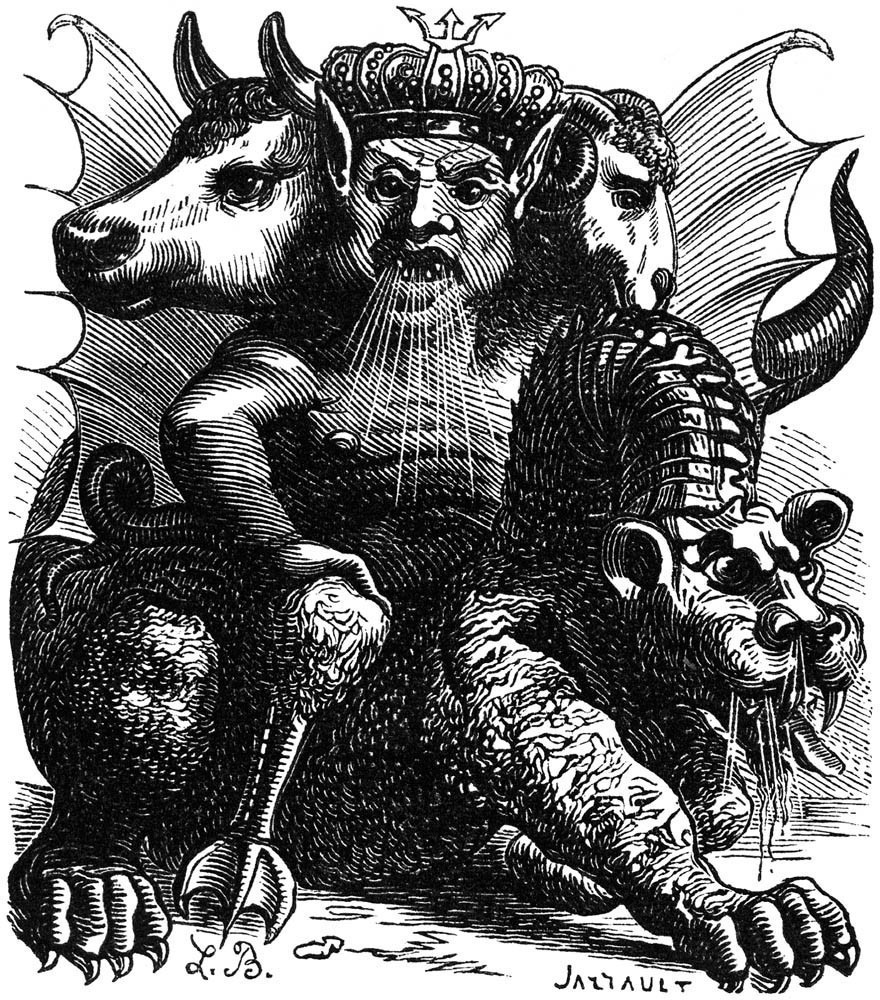
Louis Le Breton, Asmodeus from Dictionnaire Infernal (1863) / Public Domain via Wikimedia Commons
Introduction
Few figures in Western demonology have changed as dramatically as Asmodeus. Across more than two millennia of surviving texts, related forms of the name appear in Iranian religion, Jewish literature and folklore, Christian demonology, ritual-magic texts and modern popular culture.
That long history is also why simple descriptions such as “the demon of lust” can be misleading. The Asmodeus of the Book of Tobit is not identical to the Ashmedai of the Babylonian Talmud, and neither should be collapsed into the three-headed Asmoday described in the Ars Goetia. Understanding Asmodeus means separating those historical layers rather than treating every later tradition as part of one fixed mythology.
Iranian Roots: Aeshma and the Name Asmodeus
The strongest linguistic trail leads back to ancient Iran. In Zoroastrian tradition, Aeshma is a destructive spirit associated with wrath, violence and disorder. The Encyclopaedia Iranica describes Aeshma as both the metaphysical embodiment of wrath and a force expressed through human behavior, linking him with brutality, warfare and drunkenness. His principal adversary in the Younger Avesta is Sraosha, the divine figure associated with religious obedience and discipline.
Scholars have long connected the later names Asmodaios in the Book of Tobit and Ashmedai in rabbinic literature with an Iranian form reconstructed as aēšmō-daēva. The exact compound is not preserved in the surviving Avesta, but related Middle Persian forms are attested, and the linguistic relationship is widely accepted. That does not mean the characters remained functionally identical. Aeshma is primarily associated with wrath and destructive violence, while later Jewish traditions give Asmodeus very different stories and motives.
It is therefore safer to speak of an Iranian linguistic and religious background than to imagine a single unchanged demon moving intact from Zoroastrianism into Judaism.
The Book of Tobit: Seven Dead Bridegrooms
Asmodeus’s best-known early Jewish appearance is in the Book of Tobit, a work generally dated to the third or second century BCE but set during the much earlier Assyrian exile. Aramaic and Hebrew fragments discovered among the Dead Sea Scrolls confirm that the work circulated in Semitic-language forms as well as in Greek.
In the story, Sarah has been married seven times. Each husband dies on the wedding night before the marriage is consummated, killed by the demon Asmodeus. Sarah’s suffering becomes one half of Tobit’s intertwined plot.
The angel Raphael, traveling in disguise with Tobit’s son Tobias, provides the means of overcoming the demon. During the journey, Tobias catches a large fish and keeps its heart, liver and gall on Raphael’s instructions. On his wedding night with Sarah, Tobias burns the heart and liver. The odor drives Asmodeus away, and Raphael pursues the demon to Egypt and binds him.
The textual history of Tobit is complicated. The surviving Greek manuscripts preserve both longer and shorter forms, with Codex Sinaiticus representing the longer recension and Codex Vaticanus a shorter one. The Qumran fragments generally support the antiquity of the longer textual tradition. These differences matter because later translations and retellings sometimes add moral emphases that readers then mistake for the earliest version of the story.
Rabbinic Lore: Ashmedai and King Solomon
Rabbinic literature transforms the figure again. In the Babylonian Talmud, Ashmedai is called the “king of the demons” and appears in an extended story in Gittin 68a–68b. He is dangerous, but also clever, perceptive and strangely entangled with sacred knowledge.
The story begins with King Solomon’s search for the shamir, a legendary creature or substance said to cut stone without iron and therefore solve a problem connected with the building of the Temple. Solomon’s servant Benayahu learns where Ashmedai can be found. Ashmedai keeps drinking water in a sealed mountain pit, so Benayahu drains the water, replaces it with wine and waits. Ashmedai initially resists drinking but eventually becomes drunk and is captured with a chain engraved with the divine name.
On the journey back, Ashmedai behaves in ways that seem irrational until he explains that he can see hidden outcomes humans cannot. He weeps at a wedding because the groom will soon die, for example, and laughs at a man ordering shoes meant to last longer than the purchaser himself.
Ashmedai does not actually possess the shamir. He explains that it is held elsewhere, leading Solomon’s agents to obtain it through another chain of events.
The story eventually reverses the balance of power. Ashmedai persuades Solomon to remove the divine chain and hand over his ring so the demon can demonstrate his strength. Ashmedai swallows the ring, grows to enormous size and throws Solomon hundreds of parasangs away before taking his place. Solomon later returns with a ring and chain bearing the divine name, and Ashmedai flees. The Talmud closes the episode by explaining Solomon’s continued fear through the image in the Song of Songs of sixty armed men surrounding his bed.
This Ashmedai is far more complicated than the marriage-killing demon in Tobit. He is still dangerous, but he also functions as a trickster, a revealer of hidden knowledge and a humiliating mirror for royal pride.
Christian Demonology and the “Demon of Lust”
The famous identification of Asmodeus with lust belongs mainly to later Christian demonology rather than to his Iranian origins.
The Malleus Maleficarum (1486), associated primarily with Heinrich Kramer, calls Asmodeus the demon of fornication and links the name with divine judgment against sexual sin. A century later, the Catholic theologian and auxiliary bishop Peter Binsfeld developed a particularly influential classification in De confessionibus maleficorum et sagarum (1589), pairing demons with the seven deadly sins. In Binsfeld’s scheme, Asmodeus corresponds to Lust.
That classification is the source of many modern claims that Asmodeus is one of the “Seven Princes of Hell.” It should not be treated as an official or universal Christian hierarchy. Demonologists, theologians and grimoire writers produced multiple systems that do not always agree with one another.
The Dominican inquisitor Sébastien Michaëlis produced another hierarchy in the context of the Aix-en-Provence possession case of 1610–1611 and the book that followed it. Later occult literature frequently reuses elements from Michaëlis’s classification, but his system is separate from Binsfeld’s and from the Ars Goetia.
The important point is not that one hierarchy is “correct.” Historically, there was no single standardized map of Hell shared by every demonological writer.
The Goetic King Asmoday
One of the most visually elaborate versions appears in the Ars Goetia, the first part of the seventeenth-century grimoire commonly called The Lesser Key of Solomon. There he is listed as the 32nd spirit under the name Asmoday.
| Attribute | Description in the Ars Goetia |
|---|---|
| Rank | Great, Strong and Powerful King |
| Number | 32nd spirit |
| Legions | Governs 72 legions of inferior spirits |
| Superior | Described as first and choicest under the power of Amaymon |
| Form | Three heads — bull, man and ram — with a serpent’s tail and goose-like webbed feet; flames issue from his mouth |
| Mount | An infernal dragon |
| Objects | Carries a lance with a banner |
| Knowledge and gifts | Teaches arithmetic, astronomy, geometry and handicrafts; gives answers, shows guarded treasure and is said to make a person invincible |
The text also gives ritual instructions for the conjurer. The operator is told to stand throughout the action with his head uncovered. Importantly, the warning says that Amaymon, not Asmoday himself, will deceive the conjurer if the head covering remains on.
This is a major shift from Tobit and the Talmud. In those traditions, the demon is driven away, captured or outwitted. In the Goetia, Asmoday is presented as a spirit whom a ritual magician attempts to summon, constrain and question. The alleged powers described by the grimoire belong to an occult text and should be understood as claims within that tradition, not demonstrated supernatural abilities.
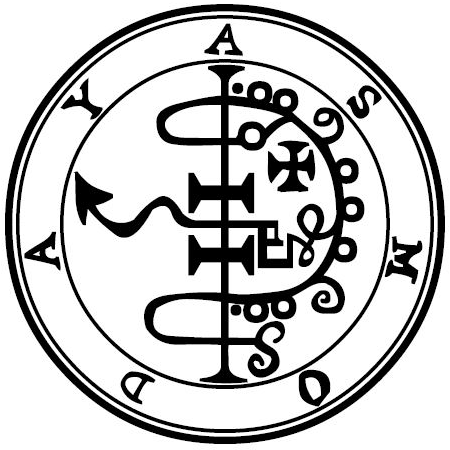
Seal of Asmoday from The Book of the Goetia of Solomon the King (1904) / Public Domain via Wikimedia Commons. Source.
Like King Paimon, Asmoday’s Goetic identity is one historical layer, not a complete account of every tradition attached to the name.
Asmodeus and the Loudun Possessions
Asmodeus’s name also became attached to one of the most notorious possession and witchcraft cases in early-modern France: the Loudun possessions.
In the early 1630s, Ursuline nuns at Loudun reported possession and accused the priest Urbain Grandier of causing their condition through sorcery. Grandier was already a controversial local figure with powerful enemies. The case became entangled with politics, public exorcisms and judicial proceedings conducted under royal authority.
Grandier was convicted of sorcery and executed by burning on August 18, 1634. He maintained his innocence and did not confess to witchcraft even under torture.
Documents presented during the affair included an alleged diabolical pact associated with Grandier. Surviving versions name demons including Lucifer, Satan, Beelzebub, Leviathan and Astaroth. Asmodeus was also repeatedly named in the possession narrative, but it is misleading to describe him simply as one of the signatories to the best-known pact. Some contemporary accounts instead claimed that Asmodeus had produced or delivered infernal documents during the exorcisms.
The case is historically real; demonic possession is not historically verifiable in the same way. Modern interpretations have emphasized political persecution, coercive judicial practices, social pressures, performance and possible psychogenic explanations. The surviving evidence does not allow the supernatural claims made during the exorcisms to be established as fact.
Asmodeus in Literature, Games and Television
Modern fiction has turned Asmodeus into an adaptable archetype rather than a fixed religious character.
- Dungeons & Dragons developed Asmodeus into one of its most important archdevils and, in later editions, the supreme ruler of the Nine Hells — a cold strategist associated with contracts, hierarchy and tyranny.
- Pathfinder presents Asmodeus as a god of tyranny, contracts and infernal law.
- Helluva Boss reimagines Asmodeus, nicknamed “Ozzie,” as the ruler associated with Lust, but gives him a personality and relationships built for the show’s own fictional cosmology rather than historical demonology.
- Supernatural uses Asmodeus as one of its Princes of Hell, again creating a mythology specific to the series.
- Le Diable boiteux (The Devil upon Two Sticks, 1707) by Alain-René Lesage features Asmodée as a witty demon who exposes the private behavior of humans by revealing what happens behind closed doors.
These versions are useful for tracing Asmodeus’s cultural afterlife, but they should not be used as evidence for what earlier religious or occult texts believed.
Common Asmodeus Claims, Checked
| Claim | Verdict |
|---|---|
| Asmodeus appears in the Bible | Tradition-dependent. He appears in Tobit, which is deuterocanonical in Catholic and Orthodox traditions and treated as Apocrypha in many Protestant editions; he does not appear in the Protestant Old Testament canon or the New Testament. |
| Asmodeus is “the” demon of lust | Later tradition. The association becomes explicit in medieval and early-modern Christian demonology and is especially famous through Binsfeld’s 1589 classification. |
| Asmodeus is one of the Seven Princes of Hell | System-dependent. This reflects Binsfeld’s influential classification, not a universal demonological hierarchy. |
| Asmodeus originated in Christianity | False. The name has earlier Jewish attestations and a strong linguistic connection with Iranian Aeshma traditions. |
| Asmodeus and Aeshma are exactly the same figure | Misleading. The names are closely related etymologically, but the characters and functions change substantially across cultures and centuries. |
| Asmodeus appears in the Ars Goetia | Yes. He appears as the 32nd spirit, Asmoday. |
| The Ars Goetia says Asmoday can make people invisible | Not in the standard Mathers/Crowley wording. That edition says he makes a person “invincible,” alongside teaching arts and revealing treasure. |
So Who Is Asmodeus?
There is no single version of Asmodeus that can accurately represent every period.
The name is linguistically connected with Aeshma, the Iranian spirit of wrath. In the Book of Tobit, Asmodeus kills Sarah’s husbands and is driven away with Raphael’s help. In the Babylonian Talmud, Ashmedai becomes a king of demons and trickster who temporarily humiliates Solomon. Medieval and early-modern Christian writers increasingly associate him with sexual sin, while Binsfeld’s 1589 classification makes him the ruler associated with Lust. The Ars Goetia then presents Asmoday as a three-headed king who teaches occult arts and commands 72 legions.
Modern horror, fantasy, games and television have borrowed from all of those layers while adding new ones of their own.
The useful answer to “Who is Asmodeus?” is therefore another question: which Asmodeus — Iranian background, Tobit, rabbinic Ashmedai, Christian demonology, the Goetia, or modern fiction? Keeping those traditions separate makes the history much stranger, and much more interesting, than any single “Prince of Lust” description suggests.
Further Reading and Primary Sources
- Encyclopaedia Iranica — Aēšma
- Sefaria — Gittin 68a–68b
- Malleus Maleficarum, Part I, Question IV
- The Lesser Key of Solomon — Asmoday
- Ville de Loudun — Urbain Grandier and the Loudun affair