lore / Demons & Occult
King Paimon Explained: The Real Demon Behind Hereditary
Who is King Paimon? The real grimoire history behind Hereditary, from the 15th-century Livre des Esperitz to the Ars Goetia, his seal, powers and appearance.
Topics: King Paimon, Paimon, Ars Goetia, Hereditary, Demonology
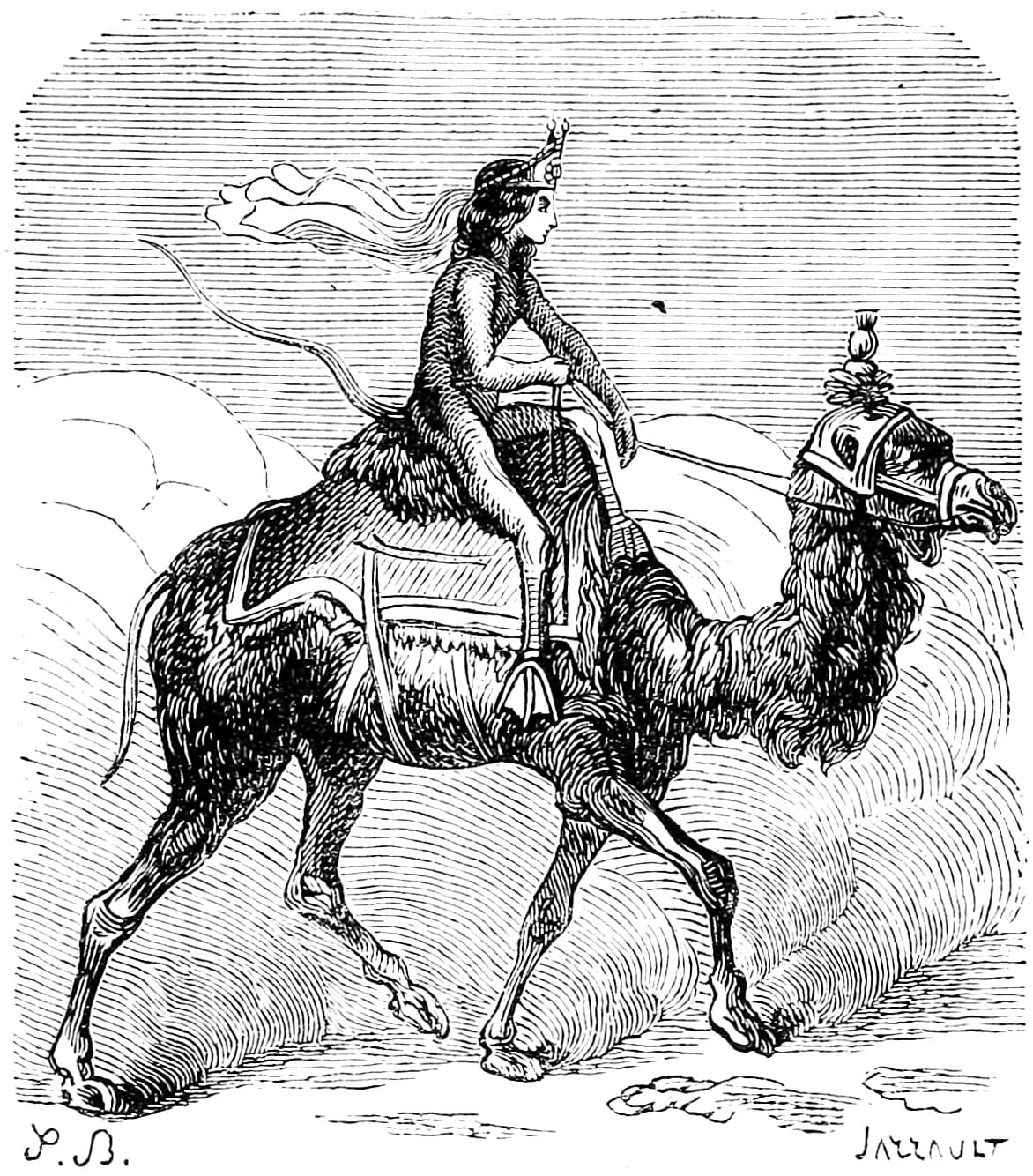
Louis Le Breton, Dictionnaire Infernal (1863) / Public Domain via Wikimedia Commons
If you know King Paimon, there is a good chance you met him through Hereditary.
Ari Aster’s 2018 film turns Paimon into the hidden force behind the Graham family’s collapse: a king of Hell whose followers want to place him in a male human host. His symbol appears throughout the film, and the final scene openly names him.
Paimon was not invented for the movie.
Versions of his name appear in European magical manuscripts centuries before Hereditary, including a 15th-century French text, Johann Weyer’s 1577 Pseudomonarchia Daemonum, and the later Ars Goetia. Those sources describe a crowned spirit associated with knowledge, rank, music and the West.
But the historical tradition is also stranger than the simplified version often repeated online. Paimon’s appearance changes between manuscripts. His place in the hierarchy changes. Some early texts give him distinctly feminine features. And there is no secure evidence that he began as an ancient Mesopotamian, Canaanite or Arabian god later “demonized” by Christianity.
So what does the record actually say?
Paimon Appears Before the Ars Goetia
The Ars Goetia is the source most frequently associated with Paimon today, but it is not his earliest surviving appearance.
One important predecessor is Le Livre des esperitz, a French demon catalogue preserved in Trinity College, Cambridge manuscript O.8.29. Scholar Jean-Patrice Boudet dates the manuscript tradition to the later Middle Ages and identifies it as part of a family of demon catalogues that fed into later Renaissance works.
In that text the name appears as Poymon.
More importantly, Poymon is one of four spirits associated with the four directions. The manuscript places him in the West and says the person compelling him should face west.
The text also credits him with answering questions truthfully, teaching sciences, revealing hidden things, granting dignities and bringing enemies into submission.
That basic profile survives remarkably well in later versions.
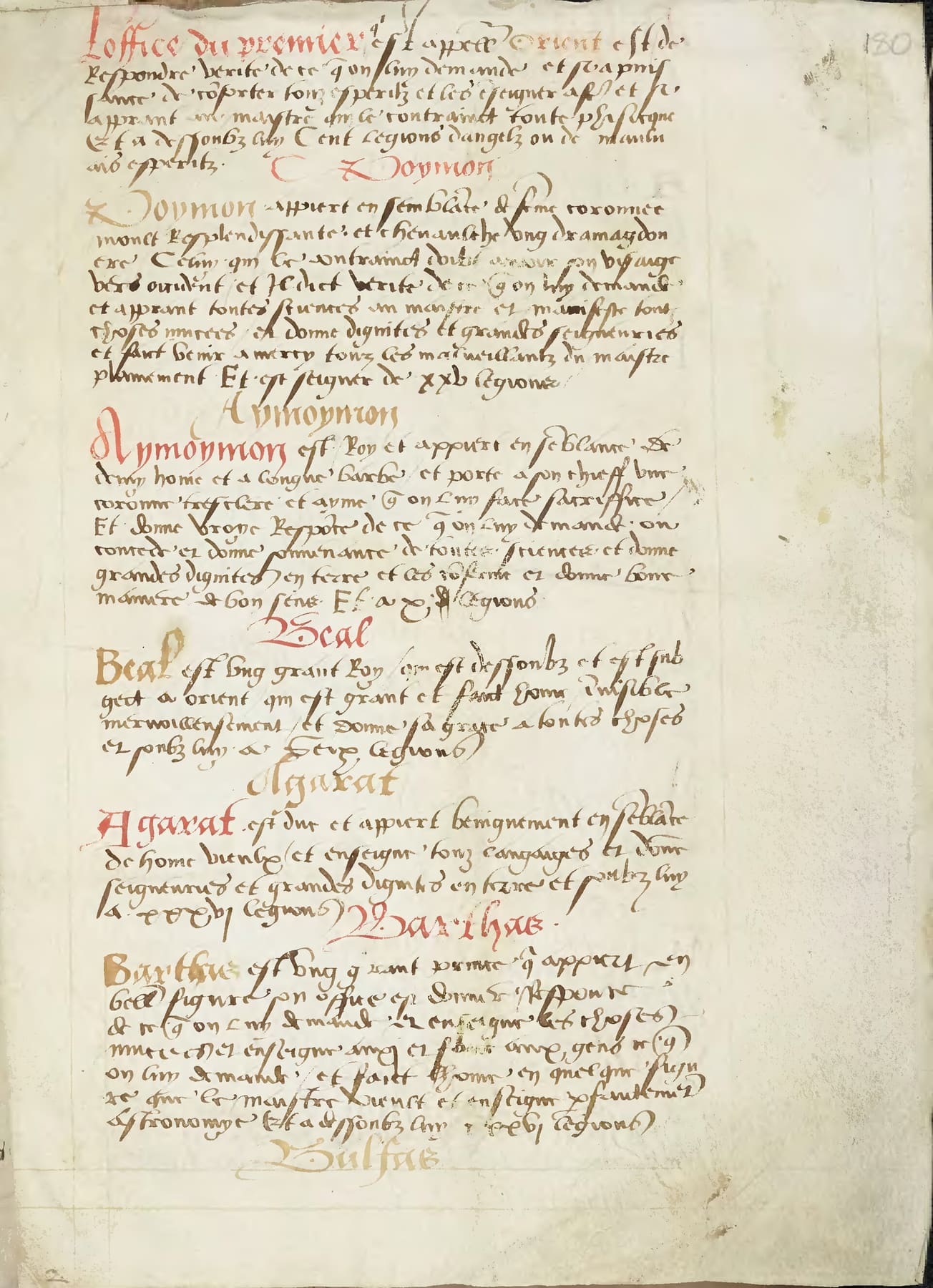
The Poymon entry survives in Trinity College Cambridge MS O.8.29. The digitized manuscript is available under CC BY 4.0 through Wikimedia Commons. Source.
An Early Paimon Could Look Feminine
One of the biggest mistakes in modern summaries is the claim that Paimon’s feminine appearance was invented in the 19th century.
It was not.
Le Livre des esperitz describes Poymon as appearing in the likeness of a crowned woman, radiant and riding a dromedary.
That does not mean every later source describes Paimon as female. The tradition is inconsistent.
Johann Weyer’s Pseudomonarchia Daemonum describes Paimon in human form, riding a dromedary and wearing a glorious crown. In the English version printed in Reginald Scot’s The Discoverie of Witchcraft, Paimon is also described as having an effeminate countenance.
The later Ars Goetia is more restrained. Its familiar printed wording simply describes “a Man sitting upon a Dromedary with a Crown most glorious upon his head” and does not emphasize the face in the same way.
So the androgynous element is not a modern invention, but neither is there one perfectly consistent “canonical” appearance stretching across every manuscript.
That is typical of grimoire traditions. Texts were copied, translated, rearranged and altered over centuries.
Johann Weyer Put Paimon at Number 22
Johann Weyer was a Dutch physician who became famous for opposing some of the most aggressive witch-persecution arguments of his time.
He still believed in demons. His criticism of witch trials should not be mistaken for modern skepticism about the supernatural. Weyer argued, among other things, that many accused witches were deceived, vulnerable or suffering from melancholy rather than wielding the powers claimed by prosecutors.
In 1577 he added the Pseudomonarchia Daemonum to an expanded edition of De praestigiis daemonum.
Paimon appears there as the 22nd spirit.
Weyer’s description preserves several features that later became standard: Paimon is a king, he is unusually obedient to Lucifer, he rides a dromedary, wears a crown and arrives with a loud musical procession.
He is also credited with teaching philosophy, wisdom and sciences, revealing secret matters, granting dignities and providing familiars capable of teaching.
This is already recognizably the Paimon who will appear in the Goetia.
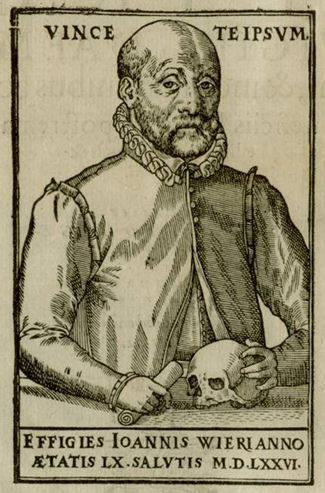
Unknown artist, Johann Weyer portrait (1576) / Public Domain via Wikimedia Commons. Weyer’s 1577 Pseudomonarchia Daemonum became one of the major textual ancestors of the later Ars Goetia. Source.
Paimon in the Ars Goetia
The Ars Goetia forms the first part of the Lemegeton, or Lesser Key of Solomon, a 17th-century English magical compilation.
Its demon catalogue draws heavily on the earlier tradition preserved by Weyer and Reginald Scot, although the order was rearranged and additional spirits were added.
Here Paimon becomes the Ninth Spirit.
The familiar description calls him a “Great King” who is very obedient to Lucifer. He appears as a crowned man riding a dromedary while a host of spirits precedes him with trumpets, cymbals and other musical instruments.
The text gives him a huge voice that is initially difficult to understand.
His attributed powers include:
- teaching arts and sciences
- revealing secret things
- answering questions about the world and the mind
- granting dignity and status
- making people subject to the magician
- providing familiars that can teach
The Goetia also says he is to be observed toward the West and gives him command over 200 legions of spirits.
Those are claims made inside a magical text, not evidence that such supernatural powers exist. Historically, however, they are the source of much of Paimon’s modern identity.
What About the Book of Abramelin?
Paimon also appears in the Book of Abramelin tradition, but this source is easy to oversimplify.
In S. L. MacGregor Mathers’ 1898 English edition, Paimon is listed among eight sub-princes, beneath four superior spirits.
Various operations in the text are assigned to groups of these spirits. Some notes state that Oriens, Paimon, Ariton and Amaimon perform particular operations through subordinate spirits, and in certain cases Paimon is singled out as capable of carrying out an operation himself.
These operations include extraordinary things such as visions, flight, remaining underwater, making apparitions and temporarily animating a dead body.
It is misleading, however, to turn every operation in Abramelin into a personal “Paimon power list.” The text works through a hierarchy of spirits assigned to different operations rather than presenting a modern superhero-style catalogue of individual abilities.
Paimon’s Seal Came Later
Weyer’s printed Pseudomonarchia does not give individual seals for its spirits.
The familiar geometric Seal of Paimon belongs to the later manuscript and printed Goetia tradition.
The symbol is now nearly as recognizable as Louis Le Breton’s camel-riding illustration. It appears in the 1904 Book of the Goetia of Solomon the King, translated by S. L. MacGregor Mathers and edited by Aleister Crowley.
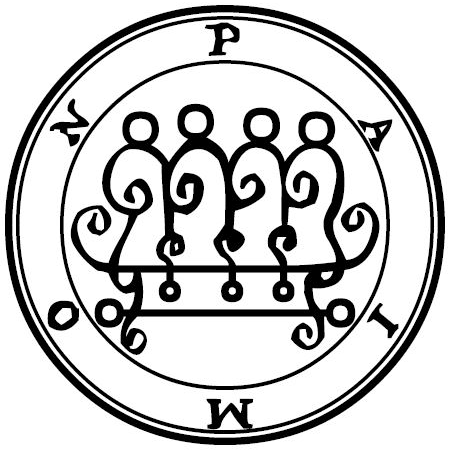
S. L. MacGregor Mathers and Aleister Crowley, The Book of the Goetia (1904) / Public Domain. One of Paimon’s seals in the 1904 edition. Source.
Hereditary uses a recognizable version of this Goetic symbol throughout the film.
That is one of the movie’s clearest borrowings from genuine historical demonological material.
The Famous 1863 Paimon Illustration
The visual image most people encounter outside Hereditary comes from Jacques Collin de Plancy’s Dictionnaire Infernal.
The illustrated sixth edition, published in 1863, included engravings by Louis Le Breton. His Paimon rides a dromedary with a crown and a delicate, feminine-looking face.
The engraving did not invent the feminine element. As we have seen, much earlier texts already contain it.
What Le Breton did was give the tradition an image memorable enough to become the default portrait.
For a figure known for centuries primarily through words in difficult manuscripts, that mattered enormously. The 1863 picture is now reproduced across books, websites and occult reference material so often that it can feel ancient itself.
It is not. It is a 19th-century interpretation of a much older textual tradition.
Was Paimon an Ancient Pagan God?
This claim appears constantly online.
Paimon is sometimes described as an ancient Mesopotamian god, a Canaanite deity, an Arabian spirit or even a being inherited from a much older pre-Christian religion.
There is no secure evidence establishing any of those identities.
That is worth distinguishing from other names in European demonology. Astaroth, for example, is connected through a recognizable historical process to Astarte and related ancient Near Eastern divine names. “Baal” has an equally obvious relationship to Northwest Semitic religious vocabulary. The same care is useful when reading about Pazuzu, another historical demon later adapted by modern horror.
Paimon’s case is different.
The securely documented Paimon/Poymon/Paymon tradition emerges from medieval and early-modern magical manuscripts. Scholars can trace textual relationships between those manuscripts, but that is not the same as tracing Paimon back to an excavated ancient cult.
His name may preserve older linguistic material. That remains possible.
But “Paimon was an ancient god demonized by the Church” goes beyond the surviving evidence.
Where Does the Name Paimon Come From?
The etymology is uncertain.
Mathers suggested a connection to the Hebrew pa’amon, meaning a bell or tinkling sound. The idea is appealing because Paimon repeatedly arrives with loud music.
But Mathers was an occult translator writing centuries after the earliest Paimon manuscripts. His suggestion is not a demonstrated historical derivation.
Other proposed origins have looked toward Arabic or other linguistic influences on medieval magical literature, but none has produced a universally accepted answer.
The most careful conclusion is also the least dramatic:
We do not know exactly where the name came from.
Paimon and Lucifer
Both Weyer and the later Goetia emphasize Paimon’s obedience to Lucifer.
That has produced modern descriptions of Paimon as Lucifer’s right-hand man, son or second-in-command.
The first idea is loose shorthand. The second is unsupported.
The historical texts describe a hierarchy of ranked spirits and Paimon’s particular obedience. They do not describe a biological father-and-son relationship between Lucifer and Paimon.
Even the hierarchy is not perfectly stable across sources.
Le Livre des esperitz treats Poymon as one of four major directional spirits. Weyer places him 22nd in his catalogue. The Ars Goetia makes him number nine while retaining his title of king. Abramelin places Paimon among eight sub-princes.
There was no single standardized infernal civil service.
How Solomonic Magic Framed Spirits
The books containing Paimon belong broadly to traditions of ritual magic associated with the legendary authority of King Solomon.
The important historical point is that the magician is usually presented as commanding spirits through divine authority rather than worshipping them.
Protective circles, divine names, seals and formal conjurations appear throughout this literature.
That is enough detail to understand the worldview without turning a historical article into an instruction manual.
The relationship in these texts is coercive and hierarchical. The operator calls on divine authority and attempts to compel a spirit to answer or perform a task.
That is very different from the cult in Hereditary.
What Hereditary Gets Right
Ari Aster chose Paimon deliberately rather than inventing a generic demon.
In a 2018 interview, Aster explained that he wanted something more specific than simply using the Devil. The film’s occult details reflect that choice.
Several elements have genuine roots:
Paimon is a king.
That title appears repeatedly in the historical tradition.
The symbol is based on a real Goetic seal.
The film places it on jewelry and elsewhere as a recurring clue.
Knowledge, honors and familiars fit the grimoires.
Those rewards closely resemble powers attributed to Paimon in the Goetia.
Paimon’s history is associated with sound.
Older texts repeatedly describe a loud voice and musical retinue.
Those details give the film’s mythology a real historical skeleton.
What Hereditary Invents
The movie then builds its own mythology around that skeleton.
The historical Paimon texts do not require:
- a male human host
- hereditary possession through one family
- a sequence of ritual decapitations
- Paimon moving from one child’s body to another
- a secret communal cult engineering a family for generations
In the grimoires, Paimon is normally treated as an external spirit to be summoned and compelled.
Hereditary transforms that into possession horror.
The movie’s body-transfer plot is therefore not a hidden teaching from the Ars Goetia. It is Ari Aster’s fiction.
That does not make the film’s use of Paimon inaccurate in every respect. It makes it an adaptation.
Is King Paimon “Real”?
There are two different questions hiding inside that one.
Is Paimon a genuine historical figure in demonological and magical literature? Yes. He appears in manuscripts and printed works going back centuries.
Do those texts prove that Paimon exists as a supernatural being? No. Historical documentation proves that people wrote about, classified and attempted to work with such spirits. It does not scientifically establish the entities described by those texts.
That distinction is the same one that matters whenever folklore, religion and occult history intersect.
Paimon is historically real as a tradition.
His supernatural reality is a matter of belief.
The Stranger Paimon Is the Historical One
The version of King Paimon preserved in the old books is less like a modern horror monster than people expect.
He rides a dromedary. Music announces him. He teaches sciences. He grants rank. He rules westward. Depending on which manuscript you open, he can appear as a crowned woman, as a man with an effeminate face or simply as a crowned man.
Centuries later, Hereditary took those fragments and built a completely different nightmare around them.
The movie did not invent Paimon.
It invented what Paimon wanted from the Graham family.