The Index
Burke and Hare: What Really Happened in Edinburgh’s 1828 Anatomy Murders?
Burke and Hare killed people for Edinburgh’s anatomy trade. Examine the 1828 murders, Margaret Docherty’s case, Hare’s immunity and the Anatomy Act.
Topics: Burke and Hare, West Port murders, Edinburgh, Anatomy Act 1832, Robert Knox
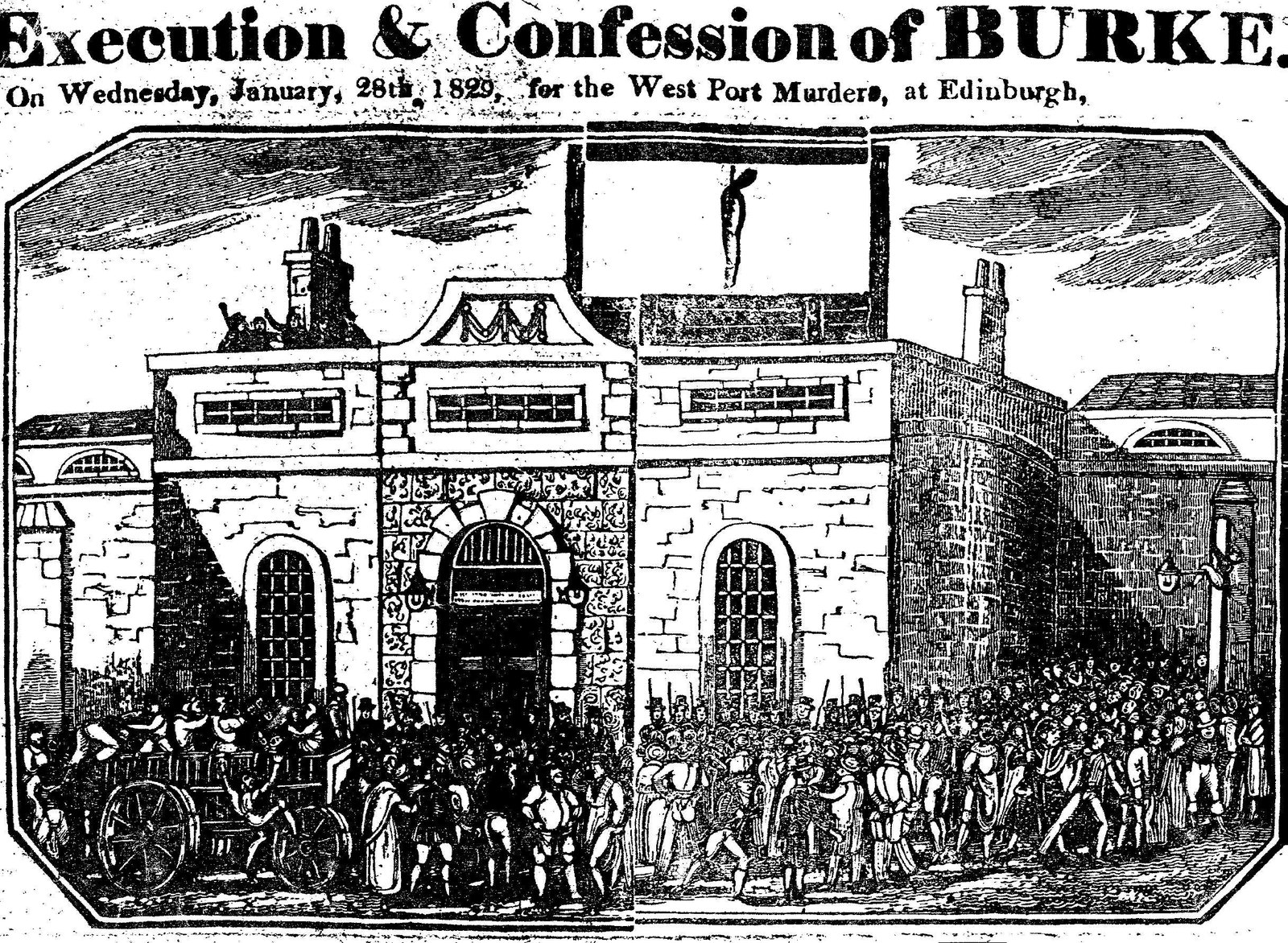
Unknown artist, 1829 / Wikimedia Commons — Public domain

William Burke and William Hare are often described as Edinburgh’s notorious body snatchers. That description obscures the central fact of the case. They did not become infamous for digging up graves. They killed living people and sold their bodies to an anatomy school.
The killings took place mainly in 1828, against a background of intense demand for human bodies in medical teaching and a restricted legal supply. Historical accounts generally attribute 16 deaths to the pair. Yet the legal record is narrower: Burke was convicted of the murder of Margaret Docherty, while Hare gave evidence for the prosecution and avoided a murder trial. The anatomist who received the bodies, Robert Knox, was not charged.
The distinction matters. The West Port murders are a documented series of killings, but the number of victims attributed to the conspiracy is not the same thing as the number of murders established by a court verdict. The story also exposes a system in which impoverished people’s bodies acquired monetary value to medical institutions without their consent. The National Library of Scotland’s examination of contemporary reports and trial material is an especially useful guide to both the evidence and the myths that gathered around it.
Hero: Unknown artist, 1829. Source image. Public domain: 1829 publication; expired UK rights and US pre-1931 publication. No cropping; resized and recompressed for web display. Imagined execution scene, not an eyewitness photograph.
Why did Edinburgh’s anatomists need bodies?
Edinburgh was a major centre of medical education in the early nineteenth century. Anatomical instruction depended on dissecting human remains, but the law provided relatively few corpses for teaching. The bodies of some executed criminals could be used; they could not meet the demand from expanding medical schools.
An illicit market developed around people called resurrection men, who removed recently buried bodies and sold them to anatomists. Families and communities responded by guarding burial grounds and using heavy iron mortsafes over graves. The UK Parliament’s history of body snatching explains how this demand, and the limited legitimate supply, contributed to the trade.
Burke and Hare’s crimes were more direct than grave robbery. They turned the same market for fresh bodies into an incentive to kill. That is why calling them merely grave robbers is misleading: the people they sold had not died before the pair encountered them.
The first sale was not a murder
The sequence began with a death at William Hare’s lodging house in Tanner’s Close, near Edinburgh’s Grassmarket. According to the National Library of Scotland, a lodger who owed Hare rent died of natural causes on 27 November 1827. Hare, helped by Burke, sold the body to the anatomy establishment of Robert Knox in Surgeons’ Square.
That first transaction is important because it separates an opportunistic and illicit sale of a corpse from the killings that followed. After discovering that an anatomist would pay for a fresh body, the men began supplying bodies they had made available by murder.
The University of Edinburgh’s Anatomical Museum says Burke and Hare killed at least 16 people. Accounts of the specific incidents differ in some details, but the pattern reported by the historical institutions is consistent: victims were brought into lodgings, often given alcohol, killed by suffocation, and their remains delivered to Knox’s rooms.
The method later became known as “burking”. It was significant to the criminal scheme because a body without an obvious wound could more readily be presented as having died from other causes. That explains the commercial logic of the murders; it does not turn the people killed into anonymous “anatomical subjects.”
Who were the victims?
Most of those killed were poor people living in or moving through Edinburgh’s Old Town. Their social position matters: the trade exploited people who had less protection and whose disappearance was easier for those profiting from the system to discount.
The National Library of Scotland identifies three particularly well-documented names in the prosecution history: Mary Paterson, James Wilson, and Margaret Docherty. James Wilson appeared in popular broadsides under a demeaning nickname, “Daft Jamie.” Repeating that label as his identity would preserve the cruelty of the historical press rather than tell readers who he was.
Margaret Docherty, also referred to in period documents as Margery Campbell or Docherty, was the last known victim. Her body was discovered by other residents before the conspirators could remove it. The alarm they raised eventually led police to Knox’s dissecting rooms. These were not merely rumors of missing persons: the last death produced evidence investigators could trace through the chain of people and premises involved.
Although 16 killings are usually attributed to the pair, Burke’s eventual conviction concerned Docherty’s murder. The wider total comes from the reconstructed history of the murders, testimony, and subsequent accounts. It should not be misrepresented as 16 separate guilty verdicts. A contemporary trial account is catalogued by the Huntington Library under Docherty’s alternate name, Margery Campbell.
How the arrests and trial unfolded
Burke, Hare, and their partners were detained in early November 1828. The prosecutor, Lord Advocate Sir William Rae, chose to use Hare as a witness against Burke and Helen McDougal, Burke’s partner. Hare received protection from prosecution in exchange for evidence that would help convict the others. His testimony was therefore vital but also came from a participant who had a direct incentive to shift responsibility.
The trial of William Burke and Helen McDougal began on 24 December 1828, continued through the night, and ended with the verdict on Christmas morning. Burke was found guilty of murdering Docherty. The charge against McDougal was found “not proven” under Scottish criminal procedure. That meant she was not convicted; it was not a judicial determination of exactly what she knew or did.
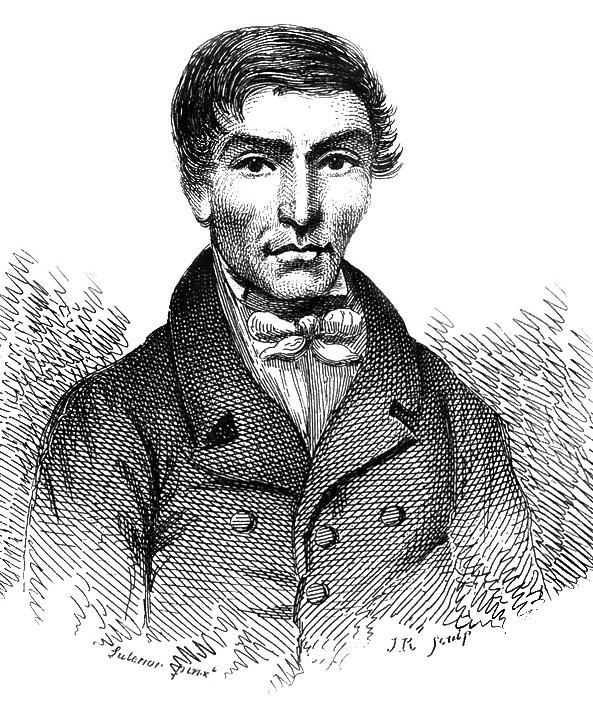
William Hare as depicted in a portrait associated with the 1828 trial, published circa 1829. George Andrew Lutenor / Wikimedia Commons, public domain. Recompressed without additional cropping. The picture is a historical representation, not a photograph.

It is easy to flatten this into a story of two men who were equally tried, equally convicted, and equally punished. That did not happen. Hare testified for the prosecution and was not convicted in Burke’s trial. Burke received the death sentence. McDougal was released. Hare’s wife, Margaret, was not tried as a co-defendant in the same way. These separate legal outcomes are documented in the National Library of Scotland’s trial summary.
What did Robert Knox know?
Robert Knox received bodies from Burke and Hare. That is part of the documented history. A claim that Knox was convicted of knowingly buying murder victims is not. Knox was not charged in connection with the killings and was not called to give testimony at Burke’s trial, despite widespread public suspicion.
The distinction between legal responsibility and professional conduct remains crucial. The National Library of Scotland describes Knox as negligent for failing to enquire properly about where the bodies came from. His reputation was damaged, and hostile crowds and caricaturists made him a symbol of the anatomical trade’s moral blindness. But the records considered here do not establish a criminal conviction, or a proven agreement between Knox and the killers to commit murder.
That narrower conclusion is not an acquittal of the wider trade. The killings took place because bodies had a price and questions about their provenance could be avoided. It is possible to examine that institutional failure without claiming more specific knowledge or guilt than the surviving evidence can support.
Burke’s execution and the public response
Burke was hanged on 28 January 1829 in Edinburgh’s Lawnmarket. His sentence included public dissection, a punishment closely connected to the scandal of selling bodies for anatomical study. His skeleton is now held by the University of Edinburgh’s Anatomical Museum, and Surgeons’ Hall Museums preserves other artefacts associated with the case.
The scene was treated as a major public event. Prints and broadsides described the trial, confession, execution, and supposed motives. Their existence tells us a great deal about the city’s response; their images do not necessarily show what an eyewitness actually saw.
A surviving 1829 execution broadside, reproduced in the hero image for this article, presents an imagined scene of the hanging and the assembled crowd. It is a document of how the event was represented, not a photograph or an independently verified reconstruction of every detail. The original image’s file record explicitly identifies the scene as imagined.
How “burking” entered political satire
The public reaction extended far beyond crime reporting. In 1829 the artist William Heath published a political cartoon called Burking Poor Old Mrs Constitution. It used imagery associated with the West Port murders to attack the government’s Catholic emancipation policy. The illustration is not a depiction of a murder committed by Burke and Hare. It shows how quickly a word associated with their crimes became political shorthand for destroying something valued.
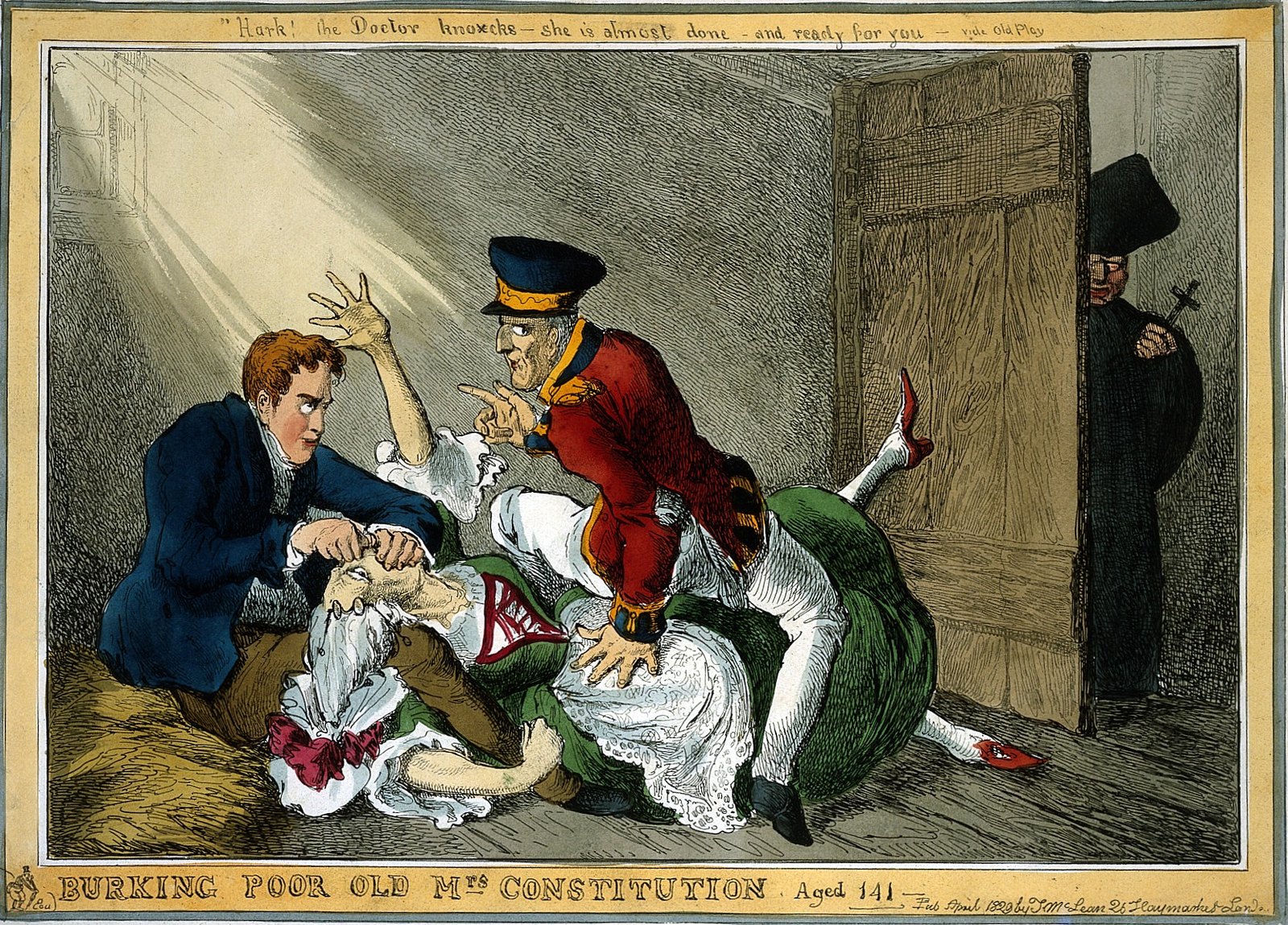
William Heath, “Burking Poor Old Mrs Constitution” (1829). Political allegory, not evidence of a historical attack. Wellcome Collection / Wikimedia Commons, CC BY 4.0; resized and recompressed without cropping; source image.

The National Library of Scotland’s collections preserve ballads, cheap single-sheet broadsides, portraits, and elaborate caricatures. Some centered the victims; others made the accused into sensational characters. The archive gives historians two different records to study: evidence about the murders, and evidence about how people turned the murders into a public story.
Did Burke and Hare cause the Anatomy Act of 1832?
The murders helped intensify an existing debate. They did not create the need for reform out of nothing. Parliament had already examined the shortage of bodies and the trade in stolen corpses before the scandal. An initial legislative effort failed.
The Anatomy Act 1832 expanded legal access to bodies for anatomical study, including certain unclaimed bodies from institutions. The UK Parliament’s history explains that the reforms were shaped by years of pressure and by the public outcry over murders connected to body supply.
Calling the Act an uncomplicated triumph misses its unequal effects. Making unclaimed bodies available meant that people who died in workhouses, hospitals, and other institutions, often the poor, remained particularly vulnerable to post-mortem use. Reform aimed to curb illegal supply; it did not suddenly make anatomical education a fully consensual practice by today’s standards.
The modern connection to the case is not merely that a law changed. It is that the law, medical training, poverty, and a market for human remains all shaped the conditions in which the murders could occur.
What happened to Hare, McDougal, and Knox afterward?
Hare disappeared from reliable historical view. The National Library of Scotland records his release from custody in February 1829 and notes that stories about his later fate, including a tale of being blinded in a lime kiln, are not securely established. Versions that supply a dramatic confirmed death for him go further than the evidence warrants.
Helen McDougal left Edinburgh after the trial. The same library’s account does not establish a definitive later biography. Robert Knox continued professional work, but the scandal harmed his standing in Edinburgh. None of these later trajectories should be mistaken for further criminal verdicts.
The relative certainty surrounding Burke’s conviction has encouraged later tellings to make every other participant’s fate equally tidy. Historical sources are not tidy on those questions, and the gaps should remain visible.
Fact versus legend: what the evidence can establish
| Common claim | What the sources support |
|---|---|
| Burke and Hare were grave robbers. | The murders were committed for the corpse trade. Their notorious method was to kill people, not dig up graves. |
| They were both convicted of 16 murders. | Sixteen killings are generally attributed to them; Burke was convicted of Docherty’s murder, while Hare testified for immunity. |
| Knox was convicted of ordering the murders. | Knox received the bodies but was not charged or called to testify at Burke’s trial. His conduct has been heavily criticised. |
| Burke was executed and dissected. | Yes: he was hanged on 28 January 1829, and his body was dissected. |
| The Anatomy Act was passed solely because of Burke and Hare. | The scandal accelerated pressure for reform, but debate and parliamentary investigation predated the murders. |
| Hare was definitely blinded by an angry mob. | Versions of this story circulated; the reliable later record does not confirm it. |
The distinction between crimes and their afterlives matters elsewhere in nineteenth-century true-crime writing too. Morbid Index’s account of H. H. Holmes and the “Murder Castle” examines another case in which documented killings and dramatic newspaper narratives became intertwined. The histories are different; the need to keep court records separate from later legend is the same.
Frequently asked questions
How many people did Burke and Hare kill?
Historical institutions commonly attribute 16 murders to Burke and Hare. This is a reconstruction of the series, not a count of separate criminal convictions. Burke was convicted in the case of Margaret Docherty.
Were Burke and Hare convicted together?
No. Burke was convicted and executed. Hare supplied prosecution evidence under an immunity arrangement. Helen McDougal received a “not proven” verdict.
Was Robert Knox prosecuted?
No. Knox received the bodies for anatomical teaching, but he was not charged in the West Port murder case. His failure to scrutinize the supply drew severe criticism.
Did Burke and Hare invent body snatching?
No. Grave robbing and the illicit market in corpses existed before the murders. Burke and Hare exploited that market by killing living people.
Why was Burke dissected after execution?
Public dissection was part of his judicial punishment. The fact that he had sold others’ bodies to anatomists made the sentence particularly resonant to contemporaries.
Did the murders lead to the Anatomy Act?
They were an important catalyst for reform. The 1832 Act expanded legal access to corpses, but the debate about scarcity and illicit body supply was already underway.
Sources & further reading
- National Library of Scotland: Burke and Hare archival guide
- University of Edinburgh Anatomical Museum: William Burke
- UK Parliament: Body snatching and Anatomy Acts
- Huntington Library: 1829 Burke and McDougal trial record
- Surgeons’ Hall Museums: Edinburgh’s dark history
- Unknown artist, 1829 — image source and reuse terms
- George Andrew Lutenor, c.1829 — image source and reuse terms
- William Heath / Wellcome Collection, 1829 — image source and reuse terms