lore / Folklore
Skinwalkers Explained: Diné Tradition, History and Internet Horror
What does Skinwalker mean in Diné tradition? A careful guide to yee naaldlooshii, the 1878 witch purge, Skinwalker Ranch and the modern myths that changed the story.
Topics: Skinwalker, Diné, Navajo Nation, Folklore, Skinwalker Ranch
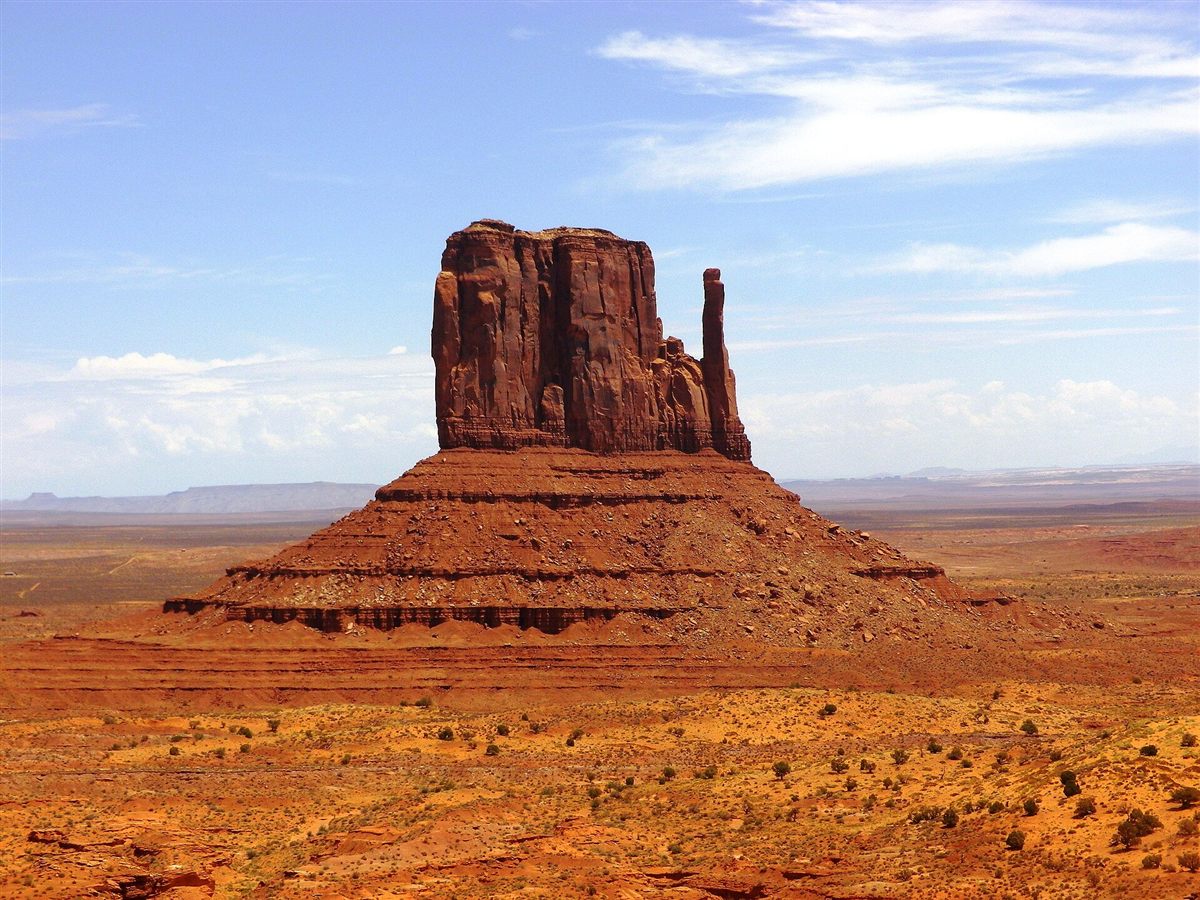
Cody escadron delta / Wikimedia Commons / Public Domain
Search for “Skinwalker” online and you will usually meet a monster.
It may have antlers. It may crawl beside a road, imitate a relative’s voice or appear as a distorted animal with human eyes. In videos and creepypasta, the word has become a catch-all label for almost anything unsettling in the American wilderness.
That is not what the term means in its original cultural setting.
The concept usually rendered in English as Skinwalker belongs specifically to Diné, or Navajo, tradition. It refers to a human practitioner associated with harmful witchcraft, not a species of cryptid and not a generic Native American shapeshifter. The subject also sits inside living religious and cultural traditions that many Diné people do not consider appropriate material for outsiders to turn into a field guide.
That boundary matters.
This article therefore explains the public historical record, the difference between Diné tradition and internet horror, the 1878 witchcraft killings, and why a paranormal ranch in Utah borrowed the same name. It does not reproduce supposed initiation rituals or step-by-step ceremonial details.
What Does Yee Naaldlooshii Mean?
The Diné term commonly written yee naaldlooshii is often glossed in English as something close to “by means of it, it goes on all fours.”
The exact cultural meaning is more important than the literal translation.
Older ethnographic literature, especially Clyde Kluckhohn’s 1944 Navaho Witchcraft, describes several categories of harmful witchcraft in Diné belief. The figure now popularized as the Skinwalker is one part of that wider subject.
That does not mean that a Diné healer, ceremonial practitioner or spiritual leader is a Skinwalker.
The English word “witch” is itself an imperfect translation carrying European associations that do not map neatly onto Diné categories. In the public literature, the useful distinction is between healing and community-oriented ceremonial practice on one hand and deliberately harmful or socially destructive practice on the other.
The Skinwalker belongs to the second side of that distinction.
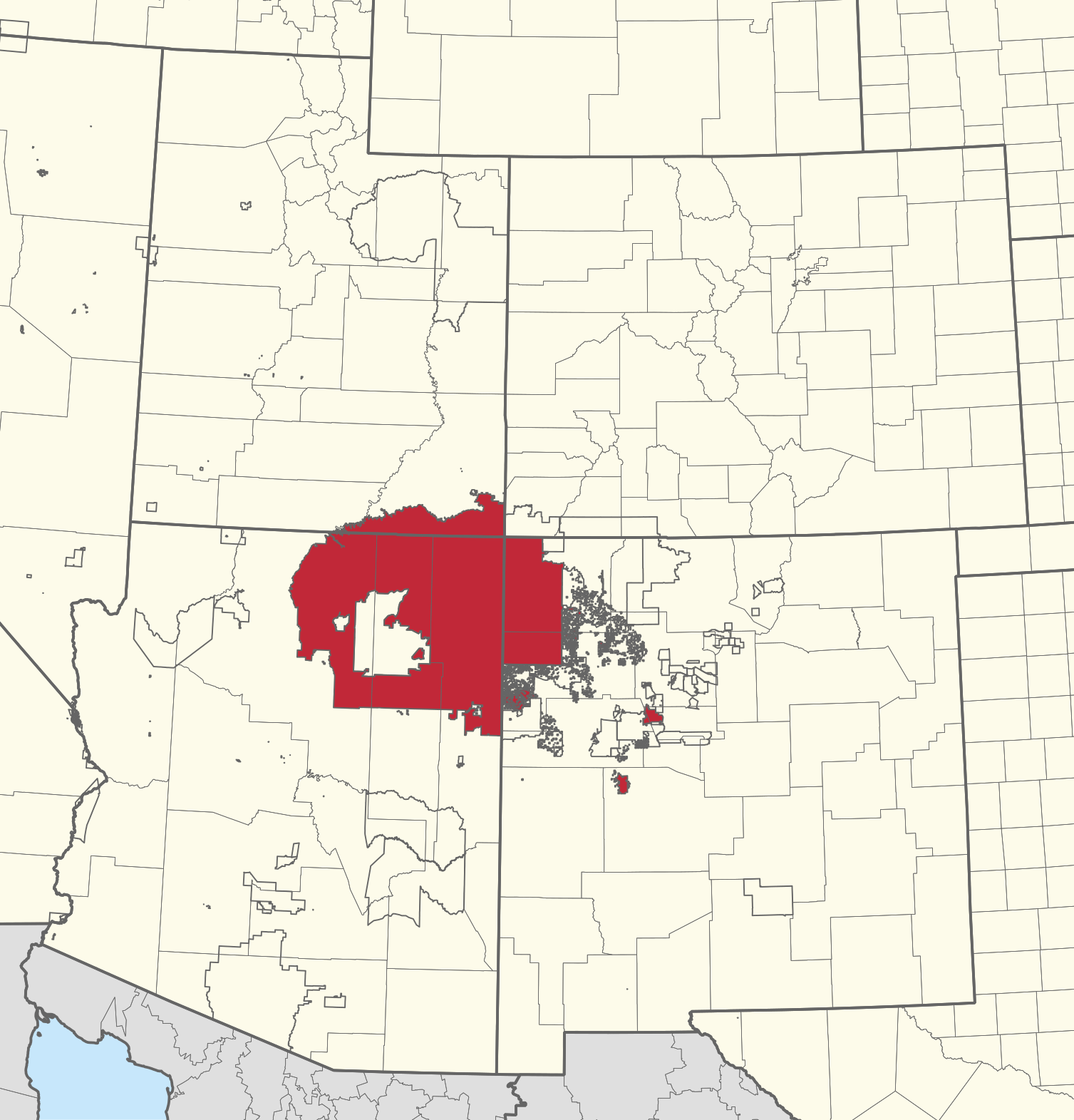
The Navajo Nation spans parts of Arizona, New Mexico and Utah. “Skinwalker” is not a generic label for the traditions of every Indigenous nation in North America. awmcphee / Wikimedia Commons / CC0 1.0. Source.
Why So Much Skinwalker Lore Is Kept Private
There is a basic problem with articles claiming to reveal the “complete secret history” of Skinwalkers.
People from the culture the subject belongs to have repeatedly said that some of this knowledge is not for public consumption.
In 2016, scholar Adrienne Keene criticized J.K. Rowling’s use of Skinwalkers in History of Magic in North America. Keene described the subject as part of a living tradition with relationships to wider ceremonial understandings, not simply a scary story available for unrestricted fictional reuse.
She also invoked the idea of ethnographic refusal: recognizing that researchers and writers do not automatically have a right to publish every piece of cultural knowledge they can obtain.
That is especially relevant here because much of the English-language source base comes from 20th-century outsider anthropology.
Kluckhohn’s work remains historically important. It should not be treated as a license to reproduce sensitive ceremonial material as entertainment.
So there are limits to what a responsible explainer should try to explain.
Is a Skinwalker a Shapeshifter?
Public descriptions commonly connect yee naaldlooshii with animals.
Accounts collected in older ethnography and later folklore writing describe transformation, disguise or animal-like movement. Coyotes and other animals recur in popular summaries.
But the internet has turned that broad idea into a rigid monster template that the public record does not support.
There is no single verified “Skinwalker anatomy.”
The now-familiar creature with a deer skull, antlers, elongated limbs and a skeletal body belongs mainly to modern horror imagery. Likewise, viral rules about a Skinwalker perfectly copying your mother’s voice, calling your name from the woods or being identified by one specific eye color are difficult to trace to reliable early documentation.
That does not mean every contemporary story is fabricated.
It means contemporary stories are contemporary stories.
Oral traditions change, communities are not frozen in time, and personal experiences can become part of folklore. But a TikTok trope from the 2020s should not automatically be described as an ancient Diné teaching.
The Historical Background Matters
The most important historical context for the late-19th-century record is not paranormal.
It is colonial violence.
During the 1860s, the United States military forcibly removed more than 10,000 Diné people from their homelands. The Smithsonian’s National Museum of the American Indian describes how the U.S. military destroyed crops, livestock and water sources, forcing families to surrender and march hundreds of miles to Bosque Redondo at Fort Sumner in New Mexico.
The Diné remember this period as the Long Walk.
Bosque Redondo functioned as an internment camp. Conditions were disastrous, and the government’s effort to transform Diné life through confinement and assimilation failed.
The Treaty of 1868 finally allowed the Diné to return to their homeland.
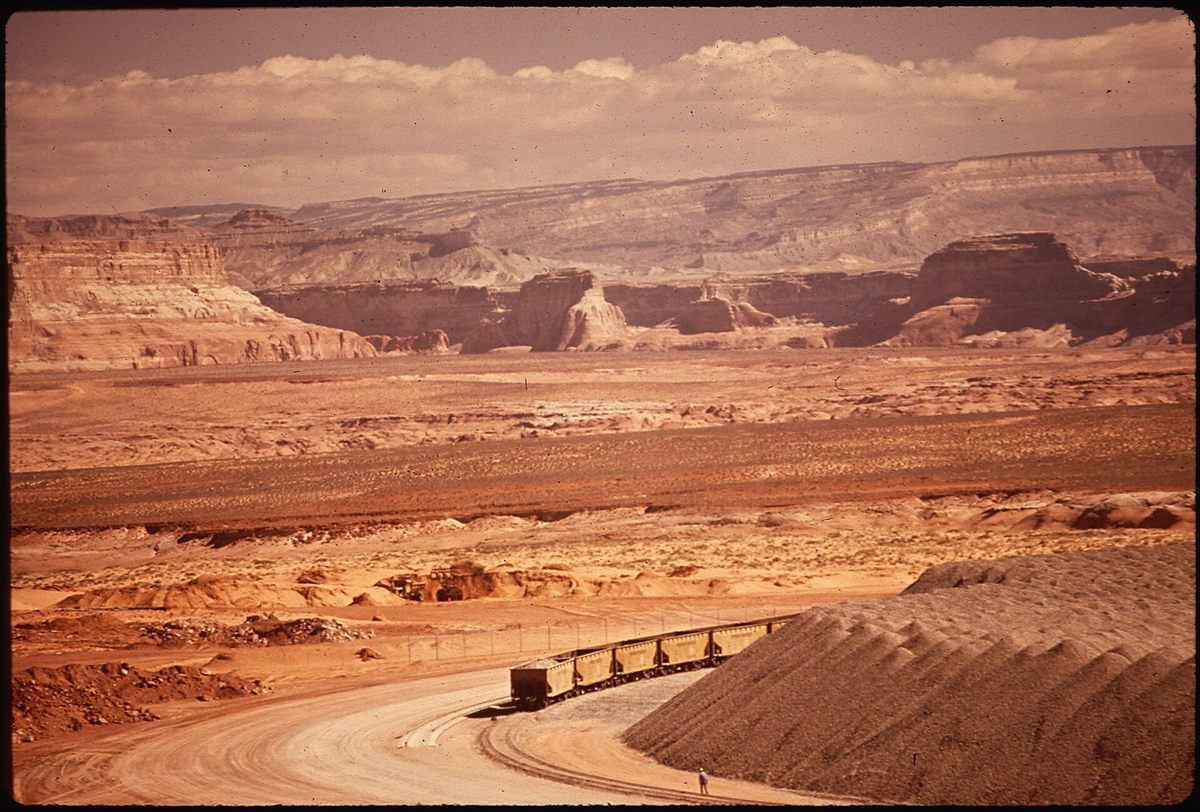
The Diné homeland is a real and living place, not a generic supernatural wilderness. This 1972 EPA photograph is preserved by the U.S. National Archives. Terry Eiler / U.S. Environmental Protection Agency / U.S. National Archives / Public Domain. Source.
The 1868 Treaty and the Return Home
The 1868 treaty is one of the most important documents in modern Navajo history.
The Smithsonian notes that, at a time when the United States was removing many Native nations farther from their homelands, Diné leaders secured the right to return to Dinétah.
The return did not erase what had happened.
Families had lost people, livestock and resources. The reservation era brought new political pressures, economic inequalities and federal supervision. Those conditions form part of the background to the wave of witchcraft accusations that followed a decade later.
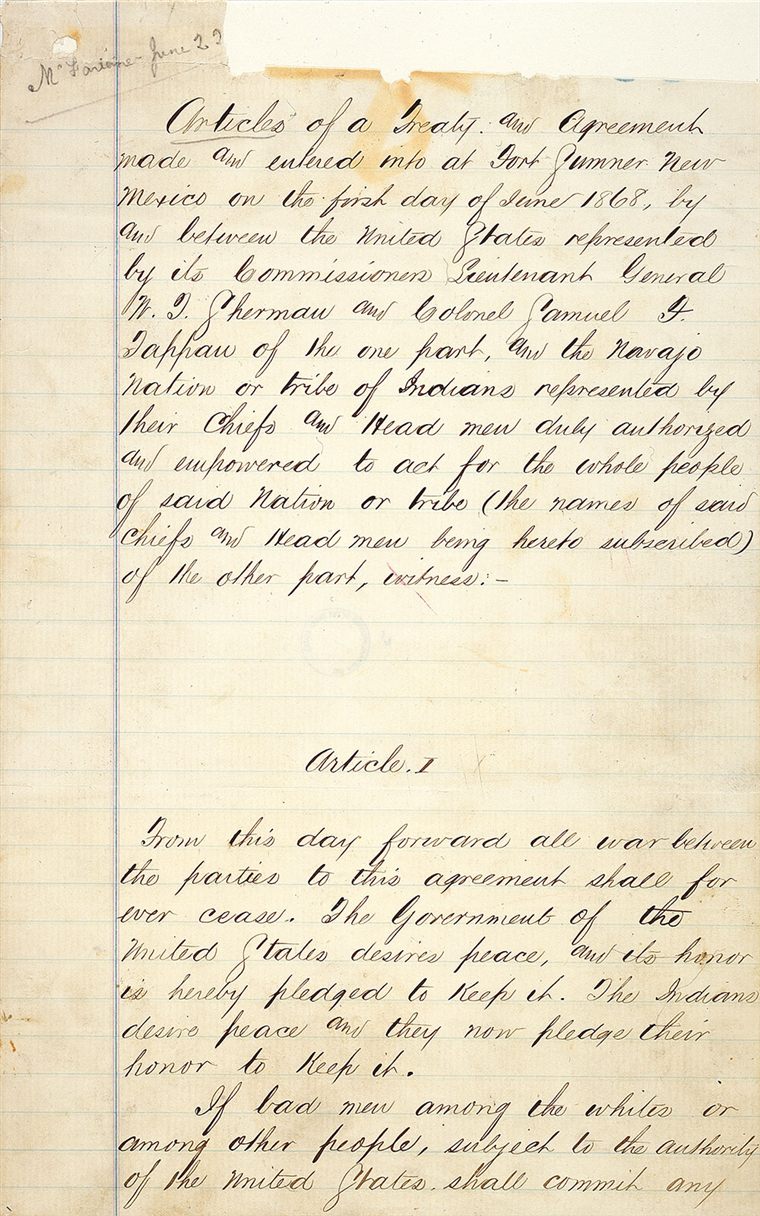
The Treaty of 1868 allowed the Diné to return to their homelands after confinement at Bosque Redondo. U.S. federal government, Treaty of 1868 / Public Domain via Wikimedia Commons. Source.
What Happened in the 1878 Witch Purge?
In 1878, witchcraft accusations led to a series of killings among Diné communities during the difficult early reservation period.
Historian Martha Blue examined the episode in The Witch Purge of 1878: Oral and Documentary History in the Early Navajo Reservation Years. Navajo Times has described up to 40 people in the Ganado area as having been accused of witchcraft and killed.
The event is sometimes retold on paranormal websites as a war against literal Skinwalkers.
That framing is not history.
The killings happened in a society recovering from forced removal while confronting new economic and political strains. Witchcraft beliefs were part of the cultural setting, but the deaths themselves are documented human violence.
No historical record can establish that supernatural shapeshifters were being discovered and eliminated.
What it can establish is that accusations of witchcraft had lethal consequences.
That distinction should never be lost merely because “Skinwalker purge” makes a more dramatic headline.
Skinwalker and Wendigo Are Not the Same Thing
Modern horror regularly combines Skinwalkers and Wendigos into one creature.
They belong to different cultural traditions.
The Wendigo/Windigo comes from several Algonquian-speaking peoples of northern North America and is strongly associated with themes such as cannibalism, excessive hunger and destructive greed.
The Skinwalker concept belongs specifically to Diné traditions of harmful witchcraft in the Southwest.
One is not a regional name for the other.
The confusion comes from modern monster culture, which often removes Indigenous supernatural concepts from their nations and puts them into a single category called “Native American monsters.”
There is no single Native American mythology.
Then There Is Skinwalker Ranch
The most commercially famous use of the word today may have little to do with Diné tradition at all.
Skinwalker Ranch is a property in Utah’s Uintah Basin near the Uintah and Ouray Reservation. That is Ute country, not the Navajo Nation.
The ranch became nationally famous after owners Terry and Gwen Sherman described unusual events there in reporting published in 1996. Their claims included strange lights, cattle deaths and encounters with unusual animals.
Las Vegas businessman Robert Bigelow purchased the property later that year. His National Institute for Discovery Science investigated reported anomalies on the site.
Those investigations became the basis for the 2005 book Hunt for the Skinwalker and, eventually, a much larger entertainment industry around the property.
But the word “Skinwalker” did not make the ranch part of Diné religious geography.
It attached an already frightening Diné term to a separate collection of Utah paranormal stories.
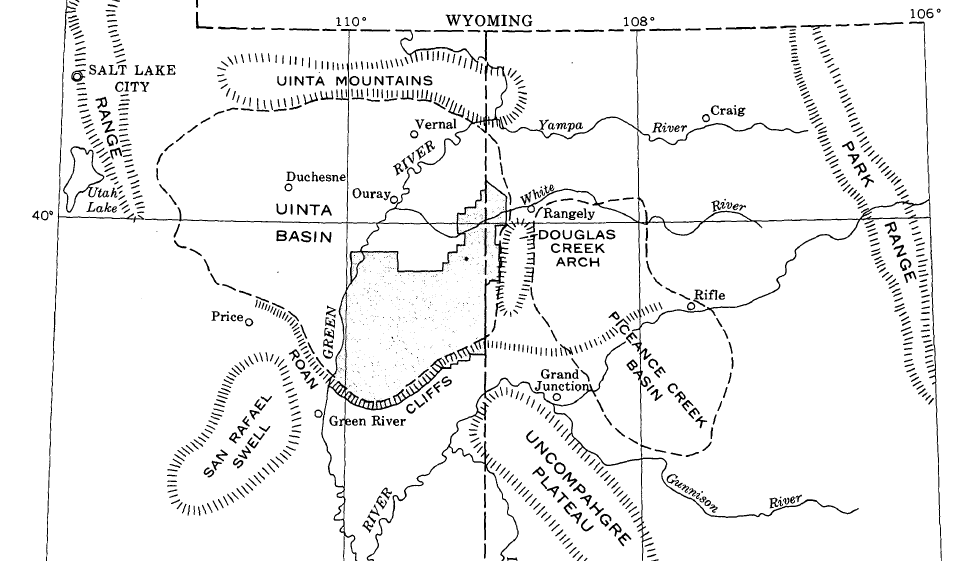
Skinwalker Ranch is in Utah’s Uinta Basin, geographically separate from the main Navajo Nation lands. W. B. Cashion / U.S. Geological Survey / Public Domain. Source.
Did the Pentagon Investigate Skinwalker Ranch?
This part of the story contains a real government program, but the details are frequently distorted.
Official Defense Intelligence Agency records show that in September 2008 the DIA awarded a contract to Bigelow Aerospace Advanced Space Studies, or BAASS, under the Advanced Aerospace Weapon System Applications Program (AAWSAP).
The program funded research into advanced aerospace topics.
Because Robert Bigelow was also closely associated with Skinwalker Ranch and paranormal research, later accounts tied some AAWSAP-era activity to the property.
That fact is often transformed online into a much stronger claim: “The Pentagon proved Skinwalker Ranch is paranormal.”
It did not.
The existence of a funded investigation shows government interest. It does not establish the truth of the phenomena being investigated.
The Defense Department’s All-domain Anomaly Resolution Office said in its 2024 historical review that it found no verifiable evidence that U.S. government investigations had confirmed extraterrestrial technology or that the government possessed off-world technology.
That finding does not explain every unusual report from the ranch.
It does mean that “the Pentagon investigated something” and “the Pentagon proved the supernatural claim” are two very different statements.
The Internet Skinwalker Is Becoming Its Own Folklore
Internet culture has now created another layer.
Skinwalker stories circulate through:
- creepypasta
- paranormal podcasts
- YouTube
- TikTok
- horror games
- “caught on camera” videos
The recurring creature is usually pale, thin, animal-like and capable of mimicking human speech.
Sometimes it has antlers. Sometimes it is essentially the Rake under another name. Sometimes every strange animal seen at night is labeled a Skinwalker.
This is digital folklore.
It has its own repeated rules, images and storytelling conventions. Studying those stories can be interesting in its own right.
The mistake is calling all of it ancient Navajo tradition.
Tony Hillerman and the Move Into Popular Fiction
The internet did not begin this process.
Writer Tony Hillerman incorporated Navajo witchcraft and Skinwalker material into his crime fiction decades earlier. The University of New Mexico’s Tony Hillerman Portal notes Skinwalker-related material in The Blessing Way, published in 1970.
Hillerman’s novels introduced many non-Diné readers to Navajo cultural settings.
They also demonstrate an older version of the same problem modern horror faces: fiction can become the public’s main source of information about a living culture.
Once that happens, invented plot devices and genuine cultural ideas become difficult for general audiences to separate.
J.K. Rowling and Cultural Appropriation
That tension became especially visible in 2016.
In History of Magic in North America, J.K. Rowling incorporated the Skinwalker tradition into the fictional history of the Harry Potter universe.
Her version suggested that stories about harmful Skinwalkers had grown from false accusations against benevolent Native shapeshifting wizards.
Indigenous writers and scholars objected.
Adrienne Keene argued that Rowling had taken a living belief belonging to a marginalized people and converted it into material for a commercial fantasy franchise. Diné writer Brian Young publicly expressed similar frustration.
The criticism was not simply “outsiders can never write fiction involving another culture.”
It was about context.
A tradition treated seriously by people who live with it had been rewritten as a misunderstanding inside an invented British wizarding universe.
Are Skinwalkers Real?
There are two different questions.
Is the Skinwalker a real Diné cultural and religious concept? Yes. It is documented in historical ethnography, folklore scholarship and modern discussions by Indigenous writers.
Is there scientific evidence that human beings physically transform into animals through witchcraft? No.
Historical evidence can demonstrate that people have held beliefs, told stories, made accusations and acted on those beliefs.
It cannot establish supernatural transformation as a biological fact.
The same distinction applies to almost every subject where religion, folklore and paranormal claims overlap.
What the Skinwalker Story Has Become
The modern Skinwalker is now several things at once.
It is a sensitive concept within a living Diné tradition.
It is part of the historical record of witchcraft accusations with deadly consequences.
It is the borrowed name of a Utah ranch famous for UFO and paranormal claims.
And it is an internet monster whose characteristics increasingly come from other creepypastas rather than Diné sources.
Those layers should not be treated as interchangeable.
The most useful way to understand the Skinwalker is not to collect more supposed rules about how to identify or defeat one.
It is to ask where each version of the story came from — and whose story it was before the internet turned it into a monster.
Sources & further reading
- Adrienne Keene, Native Appropriations
- Clyde Kluckhohn, Navaho Witchcraft
- Peggy E. Alford, Anglo-American Perceptions of Navajo Skinwalker Legends
- Martha Blue, The Witch Purge of 1878
- Navajo Times: Ganado history and the Witch Purge
- Smithsonian National Museum of the American Indian: Long Walk
- Smithsonian National Museum of the American Indian: Navajo Treaty of 1868
- Defense Intelligence Agency: AAWSAP talking points
- Department of Defense: AARO historical review
- University of New Mexico: Tony Hillerman Portal