News / Games
Signal Veil Announced: Its Haunted Phone Can Parry Ghosts and Sanity Changes Combat
Signal Veil’s haunted phone detects and parries spirits, while sanity affects combat. What the developers confirm about the upcoming survival horror game.
Topics: Signal Veil, Time Hunters, Serafini Productions, survival horror, psychological horror, horror games, Nintendo Switch 2, PlayStation 5
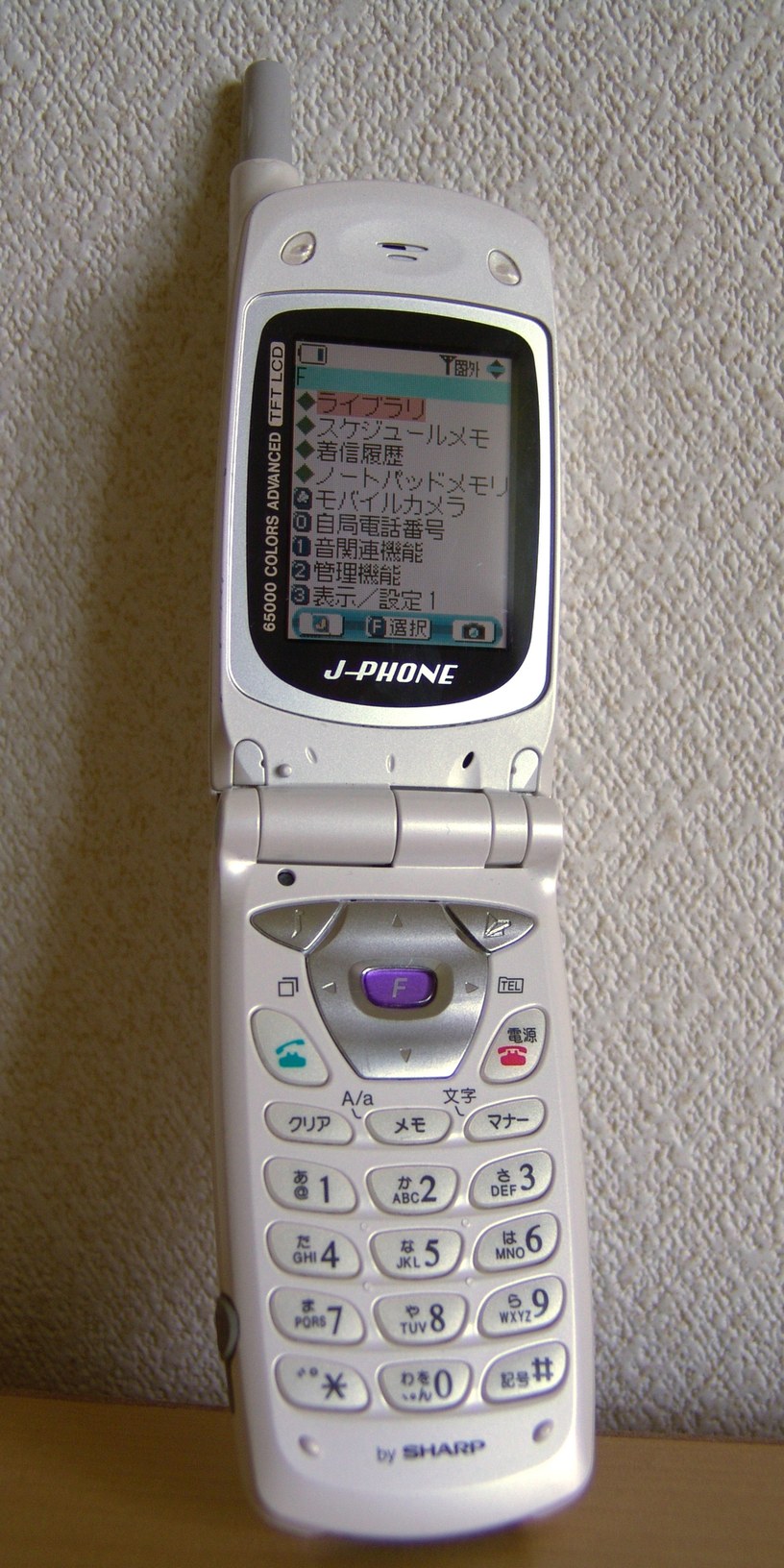
MIKI Yoshihito / Ubcule via Wikimedia Commons (CC BY 2.0; resized and recompressed)
Real-world context: a Sharp J-SH07, a 2001 phone model photographed on August 13, 2008. This is not a game prop or a documented design reference for Signal Veil. Photo by MIKI Yoshihito via Wikimedia Commons, licensed CC BY 2.0. The Commons version was cropped and color-balanced by Ubcule in 2016; resized and recompressed here.
Signal Veil is a newly revealed third-person survival horror game in which the most important tool is not a shotgun, occult book or ghost detector. It is an old cellphone inherited from the protagonist’s missing mother.
Publisher Serafini Productions and Chilean developer Time Hunters revealed the project during Insider Gaming’s 28 Games Later horror showcase on October 1, 2026. It is in development for PlayStation 5, Xbox Series X|S, Nintendo Switch 2 and PC through Steam and the Epic Games Store.
There is currently no release date.
The official Steam listing and PlayStation Store page describe Signal Veil as psychological survival horror with limited resources, supernatural enemies and a visual style inspired by anime. But a new developer interview adds the more interesting detail: the phone is not merely a story prop or a scanner.
Time Hunters says the team built enough systems around it that players can even use the device to parry an enemy.
That changes the phone from exposition into the game’s central survival-horror mechanic.
What is Signal Veil about?
The story follows Aki Mizuno, a teenager whose mother disappears without explanation.
Aki inherits her mother’s old cellphone. The device begins reacting to things other people cannot see. It vibrates, produces unusual sounds and displays interference when spiritual presences or lingering memories are nearby.
At the same time, a series of disappearances surrounds Nishikawa High School, the fictional school where most of the announced game takes place.
The public premise ties those threads together: Aki investigates the school, her mother’s disappearance and her own buried memories while supernatural forces increasingly distort the building around her.
The developers have described hostile entities as beings connected with emotional trauma and hidden memories. That description belongs to the game’s fiction; it is not a claim that trauma literally creates supernatural creatures in the real world.
The phone detects what Aki cannot see
The phone’s first function is information.
According to the official store pages, it reacts when supernatural entities or residual memories are close. That gives the player warning before a threat has fully manifested.
The camera can also reveal hidden objects or traces that are not visible normally.
In other words, Signal Veil turns the phone into a second way of seeing the environment.
That is particularly useful in a game built around restricted information.
The reveal material emphasizes fixed or deliberately constrained camera angles inspired by classic survival horror. A player may not have a clear view down every corridor, while the phone supplies another layer of sensory information through vibration, static and visual distortion.
The result is a tension between what the third-person camera shows and what the device suggests is nearby.
Real-world context: a Sharp J-SH07, a 2001 phone model photographed on August 13, 2008. This is not a game prop or a documented design reference for Signal Veil. Photo by MIKI Yoshihito via Wikimedia Commons, licensed CC BY 2.0. The Commons version was cropped and color-balanced by Ubcule in 2016; resized and recompressed here.
The phone is also part of combat
The more unusual part is what happens after a spirit is detected.
The reveal describes a sequence in which enemies have to be exposed before conventional attacks can work effectively. The player can disturb an entity with the phone, use its flash, expose a spiritual weak point and then attack or purge the threat.
Time Hunters told Insider Gaming that the phone became central during development once the studio stopped treating it as something that existed only in the narrative.
The developers experimented with it as an active combat tool and eventually created a phone parry.
That is a useful distinction from a game in which a supernatural gadget simply highlights objectives.
The phone is part of the risk-reward loop.
Pulling it out can reveal information or create an opening, but the player is still inside a dangerous environment while doing so.
The inventory does not pause the danger
The same developer interview gives another detail that fits that philosophy.
Time Hunters says the inventory is designed so that opening it does not pause the game.
The studio specifically connects that choice to vulnerability: the player remains aware of the environment and can still hear what is happening while managing equipment.
That is a small mechanical decision with a clear horror purpose.
Traditional survival horror often creates fear through scarcity. Signal Veil adds another layer by making management itself unsafe.
Medicine, key items, ammunition and mystical weapons are limited according to the official store description and showcase material. The player therefore has to make decisions about resources without necessarily receiving a protected menu screen in which to make them.
Sanity changes more than the screen effect
Aki also has an emotional-stability or sanity system.
The official store material says that hostile entities, corrupted areas and traumatic events can destabilize her mental state. As that condition worsens, her perception of the environment changes and enemy behavior can change with it.
The developer interview goes further.
Time Hunters says Aki’s combat becomes more desperate, aggressive and messy as her mental condition deteriorates. The studio describes a deliberate tradeoff: she becomes more vulnerable, but players willing to operate in that state may also gain greater potential rewards.
That makes the system more than a visual filter.
It is intended to alter how the player approaches encounters.
The developers also say they want players to question whether what they see and hear can be trusted as the deterioration continues.
Exactly how far that system goes has not yet been demonstrated in a finished public build, so pre-release descriptions should be treated as design intent rather than a review of how well the feature works.
The school is designed around restricted vision
Signal Veil takes place largely inside Nishikawa High School.
The school begins as a recognizable environment and becomes increasingly unstable under supernatural influence.
That setting supports the game’s stated use of fixed-camera tension.
A long school corridor can provide information and deny it at the same time: there are doors, intersections, blind corners and rooms whose interiors remain outside the player’s current view.

A real corridor at Chokai Junior High School in Akita, Japan, photographed in 2011. It is architectural context only; it is not Nishikawa High School and has no documented connection to the game. Photo by Douglas P Perkins via Wikimedia Commons, licensed CC BY 3.0. Resized and recompressed.
The announced game uses that kind of school architecture fictionally. Nothing in the reviewed sources indicates that Nishikawa High School is a documented haunted location or that the story is based on a real disappearance case.
It should be treated as a fictional horror setting unless the developers later identify a specific real-world inspiration.
“1990s anime-inspired” is an aesthetic label
The developers repeatedly describe Signal Veil as having a 1990s-anime-inspired aesthetic.
In the Insider Gaming interview, however, Time Hunters also names Another and Jujutsu Kaisen among the anime the team loves. Those series are much newer than the 1990s.
That does not make the description contradictory if it is read correctly.
“1990s anime-inspired” is the studio’s description of the game’s visual target and presentation, not a literal claim that every named influence comes from that decade.
The same interview identifies classic Resident Evil as a major game influence and says the team wanted to combine survival-horror tension with anime visual language and character-driven storytelling.
The announced result is therefore a mixture rather than a period recreation.
Is Signal Veil part of BrokenLore?
Serafini Productions also works on the BrokenLore horror series, which makes the connection an obvious question.
The reviewed official Steam and PlayStation listings present Signal Veil as its own title and do not identify it as a BrokenLore entry.
The announcement likewise credits Time Hunters and Serafini Productions without placing the game inside that franchise.
Unless the publisher later says otherwise, it should be treated as a separate project.
What is actually confirmed?
As of October 4, 2026, the strongest confirmed points are straightforward.
Signal Veil is in development for PS5, Xbox Series X|S, Nintendo Switch 2 and PC. Time Hunters is developing it with Serafini Productions, which also publishes the game. Aki Mizuno is the protagonist. Her inherited cellphone detects supernatural presences and hidden information, its flash can help expose threats, and the developers say the device can be used for a parry mechanic.
The game also uses limited resources, environmental puzzles, constrained camera design and a sanity system intended to alter perception and combat behavior.
What is not confirmed is equally important:
There is no release date.
There is no basis yet for reviewing the final quality of its combat, sanity system or horror pacing.
There is no evidence that Nishikawa High School is a real haunted school or that the story adapts a documented Japanese supernatural case.
And although an announcement trailer exists, trailer imagery should not be used to invent plot details that the developers have not stated.
For now, the phone is the clearest reason Signal Veil stands out.
Classic survival horror usually asks what you are willing to spend to survive.
This game adds another question:
What if the object warning you about the ghost is also the thing you have to raise in front of it?
Frequently Asked Questions
What is Signal Veil?
Signal Veil is an upcoming third-person psychological survival horror game developed by Time Hunters with Serafini Productions. It follows Aki Mizuno as she investigates disappearances and supernatural events at Nishikawa High School.
What does the phone do in Signal Veil?
The inherited cellphone detects spiritual presences through vibration, static and interference, reveals hidden clues, can use its flash against entities and is part of the game’s combat system. Time Hunters says players can even use the phone for a parry mechanic.
Does Signal Veil have a release date?
No. Steam currently lists the release date as “To be announced,” and the PlayStation Store likewise does not provide a launch date.
What platforms is Signal Veil coming to?
The announced platforms are PlayStation 5, Xbox Series X|S, Nintendo Switch 2 and PC through Steam and the Epic Games Store.
Is Signal Veil based on a true Japanese haunting?
No reviewed source says that it is. Nishikawa High School and the supernatural events should be treated as fictional unless the developers later identify a specific real-world source.
Is Signal Veil part of BrokenLore?
The current official listings do not identify it as a BrokenLore game. It is presently presented as a separate project from Time Hunters and Serafini Productions.
How does sanity work in Signal Veil?
The developers say Aki’s deteriorating mental state can distort perception, change enemy behavior and make her fighting style more desperate and aggressive, creating greater vulnerability alongside possible rewards.
Sources & further reading
- Epic Games Store: Signal Veil official store page
- Time Hunters: official studio background
- Steam: Signal Veil official store page
- PlayStation Store: Signal Veil
- Insider Gaming: Signal Veil announcement
- Insider Gaming: Time Hunters interview on Signal Veil
- Gematsu: Signal Veil announced for PS5, Xbox Series, Switch 2 and PC
- Wikimedia Commons: Japanese mobile phone
- Wikimedia Commons: Chokai JHS 2F hallway 2