News / Games
BrokenLore: ASCEND Dates Its Tower Horror for January 7 — The Rokurokubi Behind the Monster
BrokenLore: ASCEND is dated January 7, 2027. Compare its masked tower monster with Toriyama Sekien’s rokurokubi image and Lafcadio Hearn’s detached-head tale.
Topics: BrokenLore: ASCEND, Serafini Productions, Rokurokubi, Nukekubi, Japanese folklore, Yokai, Toriyama Sekien, Lafcadio Hearn, Tokyo Tower, Elysium Tower
A new date announcement for BrokenLore: ASCEND brings a very old Japanese supernatural figure back into view. But the game’s long-necked pursuer is not a straightforward reproduction of one ancient, fixed monster.
Serafini Productions has announced January 7, 2027 for its first-person psychological horror game on PlayStation 5, Xbox Series consoles and PC, according to Gematsu’s October 7 report of the developer’s announcement. The report accompanied a new release-date trailer.
ASCEND follows Ren and Yui, rooftop climbers whose SKYLIMIT channel has made risk-taking part of their public identities. They attempt a forbidden climb of the fictional Elysium Tower. The higher they go, the more a creature identified by the developer as a rokurokubi begins to threaten them.
The game’s central idea is unusually apt for this particular yōkai: an unnaturally extended neck turns vertical space into hunting ground. But to understand what is being adapted, it helps to distinguish the modern long-necked figure from older stories of heads that leave their bodies altogether.
What is confirmed about BrokenLore: ASCEND?
The developer’s project overview identifies ASCEND as a first-person psychological horror game built around climbing, stealth and a terrifying rokurokubi. Its Steam page gives the more detailed premise: Ren and Yui want to create an ultimate rooftop-climbing video, but their ascent of Elysium Tower becomes a struggle to survive.
The developers connect the monster to their fear of being forgotten or becoming irrelevant. Ren and Yui have made visibility and recognition inseparable from who they think they are.
The mechanics follow that premise. The Steam description emphasizes narrow ledges, handholds, stealth and avoiding the rokurokubi’s gaze. It presents the creature as a woman with a serpent-like neck and an ornate mask.
That is the game’s characterization. It is not a neutral definition of every rokurokubi in Japanese storytelling.
January 7 is the announced date; stores now show January 2027
Gematsu’s October 7 report attributes a January 7, 2027 launch date to Serafini Productions, for PS5, Xbox Series and PC.
The current Steam listing and PlayStation Store listing both display January 2027. They support the month and year, while the specific January 7 date comes from the developer announcement reported by Gematsu.
The developer’s November 2025 introduction on the PlayStation Blog had targeted summer 2026. That is an earlier schedule, not the release window now displayed by the stores.
There is no confirmed explanation for the scheduling change in the sources reviewed here.
The Elysium Tower is fictional; Tokyo Tower is real
The Steam story names Elysium Tower, a fictional giant structure described as Japan’s tallest skyscraper in the game’s world.
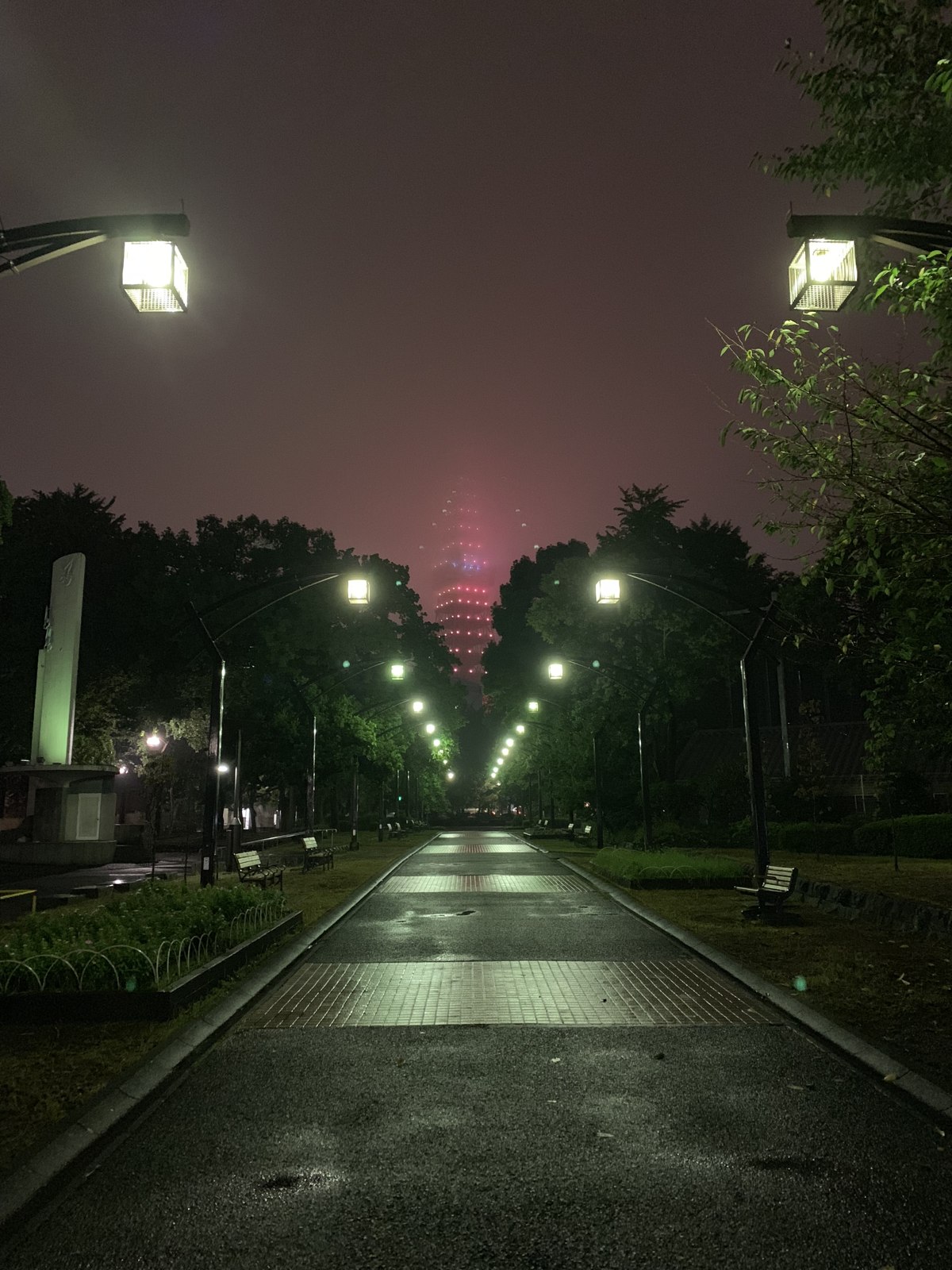
That is distinct from the real Tokyo Tower, a recognizable Tokyo landmark. The Steam listing also contains an “Officially licensed by © TOKYO TOWER” notice. The license statement does not, by itself, establish that every scene takes place on the real landmark or that Elysium Tower and Tokyo Tower are identical.
This distinction is especially important because ASCEND uses a distorted Tokyo setting. A real-world visual reference can be present without making the entire game map a documentary representation of the city.
What is a rokurokubi?
Rokurokubi (ろくろ首, often written 轆轤首) is a name used for supernatural figures in Japanese stories and illustrations. The best-known modern image is a person — frequently depicted as a woman — whose neck stretches to an impossible length.
But the written and illustrated tradition is less uniform than that familiar image suggests.
Older material includes detached or flying heads, sometimes discussed with the name nukekubi. Mingei Gallery’s print record uses that name for the detached-head type. Different texts and pictures do not consistently enforce a tidy modern division in which rokurokubi always stretch and nukekubi always detach.
A clearer way to describe the historical record is that long necks and detached heads are related but not identical motifs whose naming overlaps across sources.
That distinction is supported by the surviving works themselves. Toriyama Sekien’s eighteenth-century illustrated yōkai books show a rokurokubi-associated figure with a head apparently separated from its resting body but linked by a slender line. Later retellings can give the neck a more explicitly extended, snake-like form.
These are representations within folklore and literature, not evidence that either kind of being physically existed.
Toriyama Sekien’s image is stranger than a simple long neck
Toriyama Sekien’s Gazu Hyakki Yagyō was first published in 1776, as recorded in the National Diet Library’s bibliography of his illustrated yōkai collections.
An image associated with the name rokurokubi survives in the print tradition. A Wikimedia Commons scan identifies it as Sekien’s depiction of hitōban / rokurokubi and marks the historical work as public domain.
The illustration is not quite the modern horror-game design.
A woman’s body appears at rest; her head seems to move away from it. The narrow connection creates an ambiguity between a stretching neck, an attached thread and a separated head.
A museum or library reproduction can show what Sekien drew. It cannot tell us that every region of Japan shared one fixed definition, nor that the drawing is a photograph of a witnessed creature.
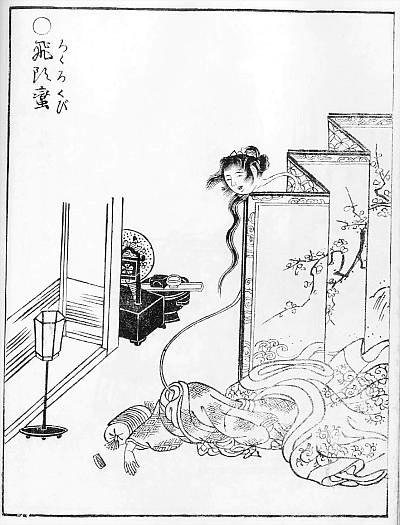
The image helps explain why treating every historical rokurokubi as a woman with a continuously extended neck would flatten the source material.
Lafcadio Hearn’s 1904 story has detachable heads
Another useful source is Lafcadio Hearn’s Kwaidan: Stories and Studies of Strange Things, published in 1904. The text of its story “Rokuro-Kubi” is available in full through Project Gutenberg.
In Hearn’s literary retelling, a traveling priest named Kwairyō discovers five apparently headless bodies. Their heads have left the house, are moving about outdoors and later try to attack him. Moving one body prevents its head from returning.
Those are flying or detached heads, not five endlessly stretching necks.
Hearn’s own explanatory note acknowledges that by his time the creature was ordinarily imagined as having a very long neck that remained attached to the body — even though the tale he retells uses a different form.
That tension is valuable historical evidence about the word’s shifting associations. It would be misleading to quote Hearn’s detached-head story as proof that the modern long-necked design is the only authentic version.
It is also important to identify Hearn’s book correctly: this is a literary retelling and editorial presentation of older material, not a direct recording of a supernatural event.
The Lafcadio Hearn Memorial Museum identifies the tale’s source as the fourth volume of Kaibutsu Yoron (1803), and explicitly contrasts its flying heads with the familiar elongated-neck image.
What the game changes about the rokurokubi
Serafini Productions’ version has a very specific appearance and function: a masked, long-necked pursuer that can search the tower’s vertical architecture.
The developer gives the creature a thematic job as well. Ren and Yui fear disappearing from public attention. The monster makes them feel visible in the worst possible way: they cannot escape its gaze.
That is an artistic interpretation of a Japanese yōkai motif, not a detail established by Hearn or Sekien.
Neither of the historical sources examined here describes a rokurokubi as a punishment for social-media fame, a skyscraper-climbing predator or a masked guardian of a high-rise. Those elements belong to ASCEND.
The distinction does not make the game less faithful in some absolute sense. Adaptation can use an old image to express a new anxiety. The factual boundary is simply that the new psychology and gameplay rules come from the modern developers.
The older stories are not all about the same kind of attack
Hearn’s version gives the detachable heads predatory intentions, but it also includes comedy: Kwairyō jokes about carrying a goblin’s head as a souvenir. Neither that tale nor Sekien’s illustration supplies one universal set of attack rules.
A single “powers list” — flies, detaches, extends, eats victims, hunts anyone who looks up — would quietly combine several different accounts into one creature that no one source necessarily describes.
For ASCEND, the powers to discuss are the ones the developers actually describe: a long-necked masked entity whose presence forces hiding and careful movement during the climb.
For folklore, it is better to identify the source before identifying the power.
How does BrokenLore use folklore across its games?
The developer presents BrokenLore as a connected psychological-horror anthology rather than one continuous story with the same protagonists every time.
The PlayStation Blog introduction written by Serafini Productions describes individual entries as having their own characters and anxieties, while contributing to a larger mystery.
For ASCEND, those anxieties are public recognition, pressure and the fear of irrelevance. The supernatural pursuit gives those ideas a physical shape.
There is no need to claim that the game’s rokurokubi is the definitive origin or interpretation of the folkloric being. Its importance is how this particular story uses the image.
What is genuinely new on October 7?
The creature, game concept and climbing premise had already appeared in earlier announcements.
The meaningful new development is the specific developer-announced release date of January 7, 2027, accompanied by a release-date trailer.
The durable part of this article is the distinction between the game’s monster and the documented traditions behind the name. That gives the story value after the date announcement is no longer fresh.
Frequently asked questions
When is BrokenLore: ASCEND coming out?
Serafini Productions has announced January 7, 2027, according to Gematsu’s October 7 report. The current Steam and PlayStation Store listings both show January 2027, without specifying the day.
What platforms is BrokenLore: ASCEND planned for?
The new announcement names PlayStation 5, Xbox Series consoles and PC via Steam.
Who are Ren and Yui?
They are the game’s rooftop-climbing protagonists, whose social-media channel SKYLIMIT has made dangerous stunts central to their public identities.
Is Elysium Tower the real Tokyo Tower?
Elysium Tower is the named fictional tower in the story. The Steam page also carries a Tokyo Tower licensing notice, but that does not establish that the two structures are identical.
What does rokurokubi mean?
It names supernatural figures from Japanese literature and visual folklore, now most often represented as people with extremely long necks. Older material also includes flying or detachable-head versions.
What is the difference between rokurokubi and nukekubi?
Modern explanations commonly distinguish the stretching neck from the detaching head, respectively. Historical naming and imagery overlap, so the distinction should not be treated as a perfect rule applying to every older source.
Did the original Japanese stories feature a masked tower monster?
No such claim is established by the historical works discussed here. The mask, skyscraper pursuit and fame-related symbolism are features of BrokenLore: ASCEND.
Is this a review?
No. This is a release-development and folklore-comparison article based on published sources. No Morbid Index author is claiming to have played the finished game.
Sources & further reading
- Serafini Productions: BrokenLore project overview
- BrokenLore: ASCEND — official Steam listing
- PlayStation Store: BrokenLore: ASCEND
- PlayStation Blog: Serafini Productions introduces ASCEND
- Gematsu: Serafini Productions announces January 7, 2027 release date (October 7, 2026)
- National Diet Library: Japandemonium Illustrated, Toriyama Sekien bibliography
- Smithsonian Libraries: Gazu Hyakki Yagyō, 1805 edition
- Lafcadio Hearn: Kwaidan, Rokuro-Kubi (1904), Project Gutenberg
- Lafcadio Hearn Memorial Museum: Rokurokubi and Hearn’s retold literature
- Mingei Gallery: Rokurokubi print record and modern naming distinction
- Wikimedia Commons: SekienRokurokubi.jpg
- Wikimedia Commons: Tokyo Tower at night in a storm