Lore & Explained / TV & Streaming
Yaga: What Changed From Kat Sandler’s 2019 Play to the AMC+ Horror Series?
Yaga began as Kat Sandler’s three-actor 2019 play. Compare its roles, missing heir and Baba Yaga themes with the expanded AMC+ and Crave adaptation.
Topics: Yaga, Kat Sandler, Baba Yaga, AMC+, Crave, theater adaptation
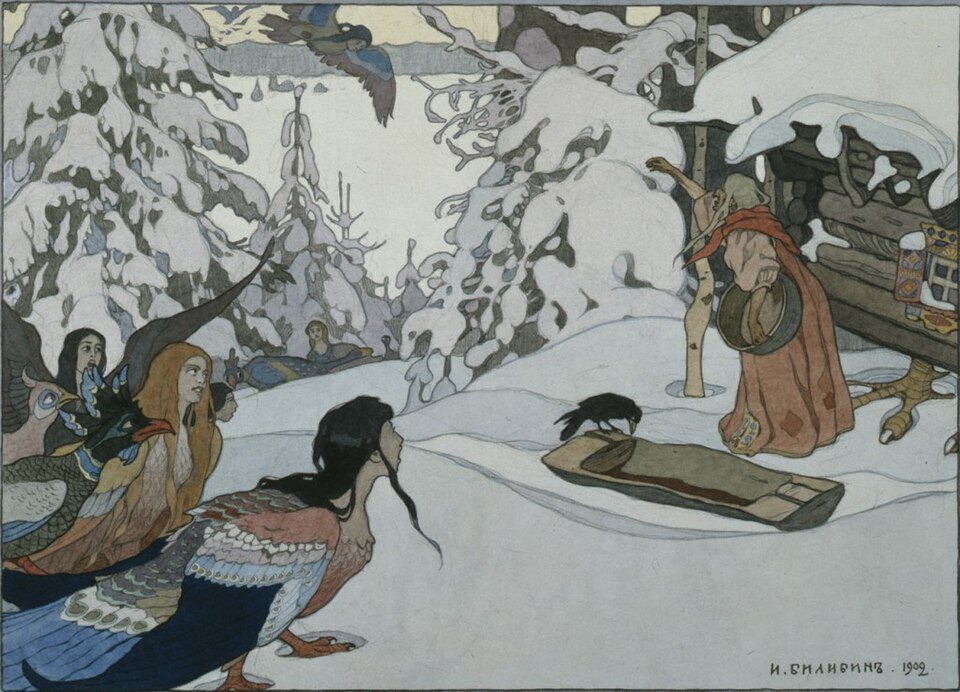
Ivan Bilibin, 1902 (died 1942) / Wikimedia Commons — Public domain
Yaga did not begin as a television mystery. Kat Sandler wrote and directed it for Toronto’s Tarragon Theatre in 2019, with three performers switching between numerous characters. For its 2026 screen adaptation, she kept the central idea—a disappearance in a town overshadowed by the name Baba Yaga—but rebuilt the casting, family business, geography and suspect list.
That distinction matters. The AMC+ and Crave series is an adaptation of Sandler’s own stage play, not a direct screen version of an old Russian fairy tale. Its use of Baba Yaga is deliberate, but its detectives, missing heir and town belong to contemporary fiction.
AMC+ set the television version’s two-episode US premiere for October 23, 2026, with eight half-hour episodes overall. AMC+ announced weekly Friday releases and a two-episode finale on November 27. Crave is the Canadian home of the series. AMC’s announcement establishes the release plan; it does not tell us how the mystery ends.
Hero: Ivan Bilibin, 1902 (died 1942). Source image. Public domain: expired Russian and UK rights; US pre-1931 publication; faithful 2D reproduction. No cropping; recompressed for web display. Historical illustration, not a television still.
The Original Yaga Was a Three-Actor Stage Thriller
Tarragon Theatre lists Sandler as both writer and director of Yaga, which ran from September 17 to October 27, 2019. The theatre’s description calls it a combination of fairy tale, murder mystery, revenge drama and comedy. A local sheriff, a young detective and a university professor become entangled in an investigation that invokes the Slavic witch. The production starred Claire Armstrong, Will Greenblatt and Seana McKenna. Tarragon’s original production archive supplies those credits and dates.
The small cast was not a limitation to conceal: it was a feature of the theatrical storytelling. According to Entertainment Weekly’s October 20, 2026 interview with Sandler and the television cast, Greenblatt played both private investigator Charlie Rapp and the missing Henry Kalles. Armstrong played Detective Carson, while McKenna portrayed Yaga and narrated the story. The two women also moved among numerous additional townspeople and suspects.
An actor returning in a different part can make an audience question what they are seeing, even when the doubling is clearly a stage convention. A filmed series has to choose whether to preserve that trick, replace it or give it a new narrative function.
What Actually Changed for Television?
Rapp and Henry Are No Longer Played by the Same Actor
The most immediate structural change is the separation of the original male roles. In the play, Will Greenblatt performed both Rapp and Henry Kalles. On television, Noah Reid plays Rapp, and Hudson Williams plays Henry, now called Henry Park. This allows the investigators and the missing person’s story to operate within a larger ensemble rather than relying on the play’s three-person rotation.
The relationship between the original production and the current cast is unusually direct. Entertainment Weekly reports that Reid had once expected to perform in the stage production but was unable to do so; Greenblatt played the roles instead. Sandler subsequently cast Reid as Rapp for the television version. That is a reported production history, not a plot detail.
Hudson Williams Still Plays Two Parts—but It Is a Different Kind of Doubling
The series does preserve a version of the original’s double-role idea. Williams plays Henry Park and Logan Casey, two separate characters who resemble each other. According to Sandler’s account to Entertainment Weekly, Logan did not exist in the 2019 play: he was created for television to expand the field of suspects and explore the social difference between the privileged heir and someone with local roots.
Crucially, it would be misleading to say that the TV series simply transfers the stage production’s doubling to Williams. The people being doubled have changed. The stage paired Rapp with Henry through one performer; the screen pairs Henry with the newly invented Logan. The effect on viewers may also differ because the two characters are presented as lookalikes within the fictional world rather than merely assigned to the same actor in a three-person cast.
Sandler told Entertainment Weekly that the team considered whether Henry and Logan should share an actor and finalized that approach when casting Williams. An audience may reasonably wonder whether the resemblance matters to the mystery, but resemblance alone does not establish an identical-twin reveal, supernatural duplication or a particular solution. Those conclusions are not established by the production sources discussed here.
A Yogurt Business Becomes a Fishing Empire
The missing heir’s family business also changed. Sandler’s stage story involved a wealthy family associated with a yogurt business. The television adaptation makes Henry Park the heir to a powerful fishery. AMC’s official synopsis confirms the fishery premise; Entertainment Weekly identifies the yogurt-to-fishing change directly.
This is more than substituting a more photogenic industry. The television series situates wealth and employment within the invented coastal community of Whittock. In her interview, Sandler explained that she wanted more tension between the town’s established wealth, its local residents and an elite university. The fishery helps anchor that conflict in the setting described for the show.
That is an interpretation of an explicitly discussed creative choice, not a claim that the television story depicts a real Canadian fishery, town or crime.
The Stage’s Sparse World Becomes a Town Full of Locations and Suspects
Entertainment Weekly describes the 2019 stage production as using a small set: simple furniture and a few stylized trees. A cast member could become a new character without the production needing an entirely new location or company of actors.
The eight-part version expands that world into a recognizable town. The officially announced leads include Clark Backo as Carson, the local detective reluctant to work with Rapp, and Carrie-Anne Moss as Katherine, the enigmatic university professor. AMC also names Sheila McCarthy, Megan Follows, Ezra Franky, Patrick Gilmore, Katharine Isabelle, Hiro Kanagawa and other supporting performers.
More locations and a larger cast give Sandler room to establish suspects, social divisions and competing versions of events across episodes. They do not prove that the underlying mystery has a different answer from the stage play. The sources establish changes in the adaptation’s machinery; they do not disclose a reliable full comparison of both endings.
Why Baba Yaga Is More Than the Story’s Monster
The name Yaga points toward a figure from East Slavic folklore, but the modern series should not be mistaken for a historically authenticated account of supernatural practices.
In traditional wonder tales, Baba Yaga can be threatening, helpful or both. She may live in a forest hut, travel in a mortar, test visitors, threaten to eat them or provide objects needed for a journey. She does not have one fixed biography or a single canonical motive. The differences between individual tales matter more than modern attempts to explain her as one universally evil witch. For the textual and scholarly background, see Morbid Index’s Baba Yaga folklore guide.
That ambiguity creates useful material for a mystery writer. If audiences expect an older, powerful woman to be either a predatory monster or a misunderstood helper, Sandler can work with the expectation without promising that either reading is correct. Tarragon’s original description explicitly pitched the play as giving the witch a voice; it did not claim to retell one particular historical event.
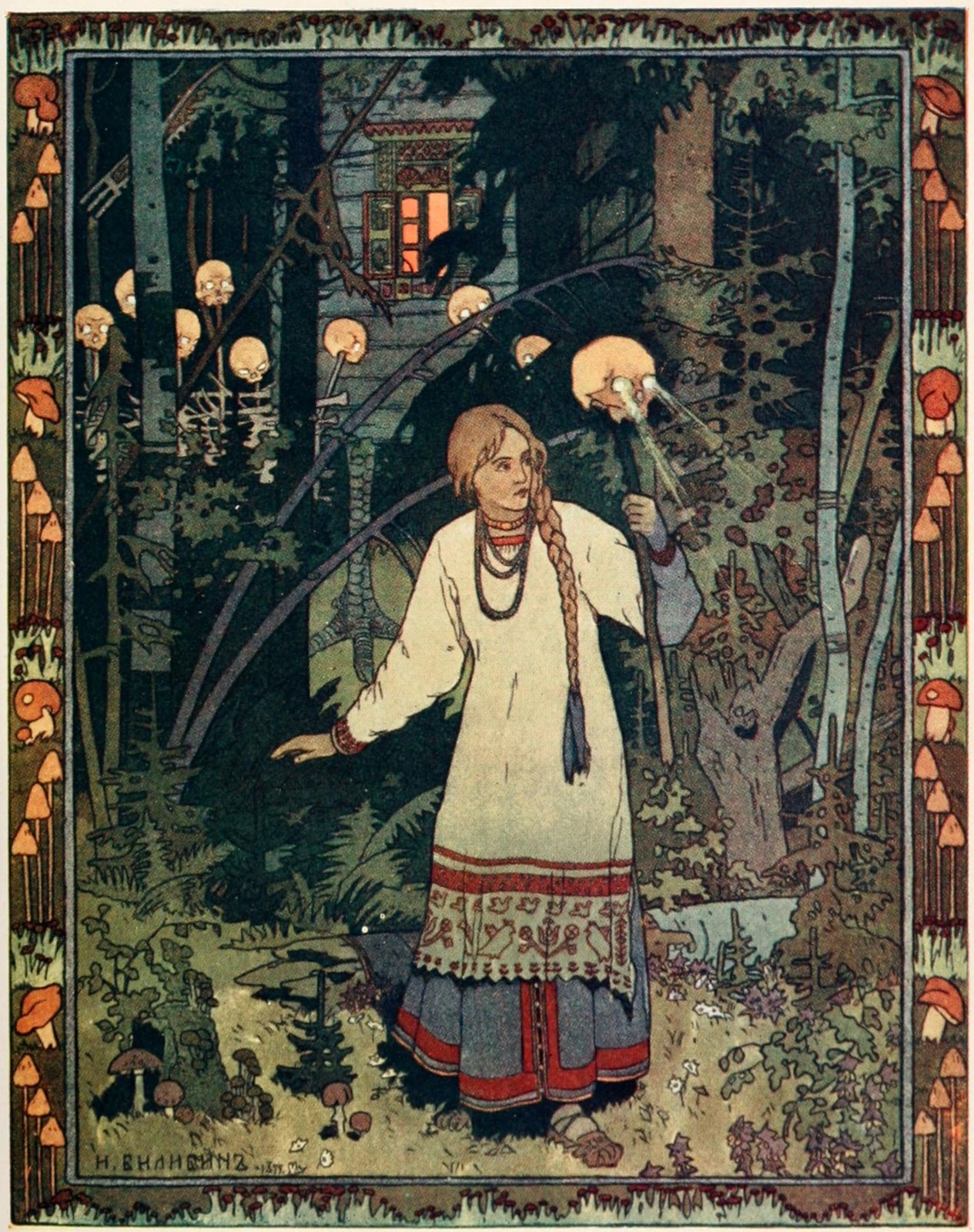
Ivan Bilibin illustrated the folk-tale world of Baba Yaga in 1899. This is historical fairy-tale art, not a photograph or production image from Sandler’s play or the AMC+ series. Resized and recompressed without cropping. Public domain / Wikimedia Commons.
A useful older example is Vasilisa the Fair, preserved in nineteenth-century Russian tale collections and later English translations. Baba Yaga threatens Vasilisa, sets her tasks and eventually allows her to leave with the frightening gift of fire. The relationship is not reducible to a conventional villain-versus-victim encounter. W. R. S. Ralston’s public-domain Russian Fairy Tales provides a historical English-language entry point into the narrative tradition.
This does not establish Vasilisa as the hidden plot of Yaga. Neither the television announcement nor Tarragon’s theatre archive says Sandler adapted that tale scene by scene. The connection is thematic: Baba Yaga’s danger, age, power and moral ambiguity can operate as creative material within an original detective story.
Katherine, Age and Power
Sandler has described an interest in writing a complex older female figure who can occupy the sort of morally troubling central position often reserved for male antiheroes. In her Entertainment Weekly interview, she linked the concept with how women may become socially overlooked as they grow older. Moss, who plays Katherine, also discussed that theme.
It is therefore reasonable to describe age, visibility and power as stated creative concerns behind the adaptation. It is not reasonable to conclude from the trailer that Katherine is definitively Baba Yaga in a literal supernatural sense, that she has committed the central crime or that any traditional Slavic belief is being portrayed accurately as contemporary fact.
The series deliberately operates between suspicion and possible magic. In this production-source comparison, character accusations and promotional suggestions remain part of the fictional mystery, not confirmed explanations.
What Has Not Been Established
Because Yaga is a mystery, several apparently straightforward questions require restraint.
- Is Henry dead? The official premise calls him missing. It does not resolve his fate.
- Are Henry and Logan twins? The showrunner confirms their resemblance and Williams’s dual casting, not a definitive relationship or supernatural explanation.
- Is Katherine literally the witch? Her connection with Baba Yaga imagery does not amount to an independently confirmed plot resolution.
- Does the series end the same way as the play? The cited pre-premiere production materials describe important changes, but do not establish a scene-by-scene or ending-by-ending comparison.
- Is Whittock a documented haunted place? No. It is the fictional setting described by the production, not evidence of a real haunting.
Readers looking for the show’s confirmed release details should use AMC’s country-specific announcement rather than infer a worldwide premiere from the US schedule. The October 23 date and subsequent Friday release pattern quoted above apply to AMC+ in the United States; Crave is the Canadian home, and distribution arrangements elsewhere can differ.
The Real Adaptation Story
The clearest change between Yaga in 2019 and Yaga in 2026 is not that a stage thriller suddenly became a witch story. The stage version was already built around a murder investigation and the cultural image of Baba Yaga. What changed was the method of telling it.
Three actors who once supplied an entire community have become an ensemble. The same performer no longer plays Rapp and Henry; instead, Henry shares an actor with a new lookalike. A yogurt dynasty has become a coastal fishing empire. The sparse theatrical backdrop has become a town with its own university, class tensions and suspects.
Sandler has retained the right to complicate the familiar witch image without treating folklore as a police report. That is the most meaningful connection between the original work and the series—and the most useful distinction for viewers who want to understand what the adaptation actually changes.
Sources & further reading
- Tarragon Theatre: Yaga, original 2019 production
- AMC Global Media: Yaga cast, premise and US release plan (September 25, 2026)
- Entertainment Weekly: Sandler and cast discuss stage-to-screen changes (October 20, 2026)
- W. R. S. Ralston: Russian Fairy Tales, historical text
- Ivan Bilibin, 1902 (died 1942) — image source and reuse terms
- Ivan Bilibin, 1899 (died 1942) — image source and reuse terms