Lore & Explained / Folklore
Pontianak and Kuntilanak Explained: How a Southeast Asian Ghost Legend Changed
Pontianak and kuntilanak are often treated as one fixed female ghost. Older Malay sources, modern ethnography and horror cinema show a tradition that changed by place and period.
Topics: Pontianak, Kuntilanak, Malay Folklore, Indonesian Folklore, Malaysian Folklore, Southeast Asian Folklore, Ghost Stories

The Bangsawan, 2020 / Wikimedia Commons, CC BY-SA 4.0 (resized)
The pontianak and kuntilanak are among Southeast Asia’s best-known supernatural figures: female ghosts associated in many modern tellings with death in childbirth, long hair, frightening cries and violent returns from the dead.
That familiar profile is real as folklore, but it is not one timeless rulebook.
An English-language Malay folklore collection published in 1900 used pontianak differently from the way many Malaysians and Indonesians use the word today. Later ethnography recorded the names shifting and overlapping. In West Kalimantan, meanwhile, the kuntilanak became part of a founding story about the city of Pontianak itself. Film then gave the figure an even more recognizable body: pale face, long hair, white clothing and a sound audiences learn to fear before the ghost appears.
The result is not a contradiction that needs to be “fixed.” It is a good example of how folklore changes when stories move between places, generations, religions and media.
Are pontianak and kuntilanak the same thing?
Sometimes, in modern usage, they overlap heavily. Historically, the answer is more complicated.
In Indonesia, kuntilanak is a common name for the female ghost. In Malaysia and Singapore, pontianak is more familiar. Modern scholarship often discusses the figures together because the traditions cross national borders and share a large body of imagery.
But older written sources do not always use those labels in the same way.
Walter William Skeat’s Malay Magic, published in 1900, records a group of supernatural beings connected with childbirth. In the material Skeat reproduced, the langsuir is associated with a woman who dies in childbirth, while the pontianak is described as the stillborn child connected with her. A modern reader expecting the pontianak to be the dead mother will immediately notice the mismatch.
That mismatch matters more than any attempt to declare one version “correct.”
A 2025 study by Ikhlas Abdul Hadi uses the contrast to show how the naming changed over time. Comparing Skeat’s material with Carol Laderman’s 1983 ethnography of childbirth in rural Malaysia, Hadi notes that by the later account both pontianak and langsuir could be understood as ghosts of women who died in childbirth.
The tradition had not stayed frozen between books.
The 1900 source does not give us a timeless original
Malay Magic is useful because it preserves descriptions that were circulating more than a century ago. It should not be mistaken for a perfect transcript of one ancient Malay belief system.
Skeat was a British colonial administrator and ethnographer writing within the assumptions of his period. His book pulled together observations, earlier writings and accounts from different communities across the Malay Peninsula. Even when a passage is valuable, it records what particular people told particular collectors in a particular historical setting.
That makes the book evidence for recorded tradition, not a final authority on what every Malay community had always believed.
The same caution applies to neat internet definitions. “Pontianak is the dead child, langsuir is the mother” accurately describes one important early printed formulation. It does not describe every later tradition. The opposite simplification — “pontianak has always meant a woman who died giving birth” — erases the older recorded distinction.
The history is more interesting precisely because the names moved.
Why childbirth sits at the center of the tradition
The connection with pregnancy, childbirth and infant death is not a decorative horror detail.
Hadi’s 2025 study places pontianak, langsuir and penanggal stories beside the historical risks surrounding childbirth. In Skeat’s material, the beings represent different feared outcomes: the death of the mother, the death of the child and threats directed toward newborns. Laderman’s later fieldwork found that supernatural protections around childbirth remained part of local practice even though the names and descriptions had shifted.
It would be too simple to say that high maternal mortality “created” the pontianak. Folklore rarely has one provable cause, and supernatural traditions are not medical case reports.
What the sources do show is that these stories gave frightening form to dangers that families knew intimately. Pregnancy could be physically dangerous. A mother or child could die. Ritual specialists and midwives operated in a world where bodily risk, religion and supernatural protection were not necessarily separate categories.
That context helps explain why the modern ghost remains so closely tied to reproductive death even after cinema and popular fiction transform almost everything else around her.
The city of Pontianak has its own kuntilanak story
The name Pontianak is also the name of the capital of West Kalimantan, Indonesia, on the island of Borneo.
A widely told local founding narrative links the city to the ghost.
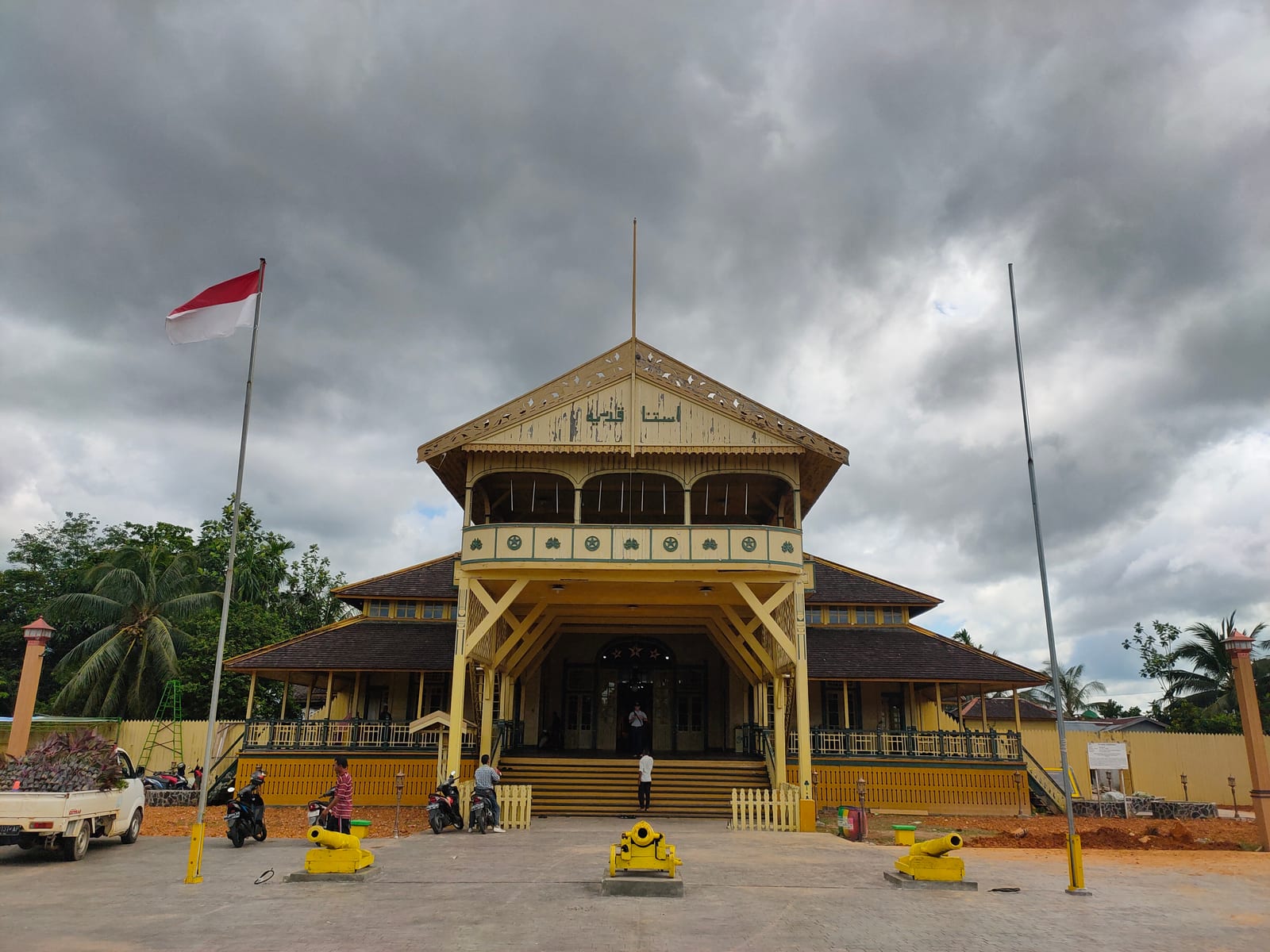
Anthropologist Timo Duile, who conducted fieldwork in Pontianak, describes a story in which the city’s founder, Syarif Abdurrahman, arrives at the confluence of the Kapuas and Landak rivers in the eighteenth century. The place is said to be disturbed by kuntilanak. Cannons are fired, the spirits are driven away, trees are cut, and a settlement takes shape. Duile dates the city’s founding to 1771 in his discussion of the narrative.
The important word here is narrative.
Duile is not presenting cannon fire against ghosts as a verified historical event. He studies the story as part of Pontianak’s cultural memory and as a way people describe the relationship between wilderness, settlement, religion and political authority.
The supernatural claim remains folklore.
Does the city name literally mean “kuntilanak”?
That is less certain than many quick explainers suggest.
The ghost story is deeply attached to the city’s identity, but Duile also records another explanation in local discussion: Ponti may be linked with pohon tinggi, “tall tree” or “tall trees.” His informants associated kuntilanak in Pontianak with large trees near the river, including banyan trees, while traditions elsewhere may associate the figure with banana trees.
Those competing explanations are a reason to avoid statements such as “the city was definitely named after the ghost.”
A founding legend can be culturally important even when it is not a provable etymology.
The safer conclusion is that Pontianak’s identity and kuntilanak folklore became strongly intertwined, and that more than one explanation for the city’s name circulates.
Trees, rivers and the edge of the city
Duile’s fieldwork also shows why location matters.
The kuntilanak he encountered in West Kalimantan was not simply a generic woman in white transplanted from a movie. Local stories placed the ghost around large trees, river landscapes and the boundary between settled space and the less-controlled interior.
Duile reads the founding story as a narrative about making a place governable: cutting trees, building a mosque and palace, establishing trade and defining a Muslim Malay civic center. In that interpretation, the kuntilanak is pushed outward toward “nature” but never disappears from cultural memory.
That is the scholar’s analysis, not a supernatural fact. It is also one regional reading, not a master explanation for every pontianak story in Southeast Asia.
The lesson is broader: place changes the ghost.
The modern woman in white is not the whole archive
Today’s most recognizable kuntilanak/pontianak image is strikingly consistent: a pale woman, very long hair, white clothing and a frightening laugh or shriek.
Cinema helped make that image portable.
Rosalind Galt’s Alluring Monsters traces the pontianak through Malay cinema and decolonization, especially films produced in Singapore and Malaysia from the mid-twentieth century onward. The figure became much more than a folktale monster. Filmmakers used her to explore gender, modernity, religion, national identity and the tensions of postcolonial society.
Indonesian cinema built its own visual vocabulary. A 2026 study of director Rizal Mantovani’s Kuntilanak films argues that the monster’s changing form works as cultural and political allegory as well as horror imagery. The study also shows how far screen versions can depart from a supposedly “traditional” appearance.
That matters because popular culture often works backward. Once enough movies show the same white-robed woman with long black hair, audiences can start to assume that every detail must be ancient.
Some motifs have older roots. Others were standardized, amplified or reinvented by modern storytelling.
Pontianak, kuntilanak, langsuir and penanggal are not one monster
The names overlap, but collapsing them all into one entry creates more confusion than clarity.
| Name | What the sources show |
|---|---|
| Pontianak | Usage varies by period and place. Skeat’s 1900 material distinguishes the pontianak from the dead mother; later Malaysian usage often describes a female ghost associated with death in childbirth. |
| Kuntilanak | Common Indonesian name for a closely related female ghost tradition. In Pontianak, West Kalimantan, the figure is central to a local city-founding legend. |
| Langsuir / langsuyar | In Skeat’s material, the spirit of a woman who dies around childbirth. Later accounts can overlap the term with pontianak. |
| Penanggal / penanggalan | Another birth-related supernatural figure in Malay traditions, but not simply another spelling of pontianak or kuntilanak. |
The table is not a taxonomy of real creatures. It is a guide to how recorded folklore terminology has been used.
Is the pontianak a vampire?
The word vampire is useful only up to a point.
English-language scholarship often calls the pontianak a “vampire ghost” because some traditions involve blood, predation and a dangerous return from death. Galt uses that language in explaining the figure to an international readership.
But the European vampire is not the template from which every blood-associated ghost should be measured.
Calling the pontianak “Southeast Asia’s vampire” can help a new reader understand the level of cultural importance or the broad revenant idea. It becomes misleading when it suggests Dracula-style rules, one fixed method of killing the creature, or a direct line of descent from European vampire folklore.
The pontianak belongs to Malay and Southeast Asian histories of spirits, childbirth, religion and local storytelling. Similarity is not sameness.
What modern horror usually leaves out
A movie needs a recognizable threat. Folklore can tolerate contradiction.
That difference explains why modern versions often give the kuntilanak a clean visual identity, a predictable sound cue and a repeatable set of powers. Older and ethnographic sources are less cooperative. Names change. One community emphasizes childbirth. Another tells a city-founding story. A printed source distinguishes mother and child where later speakers merge the categories.
There is no single “correct” loadout of powers waiting to be recovered.
What can be recovered is the history of the telling.
Are pontianak and kuntilanak real?
There is no scientific evidence establishing pontianak or kuntilanak as literal supernatural beings.
There is extensive evidence that the beliefs, stories and screen traditions are real cultural phenomena. They appear in ethnography, historical folklore collections, family and community narratives, scholarship and decades of Southeast Asian cinema.
Those are different claims.
A story about a ghost can tell us something real about fear, childbirth, gender, religion, landscape or political history without proving that a ghost exists.
That distinction is especially important with the pontianak because the tradition has changed so visibly. The figure is not interesting despite those changes. The changes are part of the history.
The ghost survives by changing
The easiest pontianak article to write would give you a white dress, long hair, a list of powers and a rule for surviving an encounter.
The sources give us something better.
They show a tradition in motion. A 1900 collector separates the dead mother from the stillborn child. Later ethnography records the names overlapping. West Kalimantan attaches the kuntilanak to the founding story of a real city. Cinema turns the ghost into one of the region’s most recognizable horror icons and keeps rewriting what she looks like and what she means.
Pontianak and kuntilanak are therefore best understood not as entries in a supernatural field guide, but as living folklore with regional and historical variants.
The ghost changes because the people telling the story change too.
Sources & further reading
- Wikimedia Commons: Masjid Jami Pontianak photograph, The Bangsawan (CC BY-SA 4.0)
- Wikimedia Commons: Keraton Kadariah photograph, Zhilal Darma (CC BY-SA 4.0)
- Timo Duile: Kuntilanak — Ghost Narratives and Malay Modernity in Pontianak, Indonesia (2020)
- Pontianak City Government: History of Pontianak
- Walter William Skeat: Malay Magic (1900), Project Gutenberg edition
- Ikhlas Abdul Hadi: Maternal Mortality and Rituals — Exploring Agency of the Dead Through a Haunted Malay Doctor (Folklore 96, 2025)
- Rosalind Galt: Alluring Monsters — The Pontianak and Cinemas of Decolonization (Columbia University Press, 2021)
- Allegorical representation of Kuntilanak in Rizal Mantovani's films (2026)