Lore & Explained
The Headless Horseman Explained: Sleepy Hollow's Haunted Ride
Who is the Headless Horseman, and what happened to Ichabod Crane? Read Washington Irving's actual ending and separate its clues from later adaptations.
Topics: Headless Horseman, Sleepy Hollow, Washington Irving, Ghost Stories
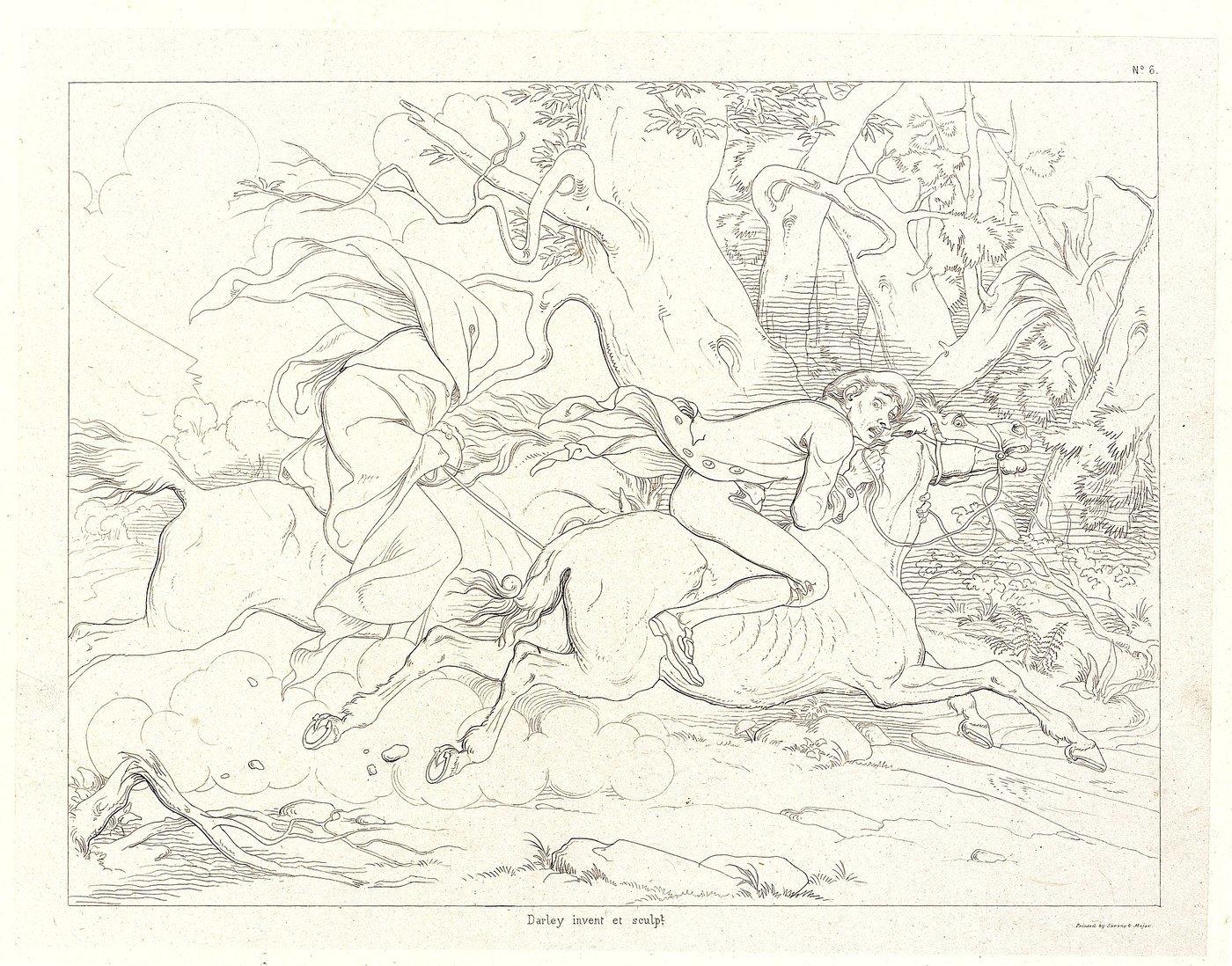
F. O. C. Darley, 1849, American Art Union (Public Domain)
The Headless Horseman in The Legend of Sleepy Hollow is said to be the ghost of a Hessian soldier whose head was lost to a cannonball during the American Revolutionary War. Washington Irving’s 1820 story makes that local legend the terror of Ichabod Crane’s ride home. It does not conclusively establish that a ghost attacks him.
That last point is easy to miss. Irving gives the reader a frightening pursuit, then leaves behind a shattered pumpkin, suggestive behavior and conflicting explanations. The horseman is both a figure in the community’s folklore and a possible disguise someone might exploit.
The discussion below reveals the story’s ending.
Who is the rider supposed to be?
Within the story, local people identify the apparition as a mounted Hessian soldier. His remains are said to lie in the churchyard, while his ghost searches for its missing head. Night riding and the return to a grave help connect the landscape’s ordinary landmarks to a supernatural explanation.
This is a legend reported by Irving’s narrator, not a verified military casualty record. The text does not identify a documented dead soldier whose movements can be reconstructed from evidence. Searching for the horseman’s “real name” therefore risks asking a fictional story to supply a historical identity it never establishes.
The place is important, though. Roads, a church, a bridge and neighboring households give the tale a route the reader can imagine following. Terror arrives not in an isolated fantasy kingdom but on the way back from a social evening.
Ichabod Crane is not the familiar movie detective
Irving’s Ichabod is a schoolmaster and singing instructor. He is hungry, ambitious and highly receptive to frightening stories. His courtship of Katrina Van Tassel includes attraction to her family’s prosperity, which the narrator makes difficult to overlook.
His rival, Brom Bones, is confident, physically imposing and associated with practical jokes. Their competition matters because it gives someone a potential reason to frighten Ichabod away. The story’s supernatural possibilities sit alongside a quite ordinary conflict over marriage and social position.
A summary that begins with a professional investigator arriving to solve a series of beheadings has already moved into adaptation. That is not the premise of Irving’s original text.
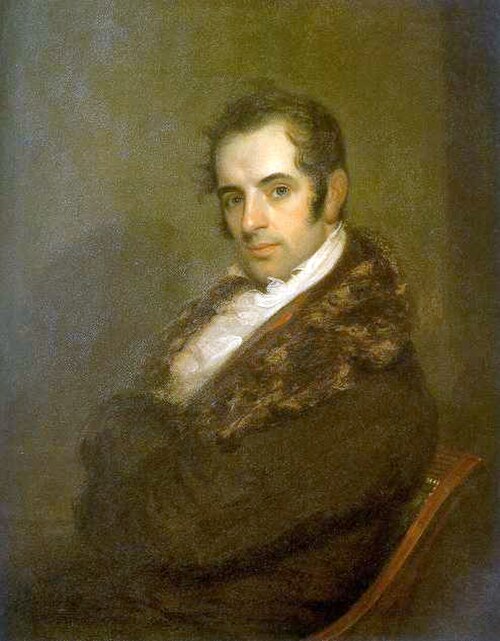
Washington Irving, painted by John Wesley Jarvis in 1809, roughly a decade before he published “The Legend of Sleepy Hollow” in The Sketch Book*. Source. Public domain.*
What happens on the ride home?
After an evening at the Van Tassel home, Ichabod rides away in a discouraged state. The narrator does not report his private conversation with Katrina in full, leaving the reader to infer that the courtship has gone badly.
The road has already been filled with stories. Darkness, sounds and familiar objects become threatening to a rider who expects supernatural danger. When a mounted figure appears, Ichabod eventually perceives that the rider has no head on his shoulders. The head seems to be carried instead.
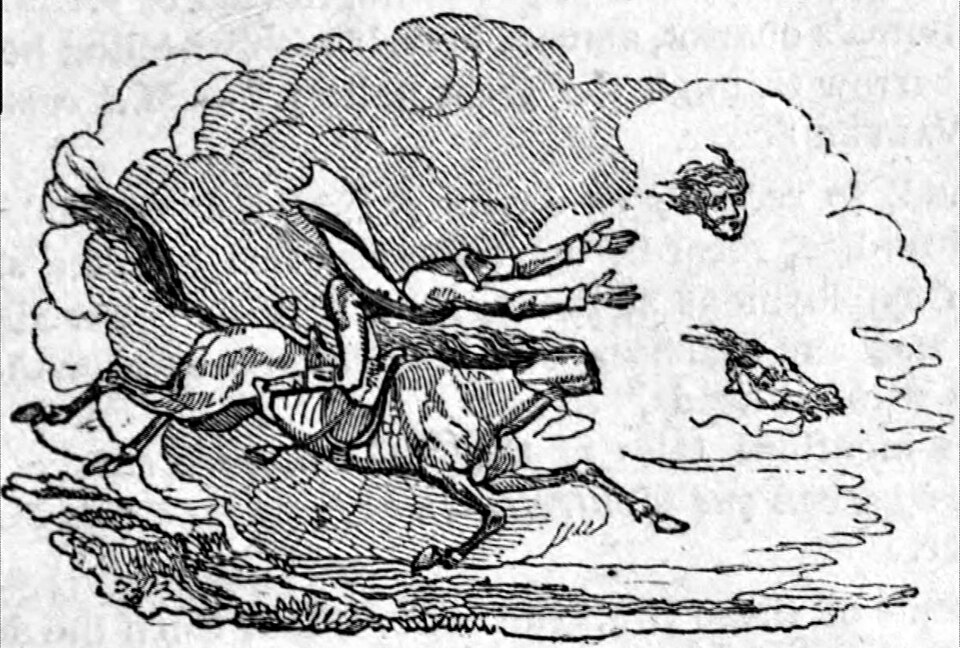
The pursuit drives him toward the bridge. He believes crossing it will bring safety because of what he has heard about the horseman’s behavior. It does not work as he expects. The rider throws the apparent head, striking Ichabod and knocking him from his horse.
The force of that scene depends on Ichabod’s experience. Something terrifying chases him. Whether he has correctly identified that something remains a separate question.
Why the shattered pumpkin matters
The next day, the searchers find Ichabod’s hat near a broken pumpkin. His horse returns, but Ichabod does not resume his place in the community.
The pumpkin strongly invites a practical explanation for the object thrown at him. It does not fit neatly with the idea that the recovered object was a dead soldier’s actual head. Still, a clue is not a full confession. Irving does not switch to an all-knowing account that reconstructs a prank from beginning to end.
Brom’s behavior adds to the suspicion. He later marries Katrina, appears unusually knowing about Ichabod’s disappearance and reacts with particular amusement to mention of the pumpkin. Readers have good reasons to suspect him. The text stops short of supplying definitive proof.
That is a more satisfying tension than a simple choice between “the ghost was real” and “the author confirmed it was Brom.” The story shows how a community can keep a supernatural version alive while leaving the materials for another explanation in plain sight.
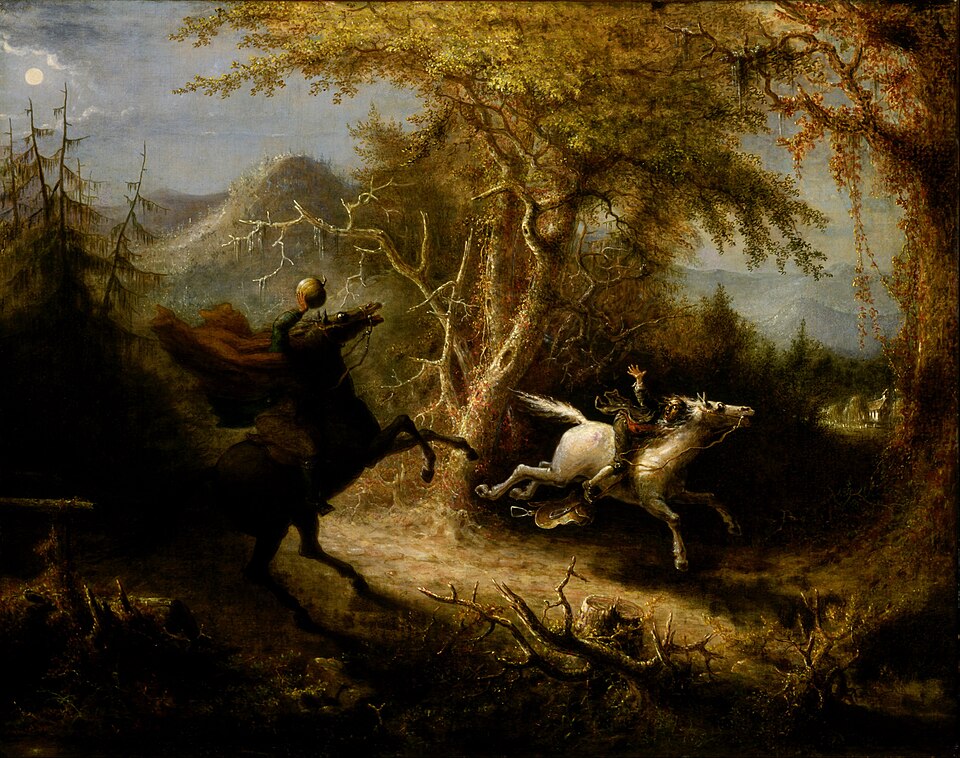
The Headless Horseman Pursuing Ichabod Crane, painted by John Quidor in 1858 — a 19th-century American artist’s vision of the story’s climactic chase. Source. Public domain.*
Does Ichabod die?
The story does not establish that he dies. An account brought back later places him elsewhere, alive and pursuing a different life. Other people in the neighborhood continue to say that supernatural forces carried him away.
Those accounts cannot both be treated as confirmed events. They are competing endings circulating within the story. The narrator also lets the horseman’s reputation grow after Ichabod disappears, which is part of the joke: evidence that might weaken a haunting can instead become another reason to tell it.
If an adaptation kills Ichabod, gives the rider a complete biography or openly reveals the prank, it has chosen a level of certainty that Irving avoids.
Is the horseman the same as the Dullahan?
No single shared identity should be assumed. Headless riders occur in more than one storytelling tradition. Irving’s Hessian ghost and the Irish figures collected under the name Dullahan can be compared, but similarity does not make one the confirmed origin of every detail in the other.
A direct influence claim needs evidence, such as a source Irving can be shown to have used. Merely placing two headless figures side by side is not enough. Keeping them separate also preserves what is distinctive about Sleepy Hollow: the social rivalry, the susceptible schoolmaster and the possibility that folklore itself becomes a tool for manipulation.
A ghost story that survives its own clues
Irving does not make belief look simple. Ichabod’s fear is genuine, Brom’s possible opportunity is clear, and the neighborhood’s appetite for a good story outlasts both men. The tale can frighten the reader and invite the reader to laugh at how fright works.
That double effect explains why the pumpkin should never be edited out of an explanation. It is not an inconvenient detail that spoils a better ghost story. It is one of the details that makes this particular ghost story work.