Lore & Explained / Demons & Occult
Valac Explained: The Real Demonology Behind The Nun's Valak
Valac, also spelled Valak, appears in European grimoires as a winged child riding a two-headed dragon. Here is how the historical figure differs from The Nun.
Topics: demonology, grimoires, Ars Goetia, The Nun, The Conjuring
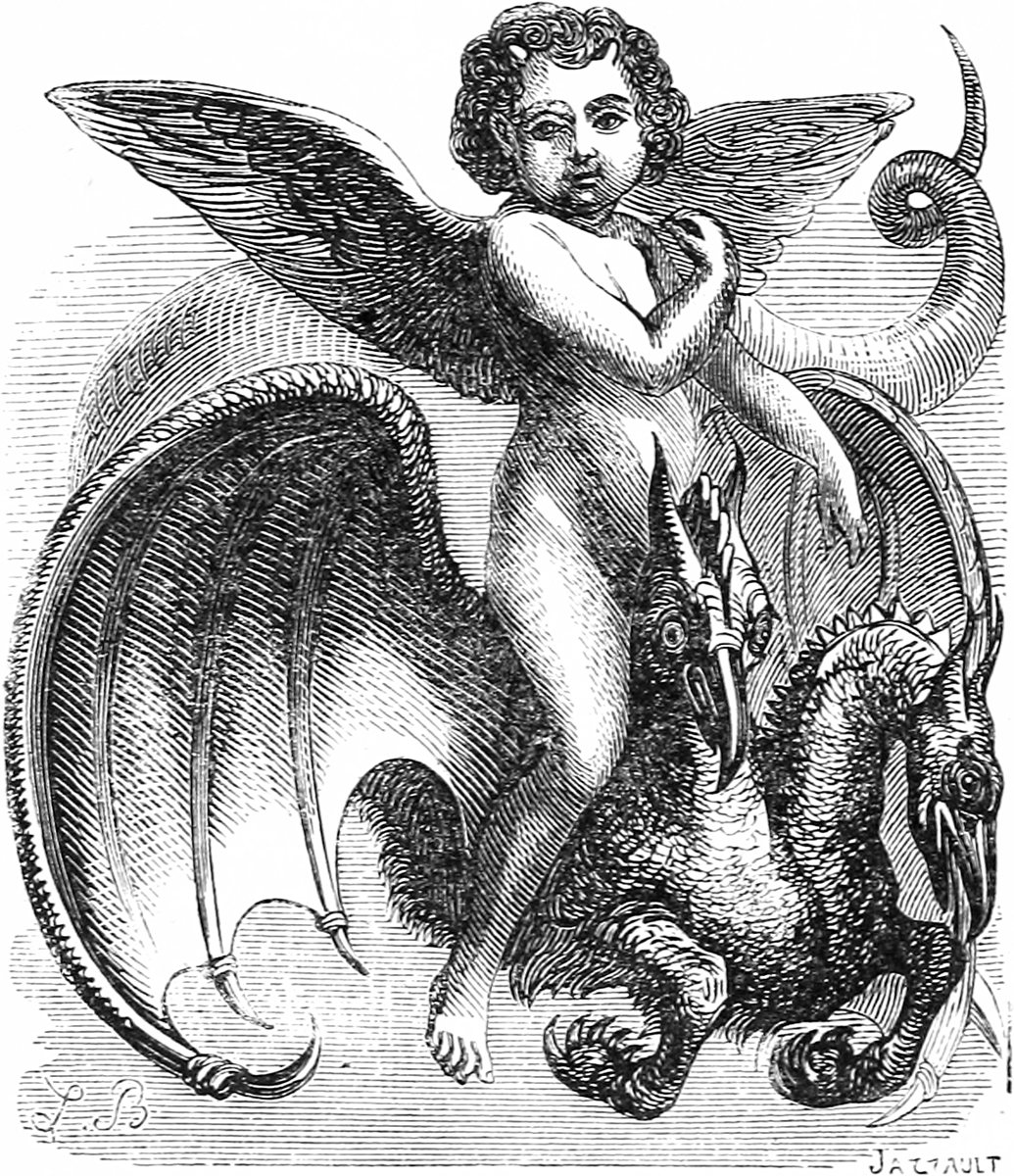
Louis Le Breton, Volac from Dictionnaire Infernal (1863) / Public Domain via Wikimedia Commons
Valac, also spelled Valak, is a named spirit in European grimoire literature; the demonic nun from The Nun is a modern fictional adaptation. If you know the name Valak at all, you probably picture that gaunt woman in a torn habit, yellow-eyed and grinning in a dark hallway. The historical tradition behind the name is centuries older and looks almost nothing like the movies.
Who Valac Is in the Historical Grimoires
Strip away the films and Valac, also written Volac, Valak, Valu or Ualac in different sources, is a relatively minor spirit in European ceremonial-magic texts.
In the Ars Goetia, the first section of the Lesser Key of Solomon, Valac is the 62nd spirit and holds the rank of President. The text describes him as appearing like a child with angel’s wings riding a two-headed dragon. His attributed functions are unusually specific: he gives answers about hidden treasure and tells the practitioner where serpents may be found.
The Goetia says he governs 30 legions of spirits, although variant manuscript traditions have produced different numbers in later references.
That is the important historical distinction. The grimoire Valac is not a demonic nun, is not described as waging war against the Catholic Church, and is not given the powers seen in The Conjuring films.
None of this establishes that a supernatural being named Valac objectively exists. Grimoires document occult traditions, ritual systems and claims made by their compilers. They are historical evidence for what texts say, not scientific evidence that the spirits they describe are real.
Valac Before the Ars Goetia
The tradition did not begin with the Lesser Key of Solomon.
One of the earliest surviving close forms appears in the fifteenth-century Munich Manual of Demonic Magic, manuscript Clm 849 at the Bavarian State Library. There, a spirit called Volach is ranked as a president and is said to command 27 legions. The description already contains features that later become familiar: a youthful, angel-winged appearance, a dragon, hidden treasure and serpents.
That makes the Munich manuscript important, but it should not be treated as proof that it is the single point where the figure originated. Demon catalogues circulated, changed and borrowed from earlier material long before the surviving Goetia manuscripts were compiled.
Related names also occur in versions of the Liber Officiorum Spirituum. Entries called Coolor and Doolas have been linked by modern editors to the same broader textual tradition because of overlapping functions and catalogue structure, although their ranks and details do not match Valac perfectly.
This kind of variation is normal in premodern magical literature. Names were copied by hand, translated, abbreviated and corrupted, while lists of spirits were reorganized by different compilers.
Johann Weyer and the Name Volac
A major step comes with physician Johann Weyer’s Pseudomonarchia Daemonum.
Weyer first published De praestigiis daemonum in 1563, but the demon catalogue known as Pseudomonarchia Daemonum was added as an appendix to the fifth edition in 1577.
There the spirit appears as Volac and is the 50th entry in Weyer’s catalogue. Weyer describes Volac as a great president appearing like a boy with angel’s wings riding a two-headed dragon. He answers questions concerning hidden treasure and identifies where serpents may be found. Weyer gives him command of 30 legions.
Reginald Scot’s skeptical The Discoverie of Witchcraft followed in 1584 and reproduced an English version of much of Weyer’s spirit catalogue. Scot renders the name Valac.
Those texts matter because the later Goetia closely resembles the catalogue preserved by Weyer and Scot, although the order of the spirits changed.
What the Ars Goetia Actually Says
By the seventeenth century, Valac appears in manuscripts of the Lemegeton Clavicula Salomonis, or Lesser Key of Solomon.
The Ars Goetia entry identifies him as the 62nd spirit and describes him as a “mighty great president” who appears like a boy with angel’s wings riding a two-headed dragon.
His office is to:
- give answers about hidden treasures
- reveal where serpents may be seen
- bring those serpents to the exorcist without force or strength
The familiar modern description comes directly from this textual tradition.
There is no nun here. No convent. No yellow eyes. No inverted crosses. No Saint Lucy relic. Those belong to modern screen fiction.
How Many Legions Does Valac Command?
The common Goetia reading gives Valac 30 legions.
Some later references report 38, while the Munich manuscript gives Volach 27. The safest way to handle the numbers is not to force them into one definitive biography. Different manuscripts and editions preserve different details.
The same caution applies to Valac’s title. “President” is part of the hierarchy used by these particular grimoires. It should not be converted into a universal ranking of how “powerful” one demon supposedly is compared with another.
The Goetia uses ranks such as King, Duke, Prince, Marquis, President, Earl and Knight, but the text does not provide a reliable modern-style power scale.
Is Valac Male or Female in the Grimoires?
Historical descriptions present Valac in a male-coded form.
Weyer’s Latin says he appears in the form of a boy, and later English descriptions retain the image of a child or boy with angelic wings.
That makes the difference from the Conjuring version especially obvious. The familiar female-presenting demonic nun is not an old depiction recovered from a grimoire.
It is a movie design.
The Two-Headed Dragon
The two-headed dragon is one of the most stable features of Valac’s historical image.
Weyer describes the spirit riding a dragon with two heads. The Goetia repeats the same basic image, and Louis Le Breton later turned it into the most famous illustration of Valac for Jacques Collin de Plancy’s 1863 sixth edition of the Dictionnaire Infernal.
Le Breton’s image shows a winged child calmly riding a large two-headed dragon.
That illustration is often circulated online next to images of the demonic nun, but they represent two completely different periods:
- 1863: Le Breton visualizes the older demonological description.
- 2016: The Conjuring 2 introduces the nun design that popularized the name Valak for modern horror audiences.
The older image is not evidence of what a real supernatural entity looks like. It is a nineteenth-century artist’s illustration of a demonological text.
Valac’s Sigil
The Goetia also gives Valac a seal or sigil.
Modern reproductions usually trace back to printed editions such as S. L. MacGregor Mathers and Aleister Crowley’s 1904 The Goetia: The Lesser Key of Solomon the King, which helped make the spirit catalogues and their seals accessible to twentieth-century occult readers.
That edition lists several spellings together, including Volac, Valak and Valu.
This is useful evidence that “Valak” existed as a spelling before the films. It does not mean the 1904 edition alone created the modern spelling. The name circulated in several forms across manuscripts and editions, while The Conjuring franchise later made “Valak” by far the most familiar version to mainstream audiences.
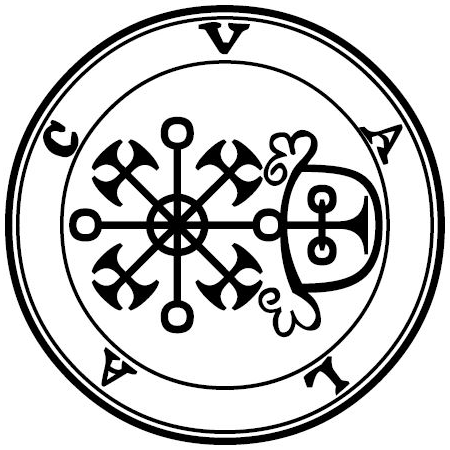
Seal of Valac from The Book of the Goetia of Solomon the King (1904) by S. L. MacGregor Mathers and Aleister Crowley / Public Domain via Wikimedia Commons. Source.
Valac Before The Conjuring
Valac was obscure outside occult literature, but the name and variants did appear in fiction before 2016.
Mike Mignola’s Hellboy: Box Full of Evil features a demon called Ualac, a clear use of a traditional variant of the name. The story was published in 1999.
The Bloodstained games also use Valac as a two-headed dragon-like demon, drawing much more visibly from the old grimoire imagery than the Conjuring films do.
John Carpenter’s Vampires (1998) has an antagonist named Jan Valek, but resemblance of the name alone is not enough to claim that the character was deliberately derived from the Goetic Valac without a production source saying so.
That distinction is worth keeping. Old demon catalogues have supplied horror and fantasy writers with names for generations, but not every similar spelling proves direct adaptation.
Why The Nun Looks Nothing Like Historical Valac
The demonic nun is a cinematic creation.
James Wan has explained that the main demonic presence in The Conjuring 2 originally had a very different design: a large horned creature created with practical effects and intended CGI wings.
During post-production, Wan decided that the creature felt too fantastical for the movie. He wanted something more personal that could challenge Lorraine Warren’s faith. He has said that conversations with the real Lorraine Warren about her reverence for nuns helped inspire the new direction.
The horned creature was replaced during additional photography, and the Demon Nun was born.
That production history is far more useful than trying to force the nun imagery back into the historical grimoires. The filmmakers borrowed the old demonological name, but the nun’s appearance and movie mythology were developed for the Conjuring universe.
For a complete breakdown of the movie version’s powers, timeline, motives and appearances, that belongs in a separate film-lore article rather than in a historical demonology guide.
Did the Warrens Really Encounter Valak?
There is no reliable historical evidence that the Valak of the films was part of the real Enfield case.
The alleged Enfield Poltergeist disturbances began in 1977 at the Hodgson family’s home in North London. Investigators disagreed sharply over what was happening. Maurice Grosse and Guy Lyon Playfair believed at least some events were paranormal, while other investigators pointed to episodes of trickery and questioned the evidence.
One of the voices attributed to the alleged entity identified itself as Bill, often associated in retellings with a deceased former resident named Bill Wilkins.
What matters here is that the historical Enfield accounts are not a story about the Goetic spirit Valac. The demonic nun and her role behind the haunting belong to The Conjuring 2’s fictional reconstruction.
It is difficult to prove a universal negative about every private Warren note or unpublished file. The responsible claim is narrower: the published historical record of the Enfield case does not establish Valac as the entity involved, and the nun design was created for the film.
History, Occult Tradition and Fiction Are Three Different Things
Valac is a good example of why demonology articles need careful labels.
Documented textual history
We can verify that:
- a Volach-like figure appears in the fifteenth-century Munich manual
- Weyer published Volac in his 1577 demon catalogue
- Scot printed the spelling Valac in English in 1584
- seventeenth-century Goetia manuscripts describe the 62nd spirit as a winged boy riding a two-headed dragon
- Louis Le Breton illustrated Volac in 1863
- the Mathers-Crowley edition printed Valak as one of several spellings in 1904
Those are claims about surviving books and manuscripts.
Occult claims
The same texts attribute supernatural abilities to Valac, including:
- finding hidden treasure
- locating serpents
- commanding legions of spirits
Those are claims within magical traditions, not independently verified facts.
Modern fiction
The Conjuring universe adds:
- the nun appearance
- conflict with Lorraine Warren
- convent mythology
- possession-centered horror
- relics and Saint Lucy material
- the powers shown in the films
Those are fictional additions.
Mixing the three categories together creates the version of Valak commonly found in low-quality demonology pages: a supposedly ancient demon nun whose “historical powers” happen to match a modern horror franchise.
The sources do not support that version.
Quick Answers
Is Valak a real demon?
Valac or Valak is a name found in genuine historical demonological texts. That proves the existence of a textual and occult tradition, not the objective existence of a supernatural being.
What does Valac look like in the old grimoires?
The best-known historical description presents Valac as a boy or child with angel’s wings riding a two-headed dragon.
Was Valac historically a nun?
No. The nun form was created for The Conjuring 2.
Is Valac the 62nd demon of the Ars Goetia?
Valac is the 62nd spirit in the Ars Goetia. In Weyer’s earlier Pseudomonarchia Daemonum, Volac appears as number 50.
How many legions does Valac command?
The most familiar Goetia text gives 30 legions, while other textual variants differ.
Did Ed and Lorraine Warren really encounter Valak?
The published historical record of the Enfield case does not establish a demon named Valak as its cause. The Conjuring version is a fictional adaptation.
Is Valak one of the most powerful demons in the Goetia?
The Goetia calls Valac a President, but it does not provide a dependable power-ranking system that lets us say objectively that one rank is “stronger” than another.
Sources and Further Reading
- Johann Weyer, Pseudomonarchia Daemonum (1577 appendix to the fifth edition of De praestigiis daemonum).
- Reginald Scot, The Discoverie of Witchcraft (1584).
- Richard Kieckhefer, Forbidden Rites: A Necromancer’s Manual of the Fifteenth Century.
- Joseph H. Peterson, ed., The Lesser Key of Solomon.
- S. L. MacGregor Mathers and Aleister Crowley, The Goetia: The Lesser Key of Solomon the King (1904).
- Jacques Collin de Plancy, Dictionnaire Infernal, 6th ed. (1863), illustrations by Louis Le Breton.
Sources & further reading
- Johann Weyer, Pseudomonarchia Daemonum
- Reginald Scot, The Discoverie of Witchcraft
- Richard Kieckhefer, Forbidden Rites: A Necromancer's Manual of the Fifteenth Century
- Joseph H. Peterson, ed., The Lesser Key of Solomon
- S. L. MacGregor Mathers and Aleister Crowley, The Goetia: The Lesser Key of Solomon the King
- Jacques Collin de Plancy, Dictionnaire Infernal