The Index / Unsolved Cases
Area 51 Explained: The Secret Base, UFO Legends, Bob Lazar, and What Is Actually Known
The CIA confirmed Area 51's existence in 2013 as a Cold War aircraft-testing site. Bob Lazar's alien-technology claims are a separate story with serious credibility problems.
Topics: Area 51, Bob Lazar, UFO, Groom Lake, Paranormal
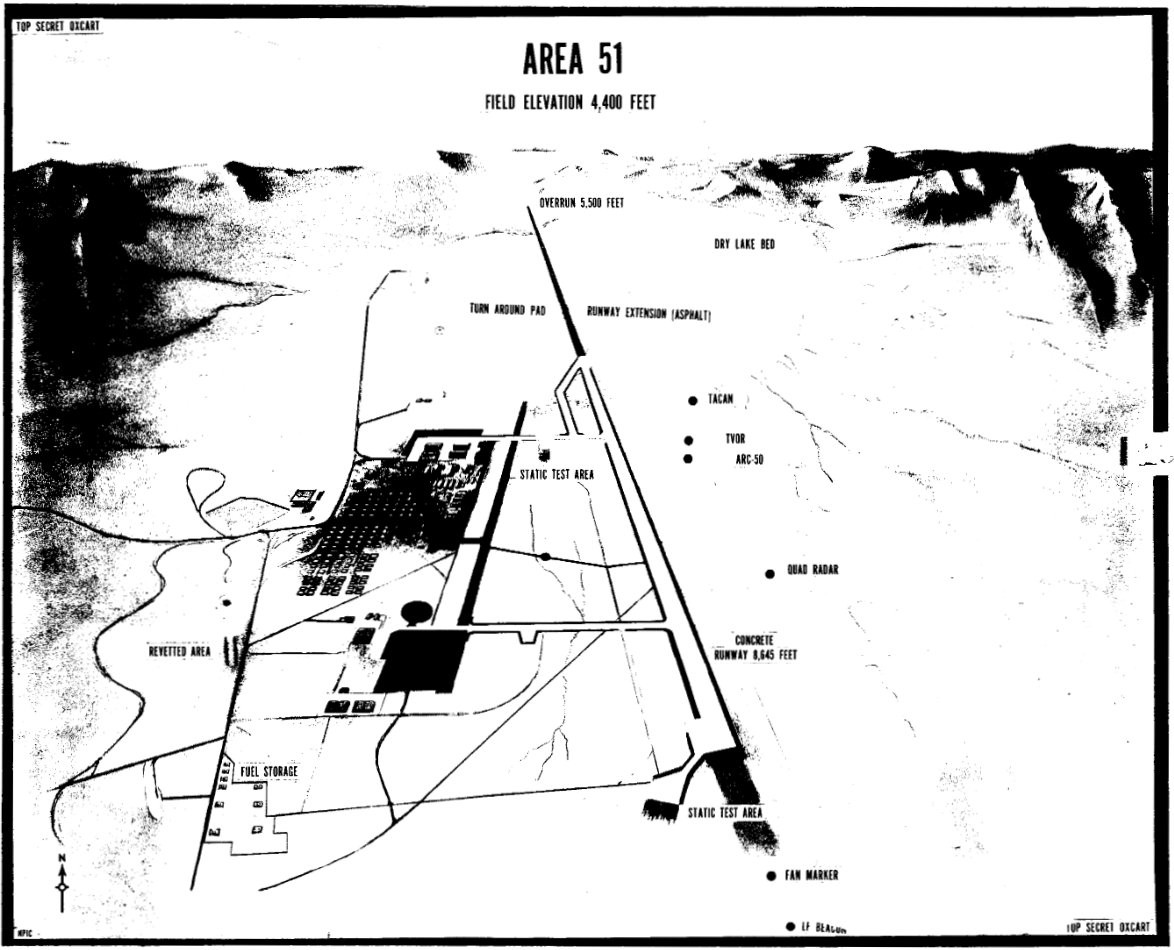
Central Intelligence Agency, 1966 (Public Domain)
Area 51 is real, its existence is officially acknowledged by the U.S. government, and its documented history involves Cold War spy planes, not extraterrestrial spacecraft. The base’s association with aliens comes almost entirely from one man’s 1989 claims, made under circumstances that independent investigation has repeatedly failed to corroborate on several key, checkable points. Those are two separate stories — a genuinely secret, now partly declassified military testing facility, and a specific, disputed personal account layered on top of it — and it’s worth keeping them apart.
What Area 51 Actually Is
Area 51 sits within the Nevada Test and Training Range, adjacent to the dry lakebed known as Groom Lake, roughly 85 miles north-northwest of Las Vegas. The CIA selected the remote site in 1955 specifically for its isolation, establishing it as a flight-test location for the Lockheed U-2 high-altitude reconnaissance aircraft, whose first flight occurred there that same year. The base later served as the testing ground for the A-12 OXCART and its successor, the SR-71 Blackbird — Mach-3-capable reconnaissance aircraft developed under CIA and later Air Force oversight — along with a range of other classified aircraft and technology programs over subsequent decades.
The 2013 Official Acknowledgment
For decades, the U.S. government’s position was to neither confirm nor deny Area 51’s existence, even as the site’s presence was effectively an open secret, visible on commercial satellite imagery and widely discussed in aviation and UFO circles alike. That changed on August 15, 2013, when the CIA released a declassified 407-page internal history, The Central Intelligence Agency and Overhead Reconnaissance: The U-2 and OXCART Programs, 1954–1974, in response to a 2005 Freedom of Information Act request. The document explicitly named Area 51, described its role in developing the U-2 and OXCART programs, and included maps pinpointing the facility’s location — the first time the U.S. government had formally used the name in an official declassified release.
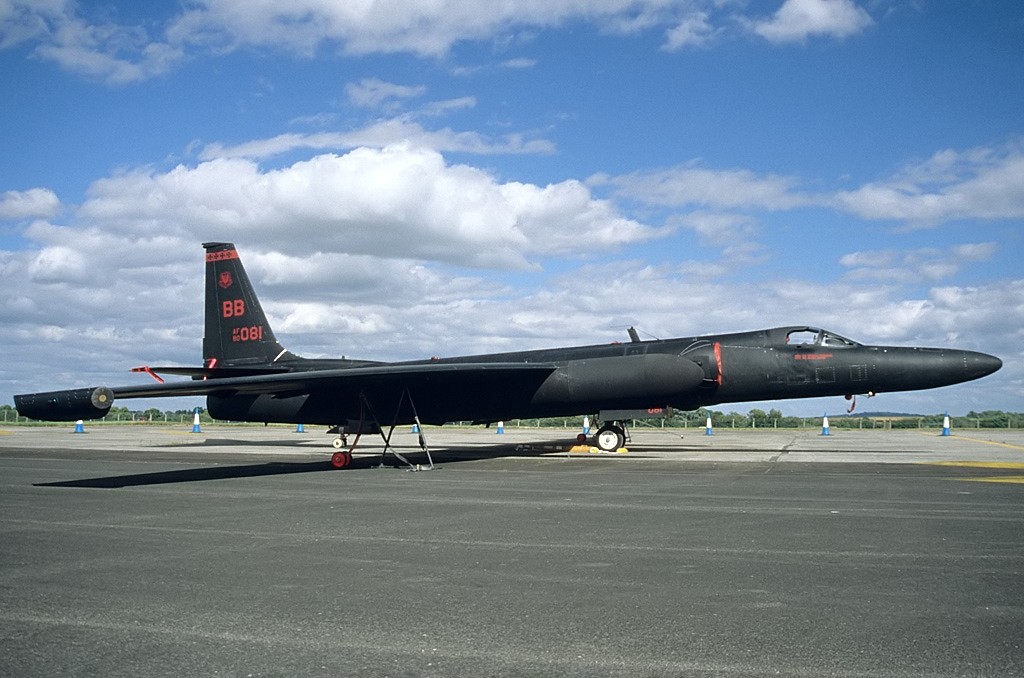
A Lockheed U-2S reconnaissance aircraft — the program that gave Area 51 its original purpose, and quite possibly its earliest UFO reports as well. Source. Mike Freer, Wikimedia Commons, GFDL 1.2.
How Secret Testing Became UFO Sightings
There’s a documented, mundane explanation for a meaningful share of the UFO reports that helped build Area 51’s mystique in the first place: the U-2 flew at altitudes far higher than any civilian or commercial aircraft of its era, meaning commercial pilots and ground observers who spotted it, especially when sunlight caught its silver airframe at high altitude during dawn or dusk, had no ordinary frame of reference for what they were seeing. Because the program was classified, Air Force investigators couldn’t tell puzzled witnesses or the press what they’d actually observed, and a number of Project Blue Book-era UFO reports have since been attributed, with reasonable evidentiary support, to unacknowledged U-2 and later OXCART test flights. A genuinely classified aircraft program, by its nature, generates unexplained sightings among people who don’t know what they’re allowed to be told — a pattern echoed in other Cold War-era UFO waves, including the 1952 UFO wave over Washington, D.C., where credible witnesses, ambiguous evidence, and an official explanation that didn’t fully satisfy everyone involved combined to produce a case that stayed genuinely contested for decades.
Bob Lazar’s 1989 Claims
In May 1989, a man using the pseudonym “Dennis,” his face obscured, told Las Vegas reporter George Knapp of KLAS-TV that he had worked on reverse-engineering alien spacecraft technology at a facility connected to Area 51. That November, he went public under his real name: Bob Lazar. Lazar described working at a site he called S-4, allegedly located near Papoose Lake south of the main Groom Lake facility, where he said he read documents describing research into anti-gravity propulsion and claimed to have seen and worked around several extraterrestrial spacecraft housed in hangars built into a mountainside.
Central to Lazar’s account was a claimed power source: a stable isotope of element 115, which he said powered the alleged craft’s propulsion system through a process he described in some technical detail. This claim briefly generated renewed interest when element 115 — since named moscovium — was genuinely synthesized by a Dubna-Livermore research collaboration in 2003. That synthesis doesn’t support Lazar’s specific claim, however: every known isotope of moscovium synthesized to date is extremely unstable, decaying within a fraction of a second, nowhere near the kind of stable, usable form Lazar described in 1989. The real 2003 discovery and Lazar’s decades-earlier description are not the same claim, and treating the element’s real existence as vindication of his stable-isotope story conflates two different things.
The Employment and Education Problem
Lazar’s credibility took a serious, specific hit almost immediately, on a claim that should have been simple to verify: he stated he held master’s degrees in physics from MIT and in electronics engineering from Caltech. George Knapp’s own 1989 investigation, along with subsequent independent research, found no enrollment or degree records for Robert Lazar at either institution. This isn’t a matter of interpretation or a disputed judgment call — it’s a checkable factual claim about institutional records that has not been corroborated by the institutions themselves, and it substantially undermines the credibility of the broader account it was meant to support, since Lazar’s claimed scientific qualifications were central to why his story was taken seriously as an insider account in the first place.
Distinguishing Acknowledged Secrecy From Unsupported Claims
It’s worth being precise about what’s actually established here. That Area 51 hosted highly classified aircraft development programs, kept information compartmentalized even within the government, and was legally allowed to withhold program details from the public — all of that is documented, acknowledged government history. That any of it involved extraterrestrial spacecraft, reverse-engineered alien technology, or the specific S-4 facility and personnel Lazar described is a separate claim resting on one uncorroborated witness whose verifiable credentials don’t hold up. Genuine government secrecy explains a lot of Area 51’s mystique on its own, without requiring an additional extraterrestrial layer to make the base interesting or worth taking seriously as a real, historically significant Cold War site.
Janet Flights
Area 51 and related classified facilities are serviced by a fleet of unmarked commercial-style aircraft, popularly known as “Janet flights,” which shuttle personnel from a dedicated terminal at Las Vegas’s McCarran (now Harry Reid) International Airport. Their existence and general operating pattern are documented through public flight-tracking data and extensive photography from spotters at publicly accessible viewing areas — this is genuinely observable, unclassified-in-practice activity, distinct from anything happening inside the base’s restricted areas themselves.
Storm Area 51 (2019)
In June 2019, a Facebook event titled “Storm Area 51, They Can’t Stop All of Us,” created as a joke by a single user, went viral and drew commitments from roughly two million people to supposedly raid the base on September 20, 2019, in search of extraterrestrial evidence. The event’s creator quickly clarified he never intended a literal raid, and the momentum was redirected into a legitimate, ticketed music and camping festival called Alienstock, held in the nearby town of Rachel, Nevada. The festival’s own organization ran into serious last-minute difficulties, with its original creator withdrawing from the planning shortly before the event. In practice, only around a hundred people showed up near the base’s actual perimeter; a handful of arrests and one vehicle-related injury were reported, but nothing resembling an actual incursion took place. Readers should treat the base’s restricted perimeter as exactly that — trespassing onto an active military installation carries serious legal consequences and isn’t a responsible way to satisfy curiosity about the site.
Frequently Asked Questions
Is Area 51 real? Yes, and its existence was officially acknowledged by the CIA in declassified 2013 documents describing its role in Cold War aircraft testing.
What does the U.S. government actually admit about Area 51? That it served as a classified flight-test site for reconnaissance aircraft including the U-2 and the A-12 OXCART, beginning in 1955.
Who is Bob Lazar and what did he claim? A man who said in 1989 that he worked reverse-engineering alien spacecraft technology at a site called S-4 near Area 51, describing propulsion powered by a stable isotope of element 115.
Are Bob Lazar’s claims about his education true? No corroborating record has been found. Investigations, including the original reporter’s own, found no enrollment or degree records for him at MIT or Caltech, the institutions he claimed to hold degrees from.
Was element 115 really discovered? Yes, in 2003, but every known isotope is extremely unstable and decays within a fraction of a second — nothing like the stable form Lazar described in 1989.
Why do people report UFOs near Area 51? A documented factor is that classified aircraft like the U-2, flying at unprecedented altitudes, generated genuine unexplained sightings among observers with no frame of reference for what they were seeing, at a time when the program couldn’t be publicly explained.
What was Storm Area 51? A 2019 viral Facebook joke that drew roughly two million event responses; it was redirected into a legitimate music festival, and only a small, peaceful gathering occurred near the base itself.
Is it legal to try to enter Area 51? No. It’s an active, restricted military installation, and trespassing carries serious legal consequences.