The Index / Unsolved Cases
The Roswell Incident Explained: What Crashed in New Mexico in 1947?
A rancher found debris, the Army briefly called it a 'flying disc,' then reversed course within a day. The Air Force's later Project Mogul explanation accounts for the physical evidence.
Topics: Roswell, UFO, Project Mogul, 1947, Paranormal
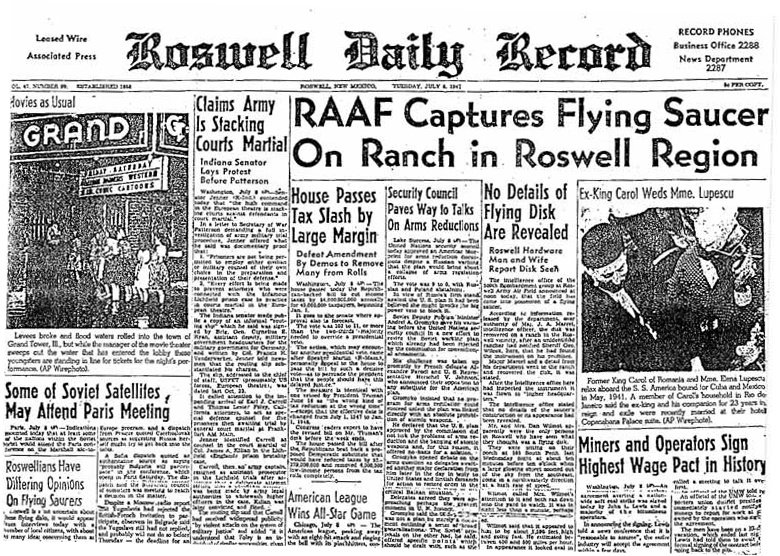
Roswell Daily Record (Public Domain)
For one day in July 1947, the U.S. Army’s own public affairs office told reporters it had recovered a “flying disc” near Roswell, New Mexico. The next day, a different general held up foil, rubber, and balsa wood and said it was a weather balloon. Both of those things actually happened, and both are part of the documented record — which is exactly why Roswell became the case that launched modern UFO culture rather than a forgotten rural news story from a slow news summer.
What Happened on the Ground
In early July 1947, rancher William “Mac” Brazel found unusual debris scattered across a stretch of his property northwest of Roswell — described in period accounts as including tinfoil-like material, balsa wood sticks, rubber fragments, and tape, some of it printed with small flower-like symbols. Brazel reported the find, and the local sheriff contacted Roswell Army Air Field, which sent intelligence officer Major Jesse Marcel to investigate and collect the material.
The Press Release and the Reversal
On July 8, 1947, under instructions from base commander Colonel William Blanchard, public information officer Walter Haut issued a press release stating that the 509th Bomb Group had recovered a “flying disc.” The Roswell Daily Record ran the story under the headline “RAAF Captures Flying Saucer On Ranch in Roswell Region” that same day. The reversal came almost immediately: within roughly a day, General Roger Ramey held a press conference in Fort Worth, Texas, displaying the recovered debris and identifying it as a weather balloon and its attached radar reflector — material consistent with a standard, unremarkable military weather-monitoring device.
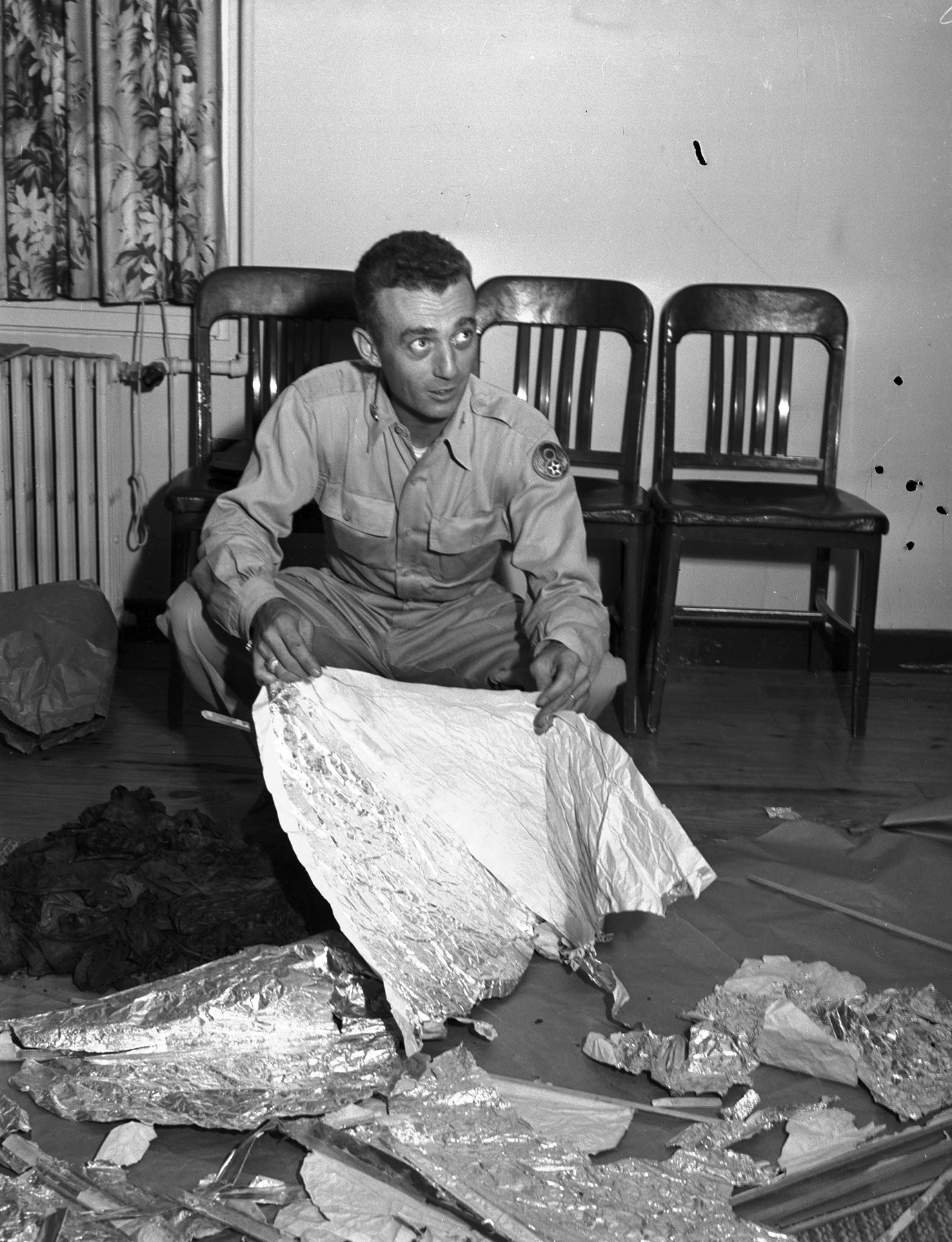
Major Jesse Marcel, photographed at Fort Worth Army Air Field on July 8, 1947, holding foil debris from the recovered material — the same day the Army’s “weather balloon” explanation was issued. Source. Fort Worth Star-Telegram, Public Domain.
What Project Mogul Actually Was
The weather-balloon explanation given in 1947 wasn’t the whole truth, but not for the reasons the later conspiracy theories assumed. What Marcel’s team actually recovered, according to the U.S. Air Force’s own later research, was debris from Project Mogul — a genuinely classified U.S. program using high-altitude balloon trains fitted with sensitive acoustic sensors, designed to detect Soviet nuclear weapons testing by listening for shockwaves carried through the upper atmosphere. Because the program’s real purpose was classified at the time, the military’s public 1947 explanation (an ordinary weather balloon) was itself a cover story — not for extraterrestrial technology, but for a different, more mundane secret: a Cold War surveillance program the Army didn’t want the Soviets to know it was running.
Why Jesse Marcel Later Changed His Account
Marcel became a central figure in the case’s later revival, giving interviews decades after 1947 in which he expressed continued conviction that what he’d initially recovered wasn’t standard weather balloon equipment and suggested the material had been switched before Ramey’s press conference. It’s worth treating this carefully rather than dismissively or credulously: Marcel was a real participant recalling a specific professional experience decades after the fact, and Project Mogul equipment — an unusual multi-balloon array with specialized sensor equipment — would genuinely have looked unfamiliar to someone expecting a standard single weather balloon, which is a plausible, mundane reason an experienced officer might describe it as unlike anything he’d seen before without that description requiring an extraterrestrial explanation.
The 1994 and 1997 Air Force Reports
Facing renewed public and congressional interest in the case during the early 1990s, the Air Force conducted an internal records search and released its findings in a 1994 report, concluding that the material Brazel found was consistent with Project Mogul equipment rather than any conventional weather balloon or anything extraterrestrial. A follow-up 1997 report, The Roswell Report: Case Closed, went further and attempted to address the separate, later-arriving claims of recovered alien bodies. Its central, and more contested, argument was that witness memories of bodies at the crash site likely reflected a conflation of decades of separate events — specifically, anthropomorphic crash-test dummies used in later Air Force parachute testing programs, and in some cases genuine airmen injured or killed in actual aircraft accidents, blended together over decades of retelling into false memories fixed to 1947. That explanation drew legitimate criticism at the time, since the dummy tests in question took place in the 1950s, years after the alleged 1947 body sightings — a genuine chronological gap the report’s own memory-conflation theory has to carry real weight to bridge, and worth stating as a fair critique of the report’s most speculative section rather than glossing over it.
When and Why the Story Changed So Dramatically
The alien-crash version of Roswell that’s now culturally dominant didn’t exist in any organized form in 1947 — contemporary coverage was brief and, after Ramey’s press conference, treated as a settled non-event. The case was substantially revived by Charles Berlitz and William Moore’s 1980 book The Roswell Incident, developed with research assistance from nuclear physicist Stanton Friedman, who had separately begun interviewing Marcel and other witnesses starting in 1978. That book explicitly framed the weather-balloon explanation as a cover story and is largely responsible for establishing Roswell’s modern reputation as a genuine alien crash-retrieval event rather than a minor 1947 news item about classified balloon debris.
Later witness claims — including alleged recovered alien bodies, described by figures like Glenn Dennis and Frank Kaufmann — emerged even further removed from 1947, decades after the fact, and have faced substantial credibility challenges. Dennis’s specific account came under sustained scrutiny after independent researchers were unable to verify key claimed details of his story. Kaufmann’s claimed intelligence-officer role and firsthand knowledge have likewise been disputed by other researchers examining his documented service record. None of this proves nothing unusual happened in 1947; it does mean the most dramatic modern elements of the story — the parts involving actual alien bodies — rest on considerably weaker, later, and more disputed testimony than the original debris-recovery event itself.
Majestic 12 and the Alien Autopsy Film
Two additional pieces of “evidence” that circulated widely deserve a direct correction rather than inclusion as open questions. Documents purporting to be 1947 presidential memos establishing a secret “Majestic 12” group to manage recovered alien material surfaced in 1984 and were subsequently determined by document examiners and researchers to be fabricated, with no corroborating evidence of Majestic 12’s actual existence ever found in genuine government records. Separately, a widely circulated 1995 “alien autopsy” film purporting to show a dissection of Roswell alien remains has since been acknowledged by its own promoters to have involved staged, reconstructed material rather than authentic 1947 footage. Neither belongs in a serious accounting of the case’s actual evidence.
What the Evidence Actually Supports
The most defensible, evidence-grounded account of Roswell is that a classified Cold War surveillance balloon program crashed and was recovered in July 1947, that the Army’s initial “flying disc” press release was a genuine but very short-lived overstatement quickly corrected to a cover story protecting the program’s classified purpose, and that the alien-crash narrative developed and expanded substantially beginning in 1978-1980, decades after the original event, through witness interviews, a bestselling book, and later testimony of varying and often disputed reliability. That’s a materially different picture than “the government has covered up an alien crash for over 75 years,” even though it does involve a real, documented government cover story — just not the one popular culture usually assumes.
Frequently Asked Questions
What actually crashed at Roswell in 1947? According to the Air Force’s own later research, debris from Project Mogul, a classified balloon-based program for detecting Soviet nuclear tests — not a weather balloon in the simple sense originally announced, and not an alien craft.
Did the military really call it a “flying disc” at first? Yes. A July 8, 1947, press release from the Roswell Army Air Field’s public information office used that language, reversed within about a day by a different general’s weather-balloon announcement.
Is Project Mogul confirmed, or just a theory? It’s the U.S. Air Force’s own official explanation, published in a 1994 report following a records search, and it’s consistent with the physical debris described in 1947.
What about the alien bodies people claim were recovered? Those claims emerged from witnesses testifying decades after 1947, several of whose accounts have faced significant, specific credibility challenges from independent researchers.
Why did the Roswell story become so much bigger decades later? A 1980 book by Charles Berlitz and William Moore, developed with researcher Stanton Friedman, revived and reframed the case as a genuine alien crash cover-up, more than 30 years after the original event.
Were the Majestic 12 documents real? No. They surfaced in 1984 and have been assessed by researchers and document examiners as fabricated, with no independent evidence supporting Majestic 12’s existence.
Was the 1995 alien autopsy film authentic? No. It has since been acknowledged by its own promoters as staged, reconstructed material rather than genuine 1947 footage.