The Index / Unsolved Cases
The Villisca Axe Murders: The Unsolved 1912 Crime Behind Iowa's Haunted House
Eight people were killed in Villisca, Iowa in 1912. The historic crime remains unsolved; the house's later paranormal reputation is a separate story.
Topics: Villisca, Iowa, Unsolved Murder
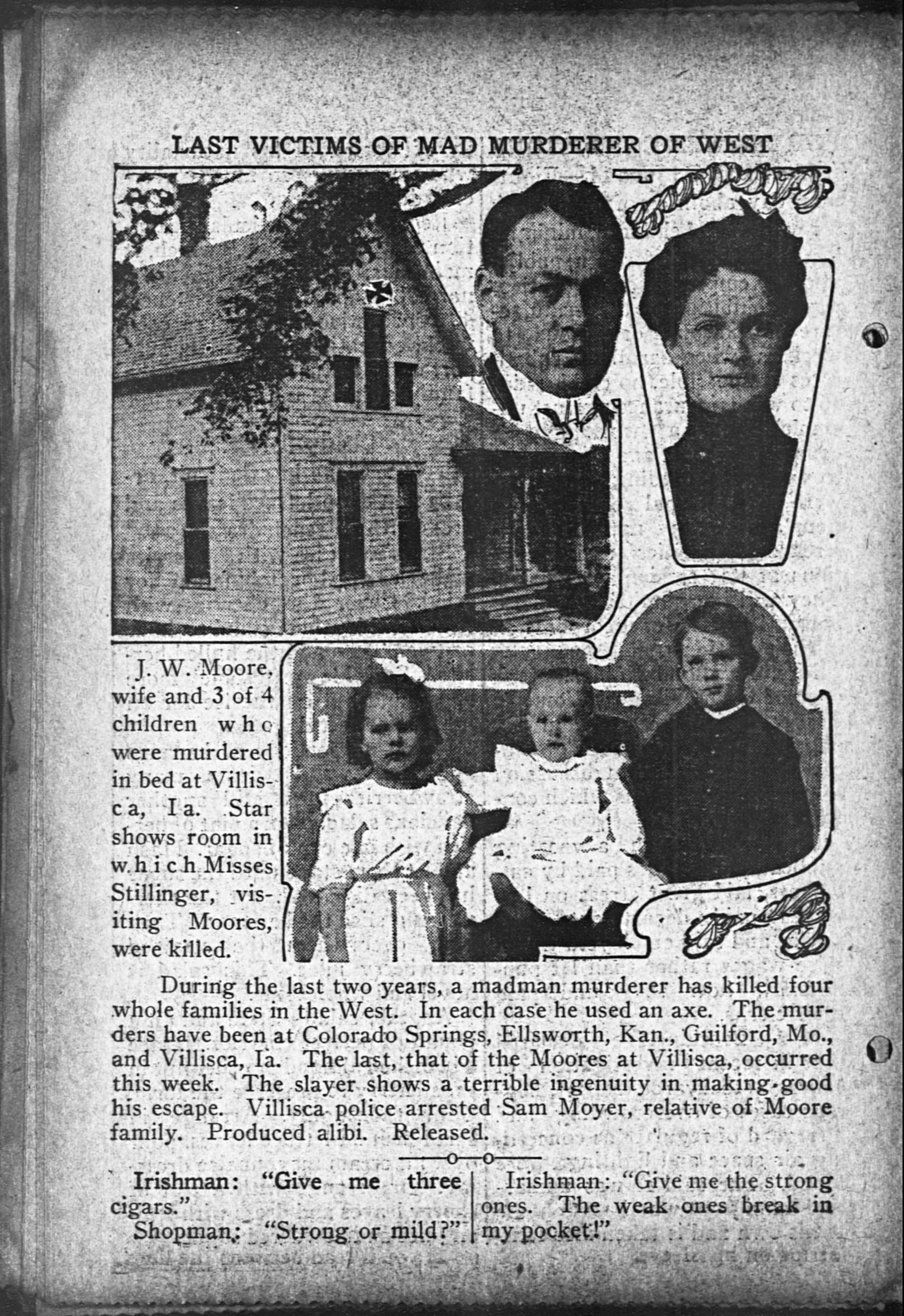
The Day Book / Library of Congress, via Wikimedia Commons (Public Domain)
The Villisca Axe Murders remain unsolved. During the night of 9 June or early hours of 10 June 1912, eight people were killed in the Moore home in Villisca, Iowa: Josiah and Sarah Moore; their children Herman, Katherine, Boyd and Paul; and visiting sisters Lena and Ina Stillinger. No prosecution established who killed them. The house’s later haunted-house reputation is a separate history, not an answer to the crime.
The case has invited confident theories for more than a century. Its surviving records support a narrower conclusion: the murders were real, the investigation was sprawling and often compromised by rivalry and publicity, several people were suspected, and the evidence never produced a reliable legal resolution.
The Moore family and the night of 9 June
Josiah Moore was a local businessman; Sarah Moore was active in the family’s church and community. On the evening of Sunday, 9 June, the Moores attended a children’s programme at the Presbyterian church with their four children. Lena and Ina Stillinger, who had been invited to spend the night with Katherine Moore, returned with the family to the house on East Second Street.
By the next morning, the family had not appeared for their usual routines. A neighbour, Mary Peckham, became concerned, contacted Josiah’s brother Ross Moore and went to the home. The bodies were found inside. Contemporary reports and later accounts describe an axe from the house as the central murder weapon. That basic fact should not be turned into spectacle: eight people, including six children, were killed in their home, and the investigation that followed did not identify a proven perpetrator.
A page from the Chicago Day Book of 14 June 1912. Its language and suggested links to other crimes reflect early newspaper speculation, not findings that later investigators proved. Source. The Day Book / Library of Congress, Public Domain.
An investigation with too many theories
The scene was not preserved to modern forensic standards. Relatives, neighbours, local officials and curious visitors entered the house early in the inquiry. Newspapers circulated details and theories rapidly. Those conditions make later claims about individual clues hard to weigh; a repeated detail in a true-crime retelling is not necessarily a fact that was securely documented at the time.
Police investigated people with personal, commercial and local connections to the Moores, as well as possible itinerant suspects. The historical record includes the names of Frank Jones, a prominent local businessman connected to Josiah Moore’s former employment; William Mansfield, a labor organizer whose movements became a subject of investigation; and the Rev. George Kelly, an itinerant minister who had been in Villisca around the time of the killings. Suspicion is not proof in any of these cases.
The much-repeated idea that the murders were certainly part of a nationwide series of axe crimes is also unproved. A 1912 newspaper could place Villisca beside other killings and imply a single “mad murderer,” as the image above does. Similarity is not identity, and no court or investigation established one perpetrator for a national series.
George Kelly and the trials
Kelly is the only person tried for the Villisca murders. He had preached at the Villisca Presbyterian church on the Sunday of the crime. Years later, after investigators focused on him, he made statements that prosecutors treated as confessions. The University of Iowa’s history of the case notes that the accounts changed and that the prosecution relied heavily on a narrative in which Kelly said he had acted under divine command.
In 1917 a grand jury indicted him. His first trial ended with a hung jury. A second jury acquitted him after a short deliberation. An acquittal is not a finding that the police had solved the case and merely lost on a technicality; it means the state did not prove guilt. No one else was later charged with the Villisca murders.
Kelly’s personal history is often used to turn the case into a neat answer. It is not one. His statements were inconsistent, the inquiry occurred years after the crime, and the juries did not accept the prosecution’s case. A respectful account can acknowledge that he was a serious suspect without presenting him as the killer.
Mansfield, Jones and the limits of suspicion
William Mansfield became a leading suspect through private investigation and allegations tied to labor disputes and travel. The evidence against him did not result in a Villisca charge or conviction. Frank Jones was also drawn into the story through business rivalries and local political conflict. Claims involving Jones, Josiah Moore and a possible affair have appeared in later retellings, but they are not a substitute for evidence connecting a person to the house that night.
Private agencies, local officials and competing advocates added to the confusion. The case’s later mythology can make every named person appear to have been a detective’s final answer. In fact, different investigators advanced different theories, sometimes years apart, while the physical evidence grew older and less useful. The failure was not a puzzle with one officially concealed solution; it was an investigation that did not meet the burden needed to identify a murderer.
That does not mean every early lead was worthless. It means the surviving evidence must be assessed in context. A reported sighting, a claimed confession, a business grievance or a later writer’s reconstruction may be historically interesting without being enough to identify a killer. The gap between an intriguing possibility and a defensible conclusion is where many Villisca accounts go wrong. The case is unresolved not because there are no stories, but because the stories do not add up to proof.
The limits of the records are also a reason to be careful with language about the victims. Contemporary coverage often reduced the family to an illustration of a broader crime wave or used lurid explanations before investigators could know whether they were true. A modern account need not repeat those assumptions. Naming the eight people and explaining the case’s uncertainty is more useful than treating their deaths as a clue set for a game.
Villisca in its own time
It is easy to see Villisca only through the murder house. In 1912 it was a small southwestern Iowa town with the ordinary civic institutions of the period: churches, shops, schools and a Carnegie library. The public reaction to the killings was shaped by that close social setting, where residents knew the victims and rumours travelled quickly.
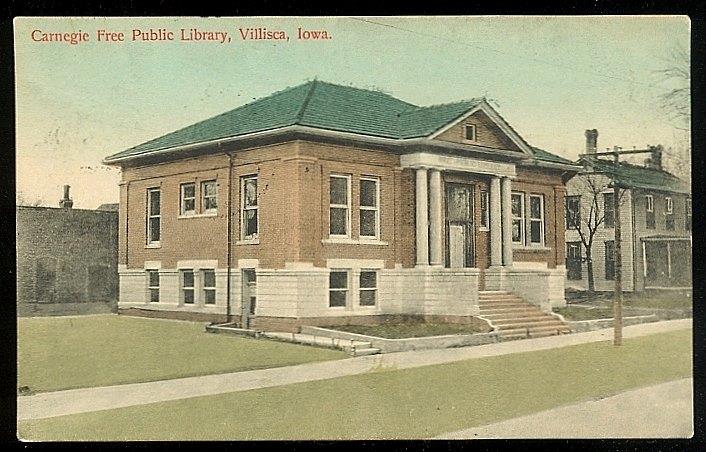
A circa-1910 postcard view of Villisca’s Carnegie Free Public Library. It is contextual town imagery, not a crime-scene photograph. Source. Unknown author / Wikimedia Commons, Public Domain.
The archival newspaper page is useful in the same limited way. It shows how quickly the killings became national news and how readily a contemporary paper framed them through a sensational theory. It should not be read as a police report. Separating those things helps keep the victims from being lost beneath a century of crime-story conventions.
Why the case remains unsolved
No modern forensic result has converted the competing suspects into a proven perpetrator. The original inquiry was conducted long before DNA analysis and contemporary scene-preservation practices. Witness memories, early reporting and later private theories cannot replace evidence that was not collected or preserved in 1912.
That uncertainty has led to a large afterlife of books, television episodes and online claims. Some select Kelly; others select Mansfield, Jones or an unidentified traveling offender. These are theories. They can identify questions worth examining, but none resolves the case.
The Moore house was restored decades later and opened to visitors. Reports of voices, shadows or other unusual experiences have become part of its tourism history. They are visitor claims, not evidence about the 1912 murders and not evidence that the victims remain at the property. The distinction is especially important in a case involving real deaths.
For another unresolved family killing, compare Hinterkaifeck. For a paranormal story whose later reputation should also be kept separate from documented history, see the Bell Witch.
Questions readers ask
Who was killed in Villisca? Josiah and Sarah Moore, their four children Herman, Katherine, Boyd and Paul, and visiting sisters Lena and Ina Stillinger were killed.
Was George Kelly convicted? No. His first trial ended in a hung jury, and he was acquitted in a second trial.
Who killed the Moore family? No perpetrator was proven. The case remains unsolved.
Is the house haunted? Haunting reports are later paranormal claims connected with the property. They do not establish what happened in 1912.

,_14_June_1912.jpg)
