Lore & Explained / Literature
Cthulhu Explained: Lovecraft's Sleeping Great Old One
What is Cthulhu, and is he really dead? Understand R'lyeh, the cult, the boat scene and the difference between Lovecraft's story and later lore.
Topics: Cthulhu, H. P. Lovecraft, Cosmic Horror, Horror Literature
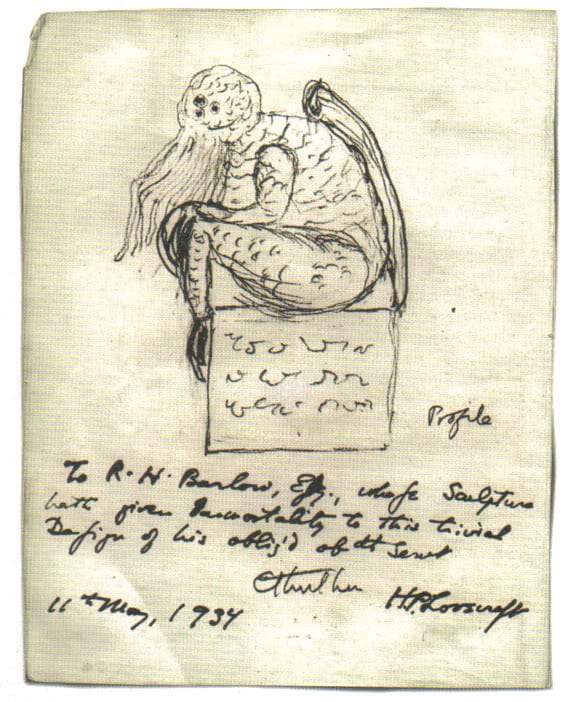
H. P. Lovecraft, 1934 (Public Domain)
Cthulhu is a fictional cosmic being created by H. P. Lovecraft, best known from the 1928 story The Call of Cthulhu. He lies in the sunken city of R’lyeh, influences human dreams and is worshipped by a secret cult that anticipates his return. He is not an ancient god Lovecraft discovered in a historical religion.
The most useful starting point is the story itself. Later writers, games and reference books have expanded Cthulhu’s world, but their neatly organized lore can obscure what makes the original unsettling: the characters never understand the whole thing.
Spoilers follow for “The Call of Cthulhu.”
What does Cthulhu look like?
In Lovecraft’s story, the first sustained impressions come through representations: a strange relief and an idol. Cthulhu’s form combines an octopus-like head, a massive body, claws and wings. The familiar tentacled face is therefore rooted in the text rather than a later invention.
But the sculptures are not a complete anatomical manual. Much of the story’s effect depends on an observer struggling to describe something using familiar comparisons. “Octopus-like” is an attempt to make a foreign shape intelligible, not a claim that Cthulhu is an unusually large terrestrial octopus.
Modern art often makes him clearly legible, symmetrical and physically stable. That is useful for illustration. It is not quite the experience Lovecraft gives his characters when the thing represented by the idol finally moves.
Lovecraft’s own idea of the shape is worth seeing directly. In May 1934 he sketched Cthulhu in a letter to fellow writer R. H. Barlow, thanking Barlow for a clay sculpture Barlow had made of the creature. The sketch above is that drawing — a stooped, tentacle-faced, winged figure perched on a block of hieroglyph-like script, in Lovecraft’s own hand.
How the story reveals him
The narrator, Francis Wayland Thurston, pieces together material left by his great-uncle, Professor Angell. The investigation connects the dreams and work of an artist, Henry Anthony Wilcox, with an earlier police encounter and a sailor’s account.
This structure matters more than a list of powers. Each section seems limited when taken alone. A strange artwork might be a private obsession. A cult investigation might be a local case. A maritime disaster might be another accident at sea. The horror emerges when the narrator recognizes the same patterns in all three.
Readers are not standing beside a scientist who can explain the creature. They are following someone who has assembled enough material to become frightened of what he has learned.
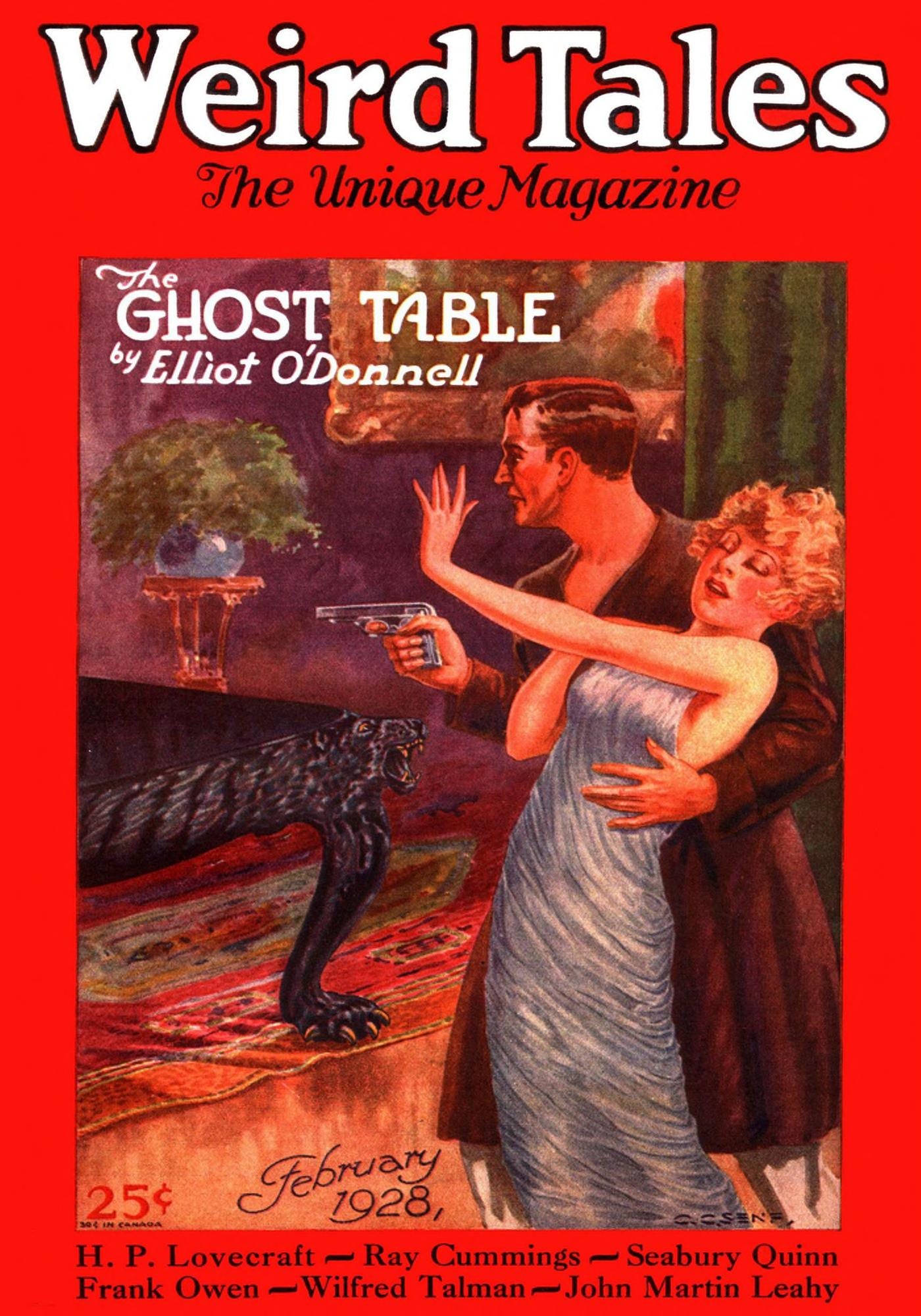
The February 1928 issue of Weird Tales*, the pulp magazine that first published “The Call of Cthulhu” — Lovecraft’s name appears among the issue’s contributors on the cover. Source. Cover art by C. C. Senf, Popular Fiction Publishing Co., 1928. Public domain.*
What is R’lyeh?
R’lyeh is Cthulhu’s fictional city beneath the ocean. In the sailor Gustaf Johansen’s account, an upheaval brings it above the water and exposes architecture whose angles seem deeply wrong to the human visitors.
Its location in a sea voyage, alongside documents and coordinates, helps the story imitate a recoverable event. That documentary technique is not proof that the city exists. Lovecraft uses the ordinary tools of factual narration to make an invented place feel discoverable.
The city’s geometry also does more than provide an unusual backdrop. Human perception becomes unreliable there. Distances, angles and surfaces do not behave as the visitors expect. The men are endangered not only by a large creature but by a place that does not seem built for their understanding of space.
Is Cthulhu dead, asleep or waiting?
The story deliberately puts pressure on those distinctions. Its cult language describes a being who is dead but dreaming, while the narrative allows him to become active when conditions change. Treating “dead” as ordinary irreversible biological death misses the contradiction that makes the phrase disturbing.
A cautious explanation is that Cthulhu exists in a dormant state that the human characters do not fully understand. His return is associated with the stars being right, but the story does not provide a scientific schedule or a reliable prediction of when another awakening will occur.
The cult’s account is also an account given within fiction by believers. It helps explain what they expect, but a reader does not need to assume that every statement they make is a perfect guide to the entire universe.
Did a boat kill Cthulhu?
No, not in the ordinary sense implied by that summary. During the escape, Johansen drives the vessel into Cthulhu’s head. The impact disrupts the creature, allowing a desperate chance to get away. The account describes its substance beginning to come together again.
The scene is not a demonstration that a sufficiently large boat permanently defeats a cosmic god. It is a temporary escape from something that does not behave like familiar living tissue. Removing the re-forming aftermath changes the meaning of the episode.
Nor does the narrator end the story comfortably convinced that the danger has passed. The documents have made the world less secure for him, not restored it to normal.
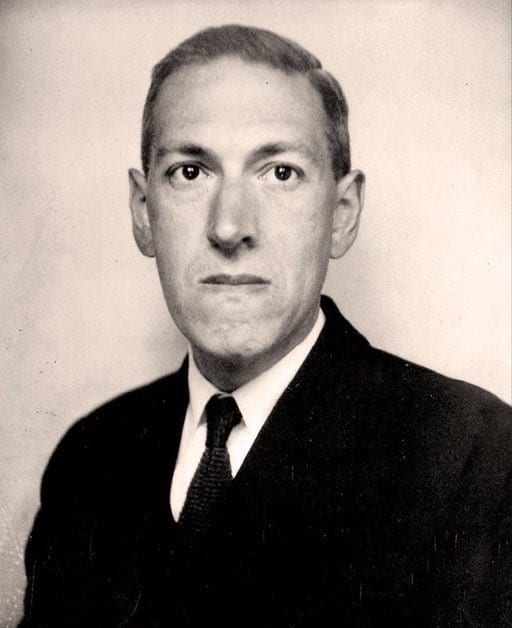
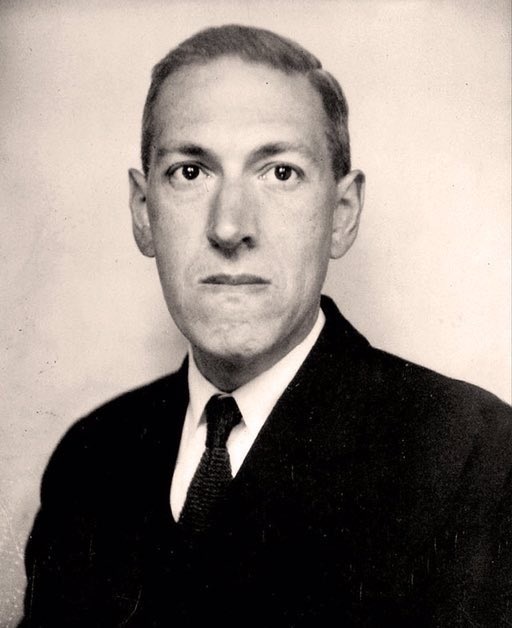
H. P. Lovecraft, photographed in June 1934 — the same year he sketched Cthulhu for R. H. Barlow. Source. Public domain.
Great Old One, god or alien?
These labels answer slightly different questions. Cthulhu is a Great Old One in the usual discussion of Lovecraft’s fiction, and human worshippers treat him as a godlike power. His origin and nature also place him outside ordinary human and terrestrial life.
None of that makes him a straightforward equivalent of Satan. The terror is not primarily a familiar moral battle in which a devil tempts an individual soul. It is the possibility that human civilization is fragile, temporary and unable to understand the older powers around it.
Later accounts of the “Cthulhu Mythos” often organize beings into elaborate categories and relationships. Those can be useful within a particular game or author’s work. They should not automatically be presented as a single complete system written by Lovecraft.
How Cthulhu differs from Nyarlathotep
Nyarlathotep is another of Lovecraft’s invented beings, but he is not simply Cthulhu under a different name. His appearances put much more emphasis on contact, persuasion, spectacle and manipulation.
Cthulhu’s defining story, by contrast, builds toward a brief encounter with something largely remote. Even the dreams and cult evidence reach the reader indirectly. The difference is a useful way to see how cosmic horror can work without making every antagonist the same monster.
The Necronomicon belongs to the same literary territory. Its appearance as a source inside fiction does not turn it into the ancient reference work the characters imagine.
What remains disturbing about the original
The story’s portrayals of cult members include racist stereotypes and exoticizing language. Those passages belong to Lovecraft’s writing, not to reliable descriptions of real communities or religions. They can be acknowledged without repeating their vocabulary as the article’s own voice.
The lasting mechanism of the story is its accumulation of fragments. A sculpture, a dream, a police report and a sailor’s testimony become pieces of one frightening pattern. Cthulhu matters because that pattern suggests the everyday world was never as comprehensible as the narrator believed.
The last thing the story offers is a complete explanation. Its monster is famous; its characters’ lack of control is what gives him weight.