Lore & Explained / Movies
Ebenezer Trailer 2: Why A Christmas Carol Was Always a Ghost Story
Ti West’s Ebenezer trailer amplifies Dickens’s ghosts and grave imagery. What A Christmas Carol contained in 1843, and what the new film has yet to confirm.
Topics: Ebenezer, A Christmas Carol, Charles Dickens, Ti West, Ebenezer Scrooge, Jacob Marley, Christmas ghost stories
Hosted by Paramount Pictures. Loading the player connects your browser to YouTube. If playback is unavailable here, use the direct link.
Video uploaded · Watch on YouTube ↗
John Leech, 1843 first-edition illustration / Wikimedia Commons (Public Domain)
Ti West’s Ebenezer is being sold as a darker, stranger version of A Christmas Carol. The second trailer makes that easy to believe: Jacob Marley arrives as a corpse-like warning, the Christmas spirits look threatening rather than comforting, and Ebenezer Scrooge is confronted with images of death and burial.
The illustrations here are John Leech’s plates for Dickens’s 1843 first edition, not stills from Ti West’s film.
But the important historical point is that West is not turning a harmless Christmas story into horror from scratch.
Charles Dickens gave his 1843 book a much longer title than the one most people use today:
A Christmas Carol. In Prose. Being a Ghost Story of Christmas.
The phrase was not an accidental subtitle. Ghosts are the machinery of the story. Scrooge is forced to confront death, memory, poverty and the consequences of his own life through a supernatural visitation that becomes increasingly frightening as the night continues.
Paramount’s new Ebenezer trailer appears to be pushing those elements toward modern gothic horror. The useful question is therefore not whether A Christmas Carol “can” be horror.
It is how much horror was already there in 1843, and what Ti West is adding to it in 2026.
What the new Ebenezer trailer confirms
Paramount Pictures published the original Official Trailer 2 on October 1, 2026, on its own YouTube channel.
Paramount’s current film page identifies Ti West as director, Nathaniel Halpern as screenwriter and Johnny Depp as Ebenezer Scrooge.
The ensemble also includes Rupert Grint, Andrea Riseborough, Sam Claflin, Daisy Ridley, Arthur Conti, Ellie Bamber, Henry Lloyd-Hughes, Charlie Murphy, Tramell Tillman and Ian McKellen.
The studio’s deliberately sparse logline is: “The name you know, the story you don’t.”
The second trailer gives that line a clearer shape.
It still contains the essential architecture of Dickens’s story: a bitter Scrooge, the ghost of Jacob Marley and supernatural visitors that force him to face his past, present and future. But the imagery is more overtly macabre than many family-oriented adaptations. Trade coverage of the trailer notes frightening apparitions and a sequence in which Scrooge appears to be buried alive.
Those shots establish tone.
They do not establish the finished film’s exact plot, whether the burial is literal or visionary, or how closely every new scene follows Dickens. Trailer imagery should not be promoted into confirmed story detail without additional context from the film itself.
The film’s current U.S. release date is November 13, 2026, according to Paramount’s official site and current U.S. trade coverage. International dates can differ by market.
Dickens called it a ghost story himself
The strongest evidence that A Christmas Carol was always supernatural is sitting on the title page.
The 1843 first-edition title page explicitly describes the book as a Ghost Story of Christmas.
That matters because modern culture often files the story under “Christmas classic,” “redemption story” or “family tale” first and “ghost story” second.
Dickens did not separate those categories.
His Christmas story works because it is a haunting.
Scrooge does not simply receive moral advice. He is terrorized into seeing consequences he has spent his life refusing to see.
Marley is a dead man in chains
The story begins by insisting that Jacob Marley is dead.
Seven years after his death, Marley returns to Scrooge’s rooms as an apparition carrying the physical burden of his life: a chain made from the objects associated with business and money.
Dickens describes the encounter with the logic of a haunting rather than a dream that Scrooge immediately accepts as symbolic. Scrooge first tries to explain the apparition away. The ghost then makes denial impossible.
John Leech’s original illustration makes the scene’s horror plain. Marley is not a friendly Christmas mascot. He is an emaciated dead man confronting Scrooge in his own home.
That is the supernatural threshold of the book.
Everything that follows happens because the ghost of a dead man has returned to warn the living.
The three Christmas spirits are not equally comforting
Modern adaptations often make the Ghost of Christmas Past luminous, the Ghost of Christmas Present warm and the Ghost of Christmas Yet to Come frightening.
The original is stranger than that neat progression.
The Ghost of Christmas Past is difficult to fix into one stable physical description. Dickens gives the spirit contradictory qualities of age and youth, winter and summer, brightness and obscurity. It behaves less like a conventional person than a visualized memory.
The Ghost of Christmas Present initially seems generous and expansive, but its stave ends with one of the book’s harshest images: Ignorance and Want, two neglected children hidden beneath the spirit’s robe. The scene turns social conditions into grotesque allegory.
Then the final visitor arrives.
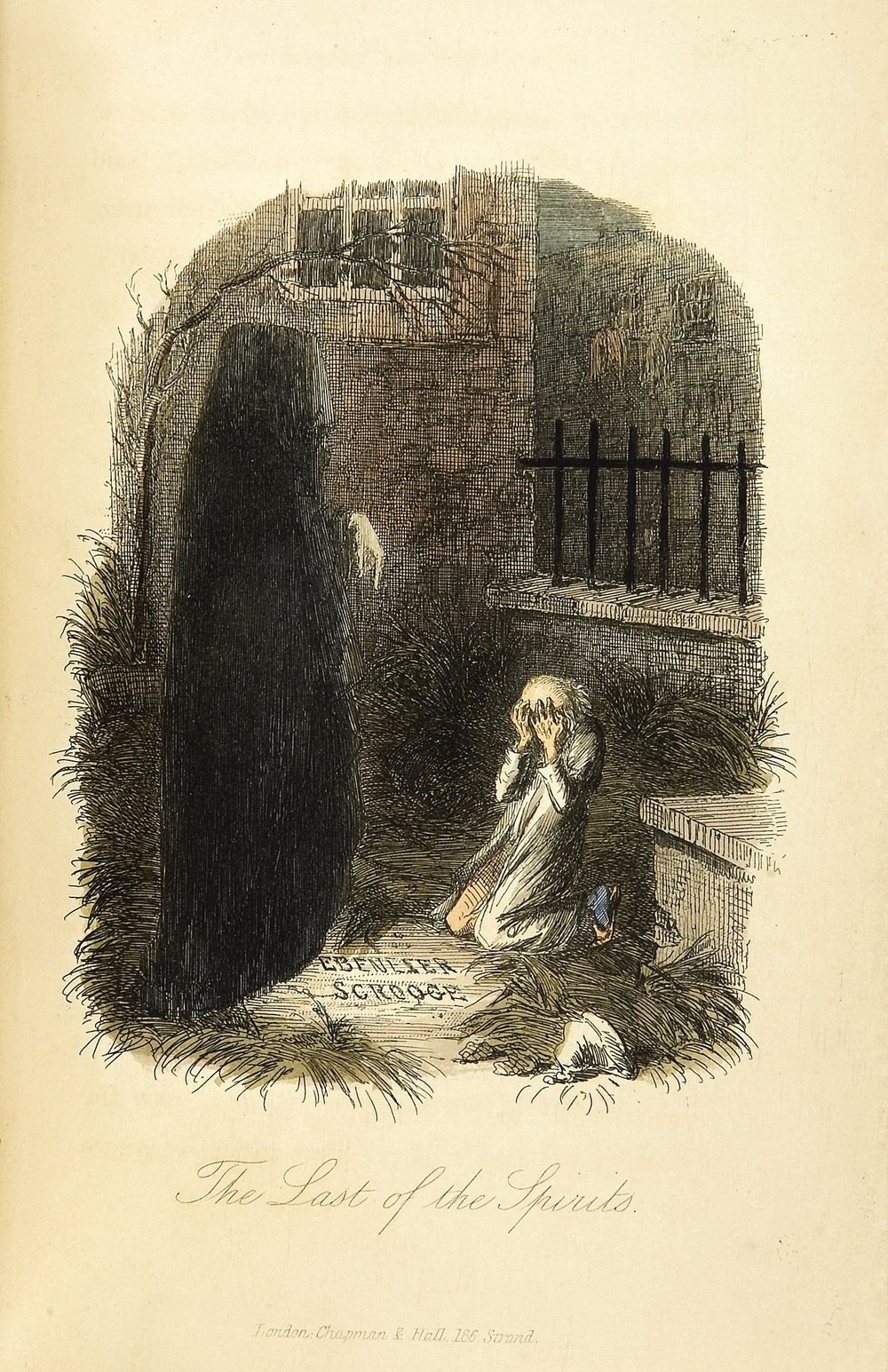
The Ghost of Christmas Yet to Come in John Leech’s 1843 first-edition illustration. This is an original literary illustration, not an image from Ti West’s Ebenezer. Via Wikimedia Commons, public domain.
The Ghost of Christmas Yet to Come is already a horror figure
The final spirit barely needs modern reinvention.
It is silent, shrouded and physically unreadable. Scrooge cannot see a face. The figure points rather than explains. Its power comes from uncertainty: Scrooge has to interpret the scenes himself.
Those scenes become progressively more morbid.
People discuss an unnamed man’s death with indifference. Others sell objects taken from the dead man’s room. Scrooge is shown a bereaved Cratchit family after the possible death of Tiny Tim. Finally, he is taken to a neglected grave and forced to recognize his own name on the stone.
The threat is not that the spirit will murder him.
The threat is that it may already be showing him the future he has created.
That is psychological horror built around mortality rather than physical attack.
A Christmas Carol also contains social horror
The supernatural scenes are only half of what makes the book dark.
The British Library’s account of the story’s origins places the novella inside the severe inequality of the 1840s. Dickens was writing about poverty, hunger, debt, child suffering and the moral consequences of treating those conditions as somebody else’s problem.
The Ghost of Christmas Present’s revelation of Ignorance and Want makes that argument visually grotesque.
Scrooge’s famous early indifference to people who might die in poverty is not just there to establish that he is rude. It links personal selfishness to a society that can explain away preventable suffering.
The ghosts make him look directly at what his worldview means for actual bodies and actual families.
A horror reading of A Christmas Carol therefore does not need to ignore its social message.
The social message is one reason the haunting is frightening.
Christmas ghost stories were already a tradition
Dickens did not invent the idea of telling frightening stories at Christmas.
The State Library Victoria notes a longstanding British tradition of Christmas ghost storytelling, especially around the dark midwinter season. Dickens became its most famous literary representative, but he was working inside an existing cultural habit rather than creating one from nothing.
He also returned to supernatural Christmas writing after A Christmas Carol.
That context helps explain why “Christmas” and “ghost story” did not sound contradictory to a Victorian reader in the way they sometimes do to modern audiences raised on brighter holiday adaptations.
A dark Ti West version may feel like a genre shift now.
Historically, the genres were already overlapping.
What Ti West appears to be changing
Ebenezer is still a new adaptation, not an illustrated reading of the 1843 text.
The trailer suggests West is enlarging the threatening physicality of Scrooge’s supernatural night. The ghosts occupy dark spaces. Death imagery is more tactile. Apparitions look designed to unsettle a modern horror audience rather than simply signal that a spirit has entered the scene.
The film’s tagline — “The name you know, the story you don’t” — also implies that Nathaniel Halpern’s screenplay may expand material around Scrooge beyond the most familiar adaptation beats.
How far it goes is not yet clear.
The current official synopsis remains deliberately vague, and a trailer is not enough evidence to decide whether new images represent literal additions, visions, compressed scenes or marketing edits.
The safest conclusion before release is that West is amplifying the horror language already present in Dickens, while the exact extent of the narrative reinvention remains unconfirmed.
Ian McKellen’s Marley returns the warning to the foreground
The second trailer gives particular weight to Ian McKellen’s Jacob Marley, a role listed on McKellen’s official filmography.
That is significant because Marley is sometimes treated as setup — the ghost who arrives before the more famous three spirits.
In the structure of the original story, he is more important than that.
Marley is the proof of what awaits Scrooge if nothing changes. His punishment turns a lifetime of moral choices into a physical afterlife burden. He is simultaneously a ghost, a witness and a possible future version of Scrooge.
Making Marley frightening does not make the adaptation less faithful to the book’s moral logic.
It can make that logic more visible.
Horror does not erase the redemption story
There is a temptation to treat “dark” adaptations as if horror and sentiment must compete.
A Christmas Carol does not work that way.
The fear is what gives the redemption urgency.
Scrooge is shown loneliness, grief, deprivation, death and the possibility that nobody will mourn him. The night strips away his defenses until he can no longer reduce human life to accounts and arguments.
The ending is joyful because the story has made its alternative unbearable.
A successful horror-forward adaptation therefore does not need to turn Scrooge into a different character or make the ending nihilistic.
It only needs to remember how frightening Dickens made the road to Christmas morning.
What the trailer does not prove
A few boundaries are worth keeping clear before Ebenezer reaches theaters.
The trailer does not prove that every frightening image is literal inside the film’s reality. It does not tell us the complete role of every spirit. It does not establish that a buried-alive image represents a new canonical event rather than a vision. And it does not show enough of the finished adaptation to say whether West has made a straightforward horror movie, a gothic fantasy, a dark family film or something between those categories.
Likewise, images from the film should not be used as evidence for Victorian beliefs about ghosts.
The 2026 movie is an adaptation.
The 1843 text is the historical literary source.
Frequently Asked Questions
Is Ebenezer a horror movie?
Paramount presents it as a new A Christmas Carol adaptation, while the second trailer strongly emphasizes gothic and frightening supernatural imagery. Director Ti West is best known for horror, but the finished film may combine horror, fantasy, drama and Christmas storytelling rather than fit one narrow genre label.
Is A Christmas Carol actually a ghost story?
Yes. Dickens’s full 1843 title was A Christmas Carol. In Prose. Being a Ghost Story of Christmas. The plot is structured around the ghost of Jacob Marley and three supernatural Christmas spirits.
Did Charles Dickens invent Christmas ghost stories?
No. Christmas ghost storytelling was already part of British seasonal tradition. Dickens became one of its most influential authors, but he did not create the custom from nothing.
Who does Ian McKellen play in Ebenezer?
Ian McKellen plays Jacob Marley, Scrooge’s dead former business partner whose ghost warns him about the consequences of his life.
Who directs Ebenezer?
Ti West directs from a screenplay by Nathaniel Halpern.
Who plays Ebenezer Scrooge?
Johnny Depp plays Scrooge.
When does Ebenezer come out?
Paramount’s current U.S. site lists a theatrical release on November 13, 2026. International release dates may differ.
Is the burial scene in the trailer from Dickens’s original book?
The original story does take Scrooge to his own grave and confronts him with his possible death, but the trailer’s specific buried-alive imagery should not be treated as a direct scene from the book without more context from the finished film.
Explore more film coverage in Morbid Index’s Movies archive.
Sources & further reading
- Ebenezer: official Paramount film site
- Paramount Pictures: Ebenezer Official Trailer 2
- Ian McKellen: official filmography and Marley role
- Variety: Ebenezer second trailer (October 2, 2026)
- British Library: Charles Dickens's A Christmas Carol
- British Library: The origins of A Christmas Carol
- Wikisource: A Christmas Carol (1843 first-edition text)
- State Library Victoria: A ghost story for Christmas