The Index / Paranormal
Project Blue Book and the Flatwoods Monster: What Did the Air Force Actually Investigate?
The Flatwoods Monster case reached the Air Force's UFO program within months of its creation. Here's what the surviving National Archives record actually shows.
Topics: Project Blue Book, Flatwoods Monster, UFO History, National Archives, Air Force

U.S. Geological Survey / Wikimedia Commons (Public Domain)
The Flatwoods Monster reached the desk of the U.S. Air Force’s UFO investigation program within its first year of existence. What that program actually did with the case is much narrower, and much less dramatic, than the version that circulates online.
This article sets aside the reported creature almost entirely. Its job is to answer a different question: what does the surviving government record show about what was investigated, by whom, and with what conclusion, and how much of what people repeat as “official findings” actually traces back to a document anyone can go read.
Why Was the Air Force Investigating UFOs in 1952?
By 1952, the Air Force had already been tracking public UFO reports for five years, through two earlier, smaller efforts. Project Sign, established in 1948 following the surge in “flying saucer” reports that began with pilot Kenneth Arnold’s 1947 sighting, was succeeded by the more skeptically inclined Project Grudge in 1949. Neither program was built to handle the volume of reports the Air Force would receive once 1952 turned into the most intense reporting year of the era.
In March 1952, the Air Force established Project Blue Book, headquartered at Wright-Patterson Air Force Base in Ohio, with Captain Edward J. Ruppelt as its first director. The timing wasn’t a coincidence. Blue Book was created specifically to bring a more systematic, better-staffed approach to a problem that was about to get much bigger than anyone in the Air Force had anticipated.
What Was Project Blue Book?
Project Blue Book was the Air Force’s formal program for collecting, investigating, and evaluating reports of unidentified flying objects, and it ran continuously from 1952 until the Secretary of the Air Force ordered it terminated on December 17, 1969. Over that span, according to the National Archives, the program logged 12,618 individual sighting reports.
Its purpose, as described in the surviving records, was twofold: determine whether UFO reports represented any kind of threat to national security, and evaluate whether any of the reported phenomena involved technology beyond what contemporary science understood. Those two questions — security threat, and technological mystery — shaped what investigators actually looked for in each case, which matters when you get to a report involving a claimed creature rather than just a light in the sky.
Did Project Blue Book Investigate Flatwoods?
Yes, but narrowly. The Flatwoods case reached the program as one of the earliest reports involving a claimed “occupant” — Air Force terminology for a UFO report that includes a reported being, not just an aerial object. That alone made it somewhat unusual among the thousands of cases the program would eventually process.
What survives in the file is modest. According to researchers who have reviewed the Air Force’s Flatwoods paperwork, the case record consists primarily of a project card — a standardized summary form used by the Air Technical Intelligence Center to log a sighting, note whatever explanation had been offered, and file it, without extensive supporting investigative material attached.
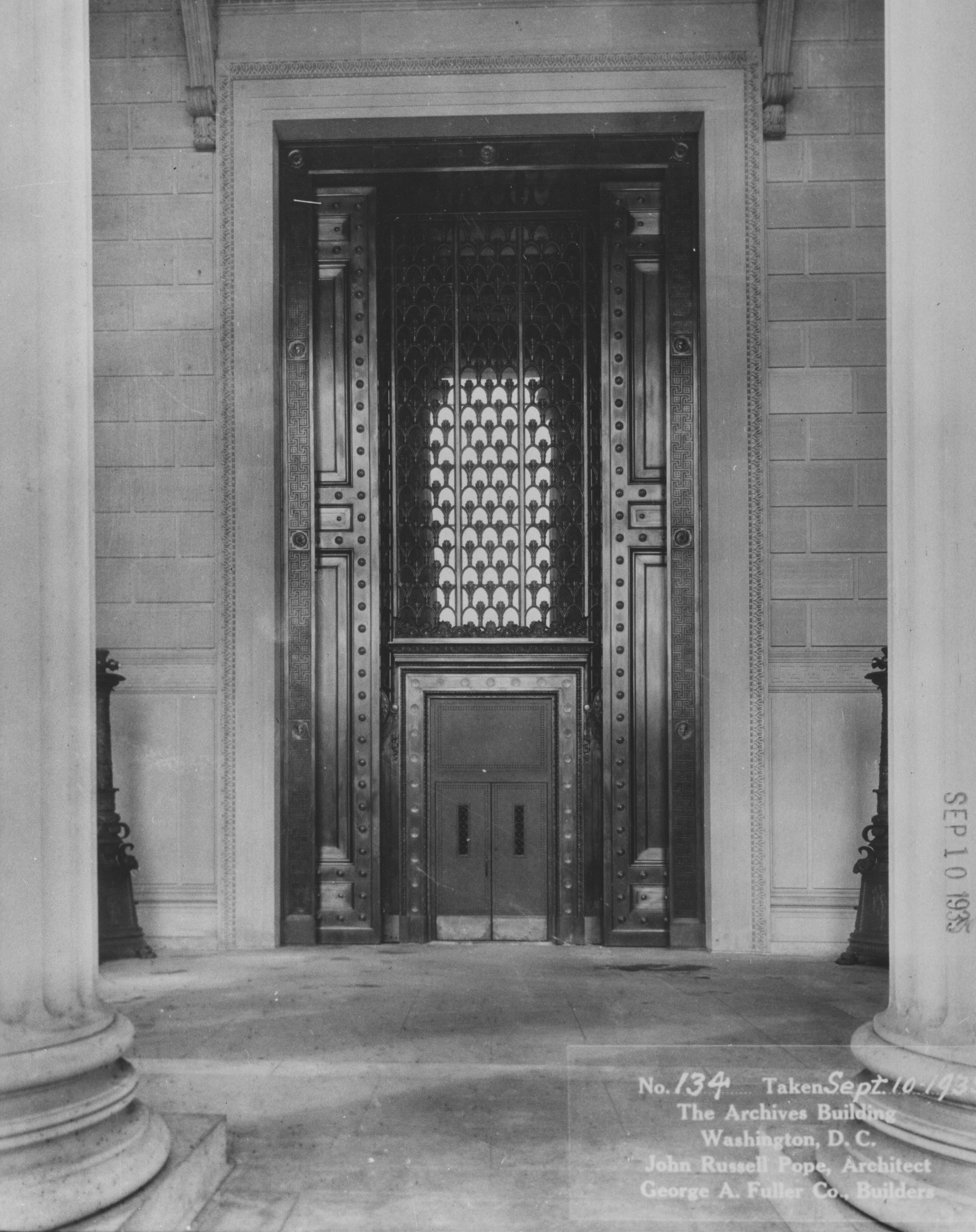
The National Archives Building’s Constitution Avenue entrance, photographed in 1935 — where the declassified Project Blue Book records, Flatwoods file included, have been held and open to public research since 1976. Public domain.
What Survives in the Government Record?
The full body of declassified Project Blue Book material is held at the National Archives Building in Washington, D.C., and has been open to public research since 1976. It comprises roughly 42 cubic feet of paper records, split between administrative files, chronologically organized individual case files, and separate Office of Special Investigations records, reproduced across 94 rolls of microfilm and available to researchers today.
Within that much larger collection, the Flatwoods file is a small entry rather than a substantial dossier. That’s a meaningful fact on its own: a case now treated online as one of the most significant “monster” encounters in American UFO history occupies a correspondingly minor place in the actual archive.
What Did Investigators Think the Light Was?
The project card for the Flatwoods sighting attributes the aerial object — the bright, fast-moving light the boys saw before the group climbed the hill — to a meteor. That conclusion lines up with independent, non-military reporting from the same night: a meteor was observed crossing the sky over Maryland, Pennsylvania, and West Virginia on September 12, 1952, giving the Air Force’s explanation external corroboration beyond the file itself.
That’s the extent of the government’s stated conclusion about the aerial phenomenon: an ordinary, if bright, meteor, not an unidentified object requiring further investigation.
Did the Air Force Investigate the “Monster”?
This is the detail most retellings get wrong, and it’s worth stating plainly. Nothing in the available Project Blue Book material indicates that Air Force investigators treated the reported creature as a distinct object of inquiry, sent personnel to interview witnesses about the being specifically, or reached any formal conclusion about what the group encountered on the hillside. The file addresses the light. It does not appear to meaningfully address the figure witnesses said they saw afterward.
That’s a real and important gap, and it cuts against several popular claims rather than supporting them. A thin project card that closes out a meteor sighting is not the same thing as a government investigation into an alleged creature, let alone one that reached a classified or suppressed conclusion about it.
What Project Blue Book Did — and Didn’t — Conclude
It helps to separate Blue Book’s case-specific work from its final, program-wide conclusions, because people frequently apply the second to the first without justification.
At the program’s closure in 1969, the Air Force’s official position, as summarized by the National Archives, held three things: first, that no UFO investigated by the Air Force had ever shown evidence of a threat to national security; second, that there was no evidence any sighting categorized as unidentified represented technology beyond the scientific knowledge of the time; and third, that there was no evidence any unidentified sighting represented an extraterrestrial vehicle.
Those are broad, program-wide findings drawn from thousands of cases over seventeen years. They are not a specific ruling on Flatwoods, and treating them as one overstates what the record shows. What can be fairly said is that Flatwoods was handled consistently with that broader pattern: a mundane explanation offered for the aerial object, no flagged security concern, and no case-specific finding of anything beyond ordinary explanation.
Claims the Records Do Not Support
A number of claims about Flatwoods and the government circulate persistently online, and it’s worth checking each against what actually survives in the archive.
The claim that “Project Blue Book officially classified Flatwoods as extraterrestrial” has no support in the available file, which offers a meteor explanation for the light and no stated conclusion about the reported figure at all. The claim that “the Air Force found alien evidence” doesn’t match a record consisting of a brief summary card rather than any kind of forensic or physical-evidence report. The claim that “the military recovered a spacecraft” isn’t supported by anything in the declassified material, and no credible primary source places military personnel recovering physical wreckage at the site. The claim that “the government sealed the Flatwoods case” doesn’t fit a file that has been part of the publicly accessible National Archives collection since 1976, available to any researcher who requests it. And the claim that “the case remains officially unexplained” isn’t accurate either, at least regarding the aerial object: the surviving Air Force paperwork offers a specific, mundane explanation for the light, even though it says essentially nothing about the reported creature.
None of this proves the witnesses were wrong about what frightened them. It does mean that the specific, dramatic claims people attach to “what the government found” mostly don’t survive contact with the actual documents.
Why Flatwoods Still Matters in UFO History
Flatwoods matters to Blue Book’s history less for what the file contains than for what it represents: one of the program’s earliest tests of how to handle a report involving a claimed being rather than a straightforward aerial sighting, arriving just months after the office was established specifically to bring order to a growing backlog of reports.
That backlog didn’t stay small. Flatwoods landed in the middle of what would become the most intense single year of UFO reporting the Air Force ever processed, a period covered in full in our 1952 UFO wave explainer, which includes the far more heavily documented Washington, D.C. radar and visual sightings from that same summer. For the full account of the encounter this article treats narrowly as an archival record, see our Flatwoods Monster pillar article.
Frequently Asked Questions
Did Project Blue Book investigate the Flatwoods Monster? It logged the case and attributed the aerial light to a meteor. There’s no evidence in the surviving file that investigators separately examined the reported creature.
What conclusion did the Air Force reach about Flatwoods? The project card attributes the sighted light to a meteor independently reported over three states that night. No specific conclusion about the reported figure appears in the available record.
Is the Flatwoods file classified or sealed? No. Declassified Project Blue Book records, Flatwoods included, have been held at the National Archives and open to public research since 1976.
Did the government ever say Flatwoods involved aliens? No. Nothing in the surviving Air Force documentation states or implies an extraterrestrial origin for the sighting.
How much material exists on the Flatwoods case specifically? Comparatively little — primarily a standard project summary card, rather than an extensive investigative file with witness interviews or physical evidence reports attached.
What did Project Blue Book conclude overall, across all its cases? At its 1969 closure, the Air Force stated that no investigated UFO had shown evidence of a national security threat, that no unidentified sighting showed technology beyond contemporary science, and that no unidentified sighting showed evidence of being an extraterrestrial vehicle. These are program-wide findings, not case-specific rulings on Flatwoods.