The Index / Paranormal
Could the Flatwoods Monster Have Been a Barn Owl?
A barn owl is the leading natural explanation for the 1952 Flatwoods Monster. Here's how well it actually fits the witness descriptions, and where it doesn't.
Topics: Flatwoods Monster, Barn Owl, Cryptids, Skeptical Investigation, West Virginia
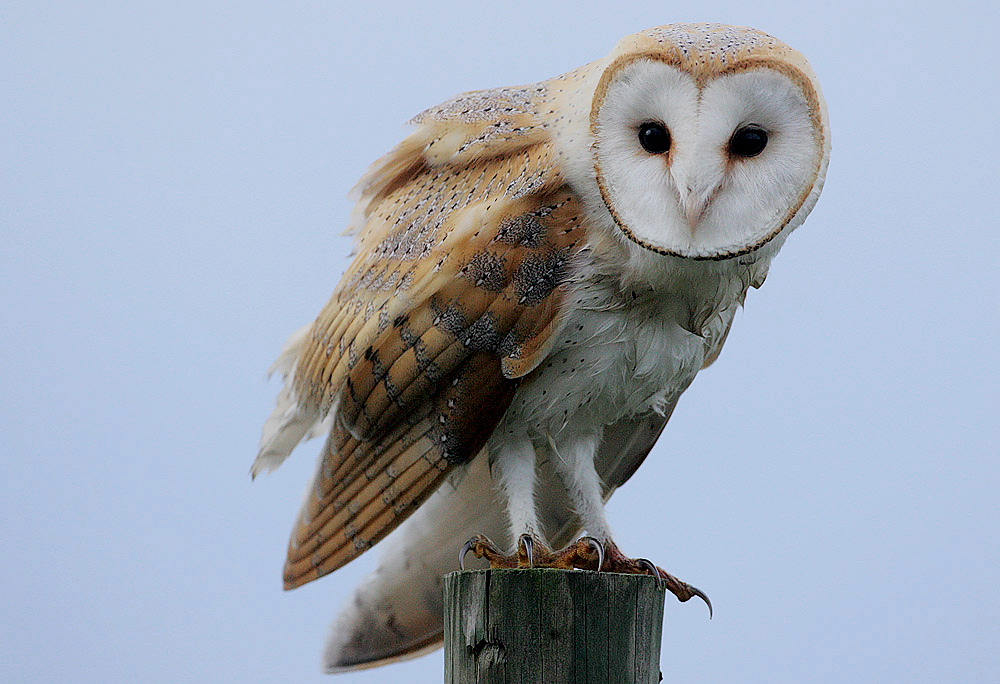
Steve Garvie (Rainbirder) / Wikimedia Commons (CC BY-SA 2.0)
A barn owl is the most credible natural explanation anyone has offered for the creature reported near Flatwoods, West Virginia, in 1952, and several features of the sighting fit a startled owl in darkness reasonably well. It’s also not a perfect fit, and treating it as a closed case oversimplifies both the witness accounts and the bird.
This isn’t an attempt to prove the witnesses were foolish. Seven people had a frightening experience in the dark, on a hillside, moments after watching what looked like a fireball fall from the sky. The question worth asking is narrower: how much of what they described can a barn owl actually account for, and where does the comparison break down?
The Encounter, Briefly
On the evening of September 12, 1952, three boys near Flatwoods watched a bright object cross the sky and appear to land on a nearby hill. A search party — including the boys’ mother, Kathleen May, and National Guardsman Eugene Lemon — climbed toward the site with a flashlight. Near the top, they reported a pulsating red light, then a large, pale-faced figure that seemed to hover above the ground before the group fled. The full history, including the meteor connection, the Air Force’s brief involvement, and how the story became regional folklore, is covered in our Flatwoods Monster pillar article. This piece stays narrowly focused on one question: does a barn owl explain what they saw?
Which Owl Species Fits the Theory?
When people say “the Flatwoods Monster was an owl,” they’re almost always referring specifically to the barn owl (Tyto alba), not owls generally. That specificity matters. Barn owls have a distinctive heart-shaped facial disc, pale coloring, and a defensive posture that differ meaningfully from a great horned owl or barred owl, both of which are also native to West Virginia. Skeptical investigator Joe Nickell, who developed the most detailed version of this theory after visiting the site and interviewing surviving witnesses in 2000, argued specifically for a barn owl rather than owls in general, pointing to its pale, heart-shaped face as a plausible match for the “round, red face” reported by witnesses under red-tinted light.
What a Barn Owl Actually Looks Like
Barn owls stand roughly 13 to 16 inches tall with a wingspan approaching four feet, according to Cornell Lab of Ornithology data. That’s a real, substantial bird — considerably larger than most people picture when they hear “owl” — with a pale, almost ghostly plumage that can look strikingly white or pale in a flashlight beam at night. Their facial disc is a smooth, pale, roughly heart-shaped surface that funnels sound to their ears, and from certain angles, especially when the bird tips or rotates its head, that disc can read as an oddly round, featureless “face” rather than a recognizably avian one.
When threatened or startled, barn owls have a documented defensive display: they spread their wings, hiss, and can appear to sway or bob, a combination of behaviors that could plausibly look erratic or unsettling to someone glimpsing it for a second or two in poor light.
Could an Owl Look Seven to Ten Feet Tall?
This is the single biggest problem with the theory on its face, and it’s worth taking seriously rather than waving away. A barn owl is objectively small — under a foot and a half tall. Witness estimates for the Flatwoods figure ran from roughly seven to twelve feet, which is a difference of several multiples, not a rounding error.
The proposed reconciliation goes like this: an owl perched several feet up a tree branch, viewed from below in near-total darkness with only a narrow flashlight beam for reference, offers almost no reliable cues for judging distance or scale. Human perception of size in the dark depends heavily on comparison to known objects — a doorway, a person, a car — and none of that was available on a wooded hillside at night. Combine that with adrenaline, fear, and the expectation that something large and unusual had just fallen from the sky, and a genuinely modest animal could plausibly be misjudged as monstrous.
That’s a real, psychologically grounded explanation for size distortion. It is not the same as demonstrating that this specific misjudgment happened. No one measured tree height, owl position, or sightline that night, and the reconstruction depends on inference rather than direct evidence.
The Eyes, Face and Silhouette
Witnesses described glowing, greenish-orange eyes, and this is one of the theory’s stronger points. Many nocturnal animals, owls included, have a reflective layer behind the retina called the tapetum lucidum, which bounces light back through the eye and can produce a bright, colored glow — commonly called eyeshine — when caught in a flashlight or headlights. The exact color of that glow varies by species and viewing angle, and it’s a well-documented phenomenon rather than a stretch; a startled owl’s eyes catching a flashlight beam directly could plausibly produce the kind of glow witnesses described, though the specific greenish-orange shade reported isn’t something that can be verified after the fact from a single secondhand description.
The reported “spade-shaped” or hooded head silhouette is a more debatable match. An owl’s rounded facial disc, combined with raised ear tufts on some species or simply the silhouette of head feathers against a dark background, could produce an irregular, vaguely pointed outline in poor lighting. It’s a plausible visual illusion, not an obvious one-to-one resemblance.
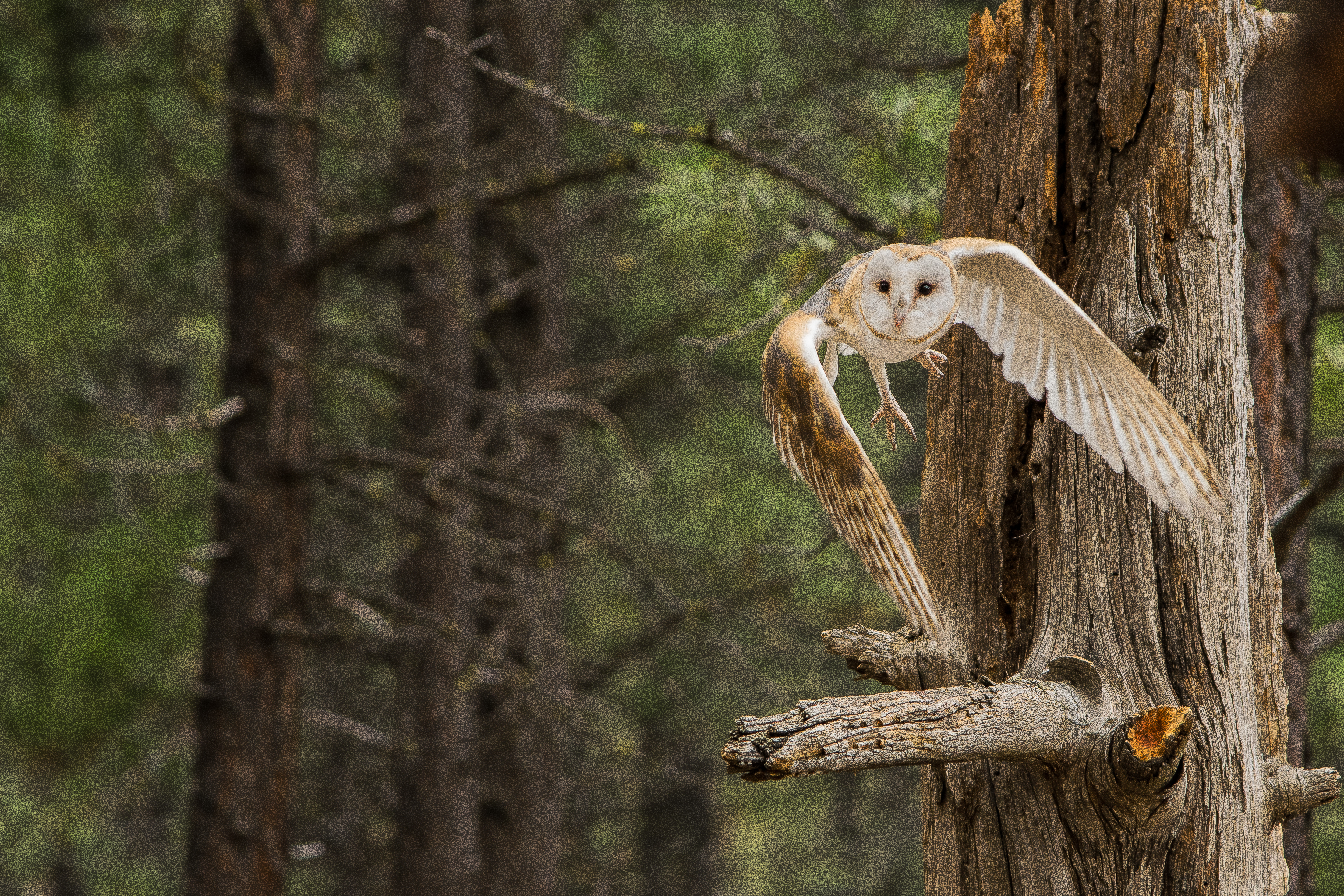
A barn owl taking flight — the kind of sudden, silent movement from a tree branch the theory proposes a frightened search party could have misjudged as something far larger. Jon Nelson, Wikimedia Commons (CC BY 2.0).
Could an Owl Appear to Glide or Hover?
Several witnesses described the figure moving smoothly, almost floating, rather than walking. Owls are capable of remarkably silent, controlled flight, thanks to specialized wing feathers that break up turbulence, and a bird gliding a short distance between branches or dropping toward the ground could look, for a half-second in flashlight glare, less like a bird landing and more like something large gliding through the air. Combined with foliage or low branches obscuring the owl’s legs and feet, that could account for descriptions of a figure that seemed to lack a clearly visible lower body or normal gait.
Where the Owl Theory Fits
The theory does real work on several fronts: the size of the bird relative to a real bird’s known defensive posture, the pale, round facial disc as a stand-in for a “face,” plausible eyeshine explaining glowing eyes, and silent flight or perching explaining an ungrounded, gliding impression. It also fits neatly with the broader circumstances — a meteor or fireball sighting that sent an adrenaline-charged search party into the woods at night, primed to interpret anything unusual as connected to what they’d just seen fall from the sky.
Where the Owl Theory Struggles
The size discrepancy remains the theory’s weakest point, and no amount of “darkness distorts perception” fully closes an eight-to-tenfold gap between a barn owl’s actual height and the witnesses’ estimates. Multiple witnesses also described a strong, unpleasant, almost metallic or sulfurous odor and short-term physical symptoms like nausea or throat irritation — details that don’t have an obvious owl-based explanation and are typically addressed separately, if at all, by proponents of this theory. And critics, including writer Frank Feschino, who has argued for a very different explanation involving military aircraft, point out that reconciling every detail of a multi-witness account with a single bird requires treating some testimony as more reliable than other testimony, without a clear, consistent basis for doing so.
Meteor Plus Owl: The Combined Natural Explanation
The fuller version of the skeptical case links two separate events rather than relying on the owl alone. A meteor, independently reported over three states that same evening, produces the initial light the boys saw appear to descend. That sighting sends a group up a dark hillside already convinced something extraordinary has happened nearby. In that state — keyed up, working with a single flashlight, expecting to find wreckage or something worse — an ordinary animal startled from a low branch gets processed through a very different lens than it would be on an unremarkable night.
That’s a coherent hypothesis. It is still a hypothesis. Nobody can go back and measure the tree, weigh the owl, or interview the witnesses again under controlled conditions, and treating this reconstruction as a settled solution overstates what the evidence can support.
So Was the Flatwoods Monster a Barn Owl?
Probably, at least in part — a startled barn owl or a similar owl species is the most parsimonious explanation for a meaningful chunk of the encounter, particularly the face, eyes, and gliding movement. But “probably, in part” is a long way from “definitely, in full.” The size discrepancy, the reported odor, and the physical symptoms sit outside what an owl alone can explain, and until someone produces stronger evidence than a compelling narrative fit, the honest position is that a barn owl offers the best available natural explanation without closing every gap in the story.
Frequently Asked Questions
What is the barn owl theory about the Flatwoods Monster? It’s the argument, developed most fully by skeptical investigator Joe Nickell, that a startled barn owl perched in a tree, seen briefly in darkness by a frightened search party, could account for much of what witnesses described as a monster.
Which owl species does the theory point to specifically? The barn owl (Tyto alba), chosen for its pale, heart-shaped facial disc and defensive display, rather than owls generally.
How could an owl look seven feet tall? Perched above ground level, viewed in near-total darkness with no reliable size references and under the influence of fear and adrenaline, a much smaller animal can be badly misjudged in scale. That’s a documented perceptual effect, though it can’t be proven to be exactly what happened that night.
Does the owl theory explain the glowing eyes? Reasonably well. Many nocturnal animals, including owls, produce a reflective eyeshine when light hits their eyes directly, which can appear as a bright, colored glow.
What doesn’t the owl theory explain? The reported strong odor and physical symptoms like nausea don’t have a clear owl-based explanation, and they remain one of the theory’s biggest gaps.
Is the owl explanation proven? No. It’s the strongest available natural explanation, well supported by owl biology and human perception research, but it remains a hypothesis rather than a demonstrated fact.

.jpg)