Lore & Explained / Literature
Frankenstein's Monster Explained: What the Novel Actually Says
Mary Shelley's creature can speak, read and argue. Explore his appearance, creation, crimes and ending without confusing the novel with later films.
Topics: Frankenstein, Mary Shelley, Gothic Horror, Horror Literature
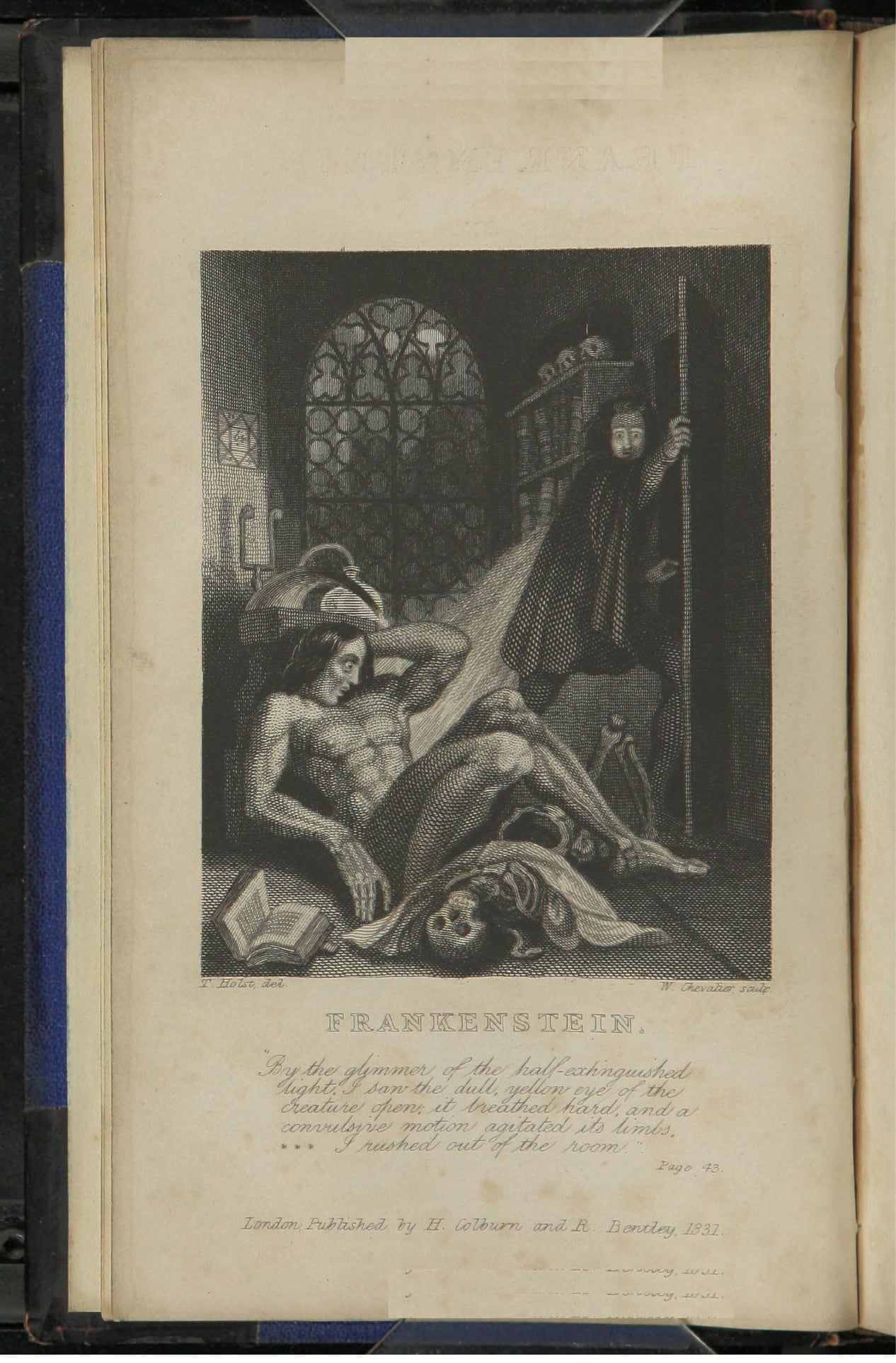
Theodor von Holst / W. Chevalier, 1831, via HathiTrust (Emory University) (Public Domain)
Frankenstein’s monster is the unnamed being created by Victor Frankenstein in Mary Shelley’s novel, first published in 1818. He is not the silent, green-skinned figure many readers expect. Shelley’s creature learns language, reads books and makes a detailed argument about his creator’s responsibilities. He also commits murders for which the novel does not excuse him.
The name confusion is easy to settle: Frankenstein is Victor’s surname. Understanding the creature takes more than correcting that name. The real difficulty is deciding what to make of someone who can describe his suffering so persuasively while deliberately inflicting suffering on others.
Spoilers follow for the novel, including its ending.
What does the creature look like?
Victor describes a being about eight feet tall. He has black hair and white teeth, but those features sit uneasily with watery eyes and yellowish skin through which the structures beneath are visible. Victor initially selects features he considers beautiful. Their combination horrifies him once the body moves.
The description is more disturbing than a simple inventory of ugly parts. Victor expects individual attractive features to add up to a beautiful whole. They do not. At the moment his experiment succeeds, he recoils from the result.
The familiar flat head and neck fittings are not specified in the novel. Nor does Shelley call the creature green. Those details belong to the visual history of adaptations, which should not be mistaken for her prose description. An early book illustration and a later film image may both depict Frankenstein’s creature while showing substantially different designs.
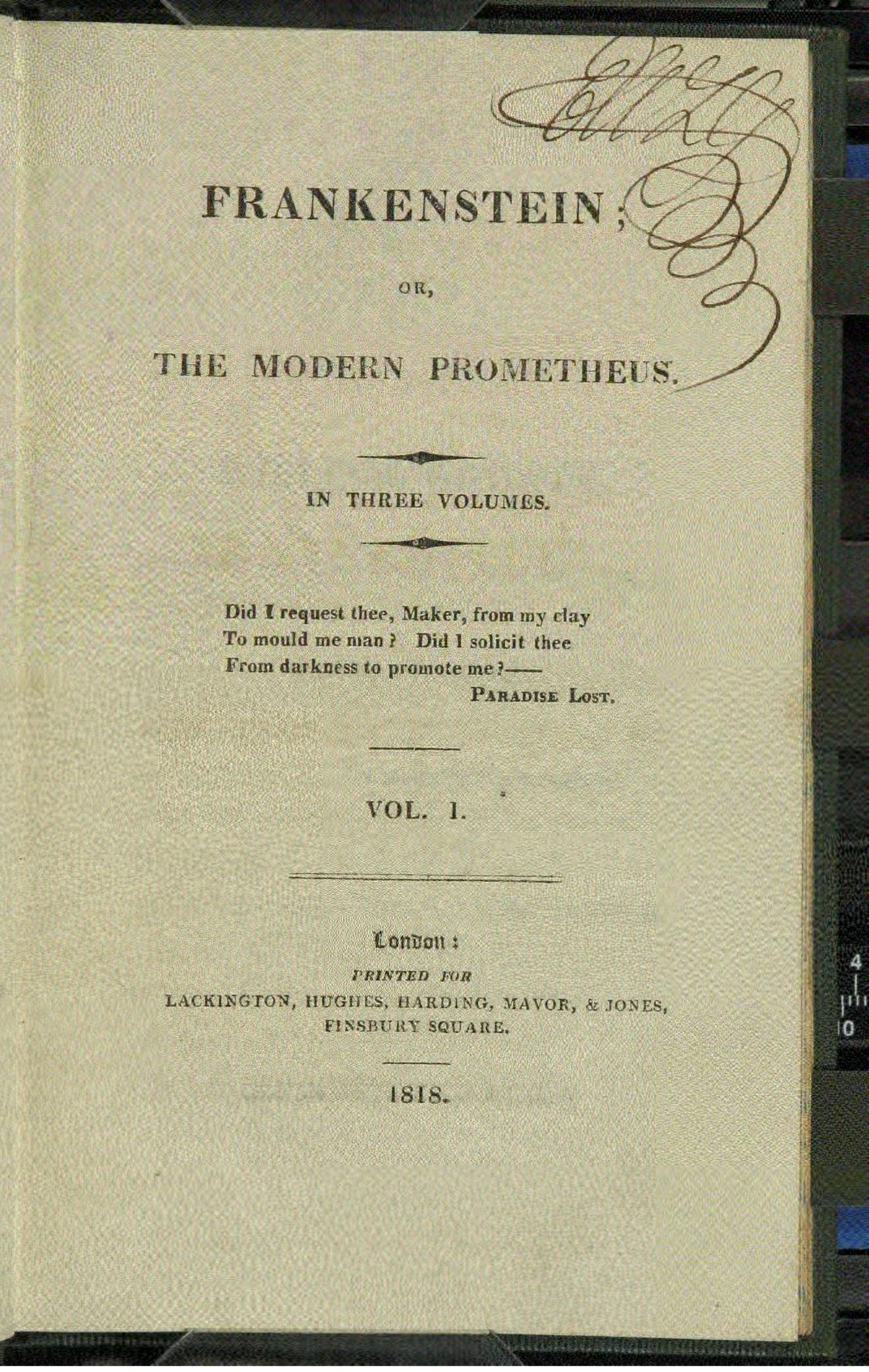
The title page of the 1818 first edition — published anonymously, in three volumes, with an epigraph from Milton’s Paradise Lost*. Source. Public domain, digitized by Emory University via HathiTrust.*
How does Victor bring him to life?
The book withholds a complete technical explanation. Victor describes studying life and death, assembling his work and bringing it to animation, but he does not provide a reproducible recipe. The famous laboratory machinery of screen adaptations fills a gap that the novel deliberately leaves open.
Electricity belongs to Victor’s intellectual world, but that does not mean the animation scene is an exact description of a lightning strike into neck bolts. The novel itself is the place to check what is actually shown.
There is also no Igor assisting him in Shelley’s narrative. Victor conducts his obsessive work in isolation. Removing an imaginary helper matters because the responsibility for creating and then abandoning the being is his own.
Can Frankenstein’s monster talk?
Yes. His ability to speak is essential to the book.
After being abandoned, the creature learns by watching and listening to the De Lacey household. He comes to understand their language and relationships while remaining outside their home. His education includes reading, and books give him frameworks for thinking about his own existence. Milton’s Paradise Lost is particularly important because it offers both a created human and a rejected rebel with whom he can compare himself.
He does not begin life already possessing this education. Shelley gives him a process of discovery: sensations, survival, observation, language and then painful self-awareness. He recognizes kindness without receiving much of it himself.
When he eventually addresses Victor, he is therefore capable of more than pleading. He presents an account of how he became the person standing before his creator. The reader has to listen to someone Victor would prefer to treat as a thing that should never have existed.
Is he evil, or is he a victim?
The novel makes that an uncomfortable choice rather than a clean division.
The creature is rejected and attacked because of his appearance. Victor fails to care for him. These experiences help explain his anger. But explanation is not acquittal. He kills William, helps implicate Justine by planting evidence, and later targets other people close to Victor. Those victims are not responsible for creating him.
A reading that calls him simply a misunderstood innocent leaves out his deliberate cruelty. A reading that treats him as evil from the instant of creation ignores the education and rejection Shelley spends so much time describing.
The conflict becomes more difficult because much of the book reaches us through embedded accounts. Robert Walton records Victor’s story, and Victor recounts the creature’s own narrative. The creature is allowed a voice, but the reader still encounters that voice within someone else’s telling.
Why does he ask for a companion?
The creature asks Victor to create another being who can share his life. He argues that companionship would make it possible for him to withdraw from human society. Victor begins the work, then destroys it before completion.
Victor fears consequences he cannot control: the proposed companion might refuse the arrangement, or the pair might create further danger. The request exposes a serious problem in treating a new person as a solution to someone else’s suffering. A companion would have her own choices, not merely a function assigned by two men arguing over her creation.
That ethical problem does not make Victor’s subsequent actions harmless. Destroying the unfinished being intensifies the conflict and sets up the threat against his wedding night.
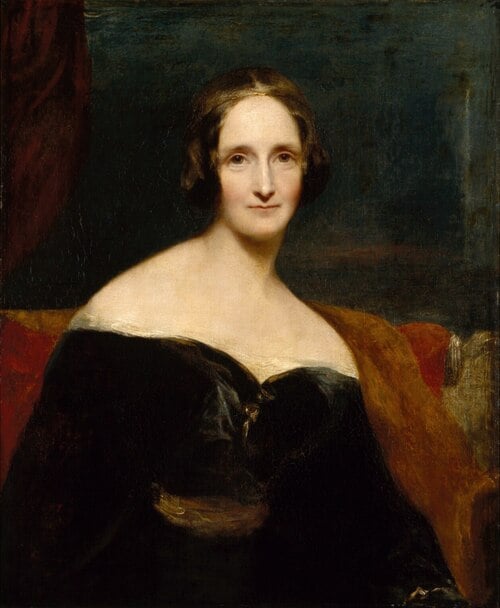
Mary Shelley, painted by Richard Rothwell; the portrait was exhibited at the Royal Academy in 1840. Source. Public domain.
What happens to him at the end?
Victor dies aboard Walton’s ship in the Arctic. The creature appears over his creator’s body and speaks about his misery, guilt and intention to end his own life. He then leaves on the ice and disappears from view.
The book does not show the promised funeral pyre. His stated intention is not the same thing as an event witnessed by Walton. Saying that the ending definitively depicts his death closes an uncertainty Shelley leaves in place.
Victor’s death also prevents the final encounter from becoming a conventional victory over a monster. The pursuit has consumed the pursuer. The surviving creature does not receive the belonging he wanted, and his creator cannot answer him.
The creature before the familiar silhouette
The novel quickly acquired another life in performance. The Huntington preserves Richard Brinsley Peake’s 1823 manuscript for the work produced as Presumption; or, the Fate of Frankenstein. The historical record of adaptation begins well before cinema.
For a first reading, leave the familiar movie silhouette outside the book. Listen instead to the creature’s language, watch what he does after learning to use it, and notice where Victor’s account tries to control the reader’s judgment. Shelley’s horror depends on both creation and refusal: a being is made, becomes conscious of what he lacks, and finds that the person responsible will not regard him as a responsibility.