Lore & Explained
Onryo and Yurei Explained: Japan's Ghosts and Vengeful Spirits
What is the difference between yurei and onryo? Japanese ghost stories, theater prints and literary tales show why not every spirit seeks revenge.
Topics: Japanese Folklore, Ghosts, Yurei, Onryo
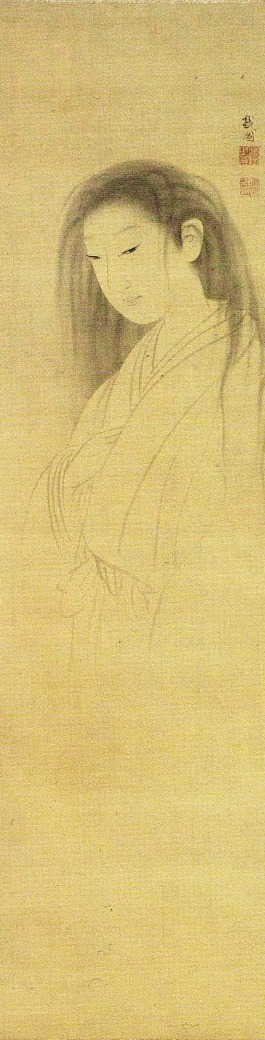
Maruyama Okyo, 18th century (Public Domain)
A yurei is a ghost or spirit of the dead in Japanese tradition. Onryo puts the emphasis on resentment and vengeance: a spirit whose anger can threaten the living. The terms overlap, but they are not interchangeable. A ghost returning because of love, anxiety or an unfinished obligation need not be seeking revenge.
That distinction matters more than a checklist of white clothing, loose hair and supernatural powers. The frightening figure is only part of a ghost story. The other part is the relationship that death has failed to end.
What makes a ghost an onryo?
The defining idea is a grievance that retains force after death. In the beliefs being described, the wronged dead are not necessarily powerless. Their resentment may return as a curse or disaster rather than as an apparition that simply stands in a room.
Historian Kobayashi Norihiko’s study of spirits and calamities in ancient Japan discusses resentful dead described as onryo and goryo. The terminology belongs to a history of religious interpretation, not a verified account of supernatural causes.
For a horror reader, the useful question is therefore not “How strong is this kind of ghost?” It is “What injury is the story refusing to let the living forget?” A character may believe a death has settled a problem. The haunting makes that belief dangerously premature.
The pattern does not require a female spirit, and it does not mean that every person who dies unhappily becomes an onryo. Those would turn a flexible tradition into a mechanical rule that the individual stories do not support.
Oiwa: a grievance given a face
Oiwa, the central ghost of Yotsuya Kaidan, offers a powerful example of revenge taking visible form. The Spencer Museum of Art’s account connects her haunting to betrayal and poisoning by her husband, Iyemon, and identifies the play’s first performance in 1825.
The museum’s lantern-ghost image gives her a distorted, unsettling presence. It is not intended as a neutral portrait of a historical witness. It belongs to the artistic life of a story, including the theatrical effects that helped make Oiwa recognizable.
That distinction prevents an easy mistake. An old print can be authentic nineteenth-century art without proving that the ghost depicted in it existed. Its value lies in showing how an audience was invited to imagine her.
Oiwa’s appearance also carries narrative information. Her injured face is not random monster decoration. It makes the violence done to her impossible for the viewer to overlook.
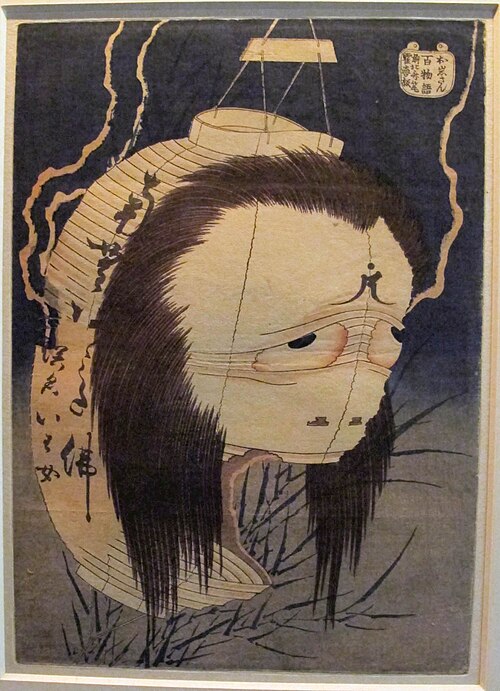
Oiwa’s face distorted within a broken paper lantern, from Katsushika Hokusai’s series One Hundred Ghost Stories (Hyaku Monogatari), 1831-32. Source. Public domain artwork; museum photograph licensed CC BY-SA 3.0.
Why Japanese ghost images are so recognizable
Loose hair, a pale figure and a body that seems to drift rather than walk can communicate ghostliness before a viewer knows the story. Those features are visual conventions, however, not compulsory anatomy.
The Smithsonian’s Staging the Supernatural exhibition explores the exchange between Japanese theater and printed images. Ghosts appeared through performance, stage illusion, actors’ poses and the work of printmakers. The image we encounter on a museum wall may therefore preserve a theatrical invention as well as a supernatural subject.
A useful comparison is the difference between a character and an actor playing that character. A print can depict both at once. Treating it as a straightforward illustration of what all Japanese people believed erases the performance that made the picture possible.
The same caution applies to modern screen ghosts. A filmmaker can draw on familiar imagery while giving a character a new history, motive or method of attack. The result is an adaptation, not a newly discovered rule governing every older tale.
A ghost who does not want revenge
Lafcadio Hearn’s 1904 collection Kwaidan contains a quieter counterexample in “A Dead Secret.” After O-Sono dies, her young son sees her return to the house. The family finds her standing near a chest of drawers, her lower body fading from sight.
They initially assume that she misses her possessions. Her clothes and ornaments are taken to the temple, but the apparition continues to appear. Removing the obvious belongings has not resolved what troubles her.
A priest discovers a letter hidden in the chest. He promises to burn it without exposing its contents, and the ghost disappears. The story leaves the letter’s private meaning largely where it belongs: with the dead woman.
No revenge is required to make this haunting work. O-Sono frightens the household because she has returned from death, yet the narrative treats her as someone who needs help, not an enemy who must be destroyed.
The contrast with Oiwa is instructive. Both stories involve a woman whose presence persists, but the relationship between the living and the dead is different. A broad word such as “ghost” can accommodate both. A label centered on vengeance cannot describe them equally well.
Can fear of a curse become part of the story?
Another tale in Kwaidan, “Diplomacy,” focuses on the living people’s expectation of revenge. A condemned man promises that his resentment will outlast his execution. The household subsequently becomes afraid of ordinary sounds and shadows, anticipating a haunting that does not arrive.
The story supplies its own supernatural logic for the absence of revenge. It is not a scientific experiment or a general explanation of ghost experiences. Still, it makes a sharp narrative distinction between a frightening prediction and the events that follow it.
That is a useful distinction when discussing paranormal claims outside fiction too. An account of someone fearing a ghost is evidence of that person’s reported fear; it does not, by itself, establish the ghost.
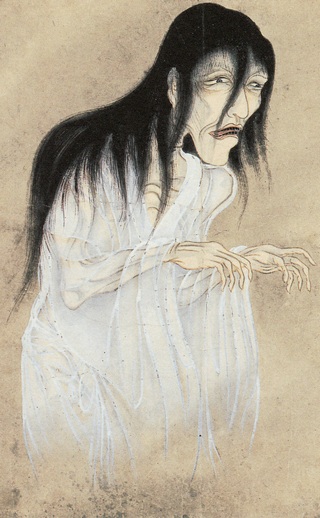
A yurei painted in the Hyakkai Zukan (Picture Scroll of a Hundred Demons), an 18th- or 19th-century scroll attributed to the painter Sawaki Suushi. Source. Public domain.
Yurei, onryo and yokai are not a simple family tree
“Yokai” is often used broadly for uncanny beings and phenomena. Its relationship to ghost terminology changes with the source and context. It is safer to explain the particular figure than to force every story into a single taxonomic diagram.
Yuki-Onna shows the problem. Hearn’s snow woman has a revealed supernatural identity, but his tale does not establish that she was a particular human who died and returned. Calling her a ghost in the same sense as O-Sono would add a biography the story never gives her.
Modern school legends such as Hanako-san introduce another layer: recurring settings and encounters can circulate in many versions without one authoritative account of the spirit’s origin.
The most useful starting point remains simple. Ask who has returned, what connects them to the living, and which version supplies the answer. Those questions tell us more than the length of a ghost’s hair.


,_il_fantasma_di_Oiwa-san,_1831-32.jpg)
