The Index / Unsolved Cases
Jack the Ripper Explained: Victims, Suspects and What We Actually Know
Who was Jack the Ripper? A careful look at the five canonical victims, Whitechapel investigation, letters, suspects, DNA claims and what remains unsolved.
Topics: Jack the Ripper, Whitechapel Murders, Unsolved Crimes, Victorian London, Aaron Kosminski
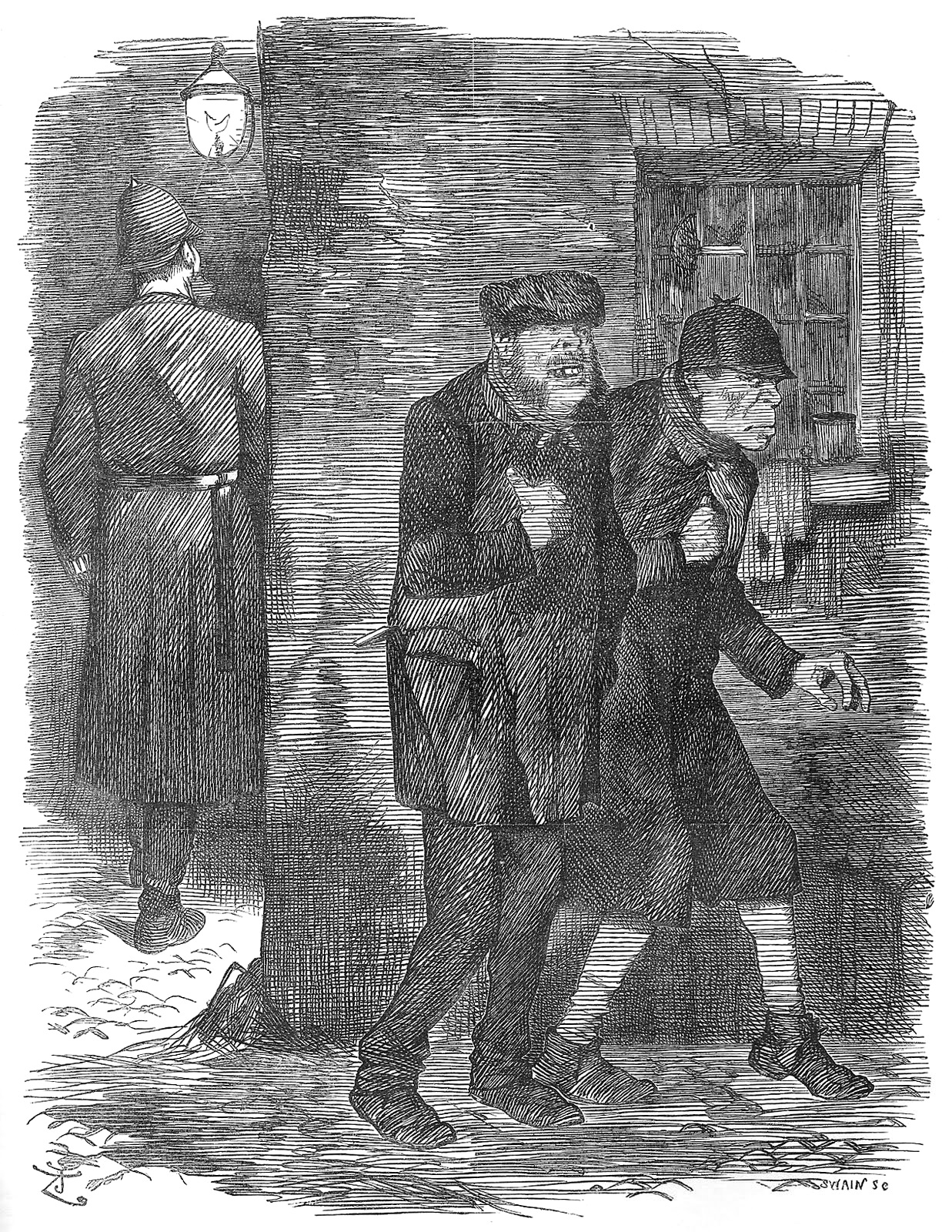
John Tenniel / Punch, 13 October 1888 / Public Domain via Wikimedia Commons
Between August and November 1888, five women were murdered in or near Whitechapel in London’s East End in a series traditionally attributed to one unidentified killer. Nobody was charged. The name that came to dominate the case — Jack the Ripper — came from a letter that may not even have been written by the murderer.
That gap between the historical record and the legend is the reason the case remains difficult to discuss cleanly. Victorian newspapers turned the murders into a spectacle almost immediately. Later books supplied hundreds of suspects. Modern DNA headlines periodically announce that the mystery has finally been solved.
It has not.
The strongest historical record still consists of the victims, the police investigation, medical reports, witness testimony and a mass of correspondence whose authenticity ranges from uncertain to obvious hoax.
Whitechapel in 1888
Whitechapel and neighboring Spitalfields were densely populated districts marked by severe poverty, insecure work and overcrowded housing. The National Archives describes late-19th-century Whitechapel as an area where poverty, immigration, housing pressure and women’s economic vulnerability all made policing unusually difficult.
Many residents depended on common lodging houses, casual labor and irregular income. A bed could cost only a few pence, but even that was beyond reach for someone who had earned nothing that day.
The social conditions matter because the five women have often been reduced to a single label.
Victorian police and newspapers repeatedly described the victims as prostitutes. More recent historical work has challenged that blanket description. London Museum’s current account notes that Mary Jane Kelly is the only one of the five known to have been working in the sex trade at the time of her murder. The others survived through combinations of casual work, lodging-house life, relationships, workhouse stays and periods of homelessness.
Historian Hallie Rubenhold’s The Five helped push that victim-centered interpretation into the mainstream, although some details of her reconstruction remain debated among Ripper historians.
The safer conclusion is not that every old account was false. It is that the five women were individuals whose lives cannot be accurately summarized by one Victorian police category.
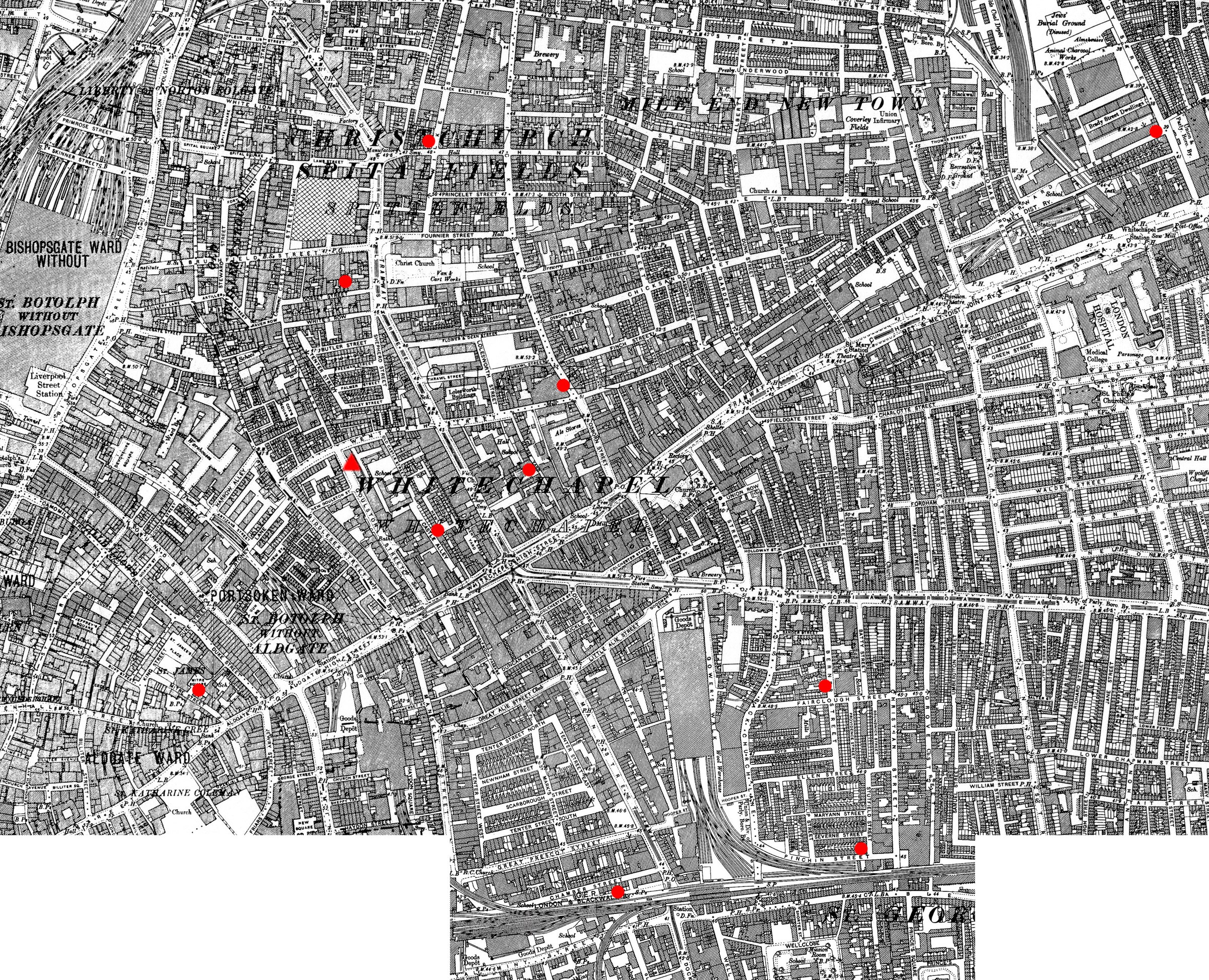
An 1894 Ordnance Survey map later annotated with Whitechapel murder locations and the Goulston Street clue. Source. Public Domain.
The Five Canonical Victims
The broader Whitechapel murder investigation covered more deaths than the five now most closely associated with Jack the Ripper. The traditional Canonical Five are Mary Ann Nichols, Annie Chapman, Elizabeth Stride, Catherine Eddowes and Mary Jane Kelly.
That grouping is historically influential, including in Melville Macnaghten’s 1894 memorandum, but it should not be mistaken for scientific certainty that one person committed every one of the five murders.
Mary Ann Nichols
Mary Ann “Polly” Nichols, 43, was found in Buck’s Row in the early hours of August 31, 1888.
Nichols had experienced marital breakdown, poverty, workhouse stays and unstable lodging. Her throat had been cut and her abdomen mutilated.
She is generally treated as the first of the canonical victims.
Annie Chapman
Annie Chapman, 47, was found behind 29 Hanbury Street on September 8.
Chapman’s life had once been more financially stable, but separation from her husband, declining health, alcohol problems and poverty left her moving between lodging houses and casual work.
Her throat had been cut and her abdomen mutilated, with organs removed.
Elizabeth Stride
Elizabeth Stride, 44, was a Swedish-born immigrant who had previously run a coffee house with her husband.
She was found in Dutfield’s Yard off Berner Street shortly after 1 a.m. on September 30. Her throat had been cut, but she did not suffer the abdominal mutilation seen in several of the other canonical cases.
One longstanding theory is that the attacker was interrupted when Louis Diemschutz arrived with his cart. That would explain the difference, but it remains a reconstruction rather than a proven fact.
Catherine Eddowes
Catherine Eddowes, 46, was killed later the same night in Mitre Square, inside City of London Police jurisdiction.
She had been released from police custody shortly before midnight after being detained for drunkenness. Her face and abdomen were mutilated, and her left kidney and part of her uterus were removed.
A bloodstained piece of her apron was later found in Goulston Street.
The killings of Stride and Eddowes became known as the double event, language that also appeared in the “Saucy Jacky” postcard sent shortly afterward.
Mary Jane Kelly
Mary Jane Kelly, believed to have been about 25, was killed in her room at 13 Miller’s Court and discovered on November 9.
Thomas Bowyer, sent by landlord John McCarthy to collect overdue rent, found her body.
Kelly was the only canonical victim killed indoors. The injuries were far more extensive than in the outdoor murders, but there is no need to catalogue them in detail to understand the historical point: whoever killed her had considerably more privacy than an attacker working in a street or yard.
Kelly’s murder is traditionally treated as the final canonical Ripper killing.
What About the Other Whitechapel Murders?
The contemporary Whitechapel murder files cover a wider sequence of killings and violent deaths between 1888 and 1891.
Emma Elizabeth Smith, attacked in April 1888, told police she had been assaulted by a group of men before dying from her injuries. Her own account makes her a poor fit for a lone Ripper attacker.
Martha Tabram, killed in August 1888, remains one of the most frequently proposed additional victims. She suffered numerous stab wounds, a method different from the throat-cutting and mutilation pattern associated with the canonical series.
Later cases including Rose Mylett, Alice McKenzie, the Pinchin Street torso and Frances Coles have also been discussed in connection with the case. None is securely established as a Jack the Ripper murder.
This is why statements such as “Jack the Ripper killed exactly five women” need qualification. Five is the conventional core of the case, not a proven total.
Did the Killer Have Surgical Knowledge?
The idea that Jack the Ripper must have been a surgeon or doctor has survived for more than a century.
Contemporary medical opinion was not unanimous.
Some doctors thought aspects of the mutilations suggested anatomical familiarity. Others strongly disagreed. Police surgeon Dr. Thomas Bond, who reviewed the earlier post-mortem material and examined Mary Jane Kelly, wrote in November 1888 that the mutilations showed no scientific or anatomical knowledge. He went further, saying he did not believe the killer possessed even the technical knowledge of a butcher or horse slaughterer.
Bond also believed the weapon was a strong, very sharp knife at least six inches long.
His assessment does not prove the killer had no practical experience with knives. It does show that the familiar “expert Victorian surgeon” profile was never an uncontested medical conclusion.
The Letters — and the Birth of “Jack the Ripper”
Hundreds of letters claiming to come from the murderer reached police, newspapers and public figures.
The National Archives preserves many of them and explicitly identifies some as hoaxes.
The most famous is the “Dear Boss” letter, dated September 25, 1888 and received by the Central News Agency. It used the name “Jack the Ripper,” helping create the identity that newspapers would repeat around the world.
Its authorship has never been authenticated.
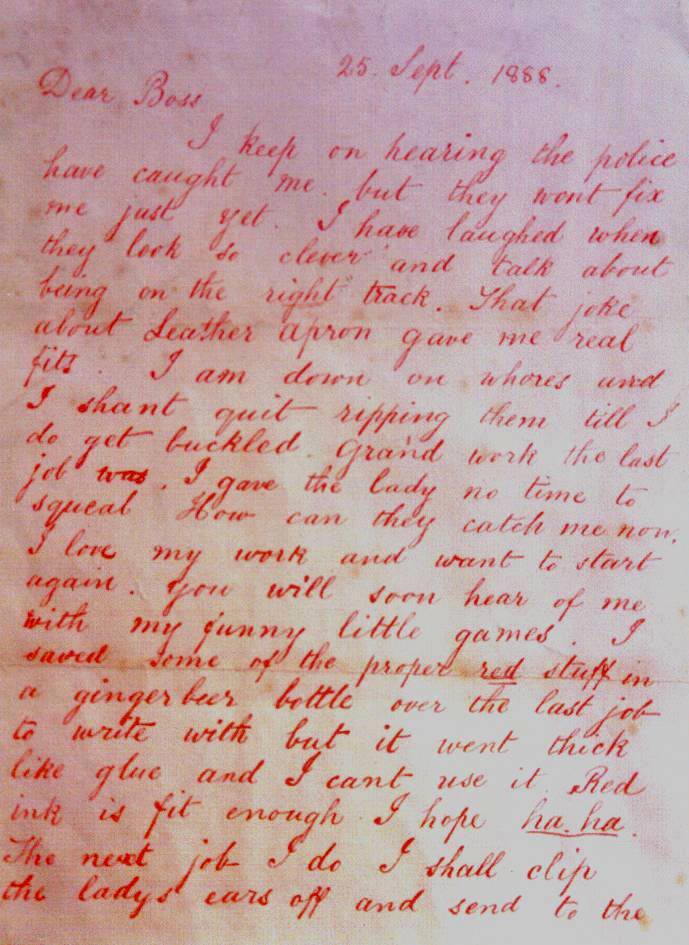
The first page of the “Dear Boss” letter, dated September 25, 1888. Its writer introduced the name that became inseparable from the murders, but the letter has never been proven to have come from the killer. Source. National Archives MEPO 3/142; Public Domain reproduction via Wikimedia Commons.
A postcard nicknamed “Saucy Jacky” followed soon afterward and referred to the two September 30 killings as a “double event.” Its handwriting resembles the “Dear Boss” letter, but similarity between two documents does not establish that either came from the murderer.
Police officials later suspected that at least some of the famous correspondence had been created by journalists or other hoaxers.
The practical effect was enormous either way. The letters supplied the press with a memorable villain, a signature and a stream of material that kept the story alive.
The “From Hell” Letter and the Kidney
The strangest communication was sent not to a newspaper but to George Lusk, chairman of the Whitechapel Vigilance Committee.
The short note, later called the “From Hell” letter, arrived with part of a human kidney preserved in spirits. Catherine Eddowes’ left kidney had been removed during her murder.
That makes the package disturbing evidence, but not conclusive evidence.
The kidney was examined at the London Hospital and identified as human and from the left side. Later claims that its disease, age and timing proved it belonged to Eddowes depend heavily on contradictory newspaper reporting and later recollections. A 2008 medical review of the episode noted the continuing uncertainty.
Medical students and anatomists in Victorian London had access to human organs, so a sophisticated hoax was possible.
The original tissue no longer exists for modern DNA testing.
Unlike most Ripper correspondence, the “From Hell” letter therefore remains difficult to dismiss completely — and impossible to authenticate conclusively.
Aaron Kosminski
Aaron Kosminski is the historical suspect most frequently revived by modern headlines.
He was a Polish Jewish immigrant who lived in the area and later spent much of his life in psychiatric institutions. Macnaghten’s 1894 memorandum named a suspect simply as “Kosminski,” and later senior police recollections also pointed toward a Polish Jewish suspect.
That is genuine historical evidence of police suspicion.
It is not evidence that Kosminski was proved to be the killer.
The surviving record contains contradictions. Kosminski was not committed to an asylum until 1891 and lived until 1919, conflicting with details in some later police recollections. No surviving physical evidence from the murders has produced an uncontested forensic identification of him.
Did DNA Finally Identify Jack the Ripper?
The biggest modern claim centers on a patterned shawl said to have been recovered from Catherine Eddowes’ murder scene.
Author Russell Edwards acquired the shawl in 2007. Research led by Jari Louhelainen and David Miller reported mitochondrial DNA profiles compatible with maternal-line descendants of Eddowes and Kosminski. Their study was published in the Journal of Forensic Sciences in 2019.
The problem is that the shawl’s history is disputed.
It does not have an uncontested documented chain of custody from Mitre Square to the present day. It was handled and displayed over generations. Mitochondrial DNA also does not identify one unique individual in the way a complete autosomal DNA profile can.
The scientific paper itself now carries an Expression of Concern from the Journal of Forensic Sciences. Critics questioned the presentation and availability of the underlying genetic data.
Historian Paul Begg and forensic specialists have also challenged the shawl’s provenance and the strength of the identification claims.
In 2025, descendants of victims publicly supported calls for a new inquest based on the renewed DNA claim. That generated another round of headlines declaring that Kosminski had been identified.
A request for a new inquest is not an official finding of identity.
As of August 2026, no court, coroner or police authority has publicly established Aaron Kosminski as Jack the Ripper.
Other Suspects
More than a century of speculation has produced an enormous suspect list.
Montague John Druitt was named in Macnaghten’s memorandum and died shortly after the canonical murders, but there is no physical evidence placing him at any murder scene.
Michael Ostrog, also named by Macnaghten, has become an increasingly weak candidate as researchers reconstructed more of his movements and criminal history.
George Chapman, born Seweryn Kłosowski, later murdered three women by poisoning. His proven crimes make him a serious historical criminal, but poisonings carried out years later do not connect him to the Whitechapel knife murders.
Francis Tumblety, an American quack doctor arrested in London in 1888 on unrelated charges, has attracted interest because of his movements and misogynistic reputation. Again, there is no conclusive forensic connection.
Charles Allen Lechmere, the carman who found Nichols’ body, became the focus of a much more recent theory. Proponents cite his route, timing and use of the surname Cross at the inquest. Critics point out that he stopped, spoke with another passerby, approached police and gave evidence openly. The theory is circumstantial.
No suspect has crossed the line from intriguing theory to demonstrated identity.
The Royal and Masonic Conspiracy
One of the most durable alternative theories claims the murders were part of a conspiracy involving Prince Albert Victor, royal physician Sir William Gull and Freemasons.
Versions of the story differ, but the basic narrative emerged many decades after the murders.
The evidence does not support it.
The theory depends on late testimony and retellings rather than contemporary investigative evidence. Prince Albert Victor’s documented movements conflict with versions that require him to be present for particular murders. Gull was elderly and had suffered serious health problems before the killings.
The conspiracy became culturally influential because it provides exactly what the real case lacks: a named villain, an elite cover-up and an ending.
History has not supplied that ending.
Walter Sickert
Painter Walter Sickert is another famous later suspect, particularly after Patricia Cornwell argued for his guilt.
The case against Sickert has relied on interpretations of his paintings, letters and genetic material associated with Ripper correspondence.
The problem is that the correspondence itself is not securely tied to the murderer. Matching DNA associated with a suspected hoax letter cannot establish that the person who handled the letter committed the murders.
Historical evidence placing Sickert outside London during at least part of the relevant period has also weakened the theory.
He remains a famous suspect largely because the theory became famous.
The Goulston Street Graffito
After Catherine Eddowes’ murder, a piece of her bloodstained apron was found in a doorway in Goulston Street beneath chalk writing that referred to “the Juwes” or a similar spelling.
The exact wording is uncertain because officers recorded different versions.
Commissioner Sir Charles Warren ordered the writing erased before it could be photographed. His stated concern was public order: the East End was already experiencing intense antisemitic suspicion, and leaving the message visible could have provoked violence against Jewish residents.
Whether the killer wrote it is unknown.
The apron fragment connects the location to Eddowes. It does not prove the person who discarded the cloth also wrote the words already on the wall.
That distinction matters because the murders took place during a period of severe hostility toward Jewish immigrants.
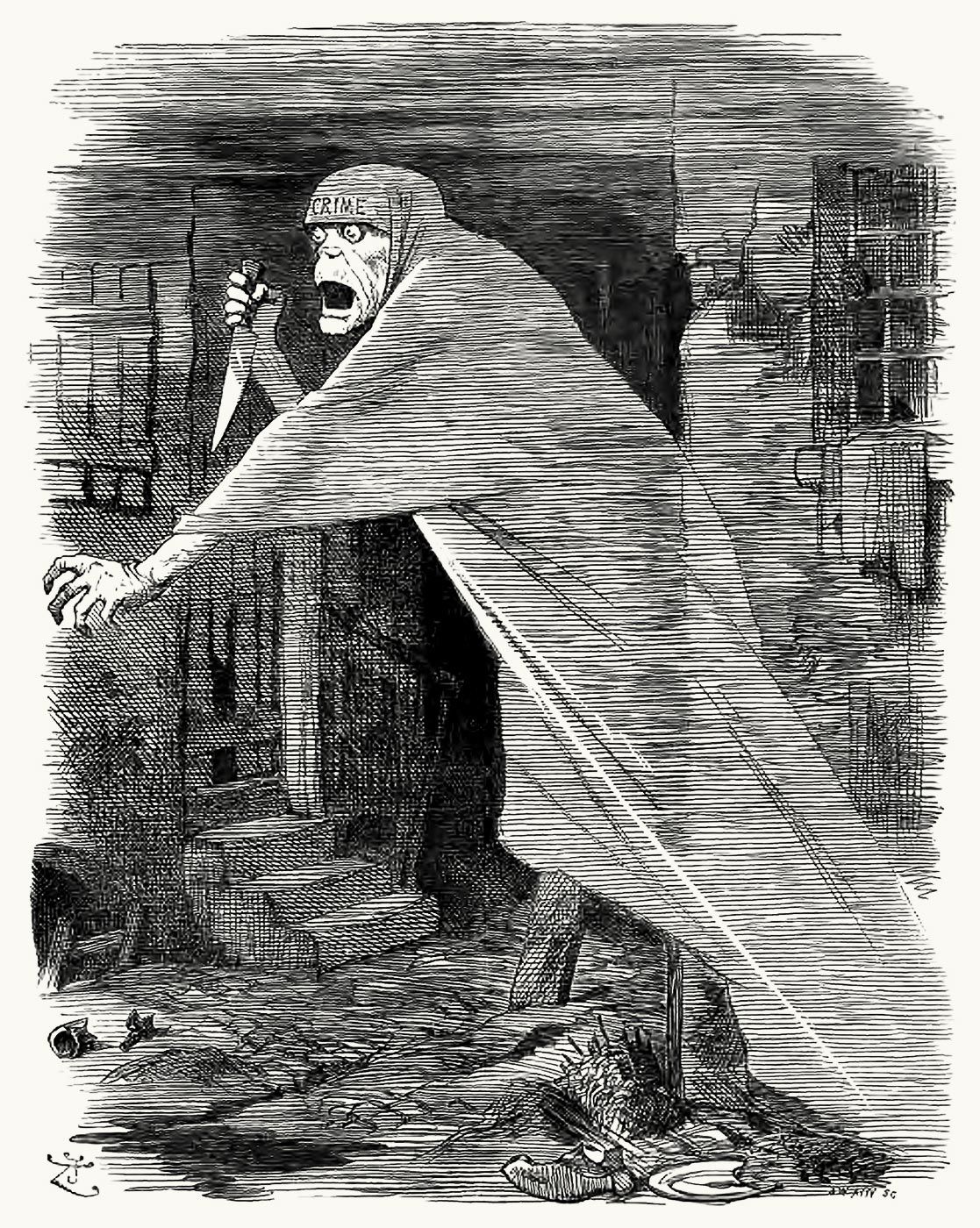
John Tenniel’s “The Nemesis of Neglect,” published in Punch on September 29, 1888, turned the Whitechapel panic into a criticism of poverty, crime and social neglect. Source. Public Domain.
“Leather Apron” and Antisemitic Panic
Before the name Jack the Ripper took over, newspapers circulated another nickname: Leather Apron.
Suspicion fell on John Pizer, a Jewish bootmaker. Police arrested him, but alibi evidence showed he could not have committed key murders attributed to the attacker, and he was released.
The episode shows how quickly the case became entangled with xenophobia and antisemitism.
London Museum notes that Jewish refugees from Eastern Europe were settling in Whitechapel and Spitalfields in large numbers while the murders took place. Newspapers and rumors repeatedly suggested the killer must be Jewish or foreign despite the absence of evidence.
The panic around Jack the Ripper hurt people who had nothing to do with the crimes.
Why the Case Was Never Solved
Police in 1888 lacked tools that later generations would treat as basic. As with the Zodiac Killer case, later forensic claims cannot replace a conclusive identification when the surviving evidence has fundamental limits.
There was no forensic DNA testing. Blood typing had not been developed. Fingerprint identification was not yet part of ordinary British criminal investigation.
Investigators had to rely heavily on witnesses, informants, physical observation, interviews and conventional detective work.
The environment made those methods difficult. Murders took place at night in densely populated streets where many residents moved between lodging houses. Witness descriptions conflicted. The killing of Catherine Eddowes also crossed into City of London Police territory, adding a second force to an already complicated investigation.
Then came hundreds of letters, tips, rumors, false confessions and newspaper theories.
The police were not doing nothing. They were trying to solve an unusually difficult series with limited forensic technology while working under extraordinary public pressure.
So Who Was Jack the Ripper?
We do not know.
The evidence does not justify upgrading Aaron Kosminski, Walter Sickert, Charles Lechmere or anyone else from suspect to identified killer.
The famous letters may not have been written by the murderer. The modern shawl evidence has major provenance and forensic limitations. The medical evidence does not establish that the killer was a surgeon. The royal conspiracy has no reliable contemporary foundation.
What survives much more clearly are the lives of the five women most closely associated with the case.
Mary Ann Nichols. Annie Chapman. Elizabeth Stride. Catherine Eddowes. Mary Jane Kelly.
The name “Jack the Ripper” may have been created by a hoaxer.
Their names were real.
Sources & further reading
- The National Archives: Hoax letter signed by Jack the Ripper
- London Museum: Jack the Ripper
- The National Archives: Whitechapel resources
- Journal of Forensic Sciences: 2019 shawl study
- Journal of Forensic Sciences: Expression of Concern
- Yale University Press: DNA claim analysis
- Nephrology Dialysis Transplantation: From Hell kidney review