Lore & Explained / Folklore
Mormo Explained: The Child-Frightening Spirit of Ancient Greek Folklore
Search for Mormo today and you'll find a vampire, a demon king, Hecate's consort. Ancient Greek sources describe something smaller and stranger: a nursery bugbear.
Topics: Mormo, Greek mythology, folklore, bogeyman, demonology, Its Name Was Mormo
The Cesnola Collection, Metropolitan Museum of Art (Public Domain)
Search for Mormo today and you will meet a fairly elaborate demon. Sites call her King of the Ghouls, Hecate’s consort, sometimes a vampire in the classical sense. Ancient Greek writers describe something much smaller and, honestly, more interesting: the thing a mother said to a child who would not go to sleep.
That gap between the modern write-up and the surviving evidence is the whole story here. Mormo (Μορμώ) barely exists as a developed myth in Greek literature. She exists as a word parents used, a term philosophers borrowed to describe irrational fear, and a name later magicians recycled for something considerably darker. Almost everything resembling a biography — the ghoul kingship, the demonic marriage, the vampire pedigree — was added centuries after the fact, mostly by people who were not writing about Greek religion at all.
Who Was Mormo?
The clearest ancient description of what Mormo actually did comes from a single line of comic theater. In Theocritus’s fifteenth Idyll, written in the third century BCE, a woman warns a fussing child: “The horse bites! Mormo bites!” No backstory, no appearance, no explanation required. The name alone does the work.
That’s the pattern across nearly every surviving reference. Mormo functioned as what Greek writers called a phobētron — a fright-object, a bugbear, something invoked to produce fear rather than a figure with an established cult or temple. She belonged to households, not shrines. Strabo, writing in his Geography around the turn of the era, groups her explicitly with other names used the same way: mothers and nurses frightened children with Lamia, with Gorgo, with Mormolyke, the same way a modern parent might invoke a monster under the bed. Strabo isn’t describing religious belief. He’s describing a parenting technique that had apparently been standard for a long time.
“Mormo Bites”: The Bogeywoman of the Nursery
The Theocritus line matters because it’s domestic evidence, not literary invention. It shows Mormo being used exactly the way you’d expect a household scare-word to be used — quickly, casually, without elaboration.
A more evocative account comes from Erinna, a poet who wrote in the fourth century BCE and whose work survives only in fragments. In her poem The Distaff, mourning a childhood friend, Erinna recalls the two of them as girls, frightened by Mormo together. Different translations render the description slightly differently, but they agree on the essentials: a creature with enormous ears, moving on four feet, and continually changing its face. It’s a short, strange image, and it reads less like a settled physical description than like the kind of half-remembered nightmare logic children actually produce — the monster keeps not looking like anything in particular, because that’s what made it frightening.
Centuries later, Plato used the same vocabulary for an entirely different purpose. In the Phaedo, Cebes worries that people fear death the way a child fears a mormolykeion — Plato’s term for the same kind of bugbear — and Socrates’ response is essentially: talk yourselves out of it, the way you’d reassure a frightened child. By the fourth century BCE, mormolykeion had become philosophical shorthand for a fear with no real substance behind it. That’s a very specific kind of cultural afterlife. Gods don’t usually end up as a debating term for irrational anxiety. Bogeymen do.
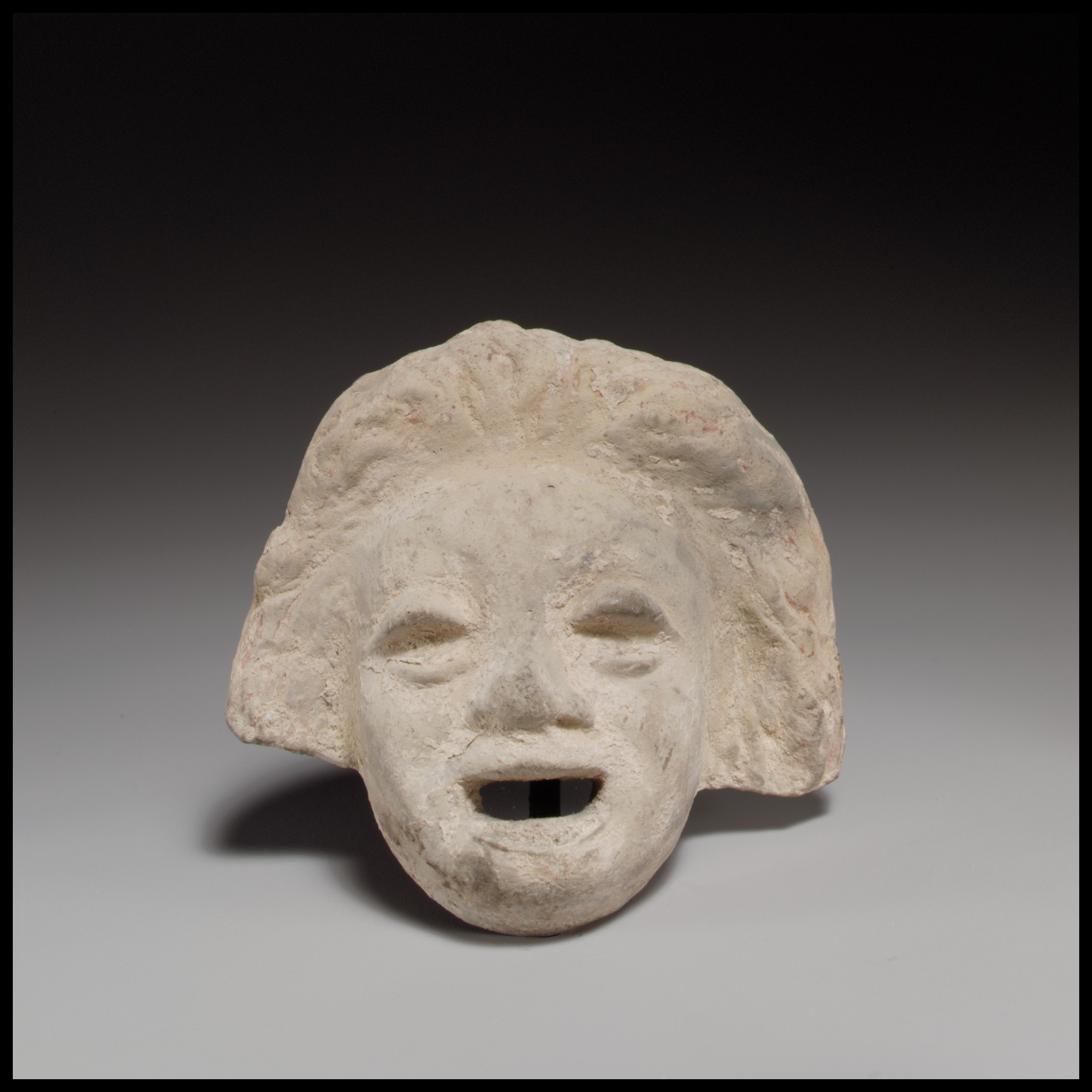
A terracotta comic mask from Cyprus, late fourth to early third century BCE. This is a theatrical mask, not a depiction of Mormo — but Greek writers used related terms, including mormolykeion, for exactly this kind of exaggerated, fear-inducing face. Source. The Cesnola Collection, Metropolitan Museum of Art, public domain.
What Did Mormo Look Like?
There is no standard ancient Mormo design, and that’s worth stating plainly, because plenty of modern sites present one anyway — usually borrowing horns, fangs, or a demonic sigil from entirely unrelated traditions. The strongest descriptive fragment is Erinna’s, and it doesn’t describe a fixed monster so much as an unstable one: oversized ears, an animal’s gait, a face that won’t hold still.
That instability is arguably the point, even if no ancient source says so explicitly. A bugbear used to frighten children doesn’t need a consistent design. It needs to be adaptable to whatever a particular child already finds frightening. A vague description does more work than a precise one.
Aristophanes uses Mormo and mormolykeion the same loose way, for comic effect rather than iconography. In the Acharnians, a character wants a frightening “Mormo”-mask removed from a scene it’s ruining. In Peace, a “Mormo-head” gets mentioned as a stock image of something absurdly frightening, tangled up with jokes about military gear. Aristophanes isn’t reporting sightings. He’s using an already-familiar scare-word as a punchline, which tells you the term was common enough by the late fifth century BCE that audiences didn’t need it explained.
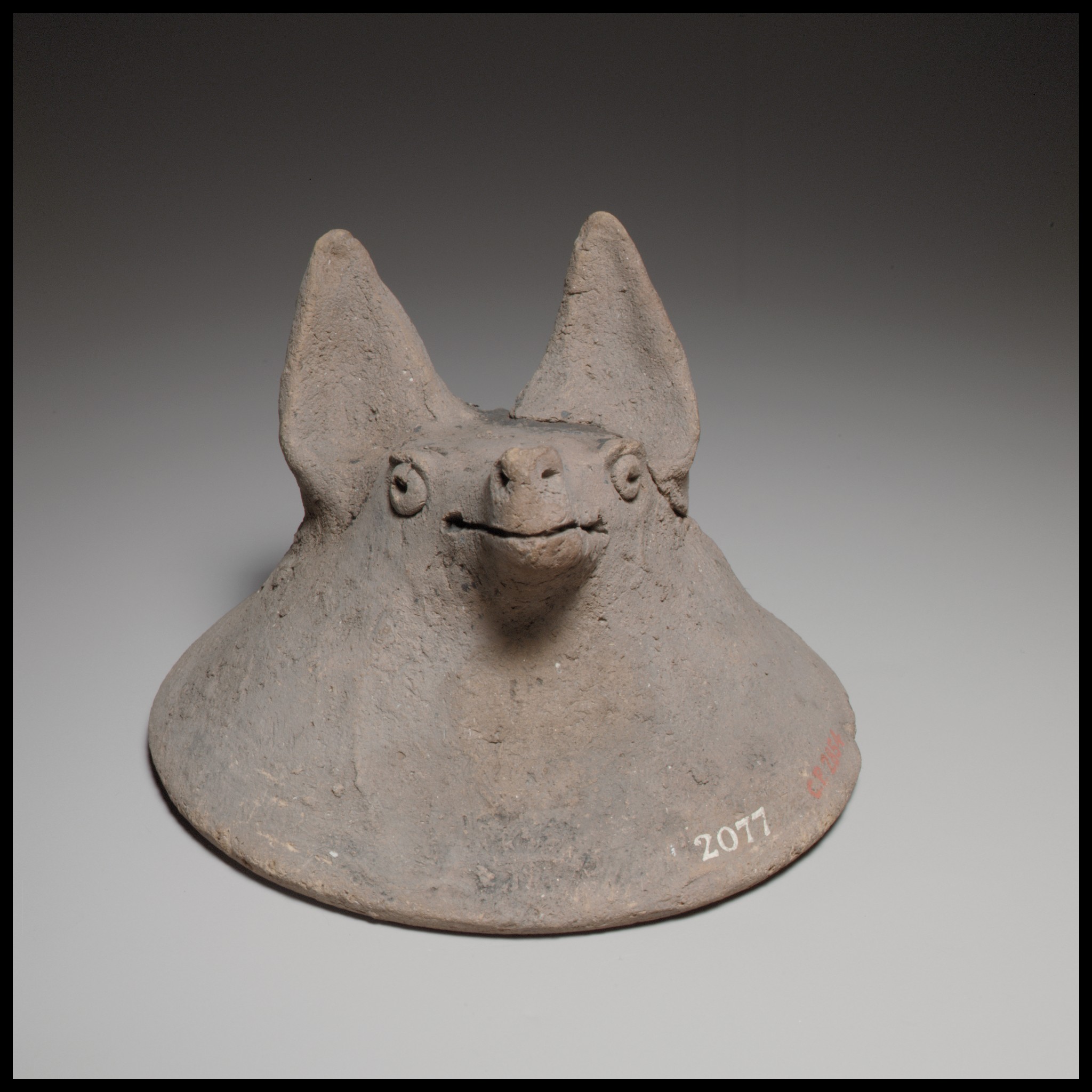
A Cypriot terracotta mask shaped like the head of a fox, dog or bat, roughly 600–480 BCE. Ancient mask-makers clearly worked with animal and hybrid faces long before anyone tried to draw Mormo specifically — a useful reminder that “frightening and not quite human” covered a lot of ground in Greek visual culture. Source. Metropolitan Museum of Art, public domain.
Mormo, Mormolyke and the Language of Fear
The related vocabulary is worth untangling briefly, without turning it into a Greek lesson. Mormō is the name itself. Mormolykē is a variant that later folk etymology connected to lykos, wolf, though the connection may be more about sound than substance. Mormolykeion is the more abstract, technical-sounding term: a frightening mask, apparition, or bugbear-object, which is why Plato could use it philosophically without invoking a specific being. A related verb, mormyssomai, simply means to frighten or threaten someone with bogeys.
None of this adds up to a fixed theology. It adds up to a family of fear-words that Greek speakers used across roughly a thousand years, from classical comedy through the Byzantine period, without ever needing to agree on exactly what Mormo was.
Mormo vs. Lamia, Gello and Empusa
Mormo gets lumped together constantly with three other Greek fright-figures, and the differences matter more than the overlap.
Lamia has an actual myth. Ancient sources describe her as a woman who lost her children — through Hera’s jealousy, in the most common version — and became a child-killer out of grief and rage, sometimes acquiring a taste for young blood in later retellings. She has motive, backstory, and a place in a divine conflict. Mormo has none of that. She’s a name, not a narrative.
Gello, or Gyllou in later Greek tradition, is closer to a specific danger than a general scare: she’s associated with infant death, miscarriage, and the perils surrounding childbirth specifically, rather than with disciplining children who are already alive and misbehaving. The overlap between Gello and Mormo grew over time, but the earlier material keeps them doing different jobs — one guards against reproductive disaster, the other keeps kids from wandering into the street.
Empusa is different again: a shapeshifting figure tied to Hecate, associated with roads, crossroads, and other liminal spaces, who appears to travelers rather than children and later picks up seductive, predatory traits in stories about young men lured to their doom. Later writers blurred all three names together. Philostratus, in his Life of Apollonius, has a character use empousa, lamia, and mormolykeia almost interchangeably, which is useful evidence that ordinary educated Greeks weren’t always precise about the distinction by the third century CE. It is not evidence that the three began as one figure, or that classical Athenians would have agreed with the conflation.
Was Mormo Connected to Hecate?
This is where most modern write-ups go wrong, and it’s worth being precise about why.
The connection traces to a single, much later source: the Refutatio Omnium Haeresium, a Christian polemical work traditionally attributed to Hippolytus of Rome, writing in the early third century CE. Book IV describes a magician’s trick for staging a fake supernatural apparition, and preserves the incantation supposedly used for it — invoking, among other names, Gorgo, Mormo, and Mene (the moon), addressed to a many-formed goddess in a nighttime ritual context. Scholars generally read that goddess as Hecate, given her strong association with the moon, crossroads, and night magic elsewhere in Greek religion.
That’s real evidence of something: a late-antique magical text that lists Mormo alongside lunar and chthonic names in an invocation. It is not evidence that Mormo was worshipped as Hecate’s independent consort, wife, or lieutenant in any organized cult. A name appearing in one magician’s spell three or four centuries after Aristophanes was making jokes about mormolykeion masks is not the same as an established theological relationship. The “consort of Hecate” framing that shows up constantly online skips that gap entirely.
How Mormo Became “King of the Ghouls”
The single biggest source of modern confusion is not ancient at all. It’s Anton LaVey’s 1969 Satanic Bible, specifically the “Infernal Names” list, a roughly two-page inventory of names from various mythologies compiled for ritual use. LaVey’s entry reads, in full: “Mormo — (Greek) King of the Ghouls, consort of Hecate.”
Almost every part of that phrase creates a problem. Mormo is grammatically and traditionally feminine in every ancient source — calling her a “king” of anything reverses her gender outright. “Ghoul” is an Arabic-derived concept (ghūl), tied to a completely separate folkloric tradition about corpse-eating desert spirits; nothing in Greek sources connects Mormo to that idea. And the Hecate “consort” claim, as covered above, rests on one late magical text being read as a marriage certificate.
LaVey wasn’t working as a classicist, and the Infernal Names list wasn’t built as scholarship — it was a ritual tool assembled from whatever sources were on hand, mixing real mythological names with garbled attributions across dozens of unrelated traditions. The problem is simply that this specific two-line entry has been copied, uncredited, across occult websites and mythology blogs for decades, until it started reading like inherited tradition instead of one mid-century American occultist’s paraphrase.
Mormo picked up a second, smaller pop-culture life through H.P. Lovecraft, who lifted the Hippolytus invocation almost verbatim for a ritual chant in his 1927 story “The Horror at Red Hook”: “Gorgo, Mormo, thousand-faced moon, look favourably on our sacrifices.” Lovecraft wasn’t inventing new lore either — he was borrowing an already-circulating classical curiosity and repurposing it for cosmic horror, the same move later occultists made for ritual manuals.
Was Mormo a Vampire?
Not in any sense the ancient sources support. There’s no classical text describing Mormo drinking blood, rising from the dead, or preying on the living in the specific way the word “vampire” implies.
The vampire label comes almost entirely from one influential twentieth-century writer, Montague Summers, whose books on vampire folklore grouped Mormo together with Lamia and Empusa as part of a broader argument that ancient Mediterranean cultures had their own proto-vampire traditions. Summers wasn’t fabricating a connection from nothing — Lamia and Empusa genuinely do have predatory, blood-associated elements in some ancient and Byzantine sources, and grouping frightening female spirits together is an old habit that goes back to writers like Philostratus. But folding Mormo specifically into that category overstates what the evidence shows for her in particular. She’s most securely attested as something children were warned about, not something that hunted adults for blood.
Did Ancient Greeks Worship Mormo?
There’s no known evidence of a Mormo temple, priesthood, or civic festival anywhere in the Greek world. She doesn’t appear in the kind of inscriptions, dedications, or sanctuary records that survive for major deities, and no ancient source describes formal cult practice built around her.
What she has instead is a long paper trail through comedy, philosophy, lexicography, and later magical texts — Aristophanes using her for a joke, Plato using her for an analogy, Hesychius and the Suda defining her for later readers who’d lost the everyday context, and a magician centuries later borrowing her name for a spell. That’s a real and traceable cultural life. It’s just a different kind of life than a goddess with an altar.
Why Parents Needed Monsters Like Mormo
It’s worth asking why a culture invents a figure like this at all, and the answer doesn’t require elaborate psychology. Ancient Greek households contained plenty of real hazards for an unsupervised child: open hearths, wells and cisterns, unpaved streets shared with animals and cart traffic, tools, and simple darkness in a world without reliable light after sunset. “Don’t go there” and “come inside now” are hard sells to a small child. “Mormo will get you” is a much easier one, and it costs nothing to say.
That’s a reasonable, historically grounded explanation for why a scare-figure like Mormo would be useful, and it’s supported by exactly the kind of evidence that survives — casual, offhand parental threats rather than developed theology. It’s worth being cautious about pushing the explanation further than that. Claims about specifically how Greek households were organized, who supervised children day to day, or how enslaved nurses factored into the practice vary by period, region, and household wealth, and the ancient evidence for any of it is thinner than popular accounts sometimes suggest. The safer version of the argument is simply that a flexible, story-free scare-word was a cheap and effective piece of childrearing technology, reused for centuries because it worked.
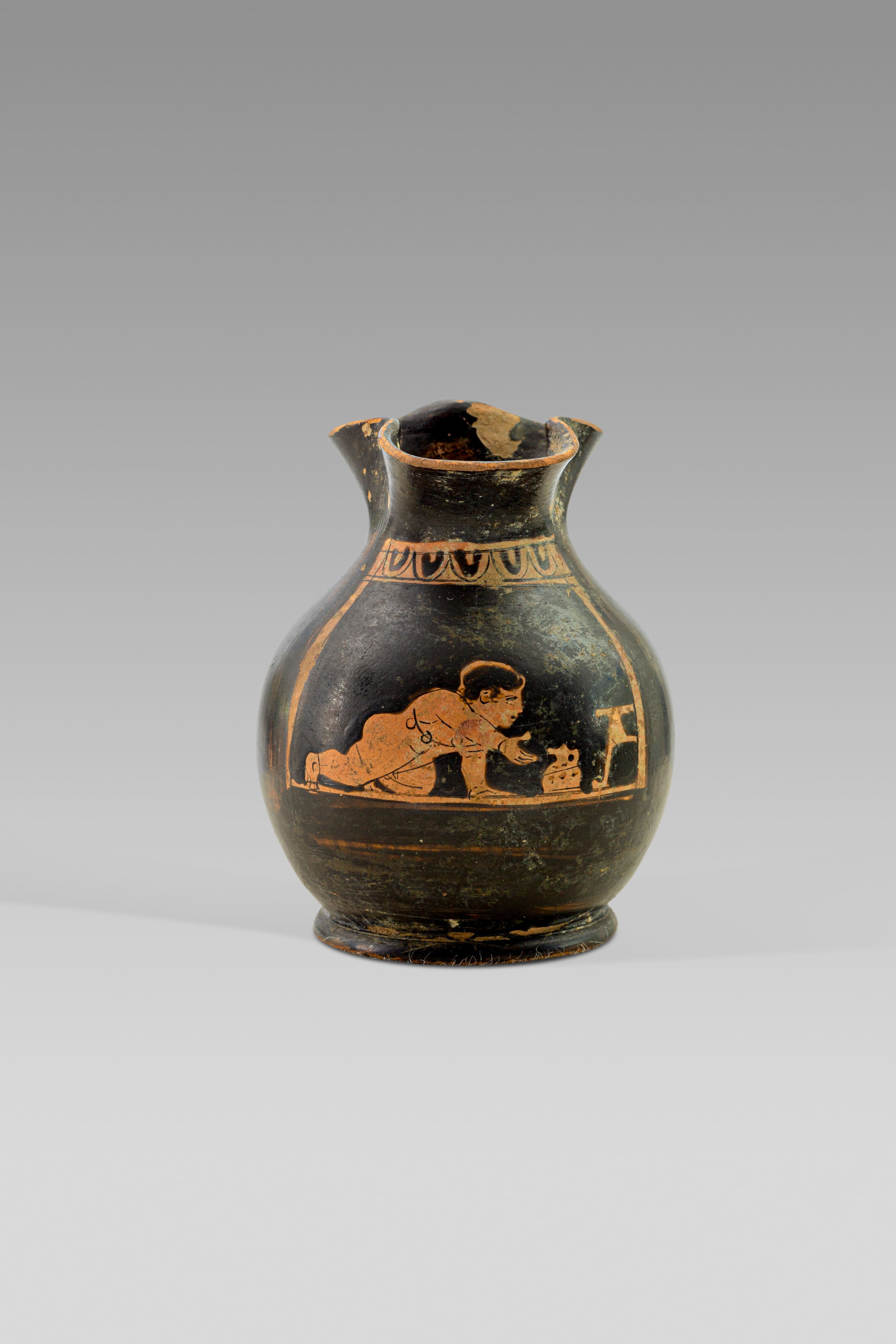
A small terracotta chous, the type of miniature jug associated with young children in Athenian household and festival life. Not connected to Mormo directly — included here for domestic context, not as an illustration of the bugbear herself. Source. Metropolitan Museum of Art, public domain.
Did Mormo Eat Children?
Later evidence complicates the tidy “harmless nursery word” picture, and the chronology matters. A scholiast — an ancient commentator annotating someone else’s text, in this case working well after the classical period — preserves a story that the original Mormo was a woman of Corinth who devoured her own children and then fled, becoming a wandering source of terror. It’s the same basic shape as Lamia’s myth, and it may well be a later borrowing from her story rather than an independent Mormo tradition.
This account survives in only one line of transmission, and nothing in the earlier classical material — Aristophanes, Erinna, Theocritus — mentions or assumes it. Treat it as exactly what it is: a later etiological explanation invented to give a simple fear-word a backstory, not evidence for what fifth-century Athenians believed when they said “Mormo bites.”
Its Name Was Mormo: How Modern Horror Changed Her
Its Name Was Mormo, an independent found-footage horror film written, directed by, and starring Mark Andrew Bowers alongside his own family, gave the name its most visible twenty-first-century outing. The film had a limited theatrical run in November 2024 followed by a digital release, and is scheduled to reach a wider audience on Shudder on September 7, 2026. Its version of Mormo functions as a targeted, almost demonic force that singles out individual family members — closer to a modern cursed-household horror entity than anything in the Greek evidence.
That’s a legitimate creative choice, and found-footage horror has never been in the business of classical philology. It’s worth naming clearly, though, because it’s one more layer added onto a figure who started out as a word a tired parent used at bedtime. Between the Corinthian scholiast, LaVey, Lovecraft, and now an indie horror film, Mormo has spent roughly two and a half thousand years accumulating a mythology that the earliest sources never gave her.
Mormo isn’t the only ancient figure whose reputation for genuine menace outgrew a much smaller original role. Long before Hecate or Lamia entered the picture, several Mediterranean and Near Eastern traditions developed their own separate supernatural explanations for the everyday dangers surrounding children — the Mesopotamian and Jewish traditions around Lilith took a very different shape, but they answer a similarly old, practical fear: what do you tell a child, or yourself, about the dangers you can’t fully explain.
So What Was Mormo, Really?
Strip away LaVey’s ghoul kingship, the Hecate marriage, and the vampire label, and what’s left is smaller but more solid: a Greek household bugbear, invoked casually across a very long span of time, described inconsistently because consistency was never the point, and eventually useful enough as a concept that a philosopher could borrow it to talk about the fear of death itself.
That’s a modest résumé compared to what modern demonology has built around her. It also happens to be the version the evidence actually supports.
Frequently Asked Questions
Who is Mormo in Greek mythology? A nursery bugbear — a frightening female figure Greek parents and nurses invoked to scare children into good behavior, first clearly attested in classical comedy and poetry rather than formal myth.
Was Mormo a demon? Not in the ancient sources, and not in the organized, infernal sense modern demonology implies. She functioned as a folkloric scare-figure, not a being with a documented cult or a fixed place in Greek religious practice.
Was Mormo a vampire? No surviving classical evidence describes her as an undead, blood-drinking figure. That label comes from twentieth-century writers like Montague Summers, who grouped her with genuinely predatory figures like Lamia and Empusa.
Did Mormo eat children? A late ancient commentary claims her origin was a child-eating woman from Corinth, but this appears centuries after the earliest references and isn’t supported by the classical material, which mostly presents her as a threat used against living, misbehaving children.
What did Mormo look like? No standardized ancient design exists. The most vivid surviving description, from the poet Erinna, describes huge ears, four-footed movement, and a constantly changing face — an unstable image rather than a fixed monster.
Was Mormo connected to Hecate? Only through one late magical text, a third-century CE incantation that lists Mormo alongside lunar and chthonic names. That’s evidence of a late magical association, not proof of an ancient consort relationship.
Was Mormo Lamia’s servant? No ancient source supports this. Lamia and Mormo are frequently confused or merged in later, looser usage, but nothing in the classical evidence makes Mormo subordinate to her.
Was Mormo worshipped? No evidence survives of temples, priests, or festivals dedicated to her. She appears in literature, lexicons, and later magical texts rather than in cult records.
What is Mormolyke? A variant name for the same figure, sometimes explained through folk etymology connecting it to “wolf.” Mormolykeion is a related, more abstract term for a frightening mask or bugbear-object.
Is Its Name Was Mormo based on Greek mythology? Loosely. The film borrows the name and a general “ancient Greek demon” framing, but its cursed, family-targeting entity has little in common with the classical nursery bugbear described by writers like Theocritus and Erinna.
Sources & further reading
- Plato, Phaedo 77e (Perseus Digital Library)
- Strabo, Geography 1.2.8 (Perseus Digital Library)
- Aristophanes, Acharnians and Peace (Perseus Digital Library)
- Suda On Line: mormolykeion
- H.P. Lovecraft, The Horror at Red Hook (Weird Tales, 1927)
- Anton Szandor LaVey, The Satanic Bible (1969), "The Infernal Names"
- Metropolitan Museum of Art: Terracotta comic mask, 74.51.1520