The Index
Paris Catacombs: The Real History Behind the Underground Ossuary
Why are there bones beneath Paris? The Catacombs began as a solution to cemetery overcrowding, not a secret burial cult or an ancient underground city.
Topics: Paris Catacombs, Ossuaries, Dark History, France
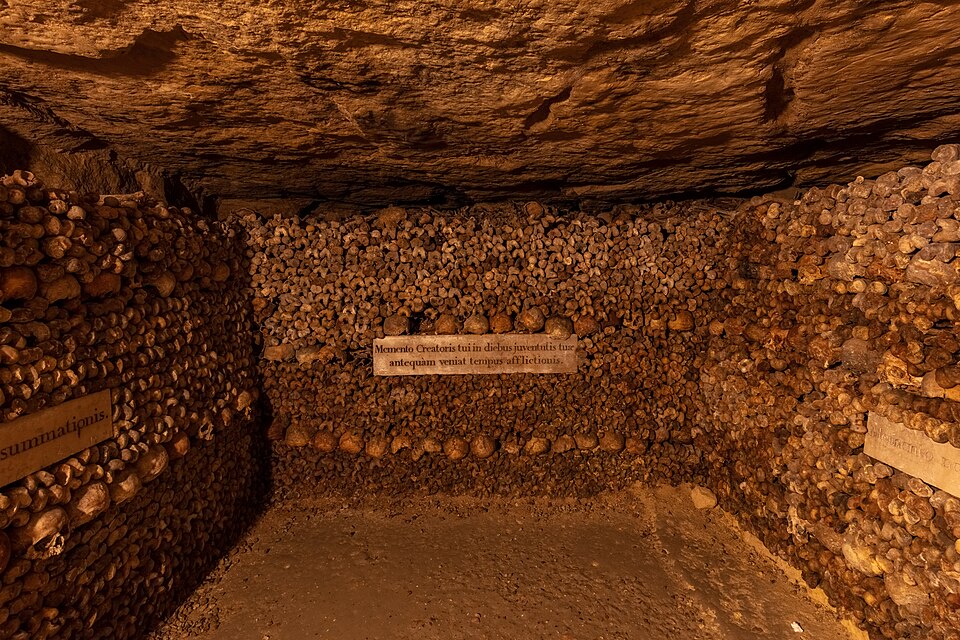
Diego Delso, 2022 (CC BY-SA 4.0)
The Paris Catacombs are an underground ossuary: a place where human bones were gathered after removal from earlier burials. They occupy former quarries that were adapted for that purpose in the late eighteenth century. The remains were not put there by a secret cult, and the galleries were not originally excavated as the tombs of an ancient civilization.
The reason was more practical and more unsettling. Paris had a problem with its cemeteries. Moving the dead below ground became part of the effort to reorganize the city above them.
Why were the bones moved underground?
According to the Catacombs’ official history, public-health concerns surrounding Parisian cemeteries led authorities to choose the former Tombe-Issoire quarries as a new resting place. The first transfers, between 1785 and 1787, included remains from the Saints-Innocents cemetery, which had closed in 1780.
The municipal ossuary was consecrated on April 7, 1786. Transfers from other burial grounds continued in later phases, linking the underground collection to changes in the city’s streets, parishes and use of land.
That history explains why an ossuary does not look like a conventional cemetery. Bones removed from earlier graves do not retain the original arrangement of a person laid to rest. The Catacombs collect the consequences of many previous burials rather than one catastrophic event.
It is therefore misleading to call every person represented there a plague victim. The existence of bones establishes neither one cause of death nor one moment when the whole collection arrived.
Were the tunnels always catacombs?
No. The quarry spaces existed before their conversion into an ossuary. The name “Catacombs” referred to the burial site, drawing an association with the Roman catacombs, rather than describing the original purpose of the excavations.
The distinction matters because the name is now often applied to much more of underground Paris. The site’s own explanation cautions against confusing the ossuary with the wider quarry network.
A tunnel photograph identified only as “under Paris” may therefore show something quite different from the arranged bone galleries. It could document another part of the quarry system without depicting the municipal ossuary at all.
The actual history contains two successive uses of space: stone was taken out, then human remains were brought in. They should not be collapsed into one supposedly ancient burial project.
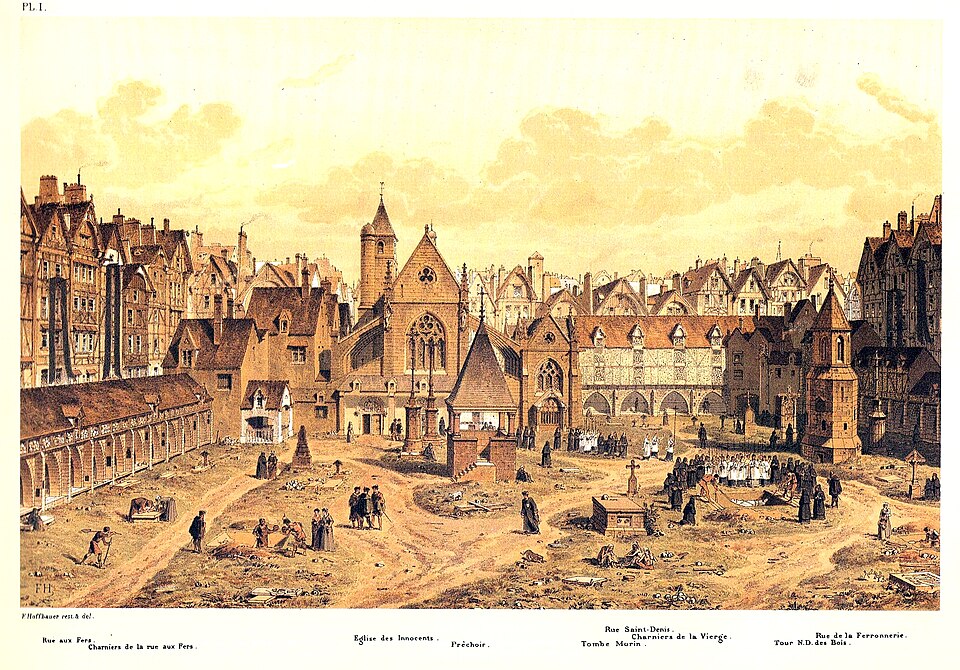
The Saints-Innocents cemetery and church as reconstructed by illustrator Fedor Hoffbauer for a 19th-century history of old Paris, showing the site around 1550. The cemetery closed in 1780, and its remains were among the first transferred to the Catacombs. Source. Public domain.
Why are the bones arranged in patterns?
The galleries were deliberately organized for visitors. Under Inspector Héricart de Thury, loosely accumulated remains were rearranged into a more architectural presentation. The official account describes walls faced with selected long bones and skulls, with other bones and fragments placed behind them.
The visible surface is therefore only part of the collection. It is both an arrangement of remains and a structure made to hold other remains in place. Seeing that relationship changes the impression of a decorative wall: the ordered face conceals a less orderly accumulation behind it.
Inscriptions and monuments also invite reflection on death. The effect can be frightening to a modern viewer, but a setting designed to provoke contemplation is not automatically evidence of occult worship.
That distinction is especially important with photographs. A tightly cropped skull pattern can seem disconnected from any human purpose. A wider view restores the gallery, the inscription and the act of remembrance around it.
How an ossuary became a place to visit
Public visits began in 1809, according to the official chronology. The encounter was therefore not invented by modern ghost tourism. People were already entering the galleries to see and think about the collected dead in the nineteenth century.
There is an uncomfortable tension in that activity. An ossuary can be a place of respectful contemplation and an object of curiosity at the same time. The visitor looks; the people whose remains are being viewed cannot answer back.
That tension does not need a ghost story to become disturbing. Much of the Catacombs’ power comes from scale and repetition, and from the difficulty of connecting individual lives to an ordered mass of remains.
What Nadar’s photographs reveal
The official ossuary account records Nadar’s experiments with artificial-light photography in 1861. Long exposures made the underground work difficult, and he used dummies to represent workers in some scenes.
That detail makes the photographs more revealing, not less. They preserve both the place and an attempt to make it visible with the technology available. A human-looking figure in a historical photograph may be part of that photographic construction rather than a person who stood motionless during the exposure.
It is also a reminder that “old photograph” does not mean “unmediated view.” Lighting, arrangement and the photographer’s purpose belong to the history of the image.
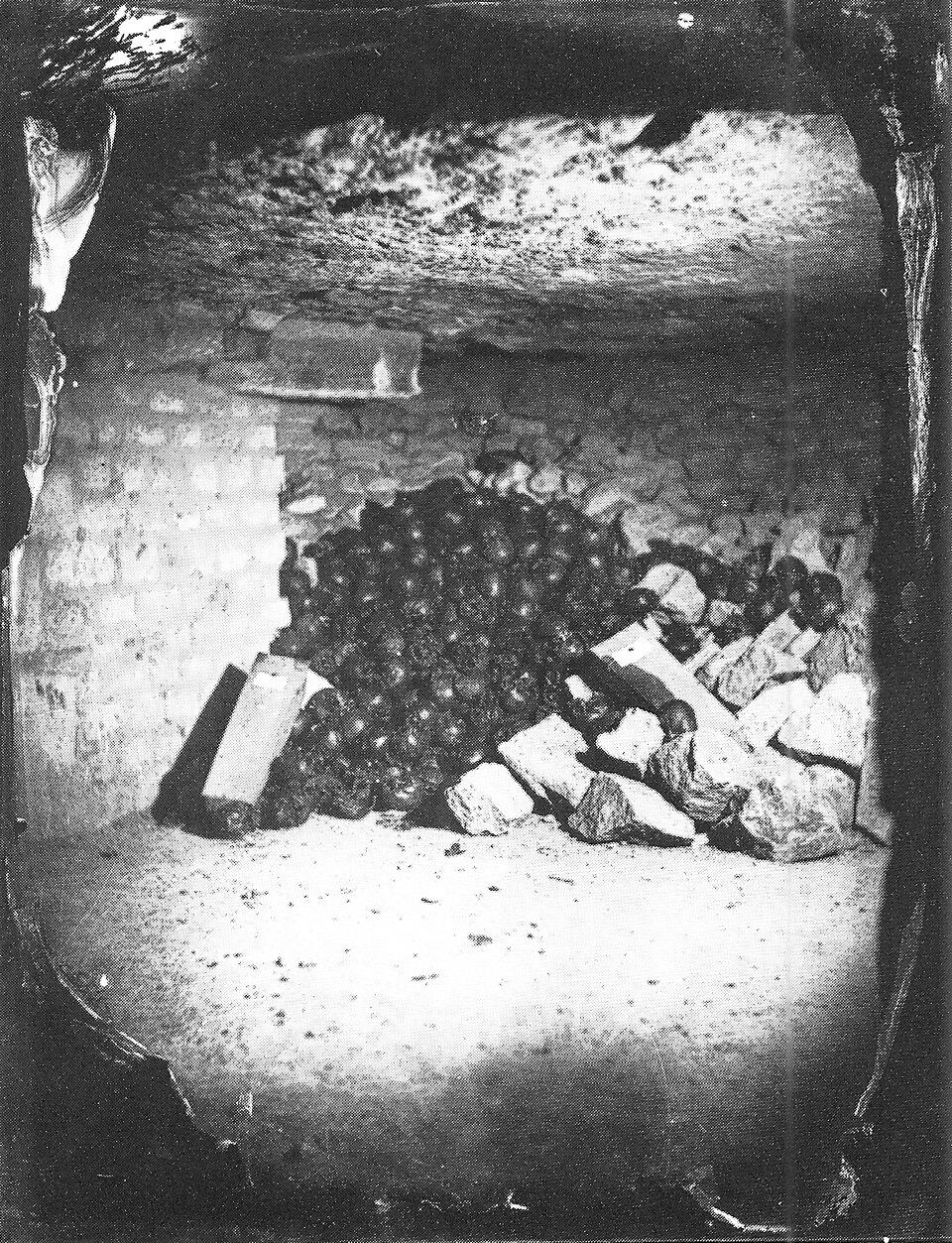
One of Félix Nadar’s Catacombs photographs, made around 1861 using early artificial-light equipment; some figures in his series represent workers with mannequins rather than long-exposure portraits. Source. Public domain.
Are the Paris Catacombs haunted?
The historical sources used here explain the ossuary’s creation, arrangement and public presentation. They do not establish a supernatural presence. An account of a visitor feeling watched or frightened would be a reported experience, not proof that a particular person among the dead had returned.
Horror fiction can give the underground spaces impossible dimensions, hidden supernatural passages or an evil purpose. Those are creative choices. They should not replace the documented explanation for why the bones are there.
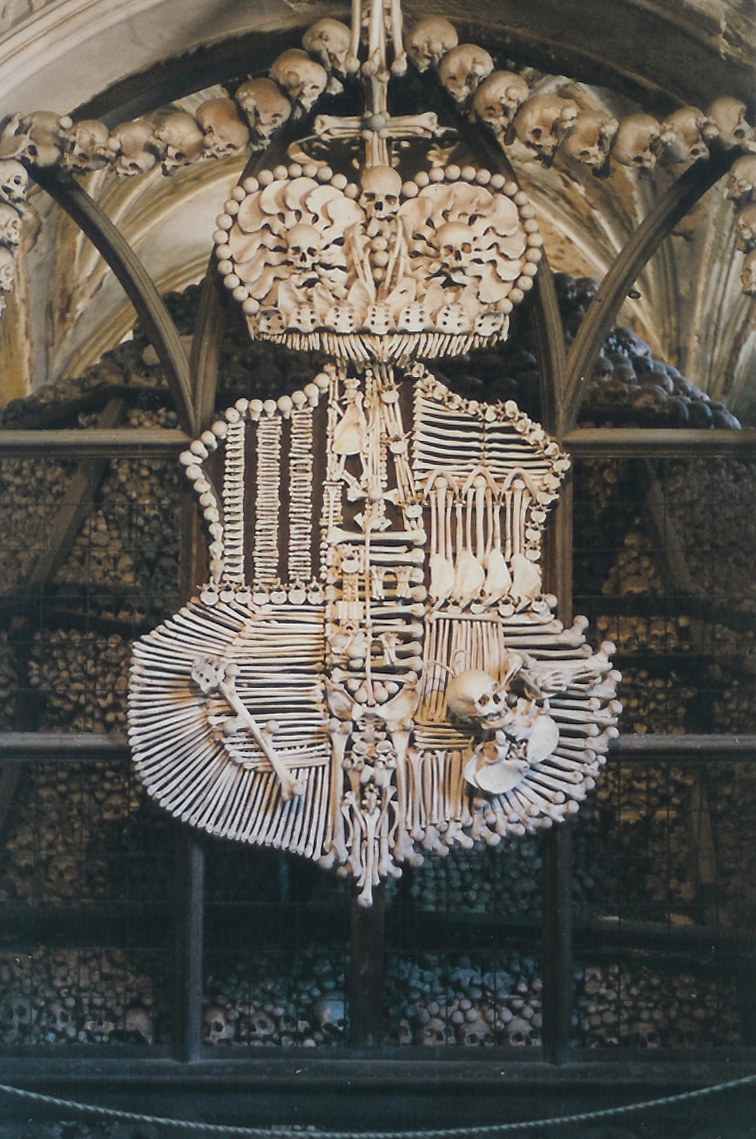
For another site where the arrangement of human remains can be mistaken for something sinister, see Sedlec Ossuary. The appearance is striking in both places, but the histories and religious contexts are not identical.
The Catacombs do not need an invented burial cult to be unsettling. Their real subject is what a city does with its dead when the spaces once reserved for them can no longer remain as they were.