The Index
Sedlec Ossuary: The Real Story of the Czech Bone Church
Sedlec's bone chapel is a Christian ossuary, not a death cult. Explore its cemetery origins, famous decorations and the history behind the skulls.
Topics: Sedlec Ossuary, Ossuaries, Dark History, Czechia
Sedlec Ossuary, near Kutna Hora in Czechia, is a chapel containing human remains arranged into striking architectural and decorative forms. The skulls and bones are real. The idea that they reveal a secret death cult is not the site’s historical explanation.
This is the lower chapel of the Cemetery Church of All Saints, a Christian burial place connected to an older cemetery. Its unsettling appearance comes from the deliberate arrangement of remains removed from graves, not from a collection assembled for horror entertainment.
What is an ossuary?
An ossuary is a place for keeping human bones, often after their removal from earlier burials. The word describes a function, not a style. An ossuary need not have a chandelier or elaborately patterned walls.
Sedlec is unusual because the remains became part of a carefully composed interior. That can make it look as though the decoration was the reason the collection existed. The sequence is more complicated: burial, the movement of remains and the design of the chapel belong to different stages of its history.
The distinction also changes the question to ask. “Who built a church out of bones?” is an arresting phrase, but the church itself is not made entirely from skeletons. Its masonry encloses arrangements of remains. The people represented there had lives before they became part of those arrangements.
The cemetery came first
The Sedlec parish’s historical account connects the site to a Cistercian monastery founded in 1142 and places the two-storey cemetery church in the first half of the fourteenth century. Its lower chapel provided space for remains, while the upper chapel served commemorative worship.
The surrounding cemetery received burials over time. When its extent was reduced and graves were cleared, bones were transferred rather than simply discarded. That practical history underlies the extraordinary interior.
A story about Abbot Heidenreich bringing soil from the Holy Land also belongs to the cemetery’s reputation. The parish explicitly presents it as a legend. It should not become an independently verified travel episode merely because it appears in an official account of the site.
The distinction does not make the legend irrelevant. It explains how the cemetery was imagined as a desirable resting place without requiring us to treat every detail of that explanation as archival fact.
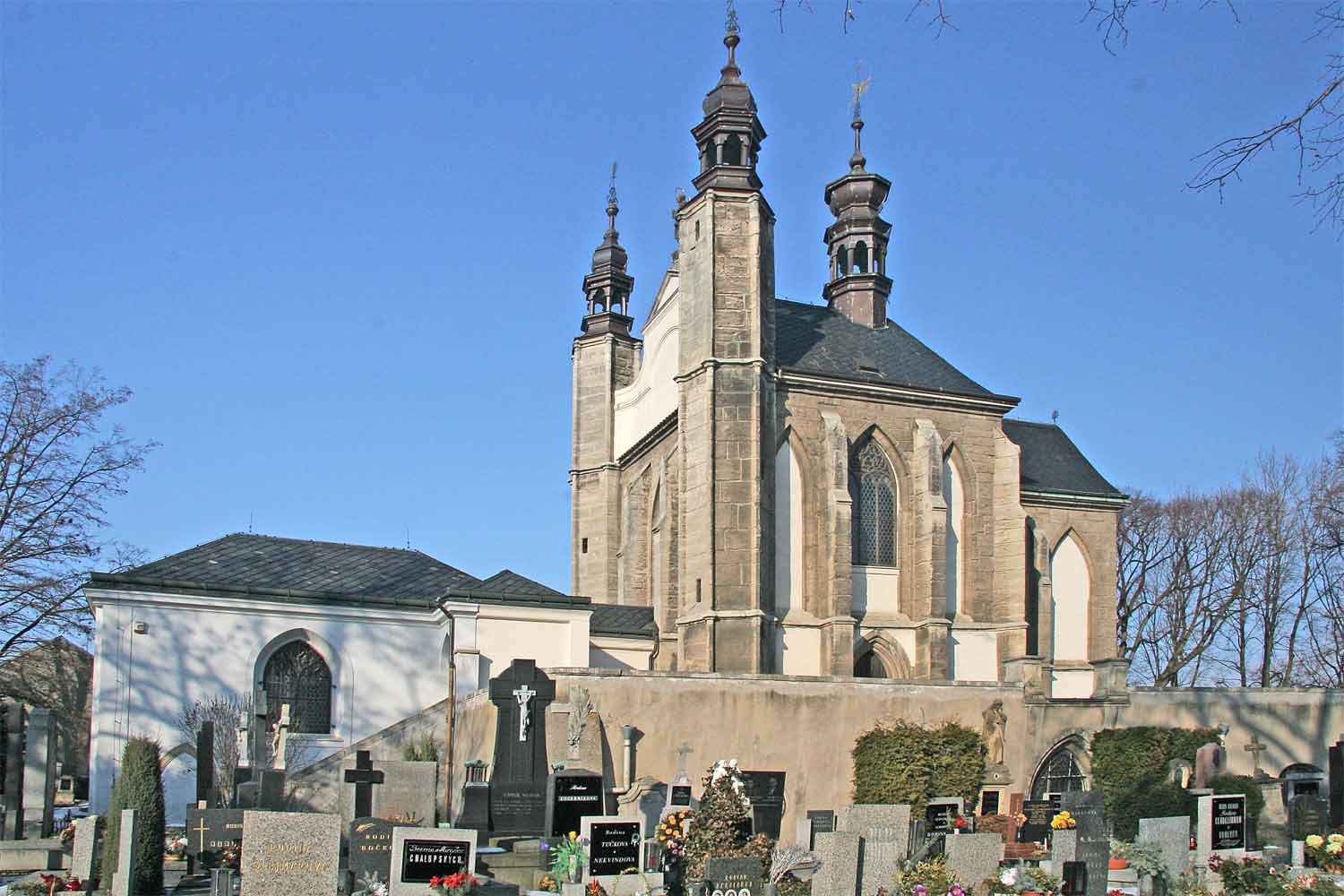
The Cemetery Church of All Saints at Sedlec, seen from the surrounding graveyard. The ossuary occupies the building’s lower chapel. Source. Photo by cs:User:Zp, licensed CC BY-SA 3.0.
Who arranged the bones?
Frantisek Rint is closely associated with the famous nineteenth-century decorations. The parish dates the completion of his work to 1870 and identifies the Schwarzenberg family as patrons of the reconstruction.
Rint was not working in an empty room with no earlier history of arrangement. The official account describes earlier decorative phases and cautiously associates a basic Baroque scheme with architect Jan Santini-Aichel. That qualification matters: the history is not simply one artist inventing the entire ossuary on one occasion.
A useful way to read the room is as an accumulation of decisions. The storage of remains, the religious setting and later aesthetic changes do not all have the same date or the same author.
That also explains why a familiar photograph cannot settle every historical question. It records the visible arrangement at a particular moment. It does not reveal, by itself, which parts belong to each earlier intervention.
The chandelier and the coat of arms
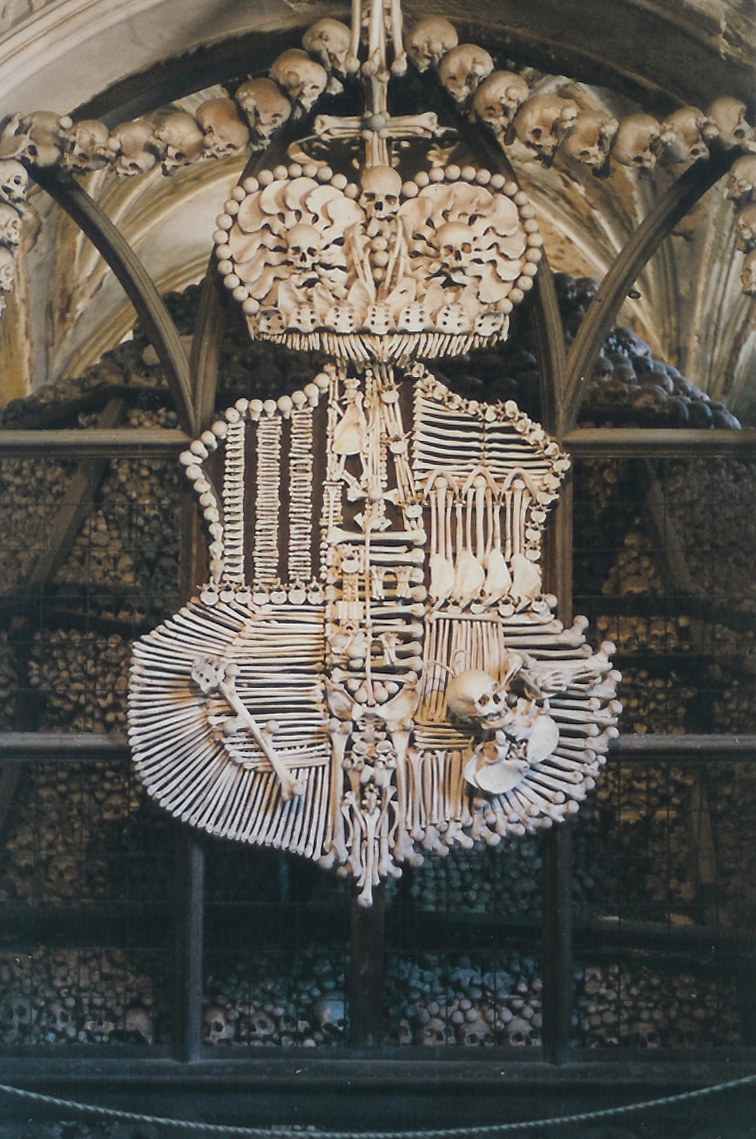
The parish’s description of the chapel identifies large bone pyramids, a chandelier and the Schwarzenberg coat of arms among its features. It connects the chandelier with light and hope, while treating the coat of arms as a secular acknowledgment of patronage.
The chandelier is often said to contain every type of bone in the human body. The parish itself qualifies that description rather than presenting it as an anatomical inventory. It is better to retain that uncertainty than to turn a memorable claim into an exact, unchecked count.
The heraldic decoration is also worth distinguishing from the devotional setting around it. Not every form in the room has the same purpose. Some communicate religious ideas; others preserve the relationship between the place and the people who funded its restoration.
The remarkable material can initially make every object seem equally macabre. Looking at their different functions restores some of the room’s historical detail.
What does memento mori mean here?
Memento mori is a reminder of mortality. In the parish’s interpretation, the chapel also points toward Christian belief in resurrection. It presents that belief as a source of hope rather than treating the remains as trophies of death.
A visitor does not have to share the belief to understand its role. The relevant distinction is between explaining what a religious site means to its custodians and declaring its supernatural teachings proven.
Nor does understanding the intention dictate a visitor’s emotional response. Someone can find the interior disturbing while recognizing that “disturbing” and “sinister purpose” are not the same thing. The emotional shock and the historical explanation can coexist.
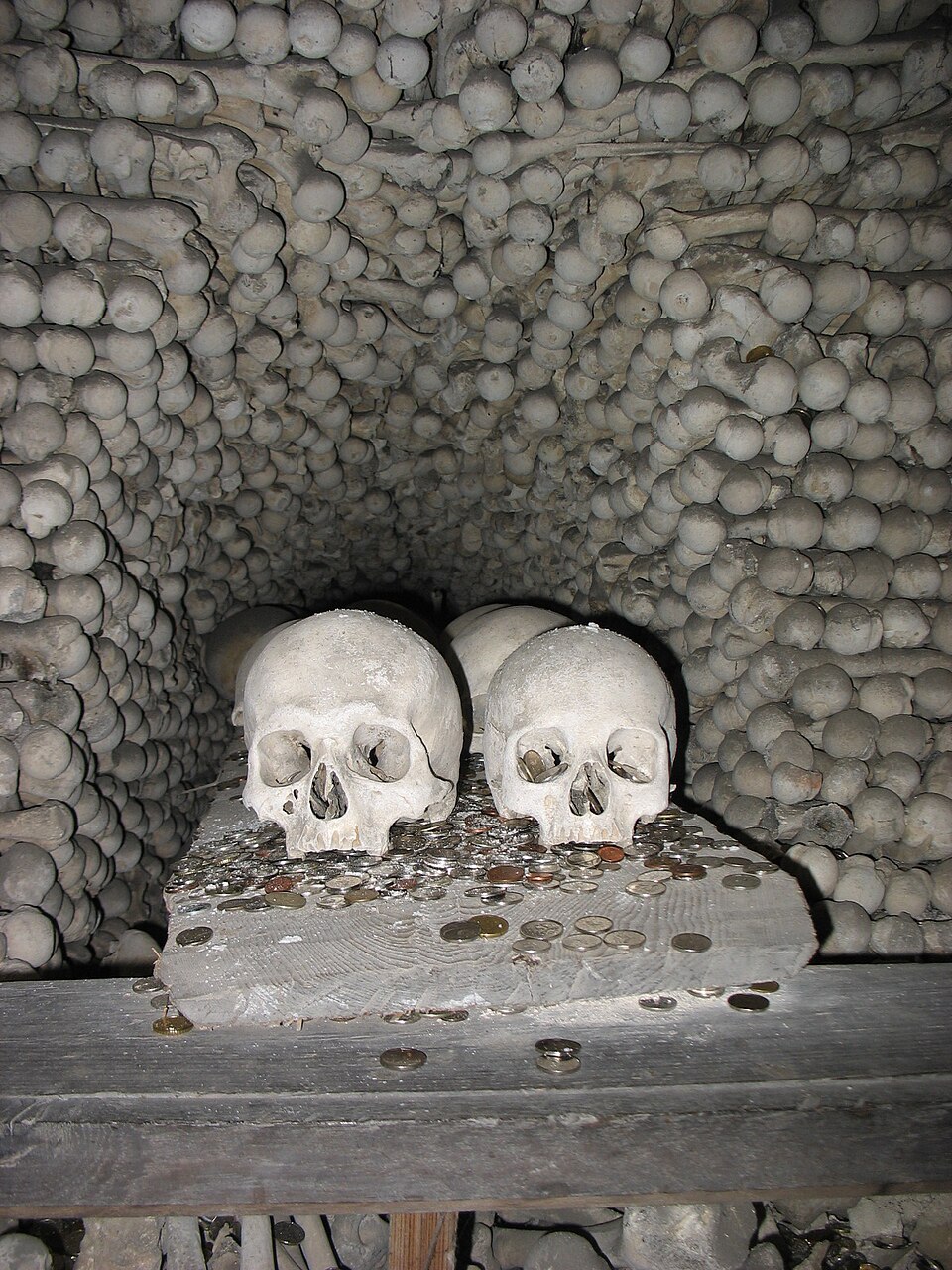
A closer view of the stacked-bone walls that line the ossuary’s chapel, with two skulls set on a ledge. Source. Photo by misha, licensed CC BY-SA 3.0.
Whose remains are in Sedlec?
The parish identifies the bones with people from the surrounding burial community but emphasizes how little is known about individual lives. A general history of famine, disease and conflict cannot provide a personal cause of death for each person represented in the chapel.
For that reason, a caption should not call a row of skulls “plague victims” simply because plague affected the region. Nor should an article assign a precise biography to an unidentified individual in order to make a stronger story.
The absence of names is itself meaningful. The display can create an overwhelming collective impression while leaving us unable to recover most of the individual stories within it.
Why the real explanation is enough
Sedlec is sometimes approached as though a place this visually extreme must hide an equally extreme secret. Its actual history involves burial space, faith, patronage and changing ideas about how the dead should be represented.
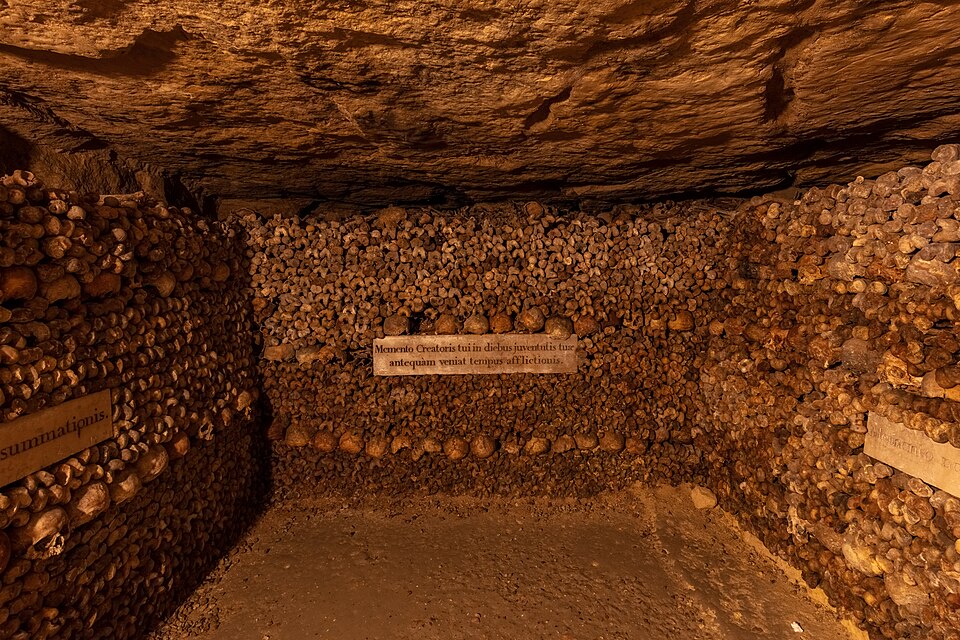
That is different from the municipal response to cemetery problems behind the Paris Catacombs, even though both places gather remains from earlier graves. One should not be used as a generic image for the other.
The bone church is not less remarkable once its purpose is understood. Its deepest discomfort may be the simplest one: the decorative forms are made from people, and the patterns cannot tell us everything about who those people were.