The Index / Unsolved Cases
The Black Dahlia Murder: What Happened to Elizabeth Short?
Elizabeth Short's 1947 murder was never solved. Here is what the investigation established, what the press added, and why the leading suspect claims remain unproven.
Topics: Elizabeth Short, Black Dahlia, Los Angeles, Unsolved Murder
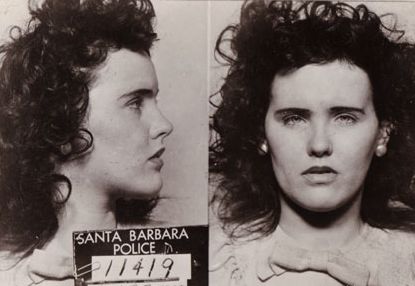
Santa Barbara Police / Wikimedia Commons (Public Domain)
Elizabeth Short was a 22-year-old woman whose murder in Los Angeles in January 1947 was never solved. The nickname “Black Dahlia” came from newspaper coverage, not from a name she used for herself. Decades of books, films and suspect theories have made the case famous, but they have not produced evidence sufficient to identify a killer.
Elizabeth Short before the nickname
Short was born in Massachusetts in 1924. Her parents separated after her father disappeared during the Depression and later re-established contact. As a young adult she spent time in Massachusetts, Florida and California, moving between relatives, friends and short-term accommodations. That unsettled biography has sometimes been turned into a morality tale in popular retellings. It should not be. It explains why investigators had to reconstruct her movements from many addresses and acquaintances; it does not explain her murder.
By early 1947, Short was in Southern California. The final days are known only in pieces. She had been traveling with Robert Manley, a married salesman, and was left in Los Angeles on January 9 after a trip from San Diego. Reports of subsequent sightings and contacts were investigated, but the public record does not provide a complete, certain account of every hour before her death.
What is documented
Short had moved frequently between Massachusetts, Florida and California before her death. On January 15, 1947, her body was found in a vacant lot in Leimert Park. The Los Angeles Police Department led the homicide inquiry; the FBI assisted with identification and interstate leads. Fingerprints helped establish her identity after newspapers published a description of the unidentified victim.
The investigation was unusually public. Reporters received letters and a package attributed to someone claiming knowledge of the crime. Those contacts mattered to detectives, but a claimed communication is not the same as a verified confession. The enormous attention also produced false confessions and a long list of people treated as possible leads rather than proven perpetrators.
The name “Black Dahlia” is often presented as though it were part of Short’s identity before the case. It was a press construction, likely shaped by accounts of her dark clothing and the recent film The Blue Dahlia. Newspapers competed for access, photographs and a compelling label, sometimes publishing personal details that gave the murder a mythology of its own. Readers should be careful with claims that begin with an anonymous columnist or a later true-crime book and cannot be traced to a contemporaneous record.
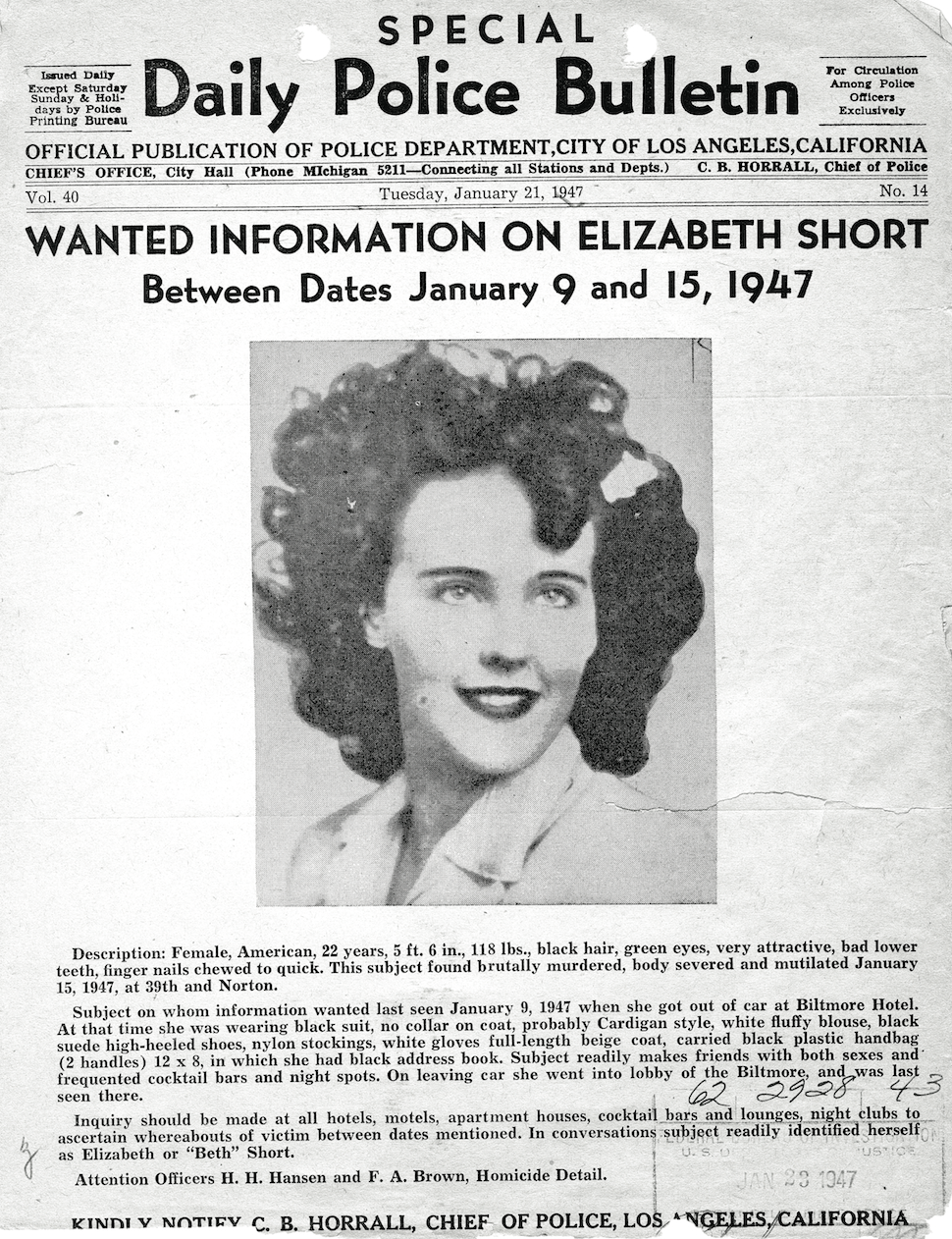
Elizabeth Short police bulletin, City of Los Angeles Police Department / Wikimedia Commons (Public Domain).
Discovery, identification and the scale of the inquiry
The discovery in Leimert Park on January 15 immediately became a major Los Angeles story. Police and the coroner documented the crime scene; the FBI’s role included identification and the interstate work for which federal records were useful. An FBI account notes that fingerprints helped identify Short after a description was circulated. That practical detail is easy to lose amid the case’s legend, but it was essential: investigators first had to determine who the victim was before they could reconstruct her life and contacts.
LAPD detectives then worked through acquaintances, hotel and travel leads, physical correspondence, and reports from the public. Attention itself complicated the task. In a notorious case, people can volunteer information because they are mistaken, seeking publicity, protecting someone, or trying to insert themselves into the narrative. The number of confessions and claimed solutions is therefore not evidence that police had many strong cases; it is part of the reason the file became difficult to separate from noise.
The package sent to a newspaper after the killing contained personal belongings associated with Short. It was treated as potentially significant, but it did not identify a perpetrator. Likewise, letters attributed to a killer have been debated over decades. Without a conclusive forensic or documentary connection, they cannot settle the case.
A case crowded with suspects
Robert Manley, who had driven Short shortly before she disappeared, was investigated and cleared. Mark Hansen and Leslie Dillon were among people examined in the inquiry. George Hodel became the subject of later, highly publicized accusations by his son, former LAPD detective Steve Hodel. Those claims have been disputed by other researchers and were never resolved by a charge, trial or official finding. They should not be presented as a solution.
Manley’s importance is chronological, not proof of guilt. He was among the last confirmed people to see Short and was scrutinized accordingly. Accounts of his polygraph testing and cooperation circulate widely, but the larger point is that investigators did not establish a case against him.
Hansen, a Los Angeles nightclub and entertainment figure in whose circle Short spent time, was also investigated. Leslie Dillon came to police attention after writing about the case and was questioned at length. Neither man’s inclusion in an investigative file establishes culpability. In old cases, being a suspect can mean anything from a lead worth checking to a person detectives regarded seriously; it is not interchangeable with being a killer.
The George Hodel theory rests largely on a later reconstruction by his son, Steve Hodel, who argued that his physician father matched aspects of the crime and some police surveillance material. Critics have challenged the interpretation of those materials and the theory’s leaps from coincidence to identification. No prosecutor or court has resolved that dispute. The responsible wording is not that the case has been solved, but that Hodel is one of several publicly argued suspects in an unsolved investigation.
The alleged connection between Short and the Cecil Hotel is similarly fragile. A location near the hotel appears in some retellings, but no reliable record establishes that she stayed there. The distinction matters, especially because the hotel’s later history has encouraged a great deal of retrospective linking. Our Cecil Hotel investigation separates its documented history from claims attached to it later.
Why it remains unsolved
The original inquiry had no DNA profiling, modern database searching, or contemporary standards for preserving and sharing evidence. That does not make every later theory equally plausible. It means the record contains unanswered questions, incomplete evidence and a large amount of publicity-driven noise.
Time has made the problem harder. Witnesses, detectives and possible suspects died; memories shifted; files were summarized or excerpted rather than available in full. Modern forensic methods can only help if usable evidence survives and a lawful comparison is possible. It is also wrong to imply that an old case is solved simply because a modern author has supplied a coherent narrative. A coherent narrative can be compelling without meeting the evidentiary standard required to name a murderer.
Elizabeth Short is often reduced to a nickname and a mystery. The more responsible account begins with the fact that she was a real victim whose killing remains unsolved. Readers comparing long-running cases can also see our guides to the Zodiac Killer and Jack the Ripper.
Questions readers ask
Who was the Black Dahlia? Elizabeth Short, a 22-year-old woman murdered in Los Angeles in 1947.
Was the murder solved? No. No one was convicted, and no official solution has been established.
Was George Hodel the killer? It is an allegation, not a proven conclusion.
Why were there so many false confessions? High-profile crimes attract people who are mistaken, seeking attention, or trying to mislead investigators. A confession needs independent corroboration before it can establish anything.