Lore & Explained / Folklore
The Werewolves of Ossory: The Medieval Irish Legend of a Priest and Two Cursed Wolves
What Gerald of Wales recorded about the werewolves of Ossory: the seven-year curse, a priest and communion, and the limits of the medieval evidence.
Topics: Werewolves of Ossory, Osraige, Irish folklore, Gerald of Wales, Topographia Hibernica, Medieval werewolves, Lycanthropy, Medieval Ireland
In one of medieval Ireland’s strangest recorded stories, a wolf does not attack a priest. It asks him to help his dying wife.
The wolf can speak, knows Christian teaching and insists that the woman inside the second wolf is still human. The priest must decide whether giving the Eucharist to a creature with an animal’s body is a sacrament or a terrible mistake.
This is the Werewolves of Ossory story recorded by Gerald of Wales in the late twelfth century. It is not an eyewitness account of a supernatural event by Gerald himself. It is a medieval writer’s report of another person’s alleged encounter, preserved in a work about Ireland that also reflects the religious and political assumptions of its author.
The difference matters. The story is historically real as a written medieval account. Its talking wolves and transformations are not established historical facts.
What happens in the original werewolf story?
In Part II, Chapter XIX of Gerald’s Topographia Hibernica (also called Topography of Ireland), a priest is travelling from Ulster towards Meath with a young companion. He stops to spend the night by a fire in a wood. A wolf approaches and speaks to him in human language, reassuring him with words about God.
The animal explains that it and its female companion come from Ossory, a kingdom in southeastern Ireland. According to the wolf, a curse associated with Saint Natalis forces one man and one woman from their people to live as wolves for seven years. If they survive, they regain their human forms and another pair takes their place.
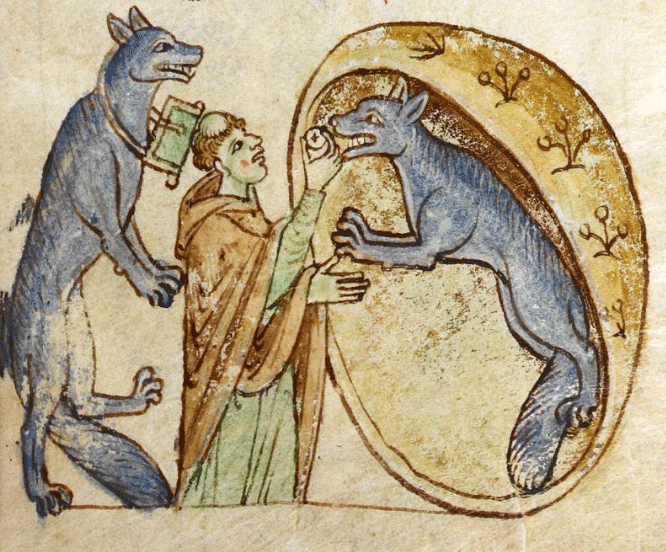
The second wolf is gravely ill. Her companion asks the priest to perform the rites of the Church for her. The priest initially gives comfort but hesitates over administering communion. In Gerald’s account, the male wolf pulls back the female wolf’s skin to expose the appearance of an elderly human woman underneath. The priest then gives her communion.
The next morning, the male wolf guides the priest out of the woods. Gerald follows the episode with an account of the wolf discussing Ireland’s future under foreign conquerors, and of later clerical deliberation over the priest’s decision.
This sequence can be read in the English translation of Gerald’s text, Part II, Chapter XIX, pages 44–46. The translation is an older edition by Thomas Forester, revised by Thomas Wright, rather than a modern critical translation.
Where was Ossory?
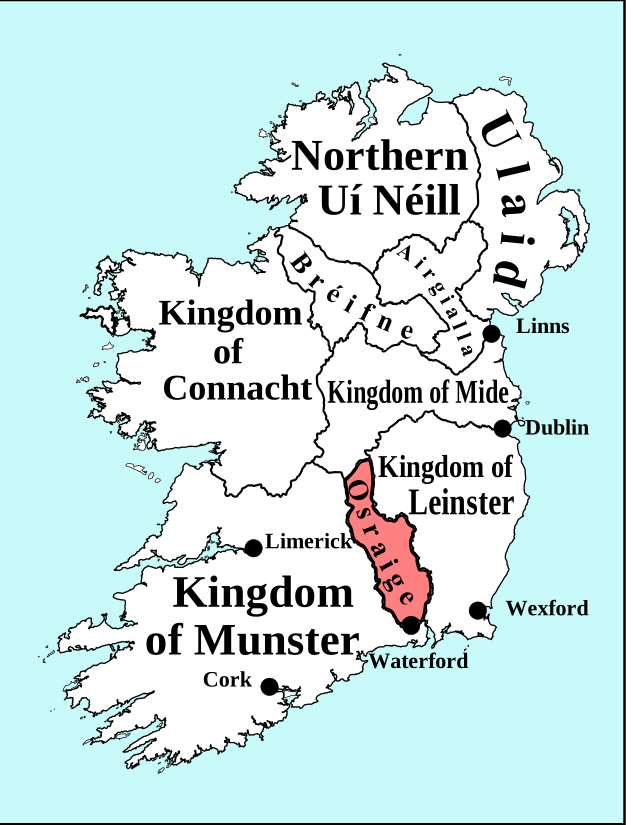
Ossory, also called Osraige, was an Irish kingdom broadly associated with the area of today’s County Kilkenny and County Laois. The local heritage account published by Kilkenny Castle places the legend within a wider history of wolf imagery, Irish dynastic tradition and medieval storytelling.
There is a geographical detail easy to miss: the travelling priest’s encounter is narrated as happening near Meath, not at a named building in Kilkenny. The wolves say they are from Ossory. Modern retellings sometimes compress that distinction and make the story sound like a documented haunting at a specific Ossory site. Gerald provides no such verifiable location.
Why does the curse last seven years?
The seven-year cycle is part of the tale Gerald records. It is not a rule shared by every Irish or European werewolf tradition.
The curse makes the characters’ wolf existence temporary and compulsory. They do not choose to hunt as monsters in the way many later horror stories portray werewolves. They are displaced humans waiting for a possible return to ordinary life.
The narrative also supplies no familiar movie trigger such as a full moon, a bite or a silver bullet. Those are not the mechanisms of this particular story. For the broader, inconsistent history of those motifs, see Morbid Index’s history of werewolf folklore and lycanthropy.
Most importantly, the seven years are a feature of Gerald’s literary record. Calling them a verified historical practice or a supernatural law would misread the source.
Why does the priest give communion to a wolf?
The central question is not whether a wolf can be killed. It is whether a being that looks like an animal can still be recognized as human.
Gerald’s priest hesitates over giving the dying she-wolf the Eucharist. The revelation of an old woman’s body beneath the skin functions in the story as reassurance that the recipient is a person. The animal speaks intelligibly, professes Christian beliefs and seeks Christian rites. The scene tests the boundary between outward appearance and spiritual identity.
Medieval literature scholar Karl Steel argues that the tale is especially concerned with reason, humanity and the priest’s fear. Gerald makes the wolf seem capable of Christian understanding while making the priest uncertain of his duty.
Gerald himself continues the question after narrating the event. His text turns to authorities including Augustine of Hippo and asks what to make of rational creatures with animal bodies. This is a theological discussion within a medieval Christian worldview, not evidence that transformation occurred.
Did Gerald of Wales witness the wolves himself?
No. Gerald presents the encounter as something that happened to an unnamed priest. He then reports that the circumstances were discussed by bishops and abbots and that the priest was ordered to take his account to the pope.
That last claim is also found inside Gerald’s narrative. It should not be upgraded into an independently confirmed papal investigation or verdict. The sources checked for this article do not establish what, if anything, Rome later decided.
A manuscript preserving Gerald’s words proves the account circulated. It does not authenticate each event the words describe.
The distinction is particularly important because the tale is sometimes presented online as though it were a medieval police report. It is a narrated marvel embedded in a religiously argumentative work.
Why Gerald’s politics matter
Gerald wrote about Ireland in the context of Anglo-Norman expansion. He travelled there in the 1180s, and Topographia Hibernica circulated near the end of the twelfth century. The British Library’s catalogue for Royal MS 13 B VIII identifies the work and its surviving illustrated manuscript tradition.
The wolf story does not end with the priest’s act of mercy. In Gerald’s telling, the wolf comments on the foreign invaders’ future in Ireland and attributes the Irish people’s subjection to their sins. He thus uses the creature’s speech to advance a moral interpretation of conquest.
That passage gives readers a reason not to treat Gerald as a neutral collector of Irish oral tradition. His account can preserve a legend while also reshaping it for his own readership and argument.
Kilkenny Castle’s heritage account discusses an interpretation, associated with scholar Catherine Karkov, in which the wolf’s human appearance beneath the skin becomes a metaphor for Ireland and religious change under Norman influence. That is a scholarly reading of the text, not a fact independently established about what every medieval listener believed.
The political dimension is not proof that Gerald invented the wolves. It is evidence that the version he wrote down has an ideological setting readers need to understand.
Were these the same werewolves as in other medieval tales?
Medieval Europe had more than one tradition about human beings in wolf form. The Ossory account is unusual because the wolves are a married pair, speak as Christians and ask for sacramental care rather than attack humans.
Karl Steel contrasts them with Bisclavret, the werewolf knight in a narrative by Marie de France. Bisclavret’s transformation and troubles involve a different set of relationships and narrative rules. Similarity of creature type does not make the two tales chapters in one shared mythology.
The same caution applies to later Irish traditions that describe a sleeper’s spirit leaving the body in wolf form. Kilkenny Castle discusses such material separately. It should not be retroactively inserted into Gerald’s scene, where a wolfskin is drawn back to reveal a woman beneath.
Does Wolfwalkers tell the same story?
The animated film Wolfwalkers (2020) is a modern fictional treatment of Irish wolf transformation. The Kilkenny Castle heritage article connects the film with the wider Ossory tradition, particularly versions involving transformation during sleep.
But Gerald’s priest-and-communion story is not the film’s plot. The movie has its own characters, supernatural rules and dramatic concerns. Similarities should be presented as cultural and thematic connections unless a filmmaker or documented production source establishes a particular borrowed detail.
Were the werewolves of Ossory real?
There is no verified evidence that two humans physically became wolves or that a priest administered communion to a transformed animal in the manner described.
What survives is substantial evidence for a story: Gerald’s medieval account, illustrated manuscript copies and later histories and interpretations. Those are valuable historical objects in their own right. They tell us how a medieval writer used the possibility of transformation to debate religion, humanity and power.
This is why the Ossory werewolves deserve a distinct place beside broader European werewolf histories. Their most disturbing question is not How do we kill a monster? It is How do we recognize the human being we think we are looking at?
Questions readers ask
Who recorded the Werewolves of Ossory story?
Gerald of Wales recorded it in Topographia Hibernica, a work composed in the late twelfth century. It appears in Part II, Chapter XIX.
What does Ossory mean?
Ossory, or Osraige, was a medieval Irish kingdom broadly associated with modern Kilkenny and Laois.
Why were the man and woman wolves?
In Gerald’s story, a curse connected with Saint Natalis required a man and a woman from Ossory to spend seven years in wolf form before another pair took their place.
Did the wolves attack the priest?
No. Gerald describes the male wolf speaking peacefully and asking the priest to assist his dying wife.
Did the priest really give the she-wolf communion?
Gerald says that the priest did. The text preserves that claim, but it is not independent proof that the event happened.
Did the pope confirm the werewolves were real?
No such confirmation was established by the sources checked. Gerald reports a proposed or ordered appeal to the pope, not a verifiable papal judgment that humans became wolves.
Is the manuscript illustration a contemporary photograph or proof?
No. It is medieval art illustrating a story in a manuscript, not a record that can authenticate supernatural transformation.
Is there a full-moon rule in the Ossory tale?
No. Gerald’s telling describes a seven-year curse, not transformation under a full moon.
Sources & further reading
- Gerald of Wales, Topography of Ireland, Part II, Chapter XIX, English translation by Thomas Forester, revised by Thomas Wright
- British Library: Royal MS 13 B VIII, illustrated manuscript of Gerald's Topographia Hiberniae
- Kilkenny Castle / Office of Public Works: The Ossory Werewolves, Peter Kenny, 2021
- Karl Steel: Reason, Freedom, and Animality: A Small Point on Gerald's Werewolves, 2021
- Wellcome Collection: Gerald of Wales, Topography of Ireland, 1881 English edition
- Wikimedia Commons: Werewolves of Ossory manuscript illustration
- Wikimedia Commons: Kingdom of Osraige map, c. 900 (modern reconstruction)