Lore & Explained / Folklore
The Beast of Gévaudan: The Real History Behind France's 18th-Century Monster Panic
Between 1764 and 1767, a series of deadly animal attacks terrified Gévaudan. Here is what the records say about the Beast, the hunts, Jean Chastel, wolves and later werewolf legend.
Topics: Beast of Gévaudan, French Folklore, Wolves, 18th Century, Werewolf Legends
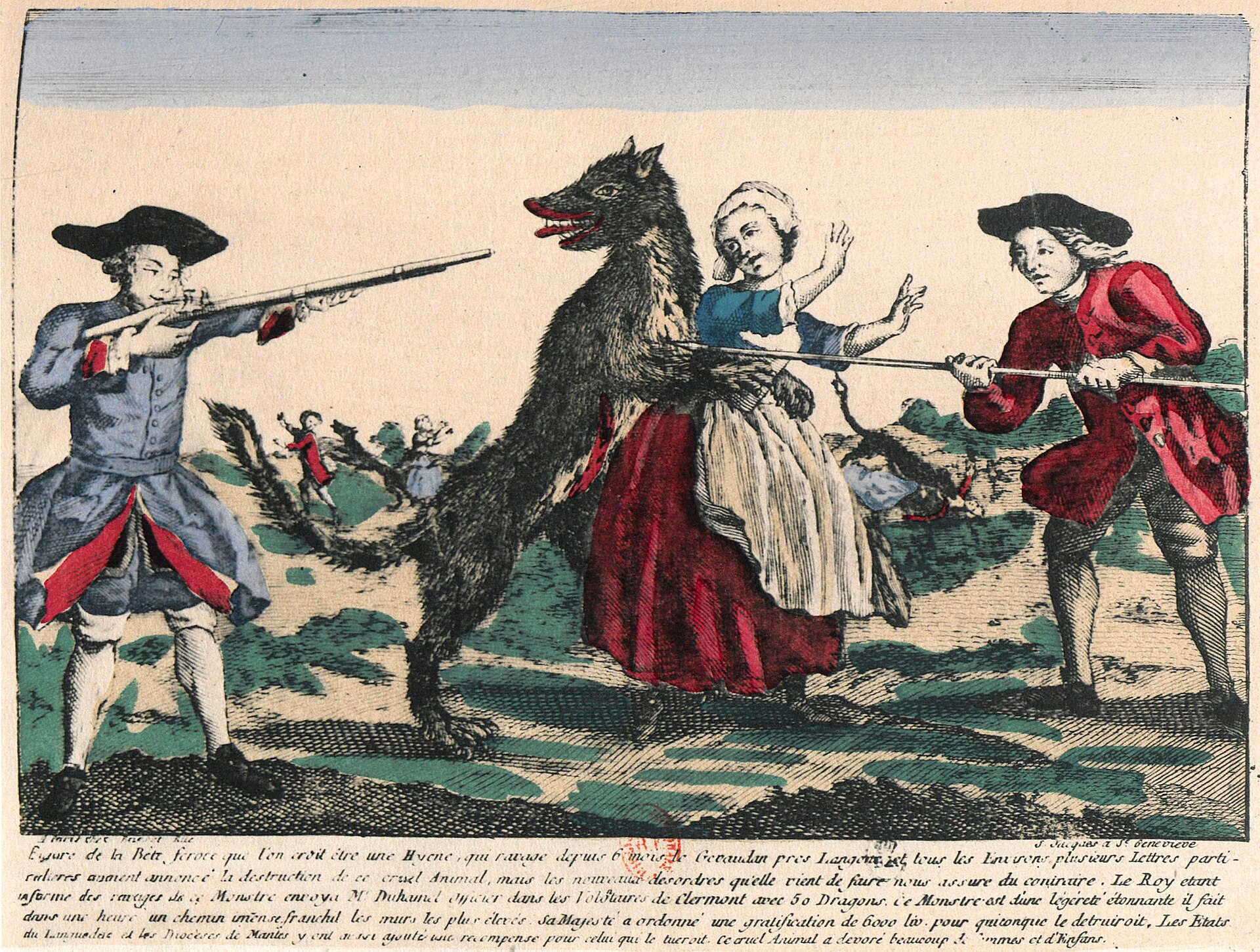
Anonymous historical illustration / Public Domain via Wikimedia Commons
The Beast of Gévaudan was not born as a werewolf story. It began as a series of attacks in a poor, rural part of southern France, in a country where wolves were real, common and feared. By the time the panic ended in 1767, newspapers had turned the animal into a national sensation and later retellings had supplied silver bullets, curses and a monster with a single fixed identity.
The historical record is grim enough without any of that. People were attacked and killed between 1764 and 1767. The difficult question is whether every attack belongs to one animal, several animals, or a mixture of real attacks and reports shaped by a famous scare.
A Panic Begins
The first widely cited attacks occurred in 1764 around the old province of Gévaudan, an area now largely within Lozère. Early victims were often children and young people tending livestock in exposed country. Reports described a wolf-like animal, but not always an ordinary wolf: witnesses mentioned unusual coloring, a long tail, a large head and extraordinary boldness around people.
Those descriptions need context. They were collected amid fear, often after an attack, and repeated through officials and newspapers. They cannot supply a reliable zoological portrait. They do establish a real public crisis.
Exact totals vary because surviving lists count incidents differently. Modern summaries commonly put the death toll around one hundred, while larger numbers sometimes combine attacks, injuries and doubtful cases. It is safer to say that the attacks were numerous, lethal and sustained enough to draw royal attention than to repeat one total as certain.
Hunts, Rewards and the King’s Wolf
Local hunts failed to end the attacks. King Louis XV eventually sent the royal gun-bearer François Antoine and a professional hunting party. In September 1765 Antoine killed a very large wolf near the Abbey of Chazes. The animal was examined, preserved and presented as the solution.
For a short time, that answer served the court and the press. Then reports of attacks continued.
That does not prove the animal Antoine killed was unrelated to the case. It may have been a dangerous wolf in the same region; records from a long panic do not create a clean before-and-after experiment. Continued reports do make the official ending inadequate.
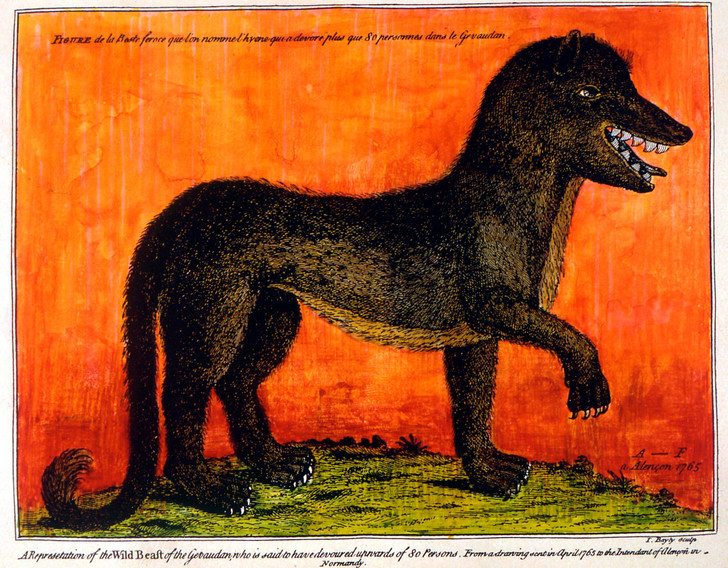
A later eighteenth-century printed image of the Beast. Such images record how the panic was imagined in print, not a trustworthy anatomical drawing. Public Domain via Wikimedia Commons.
Jean Chastel and the Animal of 1767
On June 19, 1767, local hunter Jean Chastel killed a large canid during a hunt organized by the Marquis d’Apcher. A royal notary, Roch Étienne Marin, produced an examination report the following day. This is one of the most valuable surviving documents because it is contemporary, even if its measurements and terminology do not settle modern species questions.
After Chastel’s kill, the attacks associated with the Beast stopped. That makes the animal important. It does not make every later detail about the kill factual.
The famous tale that Chastel loaded his gun with blessed silver bullets belongs to later legend, not the contemporary inspection report. The version is memorable because it turns a hard rural hunt into a werewolf climax. There is no good reason to read it back into 1767 as a documented detail.
What Was the Beast?
The leading explanation remains one or more wolves. Eighteenth-century France had a far larger wolf population than modern France, and wolf attacks on people, especially children in vulnerable rural settings, were not unknown. A large, bold individual or a run of multiple animals can account for much of the record without requiring an unknown species.
Other proposals have weaknesses but cannot be ruled out from a distance. A wolf-dog hybrid might have looked unusual and behaved less predictably. A hyena or other escaped exotic animal is a popular theory because some illustrations look striped or strange; it has no secure contemporary chain of custody. Claims of a trained killer animal or a human accomplice add drama without comparable evidence.
The Beast may never have been a single biological question. “La Bête” became the name people used for a rolling crisis. It gathered separate sightings, attacks, rumors, official incentives and newspaper copy into one creature.
When It Became a Werewolf Story
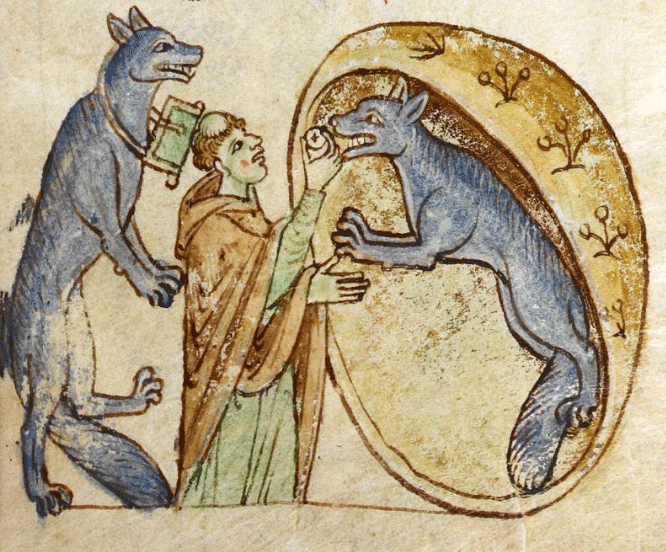
Werewolf belief already existed in European culture, but the eighteenth-century records do not present the Gévaudan animal as a demonstrated shapeshifter. The transformation came later, through fiction, illustrations and retellings eager for an ending more supernatural than a wolf hunt.
That is why the Beast belongs near the Jersey Devil: both have a real historical setting and a long afterlife in monster culture. Gévaudan’s legacy is not that France proved a werewolf existed. It is that terror, print culture and uncertain evidence made an animal impossible to forget.
Frequently Asked Questions
Was the Beast of Gévaudan a werewolf? There is no evidence that it was. Werewolf details, including the silver-bullet story, are later folklore rather than contemporary proof.
How many people did the Beast kill? Totals differ across records. Around one hundred deaths is a common modern estimate, but no single number can be treated as exact.
Did Jean Chastel kill the Beast? Chastel killed a large canid in June 1767, after which the attacks stopped. That is documented more securely than later legends about how he did it.