Lore & Explained / Haitian Folklore & Horror History
Zombie Origins Explained: Haiti, Vodou, Slavery and What Hollywood Changed
Trace zombie origins through Haitian and Caribbean traditions, slavery, Vodou, White Zombie and George Romero, with the documentary Black Zombie in context.
Topics: Zombie, Zombi, Haiti, Haitian Vodou, Black Zombie, White Zombie, Night of the Living Dead, George A. Romero, Maya Annik Bedward
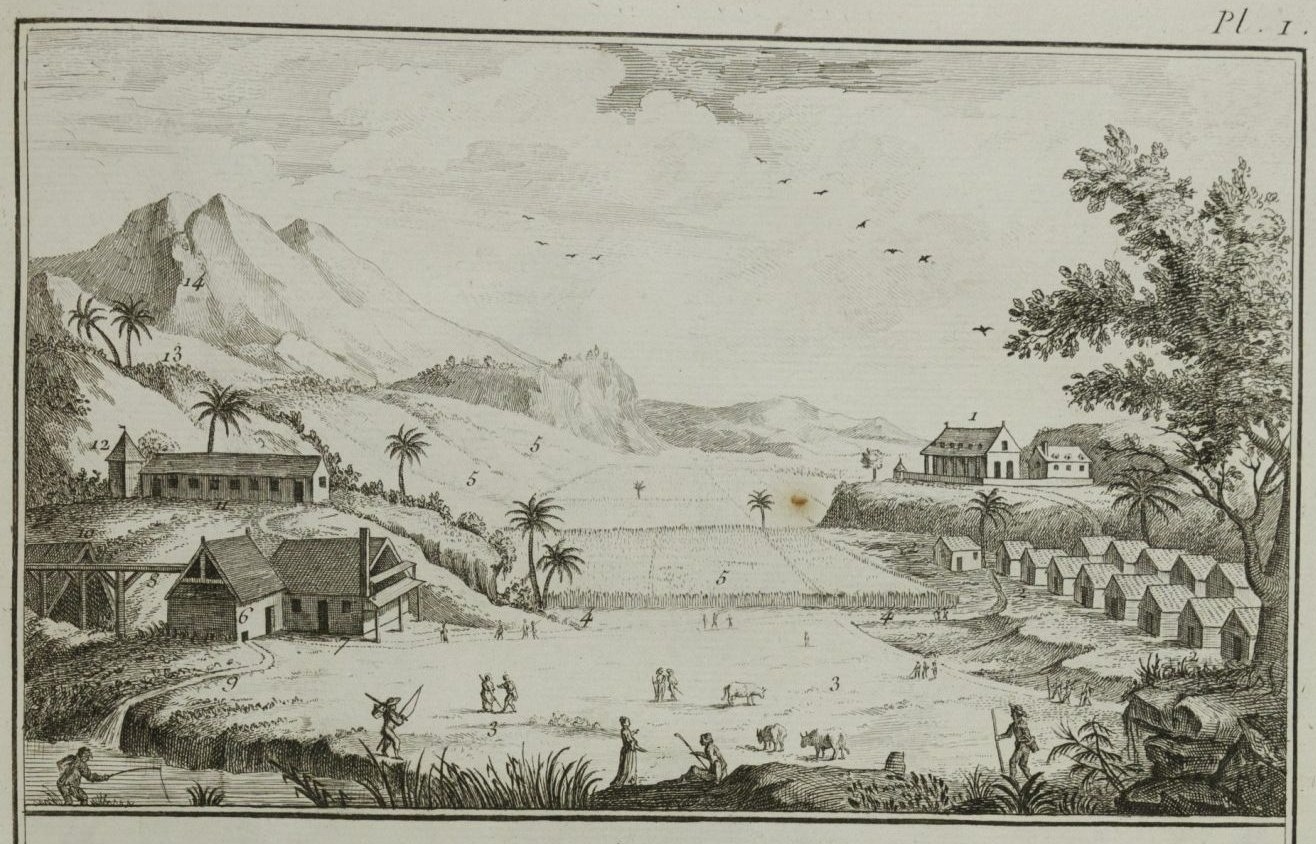
Robert Bénard / Encyclopédie / Newberry Library (public domain; cropped and recompressed)
Detail from Robert Bénard’s idealized French West Indies sugar-plantation plate in Diderot and d’Alembert’s Encyclopédie (1762). Historical context for the colonial plantation system, not a depiction of a specific Haitian plantation, a zombi tradition or Vodou practice. Newberry Library; public domain. Cropped to the complete framed plantation scene and recompressed.
The zombie most people recognize today is hungry.
It shambles or runs. It bites. One victim becomes many. Civilization collapses.
That creature owes far more to George A. Romero and the films that followed him than it does to the older Caribbean figure from which the English word zombie ultimately drew much of its cultural power.
The older history is not a simple story about corpses rising to eat the living.
It is a history of slavery, stolen agency, African and Caribbean religious ideas, colonial writing, U.S. occupation, horror cinema and repeated cultural translation.
That history is newly visible in Maya Annik Bedward’s 2026 documentary Black Zombie. Kino Lorber is currently distributing the film in the United States after its world premiere at SXSW, where it was presented as a documentary about the buried origins of the zombie and its transformation from Haitian spiritual and historical traditions into a Hollywood monster.
The documentary makes the timing useful.
But the history matters with or without a new film.
To understand where zombies came from, the first thing to abandon is the idea that there was ever one neat “original zombie” with one fixed rulebook.
There was never one single original zombie
The spelling itself is a warning.
Zombi, zonbi and zombie have been used in different languages, places and periods for different supernatural concepts.
Hans-W. Ackermann and Jeanine Gauthier’s foundational 1991 study, “The Ways and Nature of the Zombi”, surveyed the figure across Haiti, the Caribbean and African traditions and emphasized that the word does not describe one universal creature.
Maximilien Laroche made a similar point much earlier in his 1975 study “Mythe africain et mythe antillais: le personnage du zombi”. His argument was historical rather than biological: African ideas about the living dead changed under the pressures of slavery, colonialism and life in the Caribbean.
Even the common claim that “the zombie first appeared in Haiti” is too simple.
A 2023 study in Atlantic Studies notes that scholars have traced African and Caribbean antecedents and points to an early literary use of zombi in a 1697 Guadeloupe text, Le zombi du Grand-Pérou. That example describes a spirit in a colonial slave society rather than the standard corpse familiar from later Haitian and Hollywood stories.
So the safest starting point is this:
The modern zombie emerged from a transatlantic history. Haitian traditions became especially important to the form that entered twentieth-century American culture, but neither the word nor the supernatural ideas behind it began as one isolated invention.
The Haitian zombi is about stolen agency
The most important difference between the Haitian zombi and the modern apocalypse zombie is control.
Lucy Swanson’s 2023 book The Zombie in Contemporary French Caribbean Fiction describes the Haitian zombie as an enduring memory of enslavement: a body deprived of part of its personhood and compelled to labor.
That relationship between zombification and slavery is not just a convenient modern metaphor pasted onto an old monster.
It is embedded in a long scholarly interpretation of the figure.
The horror is not primarily that the zombi will eat you.
The horror is that you can become the zombi.
Your will can be taken.
Your social identity can disappear.
Your body can continue working while someone else controls it.
That is why the plantation economy is impossible to separate from the history.
Detail from Robert Bénard’s idealized French West Indies sugar-plantation plate in Diderot and d’Alembert’s Encyclopédie (1762). Historical context for the colonial plantation system, not a depiction of a specific Haitian plantation, a zombi tradition or Vodou practice. Newberry Library; public domain. Cropped to the complete framed plantation scene and recompressed.
The French colony of Saint-Domingue, which became Haiti after the Haitian Revolution, was one of the Atlantic world’s most brutally productive plantation societies.
In that context, a supernatural figure reduced to labor without autonomy carried an obvious social terror.
Swanson calls the zombie an enduring memory of enslavement.
Other scholars emphasize oppression, resistance, colonial power and the destruction of personhood.
Those interpretations do not mean every Haitian story had one political message.
They do mean that the slave-like condition of the zombi is historically central in a way that flesh-eating is not.
Vodou is not a “zombie cult”
Another distinction matters just as much.
Haitian Vodou is a religion.
“Voodoo” in American horror has often been something else: a fictional package of curses, dolls, exotic ritual, sexual threat, drums, human sacrifice and supernatural control assembled for outsiders.
Adam M. McGee’s 2012 article “Haitian Vodou and Voodoo: Imagined Religion and Popular Culture” examines exactly this split. He argues that the imagined “voodoo” of tourism and entertainment has repeatedly fed racist ideas about the real religion.
That matters whenever zombie history is summarized as:
“Vodou priests raised the dead.”
It turns a complicated religious and folkloric environment into a horror-movie mechanism.
Some Haitian zombi traditions do involve a bòkò, a practitioner associated in stories with harmful or secret magical acts.
That does not make every Vodou practitioner a zombifier.
It does not make zombification the defining purpose of Vodou.
And it does not make Hollywood’s generic “voodoo magic” a reliable description of Haitian religion.
The distinction is especially important because twentieth-century zombie cinema helped make the fictionalized version internationally familiar.
U.S. occupation helped export a frightening image of Haiti
American audiences did not encounter the zombie in a political vacuum.
The United States occupied Haiti from 1915 to 1934.
During and around that period, travel writing and popular reporting frequently represented Haiti as irrational, dangerous, sexually threatening, superstitious and controlled by “black magic.”
Marina Mandić’s 2024 study “The Cultural Tradition of Zombification in Haiti: An Example of Film White Zombie” places the early American screen zombie directly inside that colonial context.
Her analysis describes how depictions of Haiti as savage and mysterious supported an imperial gaze in which American intervention could be imagined as a “civilizing” force.
This is where a recurring problem in zombie history becomes visible.
Haitian stories about the terror of being enslaved could be transformed for American audiences into stories about the terror of Haiti itself.
The victim became the monster.
The culture that produced the warning became the frightening backdrop.
The Magic Island helped carry the zombi into American popular culture
One of the most influential bridges was William Seabrook’s 1929 book The Magic Island.
Seabrook’s writing about Haiti gave American readers an account of the zombi as a body that appeared dead but could be made to labor.
His book was enormously influential on later popular representations.
That influence is not the same thing as neutral ethnography.
Travel writing about Haiti was produced inside the same racial and imperial context as the U.S. occupation.
By the time the zombie reached an American horror movie three years later, many of the elements were already in place:
- an exoticized Haiti;
- supernatural control;
- labor without will;
- a white outsider’s fear of losing autonomy;
- and “voodoo” transformed into a cinematic source of menace.
White Zombie put the controlled corpse on screen
Victor Halperin’s White Zombie was released in 1932, starring Bela Lugosi.
Mandić identifies it as the crucial early American film in which the Haitian-associated zombi became a cinematic figure.
The movie’s zombies are not Romero-style predators.
They are controlled.
They work.
They obey.
The central horror becomes especially revealing when a white woman is subjected to zombification.
The film transfers the condition associated with coerced Black labor into a story designed around a white victim’s loss of autonomy.
That does not mean White Zombie invented the connection between zombies and slavery.
It means the movie reworked that history through the racial assumptions of early-1930s American horror.
This is why calling White Zombie simply “the first zombie movie” is accurate in one limited sense but incomplete as history.
It brought the figure to cinema.
It also helped harden the idea that Haiti and an imagined “voodoo” were themselves horror settings.
The Romero zombie was a different monster
Then came Night of the Living Dead in 1968.
Romero’s creatures are recently dead people who attack the living and consume flesh.
They are not plantation laborers under the command of a sorcerer.
They do not need Haiti.
They do not need Vodou.
They are a mass social catastrophe.
Even Romero did not initially think of them as zombies.
In a later interview he explained that he had called them ghouls and associated the word zombie with the older Caribbean screen tradition.
The BFI’s history of Romero summarizes the shift clearly: Night of the Living Dead took the marginal screen zombie idea, added flesh-eating and a mass rising of the dead, and created the template that later horror repeatedly copied.
Criterion likewise describes the film’s antagonists as “recently dead, flesh-eating ghouls.”
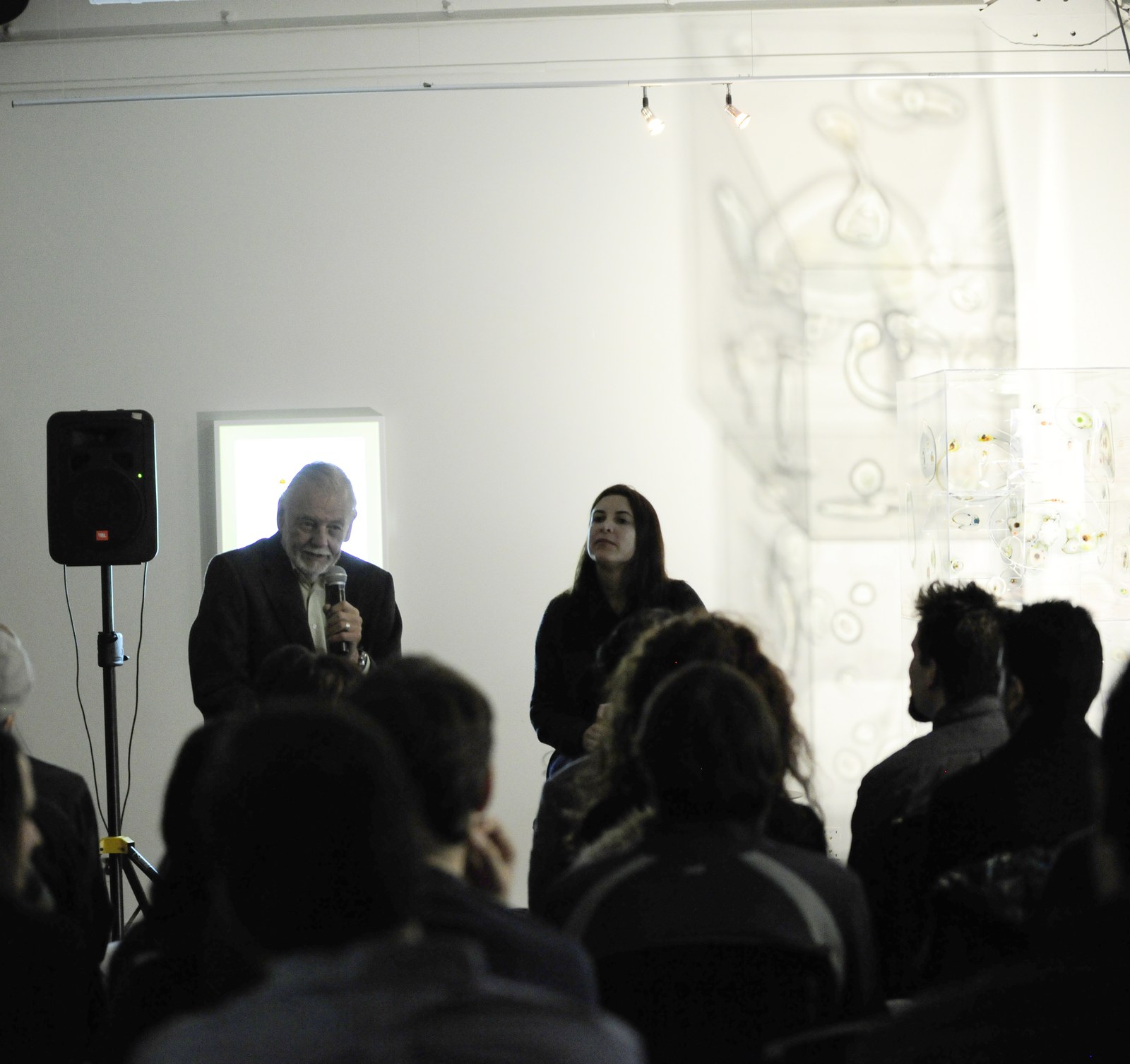
George A. Romero in 2009. Romero said he originally thought of the creatures in Night of the Living Dead as ghouls rather than the Caribbean zombies familiar from earlier cinema. Photo © 2009 Alyssa Katherine Faoro / Canadian Film Centre via Wikimedia Commons, licensed CC BY 2.0. Resized and recompressed.
The modern zombie therefore contains a historical break.
Before Romero, the most influential American screen tradition emphasized control, sorcery and a Haiti filtered through colonial fantasy.
After Romero, the dominant form increasingly became a contagious or inexplicable horde of autonomous flesh-eating dead.
Later films, games and television series added viruses, fungi, laboratories, radiation and countless other causes.
The name survived even though the monster changed.
Morbid Index’s Night of the Living Dead history covers another part of that legacy: the accident that put Romero’s 1968 film in the U.S. public domain and helped make its imagery exceptionally easy to copy, screen and remake.
The flesh-eating zombie did not erase the older zombi
Hollywood dominance can create the illusion that an earlier tradition disappeared as soon as a successful new version arrived.
It did not.
Haitian and French Caribbean writers, artists and scholars continued to use zombi figures with meanings tied to slavery, political control, trauma, dictatorship and resistance.
Swanson’s work stresses that Caribbean creators have not merely supplied raw folklore for the Global North to transform.
They have actively reshaped the zombie imaginary themselves.
That is an important correction to a common horror-history structure:
Haiti is not simply “the origin chapter” before the story moves to Hollywood.
The Caribbean zombie has its own continuing cultural life.
Hollywood is one branch of the history, not its final owner.
Was zombification caused by zombie powder?
This is where folklore, reported cases and scientific claims become especially easy to blur.
Ethnobotanist Wade Davis argued in the 1980s that some reported Haitian zombification cases could involve powders containing tetrodotoxin, the potent toxin associated with pufferfish.
The proposal became famous and influenced Wes Craven’s 1988 film The Serpent and the Rainbow.
There was laboratory debate.
A 1989 paper in Toxicon reported chemical evidence consistent with tetrodotoxin in a powder said to be used for zombification.
A 1990 paper by C. Y. Kao and T. Yasumoto challenged the claim.
The dispute is important because it prevents an easy conclusion.
The research does not justify saying:
“Science proved how Haitian zombies are made.”
It also does not justify saying that every reported zombification story can be dismissed by invoking poison.
The toxin hypothesis is a contested attempt to explain some claims.
Folklore, religious ideas, social identity, medical conditions, misidentification and individual reported cases are separate questions.
A chemical detected in a sample does not turn an entire supernatural tradition into one pharmacological recipe.
Black Zombie is part of a wider reclamation
That brings the history back to 2026.
Maya Annik Bedward’s documentary Black Zombie premiered at SXSW on March 13, 2026.
Kino Lorber later acquired U.S. rights and is currently distributing the film theatrically, with a DVD edition scheduled for November 10, 2026.
The distributor describes the film as tracing the zombie from Haitian spiritual traditions to Hollywood horror while examining how Black spiritual traditions were distorted and how a symbol of stolen agency became a profitable monster.
That argument is not the only possible scholarly summary of centuries of zombi traditions.
But it directly addresses the largest gap in the way mainstream horror often tells zombie history.
The familiar monster is not culturally neutral.
It carries pieces of histories that popular culture repeatedly transformed.
The point is not that audiences must stop enjoying Romero, The Walking Dead, Resident Evil or modern zombie games.
It is that “zombie” now names several layers at once.
A Caribbean supernatural figure.
A memory of enslavement.
A colonial fantasy.
A controlled cinematic body.
A Romero ghoul.
An apocalyptic horde.
A metaphor that creators keep rewriting.
Those layers should not be collapsed into one fake ancient rulebook.
A short zombie timeline
1697: An early Caribbean literary use of zombi appears in Le zombi du Grand-Pérou, set in Guadeloupe. It is not the modern flesh-eating corpse.
Colonial Caribbean / Saint-Domingue: African-derived supernatural ideas develop under slavery and colonialism into multiple Caribbean zombi traditions.
1915–1934: The United States occupies Haiti while travel writing and popular culture increasingly frame the country through exoticized “voodoo” imagery.
1929: William Seabrook publishes The Magic Island, an influential American account that helps popularize the Haitian zombi.
1932: White Zombie brings a controlled, Haiti-associated zombie to American horror cinema.
1968: George A. Romero releases Night of the Living Dead. His flesh-eating ghouls become the template for the modern mass zombie.
1980s: Wade Davis popularizes a controversial tetrodotoxin hypothesis for reported zombification cases.
2026: Maya Annik Bedward’s Black Zombie returns the monster’s Haitian, colonial and racial history to the center of the conversation.
The timeline does not describe one creature becoming steadily more “accurate.”
It describes a word and a group of ideas moving between cultures, genres and systems of power.
Frequently Asked Questions
Did zombies originate in Haiti?
Haitian zombi traditions are central to the history of the modern zombie, but the deeper history is transatlantic. Scholars trace African antecedents and broader Caribbean uses of zombi, including an early literary appearance in Guadeloupe in 1697.
What is the difference between a Haitian zombi and a modern zombie?
In influential Haitian traditions, the zombi is associated with loss of will, control and forced labor. The dominant modern horror zombie is usually an autonomous or contagious reanimated corpse that attacks the living.
Is the zombie part of Haitian Vodou?
Zombi traditions intersect with Haitian religious and folkloric ideas, but Vodou should not be reduced to “zombie magic.” Horror cinema’s generic “voodoo” is heavily shaped by racist and colonial popular-culture stereotypes.
Were Haitian zombies originally flesh eaters?
Flesh-eating is not the defining feature of the older Haitian zombi tradition. That behavior became central to the modern zombie largely through the influence of George A. Romero’s films and their successors.
What was the first zombie movie?
White Zombie (1932) is widely treated as the first feature-length zombie film. Its zombies are controlled laborers, not Romero-style flesh-eating hordes.
Did George Romero invent zombies?
No. Zombie traditions and zombie films existed before Romero. What Night of the Living Dead did was transform the dominant screen monster into the mass, flesh-eating undead figure that later audiences came to call a zombie.
Did Night of the Living Dead call its monsters zombies?
Romero later said he thought of them as ghouls. Contemporary and later audiences applied the zombie label, which became standard for the type of creature his film popularized.
Is zombie powder real?
Powders associated with claims of zombification have been studied. Researchers disagreed over whether tetrodotoxin was present at meaningful levels and whether the toxin hypothesis could explain reported cases. There is no scientific basis for treating “zombie powder” as a proven universal mechanism of zombification.
What is Black Zombie?
Black Zombie is a 2026 documentary written and directed by Maya Annik Bedward. It examines the zombie’s Haitian, colonial, spiritual and cinematic history and the transformation of the figure in Hollywood.
Does learning this history mean modern zombie fiction is culturally illegitimate?
No. It means the modern monster has a history. Knowing that history makes it easier to distinguish Haitian and Caribbean traditions from later colonial stereotypes and from the separate zombie rules invented by modern movies, games and television.
Sources & further reading
- Kino Lorber: Black Zombie DVD, scheduled November 10, 2026
- Maximilien Laroche, authorized reprint in L’image comme écho (1978)
- David Inglis, The Zombie from Myth to Reality (2010)
- George A. Romero interview: Diary of the Dead
- Hans-W. Ackermann and Jeanine Gauthier, The Ways and Nature of the Zombi (1991)
- Maximilien Laroche, Mythe africain et mythe antillais: le personnage du zombi (1975)
- Lucy Swanson, The Zombie in Contemporary French Caribbean Fiction (2023)
- Marina Mandić, The Cultural Tradition of Zombification in Haiti: An Example of Film White Zombie (2024)
- Adam M. McGee, Haitian Vodou and Voodoo: Imagined Religion and Popular Culture (2012)
- Doris L. Garraway, Raising the living dead in postrevolutionary Haiti (2023)
- BFI: Father of the dead — George A. Romero
- Criterion Collection: Night of the Living Dead
- Kino Lorber: Black Zombie
- Kino Lorber: U.S. rights announcement for Black Zombie
- SXSW 2026: Black Zombie
- PubMed: Evidence for tetrodotoxin in a Haitian zombification powder (1989)
- PubMed: Tetrodotoxin in zombie powder (1990)




.jpg)