Lore & Explained / Folklore
The Backrooms Explained: How an Anonymous Image Became Internet Folklore
The real story behind the Backrooms: a 2002 renovation photo from a Wisconsin hobby store, a 2019 anonymous 4chan post, and how the internet built a shared mythology around both.
Topics: Backrooms, creepypasta, liminal spaces, internet folklore, Kane Pixels, urban legends
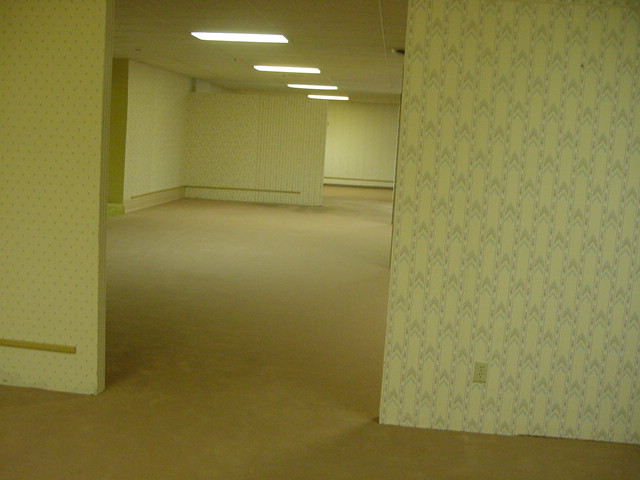
Photograph by Bill Magritz, courtesy of Bob Mazza / Wikimedia Commons (CC0 1.0)
The Backrooms are an internet horror concept: an endless, mazelike stretch of empty rooms with damp yellow wallpaper, moist carpet and fluorescent lights that never stop humming, which people supposedly fall into by accident and struggle to leave. There is no single Backrooms story. It grew, piece by piece, out of an anonymous 2019 forum post, and it kept growing because thousands of strangers online kept adding to it.
Here is the part that surprises most people who only know the concept from YouTube or the 2026 A24 movie: the famous photograph that started all of it is real. It shows an actual room in an actual building in Oshkosh, Wisconsin, and its origin sat unsolved for two decades before internet researchers finally tracked it down in 2024. The extra-dimensional maze, the monsters, the numbered “Levels” — that part is fiction, built collaboratively, with no single author and no official version.
Separating those two things is the whole point of this article.
What Are the Backrooms?
At its simplest, the Backrooms is the idea of “noclipping” out of ordinary reality into an infinite, abandoned office-and-carpet dimension that resembles a building nobody uses anymore. The atmosphere matters more than any specific plot: stained ceiling tiles, mismatched walls, hallways that repeat, and a nagging sense that you have been in this exact hallway before.
It started as a single image and a short block of text posted anonymously on 4chan in 2019. Within weeks, other users were adding their own stories, rules and monsters. Within a few years it had become one of the internet’s most recognizable pieces of collaborative horror fiction, with its own wikis, YouTube adaptations, video games, and eventually a studio film.
Where Did the Original Backrooms Image Come From?
The photograph is not staged horror art. It was taken on June 12, 2002, at roughly 8:21 in the morning, with a Sony Cyber-shot camera, inside a building at 807 Oregon Street in Oshkosh, Wisconsin.
The building had previously housed Rohner’s Home Furnishings, a furniture store. In 2002, hobby-shop owner Bob Mazza bought it to relocate his HobbyTown USA franchise, and the space needed serious renovation — water damage, an odd layout inherited from the furniture store, and a jaundiced-looking paint job that photographed a lot more sinister than it probably looked in person. An employee, Bill Magritz, documented the renovation work with a digital camera, and the shots were later folded into a slideshow for friends, full of inside jokes and photos of coworkers.
One of those images ended up on the HobbyTown Oshkosh website’s renovation blog on March 2, 2003, saved under the file name “Dsc00161.jpg.” Nobody at the store seems to have thought much of it. It was a boring construction photo of a soon-to-be hobby shop.
The photo that became “the Backrooms,” taken June 12, 2002, during renovation of a former furniture store into a HobbyTown USA location in Oshkosh, Wisconsin. Source. Bill Magritz, courtesy of Bob Mazza / Wikimedia Commons, CC0 1.0.
The image spent years floating around image boards with no known origin, showing up in “creepy/unsettling photo” threads long before anyone attached a story to it. Its real source stayed a mystery until May 2024, when a small group of internet researchers — working across a Backrooms-focused Discord server, using handles including Semliot, Serrara, Leon and Xaft — took a different approach than the usual reverse image search. They focused on the file name itself. “Dsc00161.jpg” is a standard naming pattern generated by certain digital cameras, and by combing through Wayback Machine snapshots for old small-business websites using that pattern, they eventually landed on an archived HobbyTown Oshkosh page from 2003.
Bob Mazza confirmed the discovery and, rather than being annoyed that his old construction photo had become an internet legend, leaned into it. He later released a larger set of the original renovation photos through the Internet Archive under a CC0 public-domain dedication, saying he wanted them to be free for anyone to use. The building itself is still standing, and it now operates as an RC car race track.
The Anonymous 4chan Post That Started the Legend
The photo needed a story to become the Backrooms, and that story arrived seventeen years later, on 4chan’s /x/ board — a section of the site dedicated to paranormal and unsettling content.
On May 12, 2019, someone started a thread asking for images that felt “off” without anything obviously wrong in them. The Oshkosh photo showed up as a reply. The next day, another anonymous user posted a short caption underneath it that took the image from “creepy stock photo” to “concept with a name.” It described what happens if you “noclip out of reality” into the wrong area: endless, randomly connected rooms, the smell of old carpet, fluorescent lights buzzing at maximum volume, and a warning that something might be wandering around nearby, listening for you.
For readers who don’t play video games, “noclip” is a real piece of gaming terminology. It refers to disabling an object’s normal collision detection, so a player or object can pass straight through walls, floors, and geometry that would otherwise block movement. Developers use it for testing; players sometimes use it to explore areas outside a game’s intended boundaries. The anonymous poster borrowed the term as a metaphor for accidentally slipping through the walls of ordinary reality into somewhere that shouldn’t exist.
That single post is the entire “original” Backrooms. No monster was named. No numbered Levels existed yet. No survival rules, factions or escape methods had been invented. It was one photo and a few sentences describing a mood, not a franchise bible.
What the Original Backrooms Actually Said
It’s worth being precise about this, because most modern summaries of “the Backrooms” are actually describing years of later additions layered on top of a short, simple idea.
The original post established three things: the physical description of the space (yellow walls, moist carpet, humming fluorescent lights, disorienting size), the mechanism for getting there (noclipping out of reality), and a vague, unspecified threat (something might be listening for you, somewhere in the rooms). That’s close to the whole thing. There was no lore document, no map, no named entity, and no indication that this was meant to be a shared universe other people would keep building.
It caught on anyway, immediately. Within about three weeks, a Backrooms wiki had already been started to collect fan additions, and the idea spread from /x/ into subreddits, YouTube, and eventually its own dedicated communities.
How the Internet Built Levels and Entities
Once other users got involved, the Backrooms stopped being one image and one paragraph and became an open collaborative project, the way a lot of enduring internet horror ends up working.
Fans began proposing “Levels” — numbered zones within the Backrooms, each with its own environment, dangers and rules. “Level 0” became shorthand for the original yellow-room description; later levels introduced flooded basements, endless highways, abandoned malls, and increasingly elaborate settings that had nothing to do with the original photograph. Communities invented entities to inhabit these spaces, gave them names and behaviors, debated their canon status, and wrote survival guides explaining how to avoid them. Some contributors introduced factions of other people trapped in the Backrooms, complete with their own goals and conflicts. Others invented specific objects, escape methods, and increasingly baroque cosmology connecting different Levels together.
None of this came from a central creator managing continuity. It came from thousands of separate contributors on different platforms, adding whatever they found interesting and often contradicting each other in the process.
Why There Is No Single Backrooms Canon
This is where a lot of casual explanations get it wrong by treating one wiki’s version as the definitive story.
The Backrooms Wiki on Fandom, the separate Backrooms Wikidot project, individual subreddits, and countless YouTube lore channels each developed their own version of what counts as “real” Backrooms content, and they don’t fully agree with each other. Some communities favor a stripped-down, unsettling-photography aesthetic closer to the original post. Others lean into elaborate multi-Level mythology with dozens of named entities. A Reddit user who goes by Litbeep eventually created a separate community, r/TrueBackrooms, specifically for people who felt the mainstream Backrooms subreddit had drifted too far from the original tone into overproduced monster lore.
None of these communities is the official record of an ancient legend, because there isn’t one. They’re competing, overlapping fan continuities, similar in spirit to how different regions and generations tell different versions of a piece of oral folklore — more on that comparison below. When a wiki presents a detailed timeline of “Level 37” or a named entity’s full backstory, that’s a specific community’s invention, not a discovery about a preexisting mythology.
Why Liminal Spaces Feel So Unsettling
The Backrooms rode in on a broader online aesthetic usually called “liminal space” photography: images of empty malls, motel hallways, school corridors, waiting rooms, indoor playgrounds and other transitional places, photographed with nobody in them. The appeal isn’t really about horror in the traditional sense. It’s about familiarity gone slightly wrong — a place designed for people, captured at the exact moment no people are using it for its purpose.
“Liminal” is a real academic term, borrowed from anthropology, originally used to describe an in-between stage in a ritual or rite of passage — no longer one thing, not yet another. The internet aesthetic took the word and applied it much more loosely to architecture and photography, which isn’t the original scholarly usage but has become the term’s dominant popular meaning online.
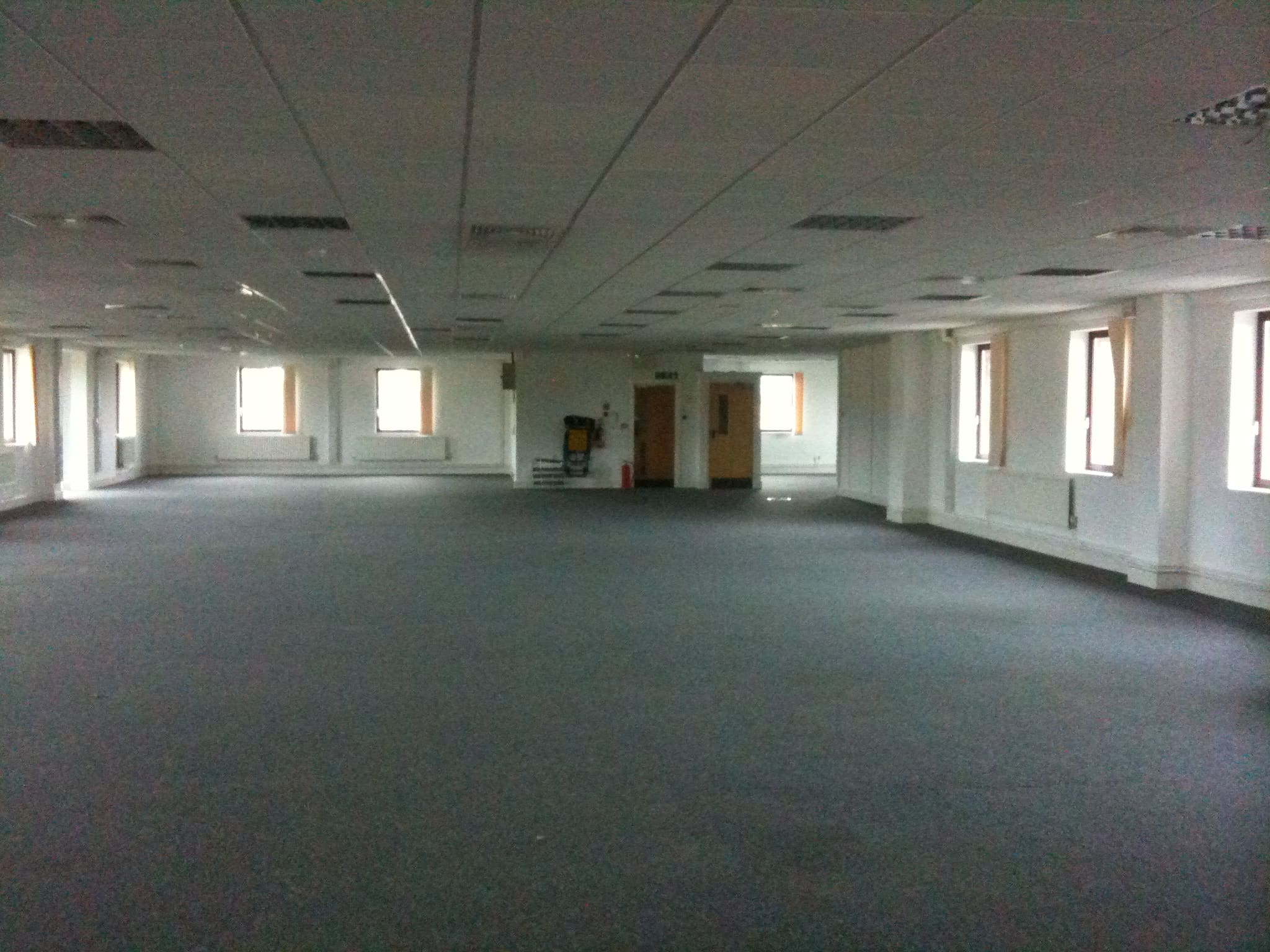
An empty office interior of the kind Backrooms communities often cite as an example of “liminal space” photography. Source. Ged Carroll / Wikimedia Commons, CC BY 2.0.
It’s tempting to reach for a tidy neuroscience explanation here — something like “your brain instinctively senses danger in empty spaces” — but that’s not a claim backed by solid research, and Morbid Index isn’t going to manufacture one. What’s better supported is a more mundane observation: these spaces are defined by absence. They’re built for crowds, transactions, meetings, and movement, and a photograph strips all of that away while leaving the architecture intact. The unease comes from the gap between what the space is for and what you’re actually looking at, not from some hardwired threat response to carpet and drop ceilings.
Kane Pixels Changed the Backrooms Again
In January 2022, a 16-year-old filmmaker named Kane Parsons, working under the name Kane Pixels, released a 25-minute short on YouTube called The Backrooms (Found Footage). Made largely with Blender and After Effects, it followed a found-footage format: a young man with a camera stumbles into the Backrooms and is stalked by something unseen while trying to find a way out.
The short was a massive hit, eventually passing 90 million views, and it did more than any wiki to bring the Backrooms into mainstream horror-content awareness. Parsons kept building on it, releasing a growing series of episodes that introduced his own original concept: Async, a research organization within his fictional universe that tries to study and eventually contact the Backrooms in order to solve real-world problems. That’s Parsons’ own addition, not something pulled from the 2019 4chan post or the earlier wiki lore — his version of the Backrooms runs closer to a serialized science-fiction thriller than to the original board-post concept.
Did Kane Pixels Create the Backrooms?
No, and this is one of the most common misconceptions about the whole phenomenon.
By the time Parsons released his first short in 2022, the Backrooms had already existed as an anonymous internet concept for roughly three years, complete with its own wikis, Reddit communities and an entire ecosystem of fan-made Levels and entities. What Parsons created was an enormously influential adaptation — arguably the single most important one, given how many people encountered the concept through his videos rather than through 4chan or a wiki. But it’s a second, distinct stage of the story: anonymous internet concept, then years of community expansion, then Kane Pixels’ interpretation, then eventually the A24 film. Collapsing those stages into “Kane Pixels invented the Backrooms” erases the anonymous post and the community that built the mythology around it before he was involved.
Is the Backrooms Real?
Depends what part of the question you’re asking.
The extra-dimensional maze, the entities, the numbered Levels, the idea that a person can physically slip through a wall into an alternate version of reality — none of that is real. It’s internet folklore and fan fiction, built collaboratively over several years with no supernatural basis and no documented case of anyone actually vanishing into it.
The photograph is a different matter. The room in that famous image genuinely existed, inside a real commercial building at 807 Oregon Street in Oshkosh, Wisconsin, mid-renovation in 2002. It wasn’t an abandoned dimension. It was a former furniture store being turned into a hobby shop, photographed by an employee on an ordinary workday. That the internet spent roughly two decades treating an unremarkable construction photo as evidence of a hidden dimension says a lot more about how online folklore spreads than it does about the building itself.
How A24 Turned the Backrooms Into a Movie
A24 announced a feature adaptation of Kane Parsons’ Backrooms universe in February 2023, with Parsons directing from a screenplay by Will Soodik. The film, produced alongside Chernin Entertainment with James Wan and Osgood Perkins attached as producers, stars Chiwetel Ejiofor and Renate Reinsve, with Mark Duplass, Finn Bennett and Lukita Maxwell rounding out the cast. It reached theaters in the United States on May 29, 2026, following a marketing push built substantially around Parsons’ existing fan base from his YouTube series.
The film centers on two people who discover a strange door in the basement of a furniture showroom — a premise that quietly nods back to the real building’s history as a furniture store before it became the setting for an internet legend. Parsons has described the project as an attempt to translate his online series for viewers who have never seen a minute of his YouTube work, rather than a direct, scene-for-scene continuation of it.
This article isn’t the place to unpack the film’s plot, ending, or how closely its version of events matches Parsons’ web series — that’s a different kind of article, better suited to entertainment coverage than to the origin story of an internet legend. What matters here is the lineage: an anonymous photograph, an anonymous caption, years of uncredited collective world-building, one teenager’s independent YouTube reinterpretation, and finally a studio adaptation of that reinterpretation. Four different things, each building on the last, none of them identical to what came before.
Why the Backrooms Works as Modern Internet Folklore
Strip away the movie deal and the Backrooms is a genuinely useful case study in how folklore forms without a single author.
Nobody owns the concept the way a studio owns a franchise character. It began with an anonymous poster building on an anonymous photograph, and it grew because strangers kept adding contradictory details, inventing their own monsters, arguing about which additions counted as legitimate, and splitting off into separate communities when they disagreed about tone or direction. That’s not so different from how oral folklore has always worked — a story gets retold, reshaped and regionally varied by whoever’s telling it next — except it happened in public, on the record, over a few years instead of a few generations. You can watch urban legends evolve elsewhere the same way: the Bloody Mary mirror ritual has no single authoritative version either, for exactly the same reason. Different tellers added different rules, and none of them is more “official” than the others.
The Backrooms just happened to do it with image boards, wikis and YouTube instead of playgrounds and campfires, which makes the whole process unusually easy to trace, document and date. That’s rare. Most folklore loses its origin point within a generation or two. The Backrooms kept its receipts, right down to a camera’s file-naming convention from 2002.
It’s worth comparing that process to Slender Man, the other major case of a documented, internet-born legend. Slender Man began as a deliberately authored character that a community then kept reinterpreting through competing web series and games. The Backrooms began from a found, unauthored image with barely any story attached, and the community built the entire mythology from there. Different starting points, same basic mechanism.
Frequently Asked Questions
What are the Backrooms? An internet horror concept describing an endless maze of empty, yellow-lit rooms that people supposedly enter by accident. It began as a 2019 anonymous 4chan post and grew into a large, collaboratively built body of fan fiction with no single official version.
Who created the Backrooms? No one person. An anonymous 4chan user posted the original photo and concept in May 2019, and the mythology around it — Levels, entities, rules — was built collectively by many different online communities afterward.
When were the Backrooms created? The concept dates to a 4chan /x/ thread on May 12–13, 2019. The photograph associated with it was taken years earlier, in 2002.
Where did the original Backrooms image come from? A 2002 photograph taken during the renovation of a former furniture store into a HobbyTown USA hobby shop at 807 Oregon Street in Oshkosh, Wisconsin. Its real-world origin wasn’t publicly identified until May 2024.
Is the Backrooms real? The supernatural maze and its entities are fictional internet folklore. The original photograph depicts a real physical location that existed in Oshkosh, Wisconsin.
Is the original Backrooms location real? Yes. It’s a real building, previously a furniture store and now a HobbyTown USA hobby shop and RC car race track.
What does noclip mean? A video-game term for disabling normal collision detection so a character or object can pass through walls and floors that would otherwise block movement. The 2019 post used it as a metaphor for slipping out of ordinary reality.
How many Backrooms levels are there? There’s no fixed or official number. Different fan wikis and communities have proposed dozens of Levels over the years, and they don’t fully agree with each other.
Are Backrooms entities part of the original story? No. The original 2019 post mentioned only a vague, unnamed threat. Specific named entities were invented later by the fan community.
Did Kane Pixels create the Backrooms? No. Kane Parsons (Kane Pixels) released his influential YouTube adaptation in January 2022, roughly three years after the anonymous concept and community lore already existed.
Is the Backrooms movie based on a true story? It’s based on Kane Parsons’ fictional YouTube series, which itself is an interpretation of the earlier internet concept. The real, verifiable part of the story is the original photograph’s location, not any supernatural events.
Sources & further reading
- 404 Media: Internet Sleuths Trace the Backrooms Creepypasta to an RC Car Race Track in Wisconsin
- Wikimedia Commons: HobbyTown USA Oshkosh interior under construction, 2002 (licensing and provenance)
- Internet Archive: Original Backrooms Full Photo Set, HobbyTown USA of Oshkosh, Wisconsin
- Wikipedia: The Backrooms
- The Hollywood Reporter: 'Backrooms' — Kane Parsons Turned YouTube Project Into A24 Horror Movie
- Wikipedia: The Backrooms (Found Footage)


.jpg)
