Lore & Explained / Folklore
Bloody Mary Explained: The Origins of the Mirror Legend
Where the Bloody Mary mirror legend came from, what older mirror-divination customs may have influenced it, and why people can genuinely see strange faces in dim glass.
Topics: Bloody Mary, urban legends, folklore, mirror divination, children's folklore, paranormal psychology
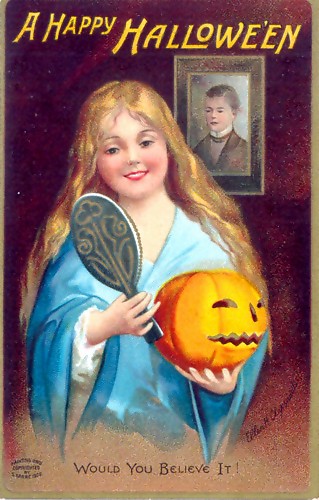
Ellen Clapsaddle, Halloween postcard (1904) / Public Domain via Wikimedia Commons
Most people learn Bloody Mary the same way: from another kid.
Turn off the bathroom light. Stand in front of the mirror. Say her name. Try not to be the first person who bolts for the door.
The details change almost immediately after that. Some people were told to say “Bloody Mary” three times, others thirteen. Some versions need a candle. Some add spinning, cold water, a taunt, or a story about a murdered girl. What appears in the mirror changes too: a witch, a corpse, a bloody face, a woman who scratches anyone foolish enough to keep looking.
That inconsistency is not a problem to solve. It is one of the clearest signs that Bloody Mary belongs to living folklore rather than to a single old story with an official set of rules.
There is also no good historical evidence that the ritual summons a real supernatural being. What we do have is a surprisingly rich trail through children’s folklore, older mirror-divination customs, urban legends, and experiments showing just how strange your own face can become when you stare at it in dim light.
What Is the Bloody Mary Ritual?
The basic structure is remarkably durable: a mirror, low light or darkness, a repeated name, and the expectation that something will appear.
Bathrooms are especially common in modern versions, but they are not universal. School washrooms, bedrooms, basements, closets and other dark rooms all appear in collected accounts. Candlelight is common too, although plenty of children performed the game with nothing more elaborate than the lights switched off.
The number of repetitions is even less stable.
Three is now the best-known version, but older folklore collections preserve much stranger counts. Mary and Herbert Knapp’s 1976 collection One Potato, Two Potato: The Folklore of American Children describes a child summoning “Mary Worth, alias Bloody Mary, alias Mary Jane” by repeating the name forty-seven times in a dark bathroom.
Other versions call for five, seven, thirteen or far more repetitions. Some require the participant to spin around, chant “I believe in Mary Worth,” or provoke the apparition with a phrase connected to one of the many backstories attached to her.
In other words, there is no authentic rule saying Bloody Mary must be called exactly three times.
That is the version popular culture largely settled on.
There Is No Single “Real” Bloody Mary
Trying to identify the woman in the mirror leads straight into another problem: folklore never agreed on who she was.
Collected versions attach names including Bloody Mary, Mary Worth, Mary Whales, Mary Jane, Mary Wolf and others to the ritual. The backstories are just as unstable. She may be a witch, a woman killed in an accident, a murdered girl, a grieving mother or simply a frightening presence with no biography at all.
A 1970 folklore record from Marshall County, Iowa, for example, describes Mary Worth as a witch said to have been burned at the stake. Janet Langlois’s influential 1978 study documented “Mary Whales” material among schoolchildren, including versions tied to a dead girl and vanishing-hitchhiker stories.
Those accounts tell us what people were saying. They do not point to one historical woman behind the legend.
Was Bloody Mary Queen Mary I?
Probably not.
Queen Mary I of England is an obvious candidate because later generations gave her the same grisly nickname. During her reign from 1553 to 1558, nearly 300 Protestants were burned for heresy as she attempted to restore Roman Catholicism in England.
John Foxe’s Actes and Monuments, first published in 1563, became enormously influential in shaping Mary’s posthumous reputation. Its accounts and woodcuts of Protestant martyrs helped build the image of Mary as a uniquely bloodthirsty monarch.
But Foxe did not document a children’s mirror ritual, and it is too simple to say he personally coined the modern “Bloody Mary” legend. The familiar sobriquet grew out of the hostile Protestant memory of her reign over later generations.
More importantly, folklorists have not uncovered a continuous tradition connecting Mary Tudor to the mirror game.
The same caution applies to internet stories about her false pregnancies. Mary did experience two episodes historically interpreted as phantom pregnancies, but claims that the mirror ritual was created around her lost children, or that phrases about stealing or killing a baby secretly refer to the Tudor queen, appear to be later attempts to make a messy modern legend fit a famous historical figure.
The history is real. The connection is not established.
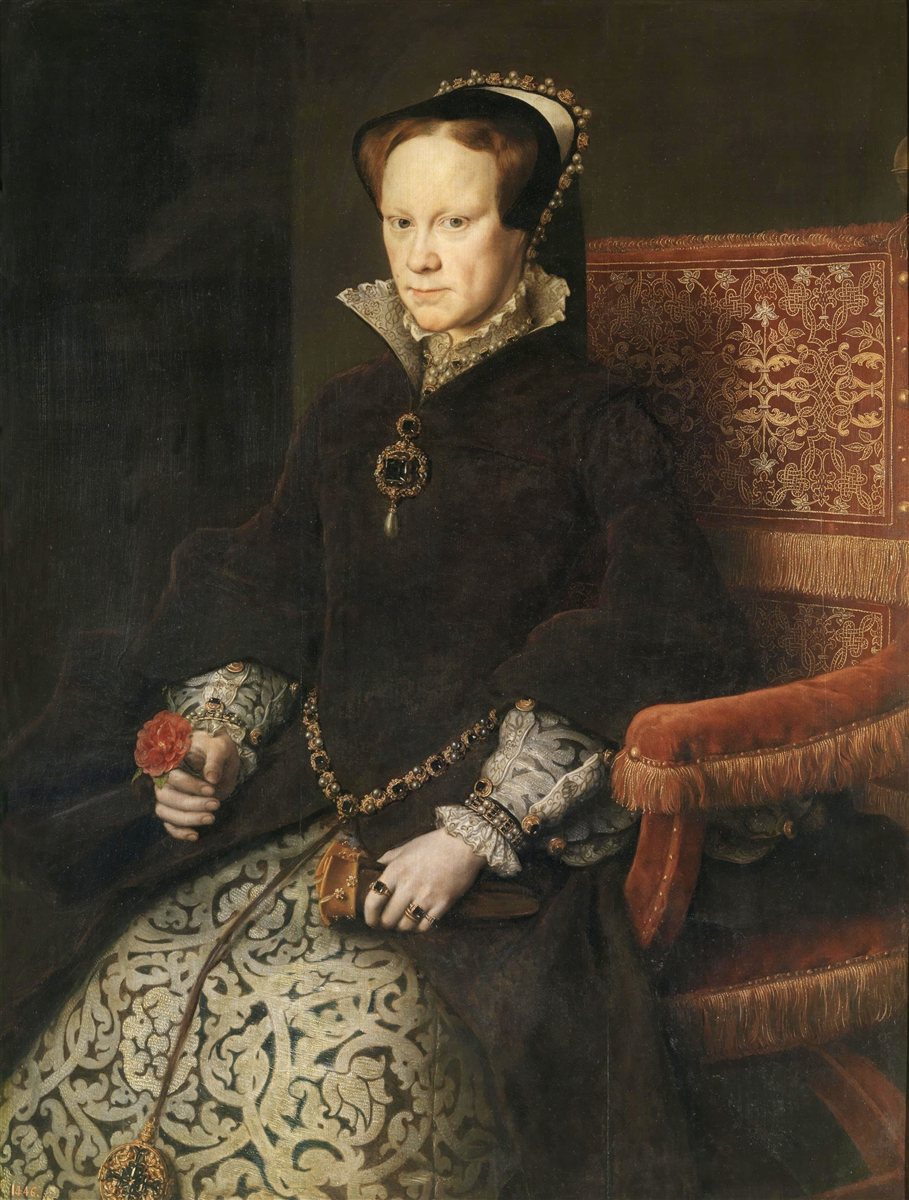
Antonis Mor, portrait of Mary I of England (1554) / Public Domain via Wikimedia Commons. Source.
What About Mary Worth?
Mary Worth is one of the oldest well-documented names attached to the American mirror game, but that does not give us a real Mary Worth either.
Online versions often turn her into a Salem witch, a child murderer or a woman burned by frightened villagers. Those biographies shift from site to site and are not backed by Salem’s surviving witch-trial records.
There is also a famous American newspaper strip called Mary Worth, which began in 1938. The Knapps noticed the coincidence when they published their children’s folklore collection in 1976 and joked about the respectable comic-strip character “moonlighting as a mirror witch.”
That is interesting, but it is not proof that the comic created the supernatural name. Folklorists have never pinned the ritual to one neat origin.
Sometimes a familiar name is simply a familiar name.
When Did the Modern Legend Begin?
This is where the documentary trail becomes much firmer.
The modern Bloody Mary/Mary Worth mirror game is securely documented by the 1970s, and folklore scholars argue that related versions were already circulating by the middle of the twentieth century.
Indiana State University’s folklore archive preserves a 1970 Iowa account involving Mary Worth and a mirror. The Knapps published their version in 1976. Two years later, folklorist Janet Langlois published Mary Whales, I Believe in You: Myth and Ritual Subdued, one of the foundational academic studies of the tradition.
Langlois’s material included accounts collected from children earlier in the decade. One 1973 interview, later discussed by folklorist Alan Dundes, involved a twelve-year-old who knew Mary Whales as a dead girl connected to a bloody vanishing-hitchhiker tale.
That does not mean someone invented Bloody Mary in 1970.
Folklore can circulate for years before anyone thinks to archive it. But it does mean claims that the specific bathroom game has been performed unchanged since medieval Europe go far beyond the evidence.
The Much Older Mirror Ritual Behind the Fear
Bloody Mary itself is modern. Staring into mirrors to see something that is not supposed to be there is much older.
For centuries, mirrors and other reflective surfaces have been used in divination. The broad practice is often called scrying, while divination specifically involving mirrors is sometimes called catoptromancy.
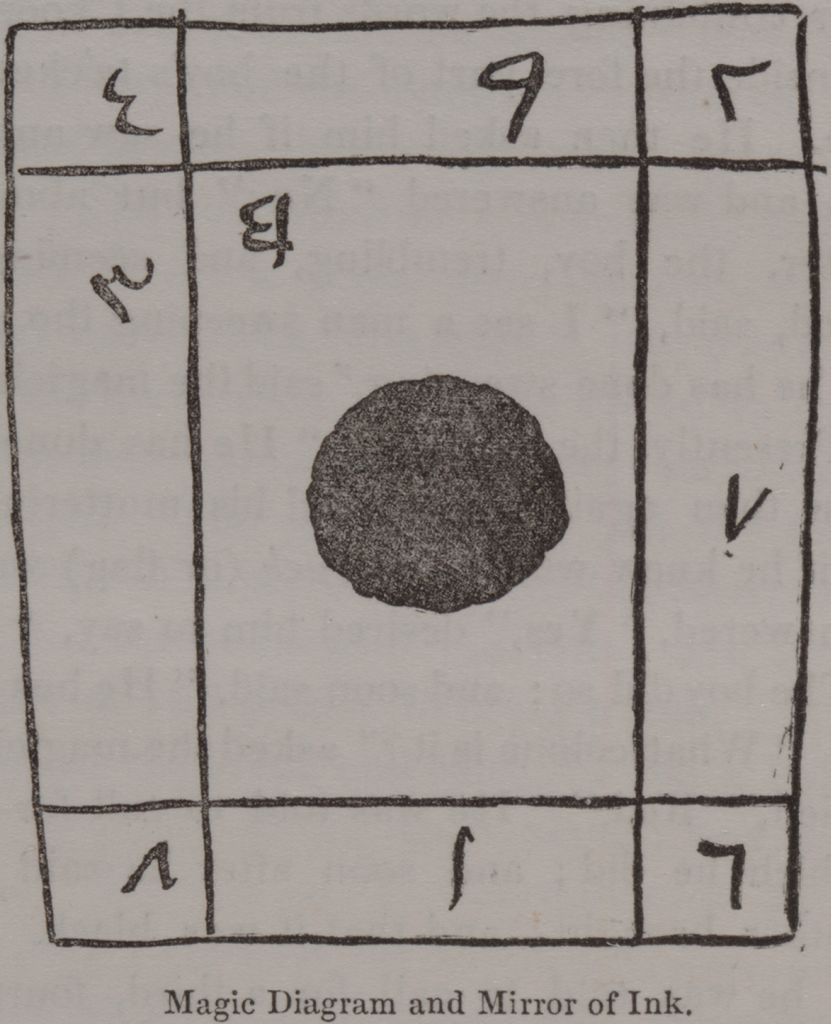
Edward William Lane, “Magic Diagram and Mirror of Ink” from An Account of the Manners and Customs of the Modern Egyptians (1836) / TIMEA via Wikimedia Commons / CC BY-SA 2.5. Source.
One important predecessor to Bloody Mary was not about ghosts at all. It was about marriage.
In Britain and North America, young people performed fortune-telling rituals in which a future husband or wife was expected to appear in a mirror. Halloween was an especially popular night for these games.
Robert Burns recorded one version in notes to his 1786 poem Halloween. A participant was instructed to take a candle, go alone to a looking glass, eat an apple before it and, in some traditions, comb her hair. The face of her future spouse was supposed to appear in the mirror as though looking over her shoulder.
American collections preserve similar customs. Fanny D. Bergen’s Current Superstitions from 1896 records Halloween rituals in which a person walks backward on stairs or into a cellar while looking into a mirror to see a future spouse.
By the early twentieth century, the idea was familiar enough to appear on commercial Halloween postcards.
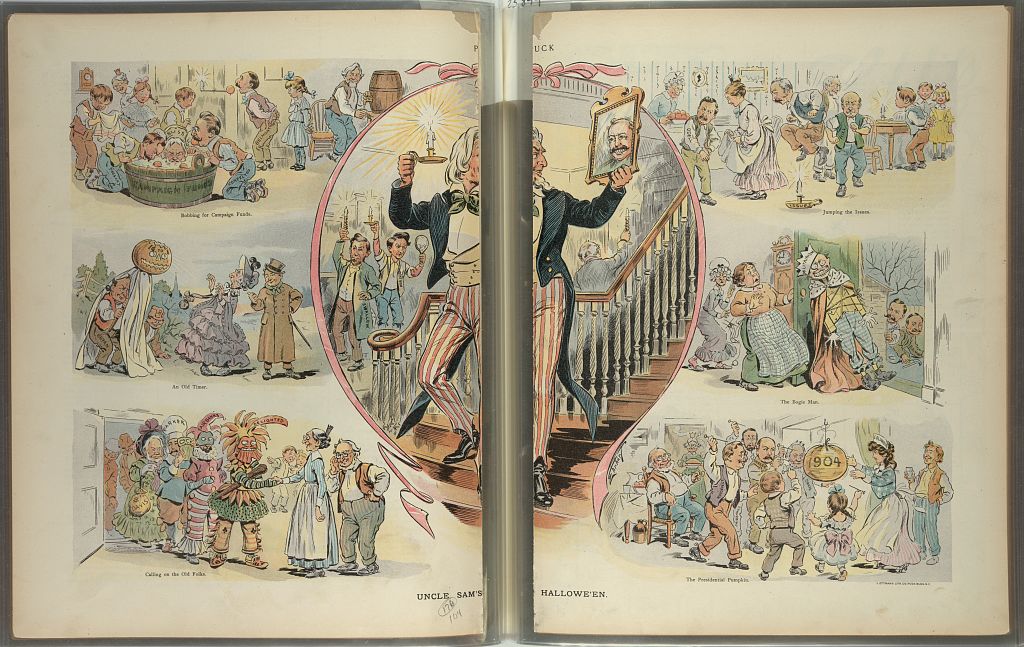
S. D. Ehrhart, “Uncle Sam’s Hallowe’en,” Puck (1904) / Library of Congress Prints and Photographs Division / No known restrictions on publication. Source.
That visual connection is striking: a young woman alone, candle in hand, staring into a mirror and waiting for another face to appear.
But the relationship needs one important qualifier. Older marriage divination is a plausible predecessor and close analogue to Bloody Mary, not a proven unbroken lineage. We cannot draw a straight line from one eighteenth-century Scottish charm to a twentieth-century American school bathroom and pretend every step in between is documented.
What clearly survived was the setup.
The purpose changed.
From Future Husband to Something Horrible
The old mirror games usually promised information. The modern ritual promises fear.
Folklorists have offered different explanations for that transformation.
Alan Dundes gave the best-known psychoanalytic reading. In his 1998 essay “Bloody Mary in the Mirror,” he linked the ritual’s bathroom setting, blood imagery and popularity among pre-pubescent girls to anxieties about menstruation, bodily change and adolescence.
It is an influential interpretation. It is not a diagnosis of every child who ever played the game.
Other folklore scholarship places more emphasis on the act itself: children testing courage, daring each other to cross a line, and performing a frightening ritual away from adult supervision. In that reading, the point is not what Bloody Mary secretly “symbolizes.” The point is what happens between the people standing outside the bathroom door.
Someone has to go first.
Someone claims they saw something.
Someone else insists they did not.
By the end, the group has a story.
That is how legends travel.
Why Do People See Faces in the Mirror?
This is the part of Bloody Mary that can feel unsettling even when everyone in the room knows it is a game.
In 2010, psychologist Giovanni B. Caputo published experiments on what he called the strange-face-in-the-mirror illusion. In one study, 50 healthy young adults stared at their own faces in a mirror under low illumination for ten minutes.
All 50 reported some form of strange-face effect. Sixty-six percent described major distortions of their own faces. Twenty-eight percent reported an unknown person’s face, and 48 percent reported fantastical or monstrous beings.
That study was not an experiment on Bloody Mary. Nobody was trying to summon a ghost.
It does, however, show that prolonged mirror gazing in poor light can produce genuinely disturbing visual experiences without requiring a supernatural explanation.
Exactly why those experiences become so elaborate is still being studied. Low-light visual adaptation and fading of stable visual details may contribute, while the brain’s face-processing systems appear to play an important role in turning unstable features into recognizable faces.
You will often see the effect reduced online to Troxler fading, the phenomenon in which unchanging peripheral details fade during steady fixation. That may be part of the picture, but Caputo’s own work does not reduce every reported monster, stranger or transformed face to one simple optical trick.
Expectation matters too.
If you stare into dim glass after being told that a mutilated woman is about to appear, you are not entering the experiment neutrally.
That does not make the fear fake.
It makes the experience a particularly effective collision between folklore and perception.
Has Bloody Mary Ever Actually Killed Someone?
Stories say yes. Reliable documentation is another matter.
Folklore versions threaten scratches, blindness, disappearance, madness and death. Those threats are part of what makes the dare work.
But folklore scholarship and reputable historical sources do not establish a verified case in which a supernatural Bloody Mary apparition killed or seriously injured a participant.
That distinction matters. “Nobody has ever been hurt while playing in a dark bathroom” would be impossible to prove. People can fall, break glass or panic.
What is unsupported is the much larger claim: that investigators, police or courts have documented the mirror apparition itself attacking someone.
Bloody Mary Has Relatives, Not Clones
Mirror and bathroom challenge legends are not limited to the United States.
Spanish-language folklore includes Verónica, a figure summoned in mirror rituals whose instructions vary considerably by region. Russian children’s folklore developed mirror-summoning games around the Queen of Spades. Japan’s Hanako-san belongs to school-bathroom legend rather than mirror divination, but she occupies a similar space in children’s dare culture: a named supernatural figure, a ritualized location, and the possibility that calling out will make something answer.
These should not be treated as translations of one universal legend.
Their local histories matter.
The resemblance is useful because it shows how well the basic format travels: take an ordinary place, add a simple set of rules, and make the participant responsible for inviting the danger in.
Bloody Mary and Candyman
Modern horror did not just borrow the atmosphere. Sometimes it borrowed the game itself.
Clive Barker’s original story The Forbidden did not contain the famous “say his name in the mirror five times” rule associated with Candyman. Director Bernard Rose added that structure while adapting the story for his 1992 film.
Rose has described drawing on Bloody Mary-style urban legend when developing the mirror invocation and has explained that an earlier version used thirteen repetitions before the number was reduced because it took too long on screen.
That makes Candyman one of the clearest examples of a movie taking a children’s mirror ritual and feeding it back into popular culture in a new form.
The relationship is influence, not identity. Candyman has his own fictional history, rules and themes.
Why the Legend Refuses to Settle Down
Bloody Mary survives because there is no official version to preserve.
The name can become Mary Worth or Mary Whales. Three repetitions can become thirteen or forty-seven. A witch becomes a dead girl, then a queen, then a grieving mother. A nineteenth-century fortune-telling mirror becomes a school bathroom with fluorescent lights switched off.
Every generation inherits enough of the ritual to recognize it and changes enough to claim it as its own.
That is more interesting than finding one “real Bloody Mary” ever could be.
The woman in the mirror has never needed a fixed identity.
She only needs somebody willing to look.
Sources & further reading
- Janet Langlois, Mary Whales, I Believe in You: Myth and Ritual Subdued
- Mary and Herbert Knapp, One Potato, Two Potato: The Folklore of American Children
- Alan Dundes, Bloody Mary in the Mirror: A Ritual Reflection of Pre-Pubescent Anxiety
- Giovanni B. Caputo, Strange-Face-in-the-Mirror Illusion
- Robert Burns, Halloween
- Fanny D. Bergen, Current Superstitions
- Library of Congress, Century-old Tricks for Finding Your True Love on Halloween
- Bernard Rose interview on the Bloody Mary influence behind Candyman




_-_TIMEA.jpg)