Lore & Explained / Folklore
The Casket Girls Explained: New Orleans Brides, the Ursuline Convent, and the Vampire Legend
Who were the Casket Girls of New Orleans? Separate the filles à la cassette, Ursuline history and small travel chests from the later vampire legend.
Topics: Casket Girls, Filles à la Cassette, New Orleans, Ursuline Convent, Vampire Folklore, Louisiana Folklore
Turbine682 / Wikimedia Commons (CC BY-SA 4.0, resized)
The Casket Girls of New Orleans are often introduced as one of the city’s oldest vampire stories.
The familiar version has everything a ghost tour needs: pale young women arriving from France, coffin-shaped luggage, an Ursuline convent, sealed attic shutters, mysterious deaths and silver nails supposedly blessed by the Pope.
The history is less theatrical — and more interesting.
French authorities really did send young women to colonial Louisiana as prospective wives. Historical writers called some of them filles à la cassette, a name connected to the small trunks or cases used for their belongings. Ursuline nuns really did arrive in New Orleans in 1727 and cared for women and girls in the colony.
But the surviving historical sources used for this article do not document the women as vampires, demons or suspects in a wave of blood-drained murders.
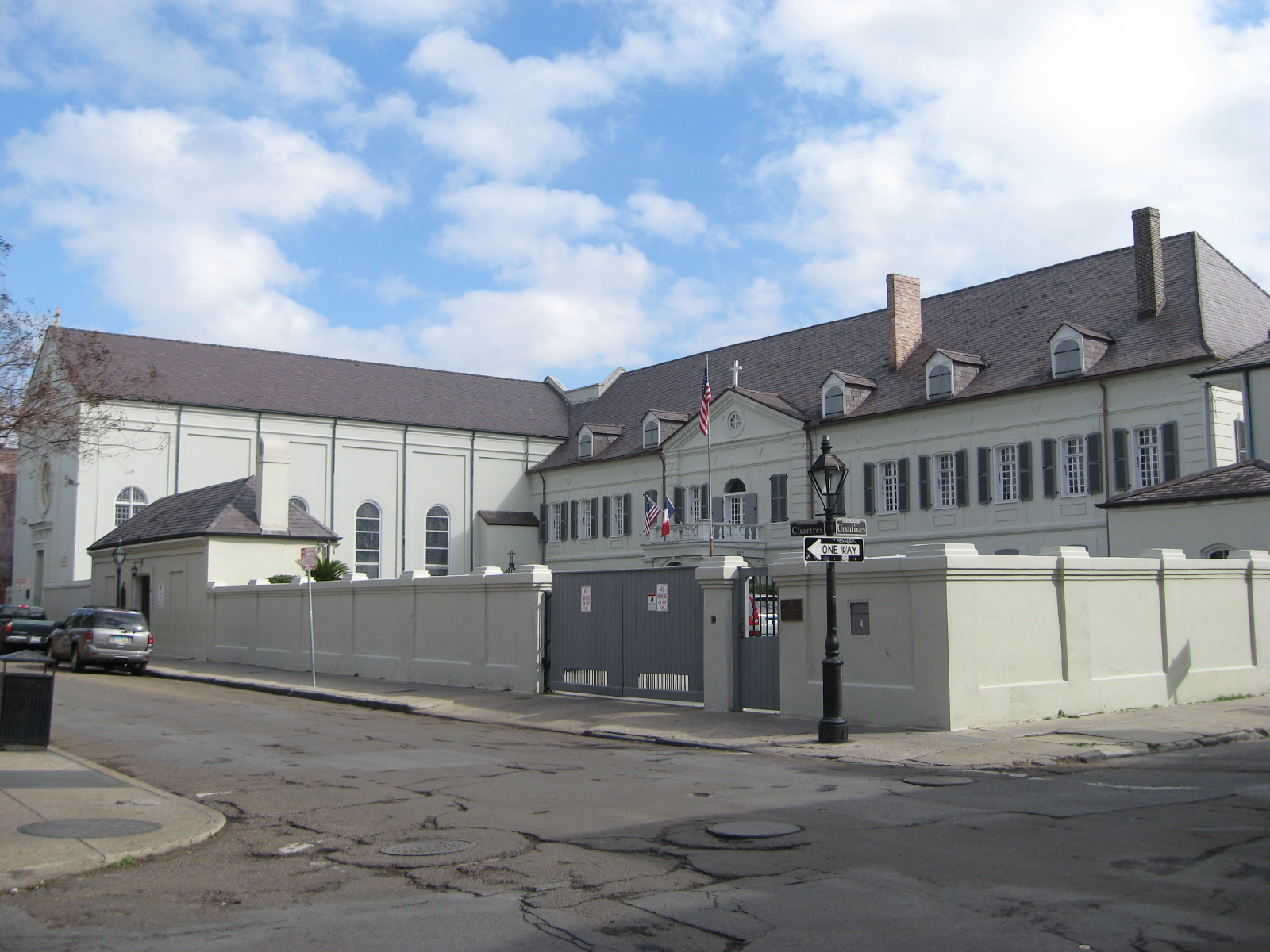
Even the building at the center of the most famous version of the legend creates a problem for a literal reading: the Old Ursuline Convent standing on Chartres Street today was completed in 1752 or 1753, decades after the arrivals usually associated with the Casket Girls.
The vampire story belongs to folklore.
The women belong to history.
Who Were the Casket Girls?
The name is usually attached to young French women sent to Louisiana during the early eighteenth century to marry settlers and help establish permanent French families in the colony.
That policy did not begin with one famous ship arriving in New Orleans.
In 1704, years before New Orleans was founded, a group of young women arrived in the French colony at Mobile aboard the Pélican. The Encyclopedia of Alabama documents this group as the Pelican Girls. They had been recruited in France as prospective wives for colonists.
The same source explains that the women were given cassettes — small suitcases or cases — for their belongings. Similar luggage was later associated with women sent elsewhere in Louisiana, including New Orleans, where the phrase filles à la cassette became attached to them.
The Historic New Orleans Collection makes an important distinction: the 1704 Pelican Girls were not the later New Orleans group remembered as the Casket Girls, even though the colonial goal was similar.
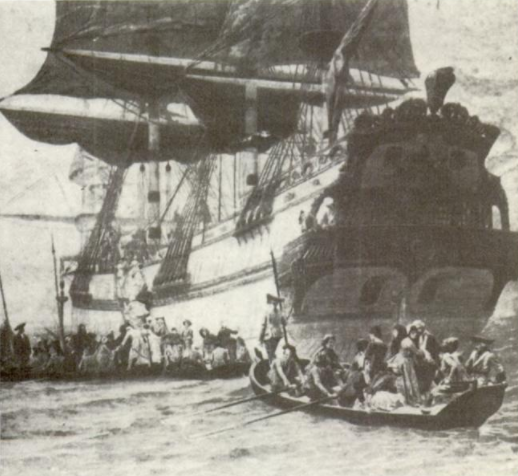
A 19th-century engraving imagining the women’s departure for the colony — itself a later artistic interpretation, not a contemporary 18th-century record. Charles Édouard Delort, Wikimedia Commons (CC BY-SA 4.0).
That distinction matters because modern retellings often compress several decades of French colonial migration into a single mysterious arrival.
There was not one simple event called “the Casket Girls” from which every later detail can safely be reconstructed.
What Does Filles à la Cassette Mean?
The French phrase is commonly translated as “girls with the cassette” or “cassette girls.”
Here, cassette refers to a small case, box or trunk used to carry personal belongings.
That is the first major gap between the history and the vampire legend.
Modern English speakers hear casket and immediately think coffin. But the historical nickname did not mean the women arrived carrying miniature coffins for themselves.
Nineteenth-century Louisiana historian Charles Gayarré wrote that a group arriving in the colony in early 1728 had each been given a casket containing articles of dress, which led to the nickname filles à la cassette.
Grace King’s 1895 history of New Orleans likewise described the name as coming from a little trunk containing a trousseau.
Both works were written long after the events they describe, so neither should be mistaken for a passenger diary from 1728. They are evidence for how Louisiana history remembered the women in the nineteenth century.
What they do not describe is a shipment of coffins.
Did the Casket Girls Arrive in 1728?
1728 is one of the most commonly repeated dates, but the published historical record is not as tidy as the legend makes it sound.
Gayarré’s nineteenth-century history places a substantial arrival of young women at the beginning of 1728 and says the Ursulines cared for them while husbands were found.
Other historical retellings use different dates for groups of women associated with the broader filles à la cassette tradition.
The Historic New Orleans Collection, for example, captions an 1888 illustration of the Casket Girls as representing women who arrived in New Orleans in 1721.
That does not mean one source has to be forced into the mold of another.
French Louisiana received women through different recruitment efforts across multiple years. Some were voluntary marriage migrants. Other women were transported under very different circumstances. Later writers then grouped or separated these migrations in different ways.
The responsible conclusion is narrower than the internet legend:
Young French women were sent to colonial Louisiana as prospective wives, small travel cases became associated with some of them, and later Louisiana histories remembered a New Orleans group as the filles à la cassette.
An exact universal count, one perfect passenger list and one single arrival date should not be asserted without specifying which group and which source is being discussed.
What Did the Ursuline Nuns Have to Do With Them?
The Ursulines are a genuine part of New Orleans history.
The order arrived from France in 1727. According to the Old Ursuline Convent Museum, the sisters first lived in the Kolly House until 1734 while an early convent was built.
The Ursulines educated girls, cared for orphans and operated within the colony’s medical and religious life.
Gayarré wrote that the Ursulines were asked to take care of the 1728 group of young women until suitable husbands could be found. Grace King later repeated the broader tradition that the filles à la cassette stayed in the convent while marriages were arranged.
That provides the historical seed from which the later haunted-convent story could grow.
But it does not verify the vampire story.
The Biggest Problem With the Vampire-Attic Story
The version told today often points to the Old Ursuline Convent at 1112 Chartres Street and claims that the Casket Girls or their mysterious trunks were locked in its attic in 1728.
The dates do not fit.
The Old Ursuline Convent Museum says the building visitors see today was authorized by King Louis XV in 1745 and completed in 1752 or 1753.
When the Ursuline sisters arrived in 1727, they were living elsewhere.
From 1734 until 1752 or 1753, they occupied an earlier convent on the same general grounds but closer to the river.
So the present building cannot literally be the same building in which a group arriving in 1728 was immediately locked in an attic.
That does not stop a haunted-place tradition from attaching itself to the surviving convent.
It does mean that a claim such as “these exact shutters have been sealing the Casket Girls inside since 1728” fails a basic chronology check.
Were the Casket Girls Vampires?
There is no credible historical evidence in the sources reviewed here that the women were vampires.
Older historical accounts focus on immigration, marriage, the women’s luggage and the care provided by the Ursulines.
They do not describe:
- women sleeping in coffins;
- girls drinking blood;
- bodies found drained of blood after their arrival;
- an epidemic of vampire murders blamed on the women;
- the nuns discovering empty coffins;
- vampires imprisoned in the convent attic;
- silver nails blessed by the Pope to seal the windows.
Those elements belong to later legend.
That distinction is especially important because modern articles sometimes introduce the vampire version with phrases such as “the true story” and then move directly into details that cannot be demonstrated from eighteenth-century evidence.
A historical person or migration can inspire a legend without the legend becoming historical fact.
What About the Sealed Shutters and the Pope’s Nails?
The most elaborate version says that the Ursulines discovered something supernatural in the attic and sealed the upper windows with hundreds of silver nails, sometimes said to have been blessed by the Pope.
The story is memorable because it gives visitors a physical object to look at.
A closed shutter becomes evidence.
An attic becomes a prison.
The problem is that architecture is not documentation of a supernatural event.
The official history of the convent explains the dates and uses of the building but does not authenticate a papal anti-vampire operation. The modern structure has undergone centuries of repairs, alterations and changing uses. It has served as a convent-school, an archbishop’s residence, a boys’ school, a public school and even the seat of the Louisiana legislature.
Closed upper windows do not prove vampires were kept behind them.
The blessed-silver-nail claim should be treated as folklore unless documentary evidence for it is produced.
Did Murders Increase After the Girls Arrived?
Some modern retellings claim that the women’s arrival coincided with a sudden increase in murders and that residents therefore accused them of being demons or vampires.
That claim has also entered current entertainment coverage.
But the historical sources used here do not establish a documented 1728 murder wave that was officially blamed on the filles à la cassette.
That does not prove no violent deaths occurred in colonial New Orleans. It was a small, difficult colonial settlement in a region marked by disease, forced labor, warfare, slavery and high mortality.
The narrower point is about evidence:
A modern claim that “murders rose, therefore the women were accused of vampirism” needs a contemporary record before it can be presented as history.
Without that record, it remains part of the legend.
Why Did the Vampire Version Work So Well?
The Casket Girls legend combines several ideas that fit together almost too perfectly.
First is the word casket. A small travel case becomes a coffin in the modern imagination.
Second is the convent itself. The Old Ursuline Convent is one of New Orleans’ most striking colonial buildings. An old religious structure with dormer windows and restricted spaces is easy to turn into Gothic scenery.
Third is New Orleans’ later reputation for vampires, ghosts, Voudou stories and supernatural tourism.
Fourth is real European vampire history.
Reports from places such as Kisiljevo in 1725 and Medveđa in 1732 helped create some of Europe’s most famous documented vampire panics. Those events belong to the historical background explored in our guide to vampire folklore before Dracula.
But chronology alone does not create a connection.
The fact that European communities were discussing vampires in the same broad era does not prove the women sent to Louisiana were suspected vampires.
The Casket Girls story works because later storytellers were able to fit a real migration, a suggestive nickname and a surviving old building into a vampire narrative.
That is how folklore often grows: not from nothing, but by reorganizing real fragments into a story with a much sharper ending.
The Casket Girls and New Orleans’ Other Legends
New Orleans has many historical figures whose documented lives became difficult to separate from later supernatural storytelling.
Marie Laveau is a good example. She was a real nineteenth-century religious leader whose paper trail can be separated from stories about magical powers, secret conspiracies and ghostly appearances.
The Casket Girls require the same approach.
There are three layers:
- documented colonial migration — French women were sent to Louisiana and marriage migration was part of colonial policy;
- later historical tradition — writers remembered women associated with small cassettes and with Ursuline care;
- modern supernatural folklore — vampires, empty coffins, bloodless corpses and a sealed attic.
The layers can be discussed together without pretending they are equally documented.
The New Casket Girls Horror Movie Is Using the Legend
The folklore is now getting another life in horror.
On September 10, 2026, ScreenDaily reported that Aura Entertainment acquired U.S. rights to a supernatural horror thriller titled Casket Girls, starring Gabrielle Union and Mike Colter.
Justin G. Dyck directs. ScreenDaily says the film follows a detective and her partner whose investigation leads to vampires being unleashed inside a centuries-old New Orleans church. Production was understood to have wrapped when the deal was reported.
The cast also includes Raúl Castillo, Matt Frewer and Thomas Lennon.
The movie is useful evidence for the legend’s continuing cultural life.
It is not evidence that the vampire story happened.
That distinction matters because some entertainment coverage describes the film as inspired by a “true story” and then repeats the supernatural version as though its details were established colonial history.
A more accurate description is:
The film is inspired by real colonial-era women and a later New Orleans vampire legend built around them.
No U.S. release date was announced in the September 10 ScreenDaily report.
So What Is Actually True?
The strongest version of the history is also the simplest:
- France sent young women to colonial Louisiana as prospective wives.
- Similar programs operated before New Orleans became the colony’s main center.
- Small cases or trunks called cassettes became associated with some of the women.
- Later Louisiana histories remembered a group as filles à la cassette.
- The Ursulines arrived in New Orleans in 1727 and were associated with the care and education of women and girls.
- Nineteenth-century histories link the Ursulines with the women remembered as Casket Girls.
- The present Old Ursuline Convent was completed in 1752 or 1753, so it did not exist in its current form in 1728.
- The vampire story is folklore, not a verified eighteenth-century event.
The story does not become less interesting when the vampires move out of the history column.
It becomes clearer.
Real women crossed the Atlantic into a colonial society that expected them to marry, reproduce and help stabilize an imperial settlement. Later generations reduced those lives to a nickname. Still later storytellers turned the nickname into a coffin and the convent into a vampire prison.
That transformation is the real haunting part of the Casket Girls story: watching history become folklore in plain sight.
Frequently Asked Questions
Were the Casket Girls real?
Women sent from France to colonial Louisiana as prospective wives are historically documented, and later Louisiana histories describe filles à la cassette associated with small travel cases. The exact dates, numbers and boundaries of one singular “Casket Girls” group are less uniform across published sources than modern retellings suggest.
Why were they called the Casket Girls?
The name is connected to the French word cassette, referring to a small case or trunk used for belongings. The term did not originally mean that the women arrived carrying coffins.
Were the Casket Girls vampires?
There is no credible historical evidence in the sources reviewed here that they were vampires. Vampirism belongs to later New Orleans folklore.
Did the Ursuline nuns lock the Casket Girls in the attic?
Historical writers connect the Ursulines with caring for women sent to the colony. The supernatural story about vampires being locked in an attic is folklore. The present Old Ursuline Convent was not completed until 1752 or 1753.
Were the convent windows sealed with silver nails blessed by the Pope?
That is part of the modern legend. The official history of the convent does not document such an anti-vampire measure.
Is the 2026 Casket Girls movie based on a true story?
It draws from real colonial history and from the later vampire legend. The film’s bloodthirsty vampires are fictional, not a documented historical event.
Sources & further reading
- Wikimedia Commons: Old Ursuline Convent by Turbine682 (CC BY-SA 4.0)
- Old Ursuline Convent Museum: History of the Site
- Charles Gayarré, History of Louisiana, Series II, Lecture 5
- Grace King, New Orleans: The Place and the People, Chapter 4
- Encyclopedia of Alabama: Pelican Girls
- Historic New Orleans Collection: Marie Grissot, the Midwife Who Battled Bienville
- ScreenDaily: Casket Girls horror starring Gabrielle Union gets US deal
- Bloody Disgusting: Casket Girls first look