Lore & Explained / Demons & Occult
Baphomet Explained: Templars, Éliphas Lévi, the Goat Image, and the Satanism Myth
The goat-headed Baphomet most people recognize was drawn by Éliphas Lévi in 1856. The Templar accusations, Lévi's symbol and later Satanic uses are separate chapters.
Topics: Baphomet, Knights Templar, Eliphas Levi, Occult, Folklore
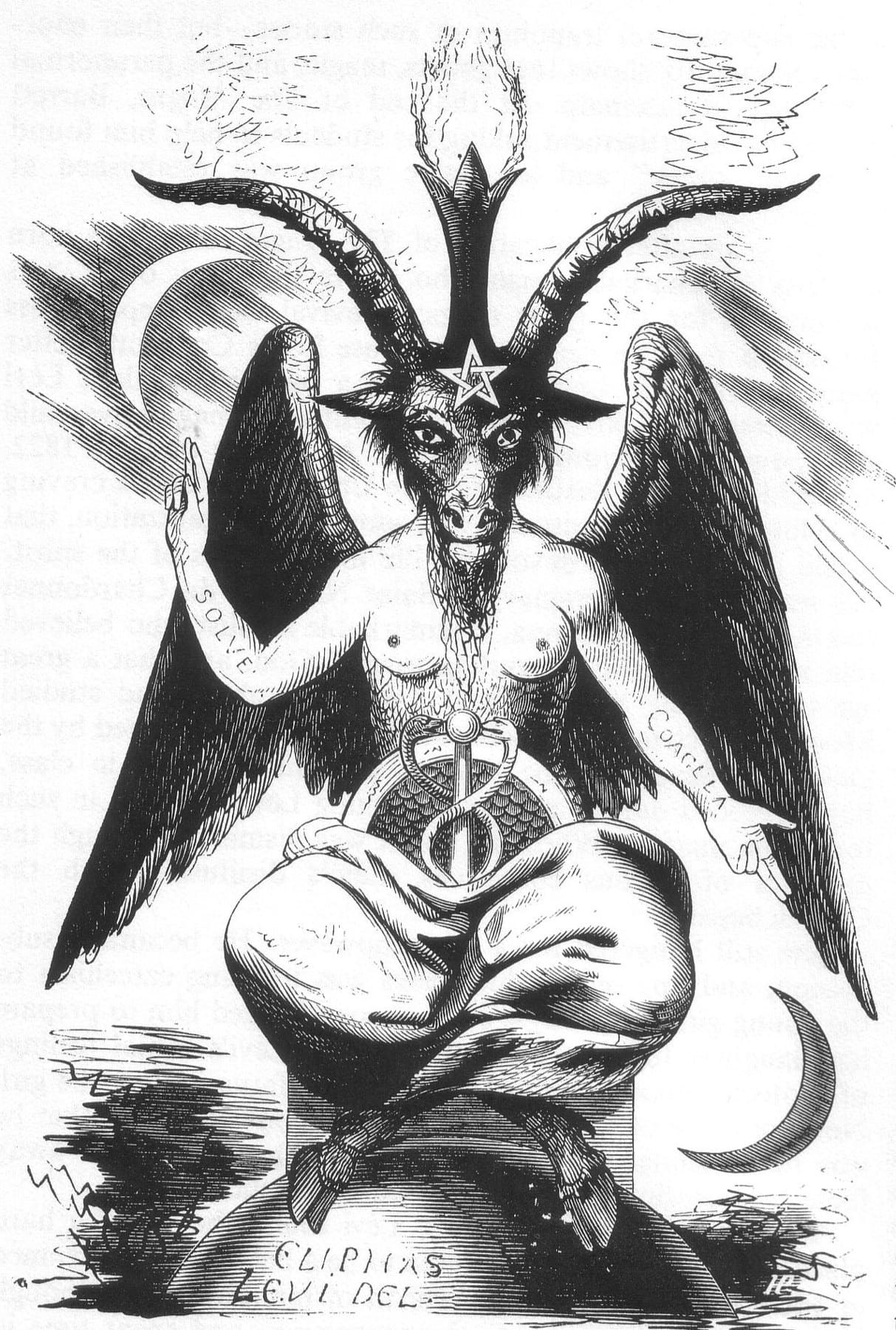
Éliphas Lévi, 1856 (Public Domain)
The Baphomet most people recognize today is not a medieval Templar idol preserved in an old manuscript. It is a nineteenth-century occult image.
French occult writer Éliphas Lévi published the now-famous goat-headed, winged, androgynous figure in the second volume of Dogme et Rituel de la Haute Magie in 1856. The name Baphomet is much older, but the medieval accusations, Lévi’s Sabbatic Goat, the modern Sigil of Baphomet, and later Satanic uses are different chapters of the story.
Keeping those chapters separate clears up the biggest misconception immediately:
There is no evidence that medieval Knights Templar worshipped Lévi’s goat-headed figure. That image did not yet exist.
The name is older than the goat
Forms of the name Baphomet appear in medieval Western material long before Lévi drew his figure.
Historians have generally connected the word to medieval European forms of Mahomet, a name used for the Prophet Muhammad in Western Christian writing. That context matters because medieval polemical writing often misrepresented Islam as idolatrous.
By the early fourteenth century, the name became entangled with accusations against the Knights Templar.
It is safer, however, not to imagine one fixed “Baphomet” moving unchanged from the Crusades into modern occultism. The medieval word and the nineteenth-century image do not come with one continuous biography.
What the Templars were actually accused of
On October 13, 1307, King Philip IV of France ordered the arrest of Templars in his kingdom.
The proceedings that followed included accusations of denying Christ, improper initiation practices, sexual misconduct and idol worship. Historian Malcolm Barber’s standard study of the trials shows how the charges expanded into a long formal list as royal and ecclesiastical proceedings developed.
Some testimony described mysterious heads, idols or figures.
But the descriptions were inconsistent.
The alleged object could be described differently from one testimony to another, and the trial record does not provide a single securely documented object that can be matched to Lévi’s later goat figure.
That is why the shorthand “the Templars worshipped Baphomet” says much more than the surviving evidence allows.
Torture matters — but the trial was more complicated than one sentence
The French Templar proceedings involved torture and coercive interrogation.
Sean L. Field’s study of the interrogations at Caen on October 28–29, 1307 examines in detail how torture shaped confession-taking during the early royal process. That is an important reason historians treat spectacular admissions from the French trials with caution.
But it is also too broad to say that every Templar statement preserved anywhere in the proceedings was simply one identical torture confession.
There were multiple phases, jurisdictions and interrogations. Royal officials, inquisitors and papal representatives did not always question the same people under the same circumstances.
The important historical point is therefore narrower and stronger: the record emerged from a politically charged prosecution in which coercion and torture were demonstrably used, while the alleged idol descriptions varied and never establish the goat-headed figure familiar today.
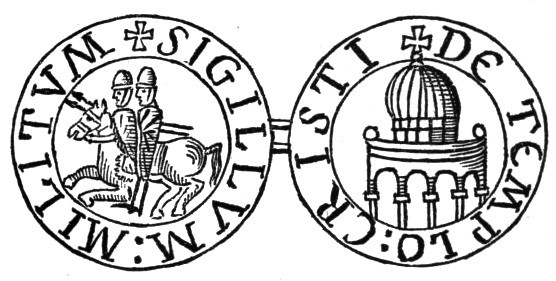
The Templar seal reproduced by Thomas Andrew Archer and Charles Lethbridge Kingsford in 1894. Public Domain via Wikimedia Commons. It is historical Templar imagery, not evidence of a goat-headed Baphomet cult.
The order was suppressed, not vindicated by a secret goat discovery
Pope Clement V formally suppressed the Templar order in 1312.
Two years later, Grand Master Jacques de Molay and Geoffroi de Charney were burned in Paris after years of proceedings.
Later discoveries such as the Chinon Parchment, which records papal representatives questioning and absolving leading Templars after confession and penance in 1308, make the legal and ecclesiastical story more complicated than popular conspiracy versions suggest.
The parchment does not prove that every accusation was invented, and it does not prove a hidden Baphomet religion existed.
What it does help show is that the Templar case cannot be reduced to a simple narrative in which church authorities uncovered a clearly defined, goat-worshipping cult.
Éliphas Lévi created the image people now call Baphomet
The decisive visual shift came more than five centuries later.
WorldCat records the two-volume Dogme et Rituel de la Haute Magie under Lévi’s name in 1856, and surviving public-domain editions preserve his illustration.
Lévi called the figure the Sabbatic Goat.
The image combines:
- a goat’s head;
- human and animal anatomy;
- wings;
- breasts;
- a torch between the horns;
- a pentagram on the forehead;
- one hand pointing upward and the other downward;
- the words SOLVE and COAGULA on the arms.
This was not Lévi sketching an archaeological discovery.
It was a constructed occult emblem.
Lévi’s own explanation frames the figure through balance and opposites: above and below, masculine and feminine, human and animal, dissolution and combination.
The meaning is esoteric and symbolic, not zoological.
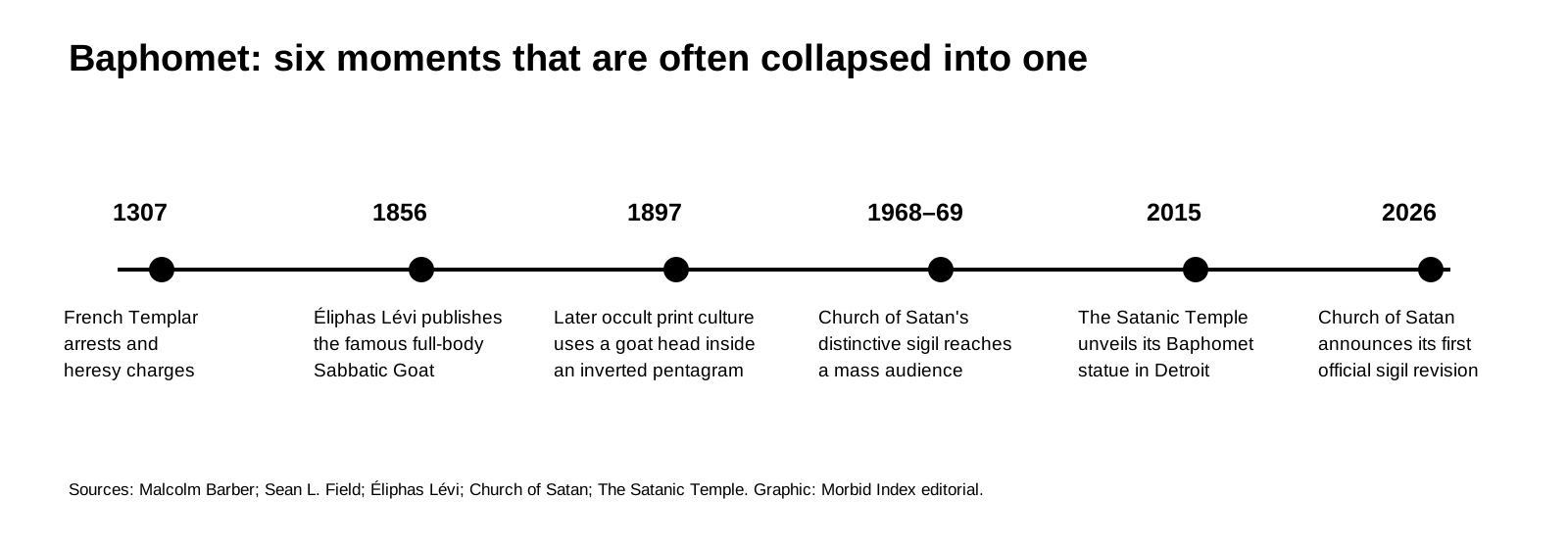
The modern Baphomet image and the modern Sigil of Baphomet entered history centuries after the Templar trials. Graphic: Morbid Index editorial.
Lévi’s Baphomet is not the same graphic as the modern Sigil of Baphomet
This is another distinction that gets lost online.
Lévi’s 1856 Baphomet is a full-bodied goat-headed figure.
The modern Sigil of Baphomet used by the Church of Satan is a goat’s head inside an inverted pentagram, surrounded by Hebrew characters.
They are visually and historically related, but they are not simply the same drawing with the body cropped away.
The Church of Satan’s own historical account traces the goat-head-and-pentagram graphic through later occult publishing. It identifies a version in Stanislas de Guaita’s 1897 La Clef de la Magie Noire, later appearances associated with Oswald Wirth, and a twentieth-century reproduction in Maurice Bessy’s A Pictorial History of Magic and the Supernatural.
That account is useful as a primary source for how the Church of Satan understands and documents its own symbol. It should not be treated as neutral authority for medieval history.
How the Church of Satan made the sigil globally recognizable
Anton LaVey founded the Church of Satan in 1966.
According to the organization’s own history, LaVey adopted and redesigned the goat-head-and-inverted-pentagram symbol for Church use. A distinctive version appeared on the 1968 The Satanic Mass LP and then reached a much larger audience on The Satanic Bible in 1969.
The Church says this mass-market use helped establish the graphic as the best-known symbol of modern Satanism.
That is a modern development.
It does not mean medieval Templars used the same sigil, and it does not turn Baphomet into an ancient synonym for Satan.
The Sigil of Baphomet changed again in 2026
There is also a genuinely current chapter to the story.
For the Church of Satan’s 60th anniversary in 2026, Magus Peter H. Gilmore and Magister Robert Merciless completed what the organization describes as the first official update to its Sigil of Baphomet since 1969.
The Church says the revision corrects asymmetries, improves printability and changes details including the goat’s eyes and geometry. A Church of Satan post dated March 22, 2026 also presented the new stylized rendering in the anniversary context.
This is not a change to “Baphomet” as a universal symbol.
It is a change to a particular religious organization’s official copyrighted version of the Sigil.
That distinction matters for both history and image rights.
Morbid Index is not reproducing that new 2026 sigil here because the Church of Satan explicitly says permission is required to use its versions.
Crowley and Thelema used the name differently
Baphomet also appears in the Thelemic tradition associated with Aleister Crowley.
Crowley’s Gnostic Mass, written in 1913, includes Baphomet in its creed. The U.S. Grand Lodge of Ordo Templi Orientis identifies the Gnostic Mass as the central rite of its ecclesiastical arm, Ecclesia Gnostica Catholica.
Again, this is a later esoteric use.
It should not be projected backward onto the medieval Templars.
A name can be reused inside a new religious or occult system without proving that the new system preserves the beliefs of the people first accused of using that name.
The Satanic Temple’s Baphomet statue is another later adaptation
The Satanic Temple uses yet another prominent modern Baphomet image.
The organization says its Baphomet with Children statue was commissioned in 2014, created by sculptor Mark Porter and publicly unveiled in Detroit on July 25, 2015.
The Satanic Temple describes the monument within its own religious-liberty and pluralism activism.
The statue draws visibly on the goat-headed occult tradition, but it is a twenty-first-century work created for a twenty-first-century organization.
It is not a medieval artifact and it should not be used as visual evidence for Templar practice.
Is Baphomet a demon?
That depends on what the question means.
Morbid Index places Baphomet in its Demons & Occult index for navigation, because that is where readers are likely to look for the subject.
Historically, however, “Baphomet” is not one stable demon with an unbroken biography comparable to a figure preserved across a continuous textual demonology.
The record instead contains several layers:
- a medieval name associated with polemical and Templar-era material;
- alleged idols and heads in trial accusations;
- Lévi’s nineteenth-century occult symbol;
- later Thelemic use;
- modern Satanic sigils, statues and religious imagery;
- popular culture that often collapses all of these into “a goat demon.”
Calling Baphomet simply “a demon” hides that history.
Is Baphomet Satan?
Not as a historical synonym.
Specific modern Satanic organizations use Baphomet imagery, and the Sigil of Baphomet became strongly associated with modern Satanism.
That does not mean Lévi was drawing “Satan” under another name, or that medieval Christians and Templars understood Baphomet as one fixed devil figure.
The association is historically layered and mostly modern.
Common claims, separated from the evidence
“The Knights Templar worshipped the goat-headed Baphomet.”
Unsupported.
The Templar trial record includes accusations of idol worship and inconsistent descriptions of alleged heads or figures. Lévi’s familiar goat-headed Baphomet was published in 1856, centuries later.
“Baphomet is an ancient pagan god.”
There is no reliable evidence for an ancient pagan deity with the continuous identity and iconography of modern Baphomet.
“The Church of Satan just copied Lévi’s drawing.”
Too simple.
Lévi’s full-body figure influenced later occult imagery, but the goat-head-in-inverted-pentagram Sigil has its own later graphic history. The Church of Satan then created its own distinctive version and made it globally recognizable through modern publications.
“The 2026 Sigil is a newly discovered historical version.”
No.
It is a new official revision announced by the Church of Satan for its 60th anniversary.
Frequently Asked Questions
What is Baphomet?
Baphomet is a name with several distinct historical layers: medieval references, Templar-trial accusations, Éliphas Lévi’s famous nineteenth-century Sabbatic Goat, and later occult and Satanic adaptations.
Did the Knights Templar really worship Baphomet?
The trial record contains accusations and confessions involving alleged idols or heads, but the proceedings included documented torture and coercion, the descriptions were inconsistent, and there is no evidence that the Templars possessed or worshipped Lévi’s later goat-headed image.
Who created the famous goat-headed Baphomet?
Éliphas Lévi published the famous Sabbatic Goat image in Dogme et Rituel de la Haute Magie in 1856.
Is Baphomet Satan?
Not as a universal or ancient theological identity. Modern Satanic organizations have adopted Baphomet imagery, creating a strong modern association, but that is different from saying Baphomet has always been another name for Satan.
What does “solve et coagula” mean?
The Latin words mean roughly “dissolve” and “coagulate” or “combine.” In Lévi’s image they form part of a wider symbolic system about opposition, transformation and reconciliation.
Is the Sigil of Baphomet the same image Lévi drew?
No. Lévi’s Baphomet is a full-bodied figure. The modern Sigil is a goat’s head inside an inverted pentagram with surrounding Hebrew characters and developed through a later graphic tradition.
Did the Church of Satan change its Baphomet symbol in 2026?
Yes. The Church of Satan says that for its 60th anniversary it completed the first official update to its Sigil of Baphomet since 1969. That statement concerns the organization’s own official sigil, not every Baphomet image.
Why did The Satanic Temple make a Baphomet statue?
The Satanic Temple says it commissioned the statue in 2014 and unveiled it in Detroit in 2015 within its religious-liberty and pluralism activism.
Is Baphomet an ancient pagan god?
No reliable historical evidence establishes Baphomet as an ancient pagan deity with the identity and iconography familiar today.
Sources & further reading
- Malcolm Barber, The Trial of the Templars, Cambridge University Press
- Sean L. Field, 'Torture and Confession in the Templar Interrogations at Caen, 28–29 October 1307,' Speculum 91.2 (2016)
- WorldCat: Éliphas Lévi, Dogme et rituel de la haute magie (1856)
- Wellcome Collection: Dogme et rituel de la haute magie, 2nd ed. (1861), Public Domain
- Church of Satan: History of the Origin of the Sigil of Baphomet and its Use in the Church of Satan
- Church of Satan: Satansplain #112 — Spring, Sigils, Victims, and Solipsism (March 22, 2026)
- Ordo Templi Orientis, U.S. Grand Lodge: Ecclesia Gnostica Catholica and the Gnostic Mass
- The Satanic Temple: Holidays — Baphomet statue unveiling history
- Wikimedia Commons: Baphomet by Éliphas Lévi (Public Domain)
- Wikimedia Commons: Seal of Templars, from Archer and Kingsford (1894), Public Domain