Lore & Explained / Demons & Occult
Leviathan Explained: The Biblical Sea Monster, Chaos Serpent, and Later Demon
Leviathan appears in Job, Psalms, and Isaiah as a chaos-serpent tied to older Near Eastern myth. The 'demon of envy' label and its supposed Ars Goetia listing came from a completely separate, much later tradition.
Topics: Leviathan, Demons & Occult, Biblical Mythology, Religious History, Ancient Near East
Leviathan appears in the Hebrew Bible as a chaos-serpent of the sea, most vividly in a lengthy, almost admiring description in the Book of Job. It shows up online today as a specific ranked demon, frequently listed as one of the 72 spirits of the Ars Goetia grimoire. That last part is simply wrong — Leviathan isn’t in the Ars Goetia at all. Its demonic reputation comes from an entirely separate, much later classification system, and conflating the two erases centuries of genuinely interesting textual development in between.
The Biblical Sea Monster
The Hebrew term livyatan appears six times across the Hebrew Bible: once in Job 3, in an extended passage in Job 40-41, twice in the Psalms, and twice in Isaiah 27. Job 41 gives by far the most developed description, portraying Leviathan as a genuinely fearsome, almost unconquerable creature — fire associated with its mouth, scales too tight to penetrate, and a general indestructibility that the text uses rhetorically to humble Job by contrast with human weakness. Isaiah 27:1 describes Leviathan as a “tortuous serpent” destined to be killed at the end of days, framing the creature within a larger narrative of divine victory over chaos rather than as an isolated monster story.
Where the Imagery Actually Comes From
Leviathan’s chaos-serpent imagery draws on much older Near Eastern mythological material, most directly the Ugaritic sea monster Lôtān, a servant of the sea god Yammu defeated by the storm god Hadad in the Baal Cycle, a mythological text from ancient Ugarit predating the biblical material. Scholars treat this connection as genuine but not perfectly clean: the surviving Ugaritic texts have real gaps, and it isn’t always certain which specific passages describe Lôtān as opposed to other sea monsters in the same broader mythological tradition. Similar patterns — a storm or sky deity defeating a monstrous sea serpent to establish order — appear across the ancient Near East and beyond, including the Babylonian god Marduk’s defeat of the chaos-goddess Tiamat, and structurally similar myths as far afield as Norse tradition, where Thor battles the sea serpent Jörmungandr. These parallels reflect a widespread ancient mythological pattern, not necessarily a single, traceable line of direct borrowing from one specific source to the biblical text.
A Feast at the End of Time
Later Jewish tradition developed its own distinct elaboration on the Leviathan material, describing God as having created both a male and female Leviathan before killing the female, preserving her flesh for a banquet to be served to the righteous at the coming of the Messiah. The Talmud describes this eschatological feast in detail, including the idea that Leviathan’s skin would be used to illuminate Jerusalem. Later Jewish mysticism, particularly the Zohar, reinterpreted this material in a more metaphorical direction, treating Leviathan less as a literal sea creature awaiting a future banquet and more as a symbolic representation of enlightenment.
Christian Demonization
Christian interpretation moved Leviathan more directly toward outright demonic identity, associating the creature with the devil and with primordial chaos generally. The seven-headed dragon described in the Book of Revelation is explicitly treated as demonic within the text, shifting the older Near Eastern framing of order defeating natural chaos into a more direct, personalized conflict between God and Satan specifically. Leviathan also became closely associated with the visual “Hellmouth” motif in Christian art, a literal gaping monstrous mouth representing the entrance to hell, appearing in surviving Anglo-Saxon artwork from around the year 800 onward.
The “Demon of Envy” Label
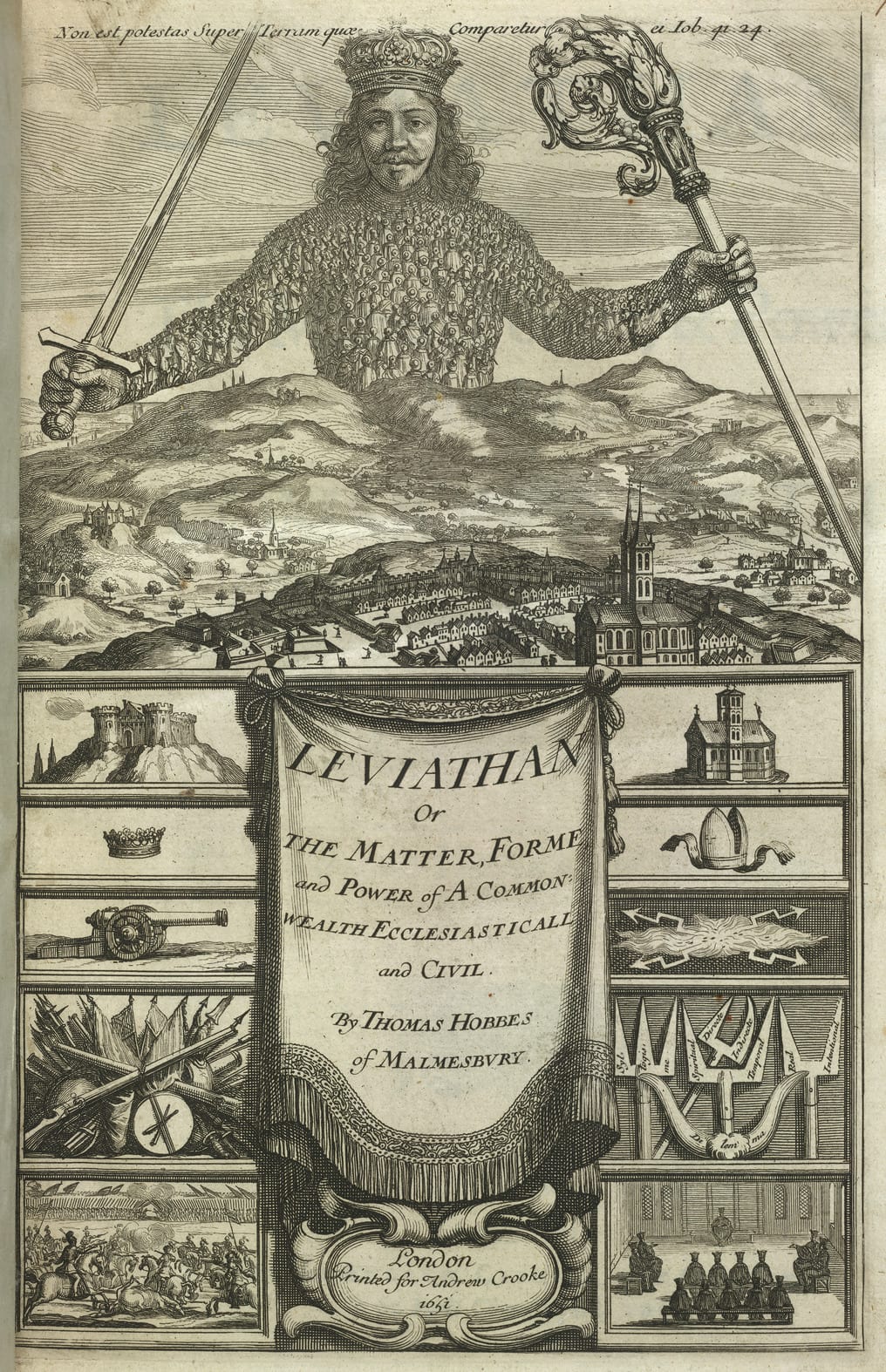
The title page of Thomas Hobbes’s 1651 political treatise Leviathan*, which borrowed the biblical creature’s name as a metaphor for state power, not a demonological reference. Source. British Library, CC0.*
The specific claim that Leviathan is “the demon of envy” traces to a particular later classification system, not to the biblical material itself. In 1589, theologian Peter Binsfeld organized a set of seven princes of Hell, each corresponding to one of the seven deadly sins, and assigned Leviathan to envy within that scheme. This is a genuinely later, separate demonological framework layered onto the older biblical figure, not a continuation of anything in Job or Isaiah — the biblical Leviathan has nothing to do with envy specifically.
Is Leviathan in the Ars Goetia? No.
This is worth stating directly, since it’s one of the most commonly repeated pieces of misinformation about Leviathan online: Leviathan does not appear among the 72 demons catalogued in the Ars Goetia, the first section of the 17th-century grimoire the Lesser Key of Solomon. That catalog includes figures like Paimon and Valac, each with their own assigned rank and seal, but Leviathan simply isn’t on that specific list. Leviathan’s demonic classification comes from the entirely separate Binsfeld system described above. Treating “demon of envy” and “Ars Goetia entry” as the same kind of fact, or assuming every named demon belongs to the same catalog, misrepresents how these distinct occult reference systems actually developed.
Thomas Hobbes Borrowed the Name, Not the Demonology
Philosopher Thomas Hobbes titled his influential 1651 political treatise Leviathan, using the biblical creature’s overwhelming, unconquerable power as a metaphor for the authority of the state. Hobbes’s Leviathan is explicitly political philosophy, not demonology or biblical commentary — he borrowed the name specifically for its connotation of an entity too powerful to meaningfully resist, using it to argue for the necessity of strong, centralized governmental authority, an idea entirely separate from any of the religious or occult traditions discussed above.
Was Leviathan a Real Animal?
Some translations and commentators, including footnotes in the Revised Standard Version, have proposed that the Job 41 description reflects an exaggerated but ultimately naturalistic account of a real animal, most often a crocodile, with Behemoth in the same section separately identified as a probable hippopotamus. Nineteenth-century scholarship generally favored this kind of grounded reading, treating the text as poetic exaggeration built on a genuine, if embellished, large aquatic animal, and the term Leviathan later became loosely associated with whales in general usage. This naturalistic reading coexists in scholarship alongside the mythological chaos-serpent interpretation; the text itself supports reading it as deliberately larger-than-life regardless of which specific real or legendary animal, if any, originally inspired it.
Leviathan’s split identity — biblical chaos monster, later eschatological figure, and separately assigned demon of envy under a completely different classification system — is exactly the kind of case covered in our Demons Explained field guide, and it parallels how Azazel means something different depending on which specific text and tradition you’re reading. Beelzebub has a similarly layered history worth reading alongside this one.
Frequently Asked Questions
Is Leviathan a demon? Only within a specific, later demonological classification. Peter Binsfeld assigned Leviathan the role of “demon of envy” in a 1589 system of seven princes of Hell; that’s a much later addition to a figure that originates as a biblical chaos-serpent, not a description carried over directly from the Bible itself.
Is Leviathan in the Bible? Yes, appearing in Job, Psalms, and Isaiah, generally as a powerful sea creature or chaos-serpent associated with divine power over disorder.
What animal is Leviathan? The text’s description in Job 41 is often read as either mythological chaos-serpent imagery or an exaggerated, poetic account of a real animal, most commonly proposed as a crocodile.
Is Leviathan Satan? Not directly in the original biblical texts, though later Christian interpretation increasingly associated Leviathan with the devil and with general cosmic chaos, especially through imagery like the dragon in Revelation.
Is Leviathan the same as Lotan? Leviathan’s imagery draws on the Ugaritic sea monster Lôtān from the Baal Cycle, an older Near Eastern mythological text, though scholars note the surviving source material has gaps that limit how precisely the two figures can be equated.
Was Leviathan a real animal? Possibly the inspiration behind the imagery, according to some scholars and translations, most often proposed as a crocodile. The biblical text itself presents Leviathan as something considerably larger and more fearsome than an ordinary animal, whatever the underlying inspiration.
Is Leviathan in the Ars Goetia? No. This is a common misconception. Leviathan doesn’t appear among the 72 demons catalogued in the Ars Goetia; its “demon” classification comes from a separate system devised by Peter Binsfeld in 1589.
,_title_page_-_BL.jpg)