Lore & Explained
Black Shuck Explained: East Anglia's Ghost Dog and the 1577 Storm
Explore Black Shuck, the ghostly dog of East Anglia, through the Bungay storm, Abraham Fleming's pamphlet and the difference between history and legend.
Topics: Black Shuck, Black Dogs, English Folklore, Bungay
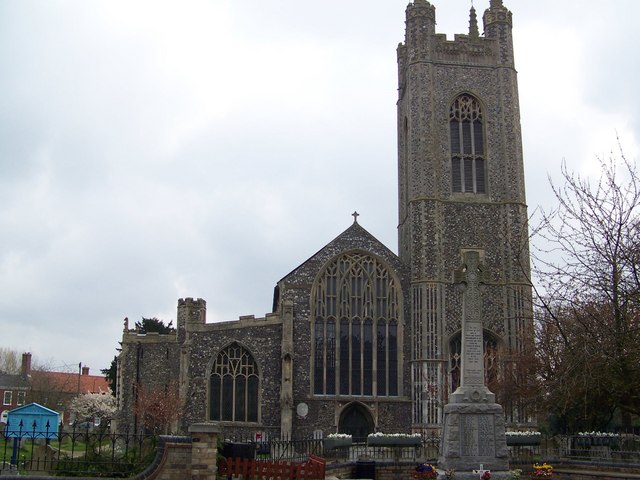
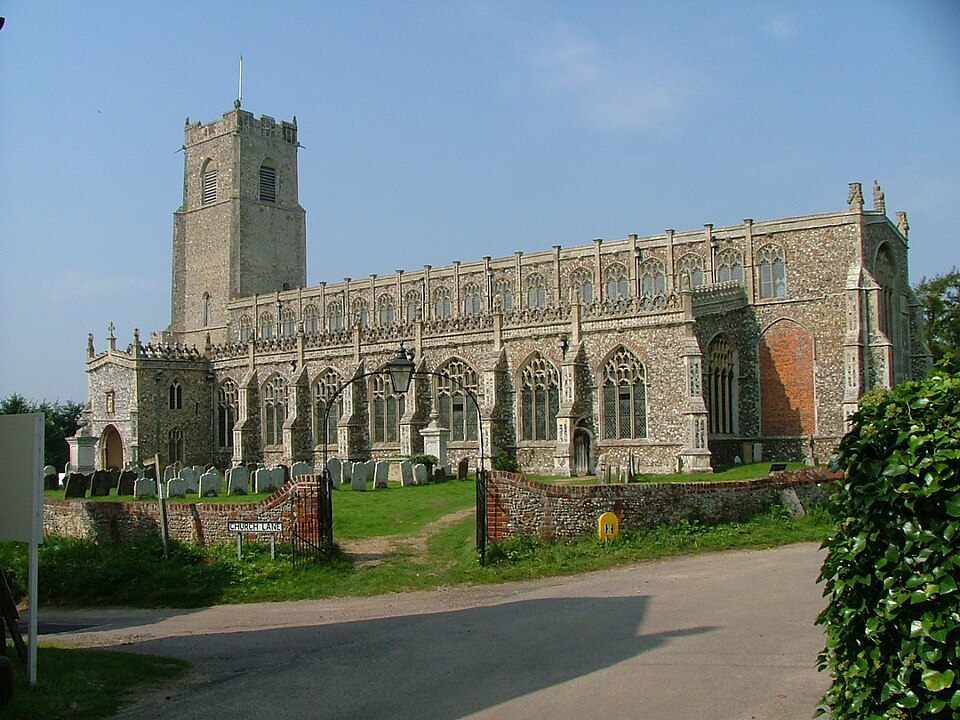
Photographed at Bungay, Suffolk (CC BY-SA 2.0)
Black Shuck is the ghostly black dog of East Anglian folklore, associated especially with Suffolk and Norfolk. One of the best-known stories connects the creature to a violent storm at Bungay and Blythburgh on 4 August 1577. The storm and the printed account belong to history. The claim that a supernatural dog attacked the congregations belongs to the interpretation and legend surrounding them.
That distinction is not a technicality. Black Shuck is often presented as though a surviving old pamphlet proves the beast existed. What the pamphlet establishes is that a frightening event was described in supernatural terms, and that the description became part of a lasting regional story.
What is Black Shuck supposed to look like?
The central image is a large black dog encountered under unsettling circumstances. Modern local retellings place it on lonely lanes, near churches and in the countryside. The dog is not frightening merely because it is an unfamiliar animal; it carries an implication that the encounter means something terrible is approaching.
Not every retelling gives it the same appearance or rules. Exact size, eyes, behavior and consequences need to be attributed to the version being discussed. A folkloric figure should not be given a supposedly official anatomy assembled from the most dramatic details available online.
Nor is there a documented dog breed that solves its identity. A photograph of a real black dog can illustrate an animal, but it cannot authenticate an apparition. The more useful images are often the pamphlet, the churches and the ways the legend appears in the landscape.
The storm at Bungay in 1577
St Mary’s Church at Bungay is the center of the famous account. Visit Bungay’s history of the church identifies a lightning strike in 1577 as the event associated with the Black Dog legend.
In the supernatural version, a monstrous dog rushes through the congregation during the storm and attacks worshippers. A related account places the creature at Holy Trinity Church in Blythburgh. These scenes are still repeated in local heritage storytelling, including material from the Churches Conservation Trust.
The responsible wording is “the account says” or “the legend describes,” not “a demon killed the worshippers.” The existence of the churches and the date of the reported storm do not remove the need to distinguish the event from the supernatural explanation.
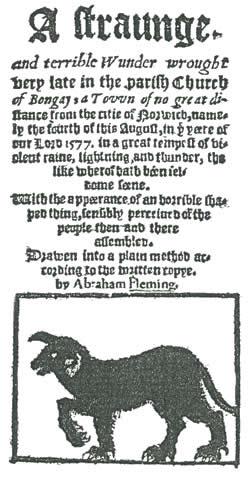
The title page of Abraham Fleming’s A Straunge and Terrible Wunder*, printed in 1577 — the earliest surviving printed source for the Bungay storm story, with its woodcut of “an horrible shaped thing.” Source. Public domain.*
What Abraham Fleming’s pamphlet actually establishes
The Folger Shakespeare Library catalogue records Abraham Fleming’s A Straunge and Terrible Wunder, published in 1577. Its long title explicitly connects Bungay, the date, violent rain, lightning, thunder and the reported appearance of a horrible shape.
The title also describes the work as drawn from a written copy. That is different from a declaration that Fleming personally witnessed the scene. Treating him automatically as an eyewitness adds a claim the catalogue does not establish.
A contemporary printed account is valuable evidence for what was being reported. It is not automatically an accurate record of every detail. The writer’s purpose, the information available to him and the way a disaster was framed all matter. A reader should not confuse the age of a document with an independent verification of its supernatural content.
The surviving publication also does not license every later detail attached to Black Shuck. A modern retelling needs to show which elements come from the pamphlet and which belong to subsequent folklore.
What about the marks on the Blythburgh door?
Local accounts connect marks on the church door with the beast’s claws. The Churches Conservation Trust describes that connection as legend.
A physical mark and an explanation for a mark are different things. An image can show that the surface has been damaged or marked; it cannot by itself identify a supernatural cause. It would also be too confident to announce a precise alternative cause without an appropriate examination or historical source.
This is a useful way to read haunted-place claims more generally. The object may be real while the story used to explain it remains unproven. Keeping both facts visible is more informative than either treating the mark as a relic of a demon or dismissing the entire location as fabricated.
Holy Trinity Church, Blythburgh — the second Suffolk church where the 1577 storm and its dog legend are said to have struck. Source. Public domain (CC0 dedication).
Is Black Shuck a ghost, a demon or an omen?
Those descriptions emphasize different parts of the tradition. A ghost-dog label describes an apparition. A demonic interpretation places the event within a religious understanding of threatening forces. An omen makes the encounter a sign of something to come rather than necessarily its cause.
They should not be flattened into one mandatory identity. The Bungay storm story is particularly violent, but that does not make it a complete account of every black-dog tradition in East Anglia or the wider British Isles.
For another example of a supernatural figure interpreted as a warning of death, compare the banshee. The comparison concerns storytelling roles, not proof that the two figures share a single origin.
The dog that remained after the storm
Black Shuck now belongs to the cultural identity of the places that tell its story. Local heritage material preserves the association with church buildings, paths and civic imagery. That is a documented afterlife of the legend, quite apart from whether anyone accepts the apparition as real.
The strongest version of the history does not need an authenticated monster. It has a frightening storm, a printed account, two churches and generations of people finding ways to tell the event again. What remains uncertain is not whether the story exists, but which parts describe an event and which parts describe what people made of it.