The Index / Cryptids & Legends
Chupacabra Explained: How Puerto Rico's Goat-Sucker Became a Global Monster
The Chupacabra began in Puerto Rico in 1995 as a spiny, bipedal creature. Later U.S. reports often involved hairless canids. Here's what contemporary reporting, animal testing and folklore research actually show.
Topics: Chupacabra, Puerto Rico, Cryptid, Urban Legend, Paranormal
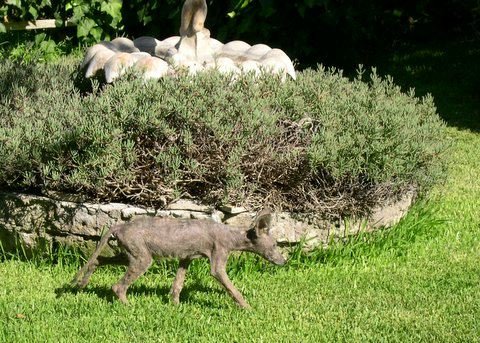
USDA Wildlife Services (Public Domain)
The Chupacabra most people picture today — a hairless, grayish, doglike animal — is not the creature that defined the legend in Puerto Rico in 1995.
The early Puerto Rican version was described as an upright, spiny creature with large eyes. The later version that became common in Texas and the American Southwest is usually a four-legged canid with severe hair loss. Those descriptions are so different that treating them as one stable animal can hide the most interesting part of the story: the Chupacabra legend changed as it spread.
That makes the Chupacabra useful not only as a cryptid story, but as a case study in how witness reports, mass media, wildlife misidentification and popular culture can merge into a modern legend.
The 1995 Puerto Rico wave
Puerto Rico was experiencing a wave of reports about dead farm animals by 1995. Contemporary reporting from that year describes residents blaming an unknown creature for attacks on goats, chickens, rabbits and other animals.

Canóvanas, Puerto Rico, where Madelyne Tolentino’s 1995 report helped define the Chupacabra’s original appearance. CC BY-SA 3.0, Wikimedia Commons.
The sighting that became especially important to the creature’s appearance came from Madelyne Tolentino in Canóvanas. Her account described a roughly human-sized or smaller upright creature with unusual eyes, grayish skin and structures or spines along its back.
Those details matter because they do not resemble the hairless-coyote image that would later dominate U.S. Chupacabra stories.
The 1995 claims were never the equivalent of a collected zoological specimen. They were eyewitness reports, livestock-death reports and media accounts made during a period of intense public attention. Contemporary coverage documents the panic and the claims; it does not establish that an unknown species was present.
Where the name came from
Chupacabras literally means “goat-sucker” in Spanish.
Puerto Rican comedian and radio personality Silverio Pérez is widely credited with coining or popularizing the name during the 1995 wave, when the animal-death stories had become a major topic in local media.
The name spread faster than any single physical description. That helped different kinds of later sightings — including animals that looked nothing like the original Puerto Rican creature — get absorbed into the same legend.
The Species connection
One of the most debated origin theories comes from writer and investigator Benjamin Radford, who spent years researching the Chupacabra and published his findings in Tracking the Chupacabra in 2011.
Radford argues that Tolentino’s description shows a striking resemblance to Sil, the creature designed for the 1995 science-fiction horror film Species. He has based that argument in part on interviews about what Tolentino saw and on the timing of the film’s release in Puerto Rico shortly before her reported encounter.
That is an attributed research conclusion, not an independently proved explanation for her experience.
The useful distinction is simple: it is reasonable to say that Radford found a specific pop-culture parallel and argued that it may have influenced the report. It is not accurate to present that influence as settled fact.
How the creature became a hairless dog
As the Chupacabra story spread outside Puerto Rico, especially into the mainland United States, its appearance changed.
Many later reports from Texas and the Southwest describe a four-legged, hairless or nearly hairless animal with an unusually thin body, exposed skin and a strange-looking head. That is a much closer match for a diseased wild canid than for Tolentino’s upright, spiny creature.
This is where physical testing becomes especially important.
In 2007, a carcass promoted as a possible Chupacabra specimen from Cuero, Texas, was subjected to DNA testing. Reporting on the result identified it as a coyote, not an unknown species.
That single result does not explain every Chupacabra report ever made. But it demonstrates that at least some highly publicized “Chupacabra bodies” were ordinary known animals that looked unusual.
Why mange can make coyotes look unfamiliar
Sarcoptic mange is caused by mites that infest the skin of mammals, including wild canids.
Wildlife-health sources describe symptoms that can include severe hair thinning or hair loss, thickened or wrinkled skin, crusting and, in serious cases, weight loss and poor condition. A badly affected coyote can therefore look dramatically different from the healthy animal most people expect to see.
That can plausibly account for many later U.S. sightings of the hairless, quadrupedal “Chupacabra.”
It does not retroactively explain the original Puerto Rican bipedal description. Those are different categories of claim and should not be collapsed into one explanation.
What happened to the “drained of blood” claims?
The idea that livestock had been mysteriously drained of blood became one of the legend’s most memorable elements.
But government animal examinations in Puerto Rico did not support that description in the cases they examined.
In January 1996, the Associated Press reported that a Puerto Rico Agriculture Department veterinary diagnostic laboratory had performed roughly 20 animal autopsies connected to the scare. The laboratory’s director said investigators had found nothing unusual. Some wounds looked consistent with dog bites, some animals had died of illnesses such as pneumonia or hepatitis, and the animals’ cardiovascular systems were intact rather than emptied of blood.
That does not prove that every livestock death reported during the 1995 wave had the same cause. It does show that the dramatic “blood completely sucked out” claim was not supported by the examined animals in that official investigation.
Why the legend spread so quickly
The Chupacabra appeared at a moment when television, newspapers, radio and cross-border Spanish-language media could carry a vivid local story far beyond the place where it began.
The 1995 reporting shows just how quickly the story became public spectacle. Residents reported sightings, officials responded to public concern, journalists repeated increasingly recognizable creature descriptions and new animal deaths could be interpreted through the same existing frame.
Once the name had become widely known, the legend no longer depended on the original Puerto Rican description.
A hairless canid in Texas, a dead goat elsewhere in Latin America and an unusual night-time sighting could all be labeled “Chupacabra” even when the reports described very different things.
That is similar to what happens with other modern monster traditions such as Mothman: a specific cluster of reports can become a much larger cultural category after the original event. The Chupacabra’s unusually sharp 1995 media origin makes that transformation especially easy to trace.
Two Chupacabras under one name
It is useful to think of the legend as having at least two major visual traditions.
The Puerto Rican 1995 form is upright, spiny and large-eyed.
The later U.S. canid form is four-legged, hairless and often associated with coyotes or dogs suffering from disease.
They share a name and a reputation for attacking animals, but not a consistent anatomy.
That mismatch is not a minor detail to explain away. It is evidence of how folklore changes when a story moves between places, media systems and local wildlife encounters.
Frequently Asked Questions
Is the Chupacabra real?
No verified biological evidence establishes an unknown species behind the Chupacabra legend. Specific U.S. carcasses promoted as Chupacabras have been identified through testing as known canids, while the original Puerto Rican creature remains an eyewitness claim rather than a specimen.
Where did the Chupacabra legend begin?
The modern legend emerged in Puerto Rico in 1995 during a wave of reported livestock deaths and sightings.
Who named the Chupacabra?
Puerto Rican comedian and radio personality Silverio Pérez is widely credited with coining or popularizing the name during the 1995 scare.
Why do Chupacabra sightings look so different?
The original Puerto Rican description was an upright, spiny creature. Many later U.S. reports describe hairless four-legged canids. The legend changed as it spread and began absorbing different kinds of sightings.
Did the movie Species inspire the Chupacabra?
Researcher Benjamin Radford argues that Madelyne Tolentino’s description resembles the creature Sil from Species and that the film may have influenced the sighting report. That is his documented interpretation, not an independently proven fact.
Were the animals in Puerto Rico really drained of blood?
Official animal examinations reported in January 1996 did not support that claim in the cases examined. Puerto Rico’s Agriculture Department laboratory reported intact cardiovascular systems and ordinary explanations including illness and bites in those animals.
Are hairless coyotes really mistaken for Chupacabras?
Yes, that has happened in documented cases. A heavily publicized 2007 Texas specimen was identified through DNA testing as a coyote, and sarcoptic mange can produce severe hair loss and other changes that make wild canids look unfamiliar.
Is the Chupacabra connected to Bigfoot or Skinwalkers?
No documented historical connection links the Chupacabra to Bigfoot or to Diné Skinwalker traditions. Treating unrelated legends as one supernatural system erases their different origins and cultural contexts.
Sources & further reading
- Benjamin Radford, Tracking the Chupacabra: The Vampire Beast in Fact, Fiction, and Folklore (University of New Mexico Press, 2011)
- Benjamin Radford, 'Chupacabra Revisited: Dueling Origin Stories of the Hispanic Vampire,' Skeptical Inquirer (May/June 2025)
- Karl Ross, 'Mystery Creature Ravages Puerto Rican Livestock,' The Washington Post (December 26, 1995)
- Associated Press, 'Farm Animal Autopsies Undermine Puerto Rican Goat-Sucker Theory,' The Washington Post (January 18, 1996)
- Associated Press, 'It's Not Chupacabra, Just A Coyote,' CBS News (November 2, 2007)
- Cornell Wildlife Health Lab, 'Mange'
- Wikimedia Commons, 'Coyote with mange.jpg' (USDA Wildlife Services, Public Domain)