The Index / Dark History
Ed Gein: The True Story Behind Psycho, The Texas Chain Saw Massacre, and The Silence of the Lambs
Ed Gein admitted killing Mary Hogan and Bernice Worden, but he was tried only for Worden's murder. Here's the documented case, the 1968 insanity ruling, the grave robberies, and what horror films actually borrowed.
Topics: Ed Gein, Psycho, Texas Chainsaw Massacre, Silence of the Lambs, True Crime
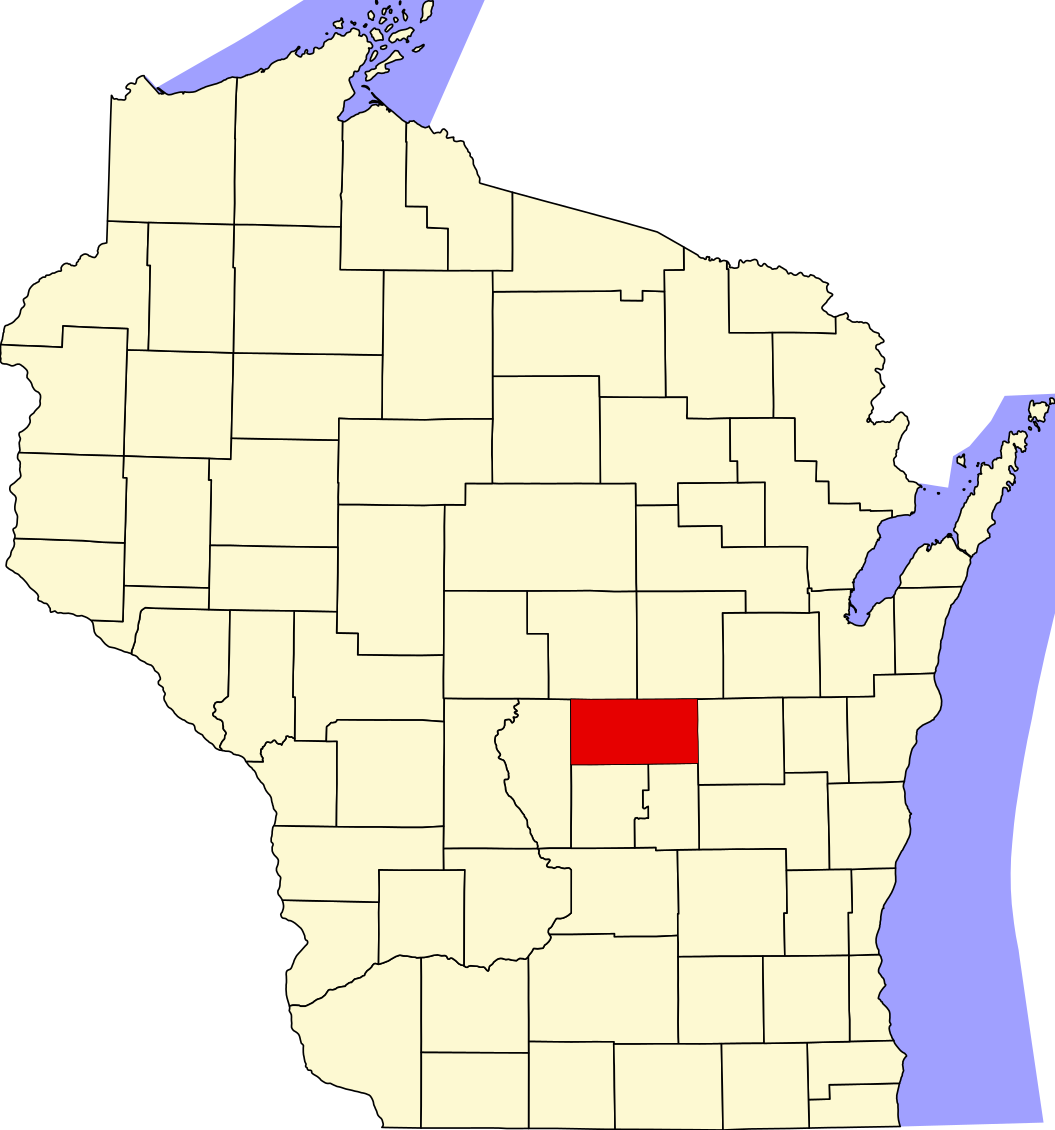
David Benbennick, Wikimedia Commons (Public Domain)
Ed Gein admitted killing Mary Hogan and Bernice Worden, but the legal record is narrower than the shorthand often used online.
He was tried only for Worden’s 1957 murder. In the first phase of his 1968 bench trial, Judge Robert H. Gollmar found that Gein had killed Worden. In the second phase, which addressed his mental state at the time of the crime, Gollmar found him not guilty by reason of insanity and returned him to institutional psychiatric care.
That distinction matters. Gein’s reputation grew far beyond the two killings he admitted, and later horror films borrowed selected details from his case so effectively that fiction is now often repeated as biography.
He did not wield a chainsaw. There is no documented Texas massacre. Norman Bates was not written as a direct biographical portrait. Buffalo Bill was a composite character drawing on several real cases.
The real story is already disturbing enough without importing movie mythology into the record.
Mary Hogan and Bernice Worden
Gein admitted killing two women from the Plainfield area.
Mary Hogan, who ran a local tavern, disappeared in 1954. Her disappearance remained unsolved until the investigation of Gein three years later.
Bernice Worden, who operated a hardware store in Plainfield, disappeared on November 16, 1957. Investigators were quickly directed toward Gein because he had been in the store and a transaction connected him to Worden that day.
A search of Gein’s farm led to the discovery of Worden’s body and other human remains.
This article does not reproduce the case’s graphic inventory. Those details are widely available in historical accounts, but repeating them item by item adds little to understanding the case and risks turning two real victims into props for a horror story.
The grave robberies were central to the case
The 1957 search also revealed that not all of the human remains found at the farm came from murder victims.
Gein described making repeated trips to local cemeteries and removing remains from recently buried women. Investigators checked graves he identified and found evidence consistent with at least part of his account.
That distinction is crucial.
Gein’s home contained human remains from grave robbery as well as homicide. Later retellings sometimes turn every object discovered on the property into evidence of a separate killing, which dramatically inflates his supposed body count.
The documented record does not support the idea that every set of remains represented another murder victim.
He was not tried in 1957
After his arrest, Gein was found mentally incompetent to stand trial.
He was committed to Central State Hospital for the Criminally Insane in Waupun, Wisconsin. He remained institutionalized for roughly a decade before doctors concluded in 1968 that he was competent to participate in his defense.
The murder case that finally went to trial concerned Bernice Worden only.
Judge Robert H. Gollmar, who later wrote a book about the case, presided over the bench trial.
What the 1968 verdict actually means
The 1968 proceeding had two legal questions that are often compressed into one sentence.
First: did Gein kill Bernice Worden?
Judge Gollmar found him guilty of the killing.
Second: was Gein legally responsible given his mental state at the time?
After a separate sanity phase, Gollmar ruled Gein not guilty by reason of insanity.
He was therefore returned to psychiatric custody rather than sentenced to an ordinary prison term.
This is why both “found guilty” and “not guilty by reason of insanity” appear in accounts of the case. They refer to different phases of the same proceeding.
It is misleading, however, to say Gein was “convicted of two murders.” He was tried only for Worden’s death. Hogan’s killing was admitted but not separately tried.
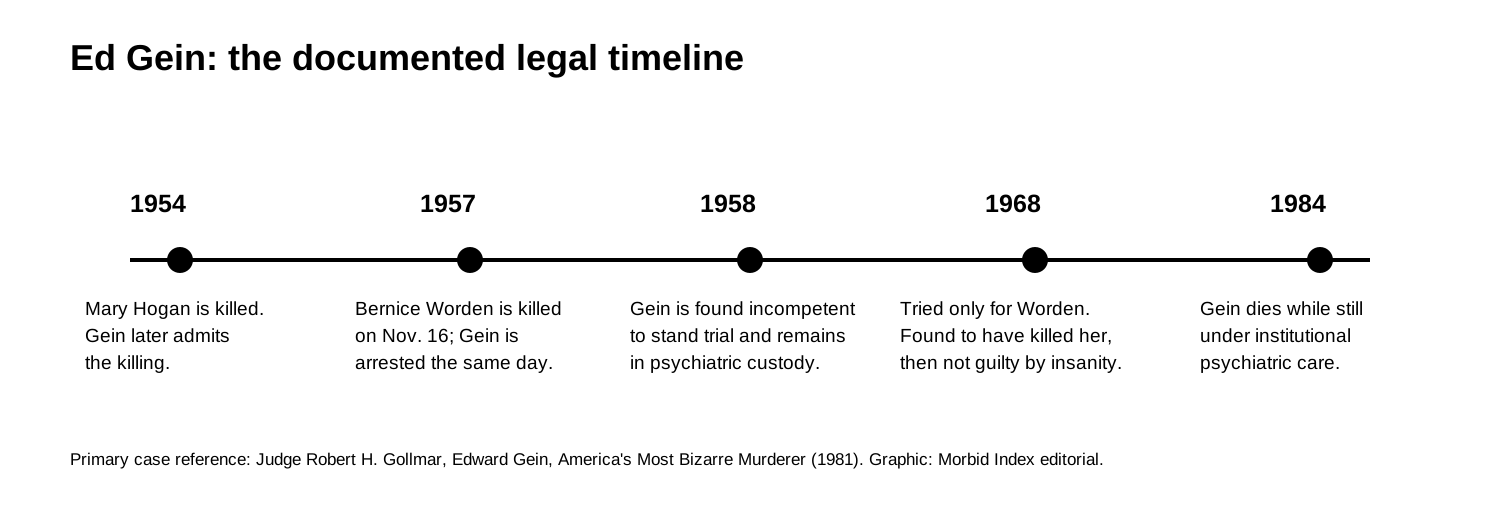
The legal record is narrower than the popular legend: Gein admitted two killings but was tried only for Bernice Worden’s murder. Graphic: Morbid Index editorial.
Was Ed Gein a serial killer?
The label is less useful here than the underlying facts.
Gein admitted two killings. He was tried for one. He also robbed graves and used human remains in ways that became central to his notoriety.
Those facts are enough to explain why the case became internationally infamous.
Claims linking Gein to additional disappearances have circulated for decades, but suspicion is not proof. Those cases should not be folded into his confirmed record without evidence establishing his involvement.
Was Ed Gein a cannibal?
Cannibalism is repeatedly attached to Gein in popular retellings, but it is not a fact that should be stated as established on the basis of the sources used here.
The documented core of the case is murder, grave robbery, preservation and alteration of human remains, and the objects investigators recovered from his property.
Later films and sensational retellings frequently add cannibalism because it fits the horror image that grew around him.
Morbid Index does not treat that addition as proven fact.
Did Ed Gein kill his brother Henry?
Gein’s brother Henry died in 1944 during a fire on the family property.
Later writers have questioned the circumstances and sometimes imply that Ed killed him.
That remains speculation.
Gein was not charged with Henry’s death, and the material cited for this article does not establish that he killed his brother. A responsible account should therefore keep Henry’s death separate from the two killings Gein admitted.
What Robert Bloch actually said about Psycho
The relationship between Gein and Norman Bates is more complicated than the phrase “based on Ed Gein” suggests.
Robert Bloch, the author of the 1959 novel Psycho, addressed this directly in a later public conversation preserved on his official website.
Bloch said he did not use Ed Gein as the basis for Norman Bates because he did not yet know the detailed facts later associated with Gein when writing the novel.
What did interest him was the circumstance: the idea that someone could live in a small community where neighbors believed they knew one another, while hiding terrible acts.
The similarities between Gein and Bates became more striking after more information about Gein emerged.
That makes Psycho connected to the Gein case, but not a straightforward fictional biography.
What The Texas Chain Saw Massacre borrowed
Tobe Hooper’s 1974 film is even more distorted by “true story” marketing.
Hooper remembered hearing stories about Gein while growing up, and Gein’s case formed part of the background from which the film’s grotesque imagery developed.
The clearest overlap is the use of human skin and bones as material for masks and household objects.
But the movie’s plot is fictional.
The killings did not happen in Texas. Gein did not belong to a murderous cannibal family. He did not chase victims with a chainsaw.
Leatherface’s chainsaw is movie invention, not historical evidence.
That difference is especially important because the fictional weapon became so iconic that many people now attach it backward to Gein.
Buffalo Bill was a composite
Jame Gumb, better known as Buffalo Bill in The Silence of the Lambs, is another character often reduced to “based on Ed Gein.”
Retired FBI profiler John Douglas has described the character as a composite drawing on multiple real offenders.
The elements commonly identified include:
- Ed Gein — the use of human skin and the idea of constructing a skin garment;
- Ted Bundy — feigning injury to make a potential victim lower her guard;
- Gary Heidnik — holding kidnapped women in a pit.
Gein is therefore one identifiable influence on Buffalo Bill’s fictional behavior, not the complete model for the character.
Why the horror-film connection keeps swallowing the real case
Gein’s cultural afterlife is unusually powerful because later fiction selected the most visually memorable parts of the case and built larger monsters around them.
Norman Bates added the motel and a very different murder narrative.
Leatherface added Texas, a family of killers and the chainsaw.
Buffalo Bill combined selected Gein-related imagery with behaviors taken from other offenders.
Once those fictional characters became more famous than the court record, their details began flowing backward into popular descriptions of Gein.
That is why careful sourcing matters here more than simply repeating a familiar true-crime summary.
The history and the horror influence are connected.
They are not the same story.
Frequently Asked Questions
How many people did Ed Gein kill?
Gein admitted killing Mary Hogan in 1954 and Bernice Worden in 1957. He was tried only for Worden’s murder.
Was Ed Gein convicted of two murders?
No. That wording is misleading. Gein admitted two killings, but the 1968 trial concerned Bernice Worden only. Judge Robert H. Gollmar first found that Gein killed Worden, then ruled him not guilty by reason of insanity after the sanity phase.
Why did Ed Gein spend the rest of his life in a psychiatric institution?
He was initially found incompetent to stand trial. After being found competent in 1968, he was tried for Worden’s murder and ultimately adjudged not guilty by reason of insanity, so he returned to psychiatric custody.
Did Ed Gein use a chainsaw?
No documented evidence connects a chainsaw to Gein’s murders. The chainsaw belongs to The Texas Chain Saw Massacre.
Was Ed Gein a cannibal?
Cannibalism is common in later retellings, but the sources used here do not establish it as a documented fact.
Is Norman Bates directly based on Ed Gein?
Not as a detailed biographical portrait. Robert Bloch said he did not know the later-famous details of Gein’s crimes when he wrote Psycho. He was interested in the idea of an apparently ordinary person hiding terrible acts in a small community.
Is Leatherface based on Ed Gein?
Gein’s case influenced some of the imagery associated with Leatherface, especially human-skin masks and the use of human remains. The movie’s Texas setting, murder family and chainsaw killings are fictional.
Is Buffalo Bill based on Ed Gein?
Partly. John Douglas has described Buffalo Bill as a composite drawing on Ed Gein, Ted Bundy and Gary Heidnik.
Did Ed Gein kill his brother?
There is no established evidence in the record used here that Gein killed his brother Henry. Later suspicion should not be reported as a confirmed crime.
Sources & further reading
- Wisconsin Historical Society: Ed Gein case history and insanity ruling
- Robert H. Gollmar, Edward Gein, America's Most Bizarre Murderer (1981) — Open Library record
- Robert Bloch official site: A Conversation with Robert Bloch
- Film Comment: Interview with Tobe Hooper
- Oxygen: Is The Texas Chain Saw Massacre Based on the Crimes of Ed Gein?
- Oxygen: Gary Heidnik and the composite behind Buffalo Bill
- A&E: The real killers whose traits informed Buffalo Bill
- Wisconsin Historical Society: Ed Gein escorted to the State Crime Laboratory, November 17, 1957
- Wikimedia Commons: Map of Wisconsin highlighting Waushara County (Public Domain)