The Index / Dark History
The Donner Party Explained: What Really Happened in the Sierra Nevada
The Donner Party was trapped by early snow in the Sierra Nevada in the winter of 1846-47. Some survivors did resort to cannibalism -- the specific murder accusations against Lewis Keseberg were never proven.
Topics: Donner Party, Dark History, Westward Migration, Sierra Nevada, 1846
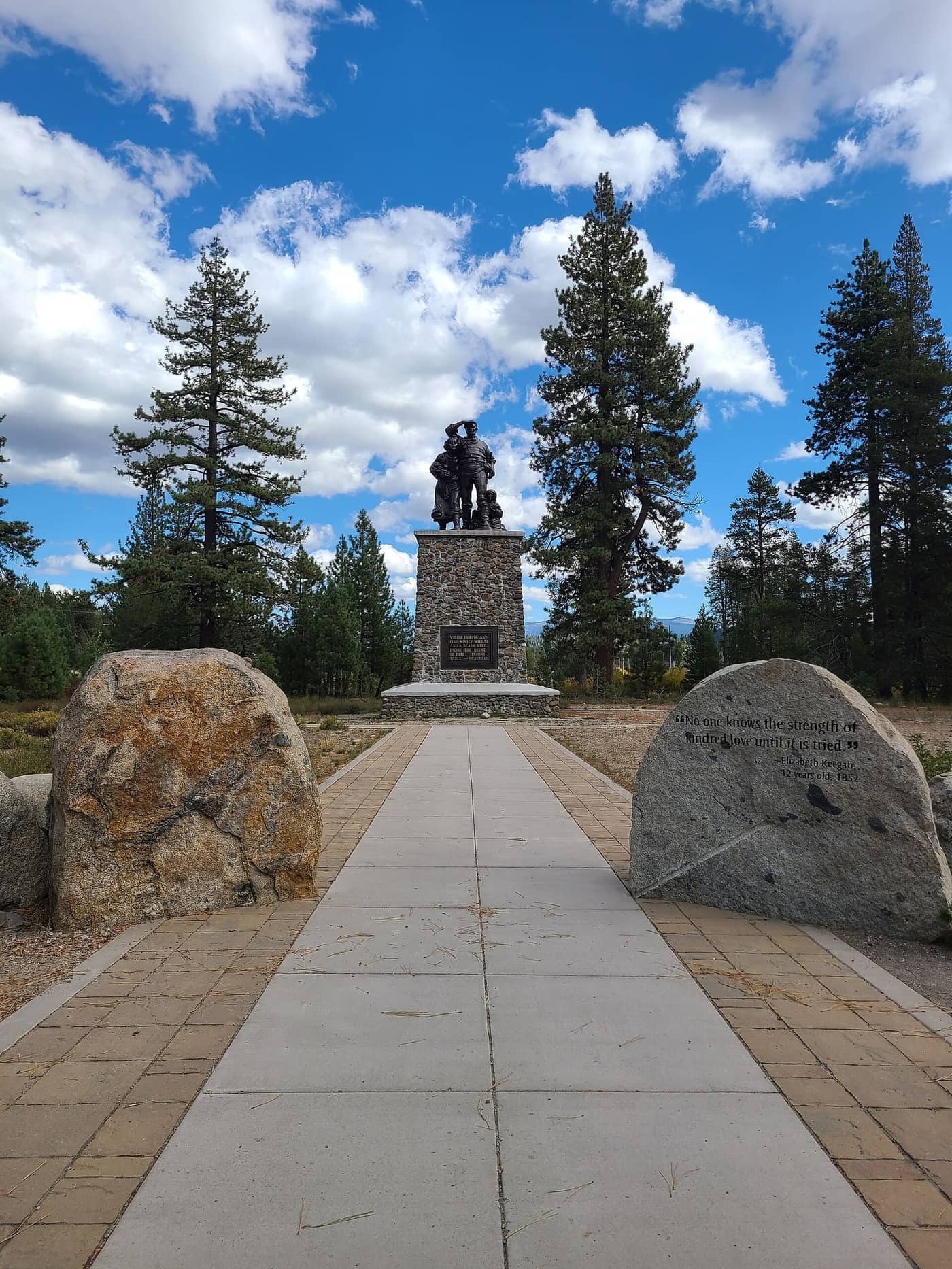
RaybiesFlynn, Wikimedia Commons (CC BY-SA 4.0)
Eighty-seven people set out from Illinois in 1846 hoping to reach California before winter. Roughly half of them didn’t survive it. What happened to the Donner Party is genuinely well documented, through survivor diaries, a contemporary account written by one of the trapped members, and later court testimony — and what’s documented includes real cannibalism among people facing starvation, not the cartoonish, purely sensational version the case is often reduced to.
Setting Out
The core of the party — George Donner, his brother Jacob, and James F. Reed, traveling with their extended families — left Independence, Missouri, on May 12, 1846, part of a much larger westward migration that saw roughly 500 wagons depart that season. Other families joined along the way, and by the time the group reached the Wasatch Range, it had grown to about 87 people traveling in 60 to 80 wagons.
The Shortcut That Wasn’t
At Fort Bridger, the party was persuaded to take the Hastings Cutoff, a route promoted by Lansford Hastings and endorsed locally by Jim Bridger, who claimed it would shave roughly 350 miles off the standard trail. In reality, the cutoff added distance and crossed genuinely brutal terrain through the Wasatch Range and the Great Salt Lake Desert. The party had been warned against it directly, by both a journalist, Edwin Bryant, and an experienced trail guide, James Clyman, and proceeded anyway. A crossing Hastings had described as two days and 40 miles turned into six days and roughly 80 miles across salt-crusted ground that swallowed wagon wheels and exhausted the party’s oxen; roughly 100 head of cattle and oxen were lost in the desert crossing alone. By the time the group rejoined the standard trail at the Humboldt River in late September, they were about two months behind the schedule they needed to clear the Sierra Nevada before winter.
A Killing on the Trail
Tensions that had been building for weeks boiled over on the Humboldt River in October, when a dispute over tangled wagons escalated into a physical confrontation between teamster Milt Elliott and another emigrant, John Snyder. When James Reed intervened, Snyder struck him repeatedly, including hitting Reed’s wife in the process, and Reed responded by fatally stabbing Snyder. A party council, held with George Donner notably absent, banished Reed from the group, sending him ahead unarmed — though his stepdaughter Virginia secretly supplied him with a rifle and provisions before he left. Reed’s expulsion meant he wasn’t with the main party when disaster hit weeks later, a fact that shaped both his own survival and his later role in organizing rescue efforts.
Trapped by Early Snow
The party made the consequential decision to press on toward the Sierra Nevada on October 20, despite warnings that the pass wouldn’t typically close until mid-November. An unusually early, heavy snowfall trapped them near what’s now called Donner Lake in early November, before they could cross. The timing was worsened by a broken wagon axle and an infected hand injury George Donner suffered while repairing it, slowing the group at exactly the wrong moment.
The trapped party split into two camps. About 60 people sheltered at the lake in three hastily improved log cabins, while a smaller group of 21, including the Donner families, set up tents several miles away at a site now known as Alder Creek. Neither location offered real protection from a Sierra winter, and both camps quickly ran out of food.
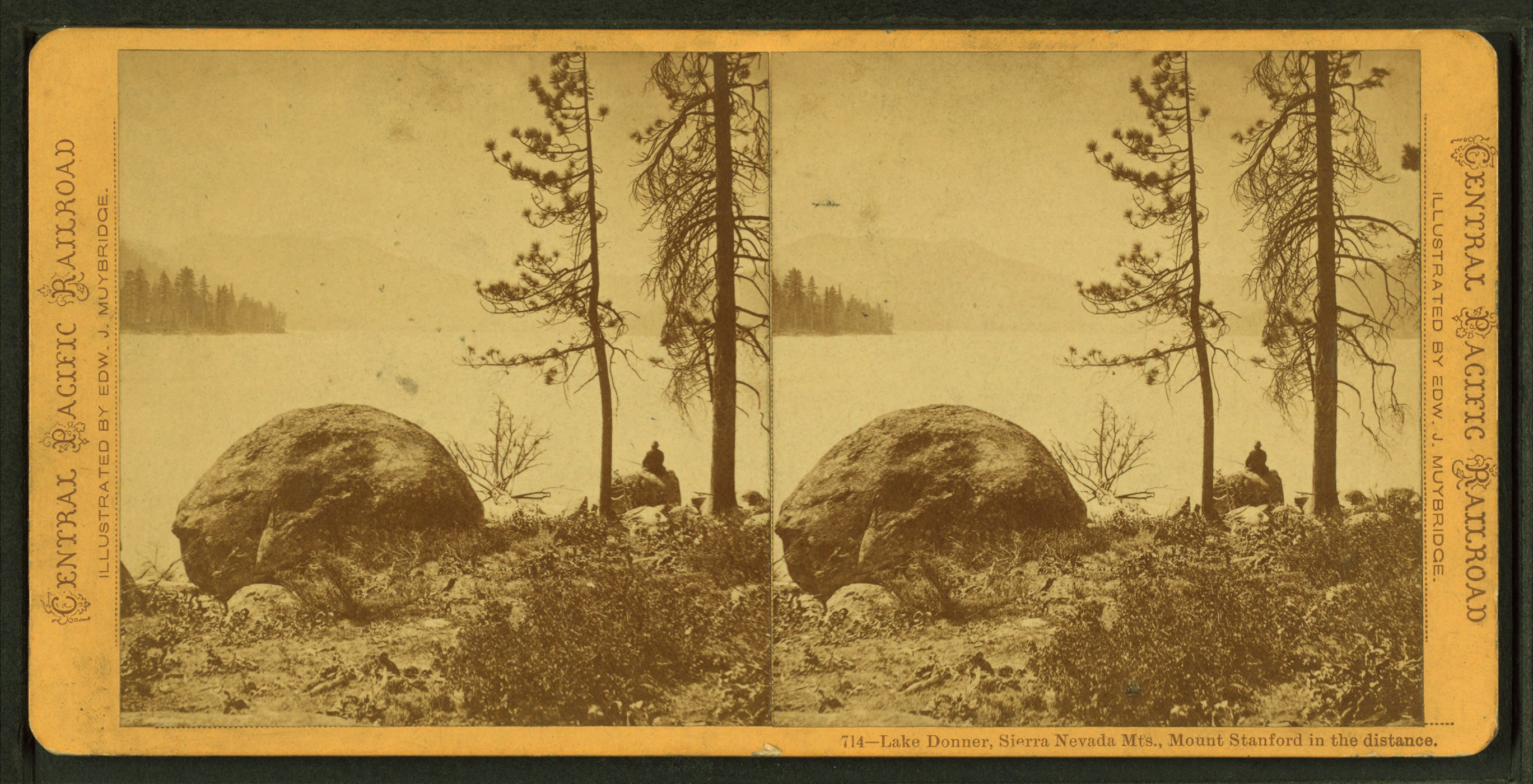
Lake Donner, photographed by Eadweard Muybridge roughly two decades after the disaster. Public domain, via Wikimedia Commons.
The Forlorn Hope
On December 16, seventeen members of the party set out on improvised snowshoes in a desperate attempt to cross the mountains and find help, a trek that became known as the Forlorn Hope. It took 33 days. Eight of the ten men in the group died along the way, largely from exposure and starvation, while all five women survived. Once food ran out entirely, survivors resorted to eating the bodies of those who had already died, and two Indigenous guides who had joined to help, Luis and Salvador, were killed and eaten as well — a fact documented in survivor accounts and treated by historians as one of the more genuinely disturbing episodes of the entire ordeal. Only seven of the original seventeen reached help, discovered by would-be rescuers on January 17.
Rescue
Word of the trapped party reached California settlements through the Forlorn Hope survivors, triggering a series of relief expeditions. A first relief party reached the camps on February 18 and evacuated 23 people, leaving 33 behind who were too weak to travel immediately. A second relief on March 1 retrieved 17 more, suffering serious losses of its own during the return trip. A third and final relief on March 14 extracted the last five survivors, including two of the Donner daughters. In total, of the roughly 87 people in the party, 48 survived; the other 39 died across the journey and the winter, with 5 deaths occurring before the party ever reached the mountains and 34 more during the winter of entrapment itself.
What the Documented Evidence Says About Cannibalism
This part of the story is real, and there’s no need to either sensationalize or minimize it. Patrick Breen, one of the trapped emigrants, kept a diary throughout the ordeal that survives as a primary source, including one widely cited entry describing another survivor, Mrs. Murphy, apparently considering eating the body of a boy named Milt. Multiple accounts from both camps describe survivors consuming the remains of those who had already died once starvation became a matter of days rather than weeks, along with bones being boiled repeatedly to extract whatever nutrition remained. This was survival cannibalism under extreme, well-documented starvation conditions, consistent with other historically recorded instances of extreme famine — not evidence of premeditated murder for the purpose of eating victims, which is a distinct and much more serious claim that applies to a much narrower part of the story.
The Keseberg Accusations, Specifically
Lewis Keseberg is the one figure from the party whose case moved beyond general survival cannibalism into direct accusations of murder. The final relief party found human remains in his cabin along with valuables belonging to the Donner family, and he was specifically accused of murdering Tamsen Donner, who had died at his cabin, and of eating the remains of a child belonging to the Eddy family. Keseberg maintained he had not killed anyone and had only eaten already-dead bodies out of desperate necessity, the same as other survivors. He later brought a defamation suit against one of his accusers; the court that heard it awarded him only a single dollar in damages while still requiring him to cover court costs, an outcome that satisfied no one fully. Historian Charles McGlashan, who conducted one of the most thorough contemporary investigations into the case, ultimately concluded no murder had actually occurred, and survivor Eliza Donner Houghton, one of the Donner children who lived through the ordeal, publicly believed in Keseberg’s innocence as well. The evidence against him has always been circumstantial rather than conclusive.
What Archaeology Has and Hasn’t Confirmed
Modern archaeological testing at the Alder Creek campsite has been unable to conclusively identify any recovered bone fragments as human remains, which means physical archaeology has neither confirmed nor disproven the specific details in survivor testimony. The documented record here rests primarily on written accounts from the period — diaries, survivor testimony, and later interviews — rather than forensic physical evidence.
How the Story Became a Byword for Cannibalism
Contemporary California newspapers covered the rescue with graphic, often exaggerated detail, and the Donner Party’s story was absorbed quickly into American folklore as a kind of shorthand for wilderness cannibalism specifically, overshadowing the broader, more human story of a large group of families making a series of genuinely disastrous logistical decisions under worsening conditions. The site became a tourist destination as early as 1854, and a memorial dedicated in 1918 now sits within Donner Memorial State Park, which draws roughly 200,000 visitors a year — a scale of dark tourism that says something about how thoroughly this specific tragedy was absorbed into popular memory, for better and worse.
The Donner Party’s documented ordeal sits alongside other historical dark-history cases on this site involving disputed evidence and later folklore, including the Dyatlov Pass Incident, where a genuinely mysterious set of deaths has similarly attracted far more speculation than the physical evidence supports, and Roanoke Colony, another case where the human reality of a historical disaster gets simplified into something more mysterious than the record actually shows.
Frequently Asked Questions
How many people died? Of roughly 87 people in the party, 39 died — 5 before reaching the mountains, and 34 during the winter of entrapment and the rescue period.
Did the Donner Party really eat people? Yes, documented survival cannibalism occurred among trapped members facing starvation, described in survivor diaries and testimony. This is distinct from murder allegations, which apply specifically and only to accusations against one individual, Lewis Keseberg.
Why did they take the Hastings Cutoff? They were persuaded by promoter Lansford Hastings’s claims that it would shorten their journey by roughly 350 miles, despite warnings from experienced travelers that the route was unproven and dangerous. It ultimately added time and hardship rather than saving either.
How long were they trapped? Roughly from early November 1846, when snow blocked the mountain pass, until mid-March 1847, when the third and final rescue party extracted the last survivors.
How many survived? 48 of the roughly 87 party members survived.
What happened to James Reed? He was banished from the party after fatally stabbing John Snyder in a fight in October 1846. Traveling ahead separately, he survived and later played a direct role in organizing rescue efforts for the party that had expelled him.
Did Keseberg murder anyone? This was never proven. He was accused of murdering Tamsen Donner and eating a child’s remains, but a contemporary defamation lawsuit and a thorough later historical investigation by Charles McGlashan both concluded there was no solid evidence of murder, only of cannibalism under starvation conditions, which he admitted to.