The Index / Dark History
The Lost Colony of Roanoke Explained: What 'CROATOAN' Really Means
John White returned to Roanoke in 1590 to find his colony gone and one word carved into a post: CROATOAN. That was the name of a real, allied Indigenous community and their island -- not a curse.
Topics: Roanoke Colony, Lost Colony, Croatoan, Dark History, Colonial America
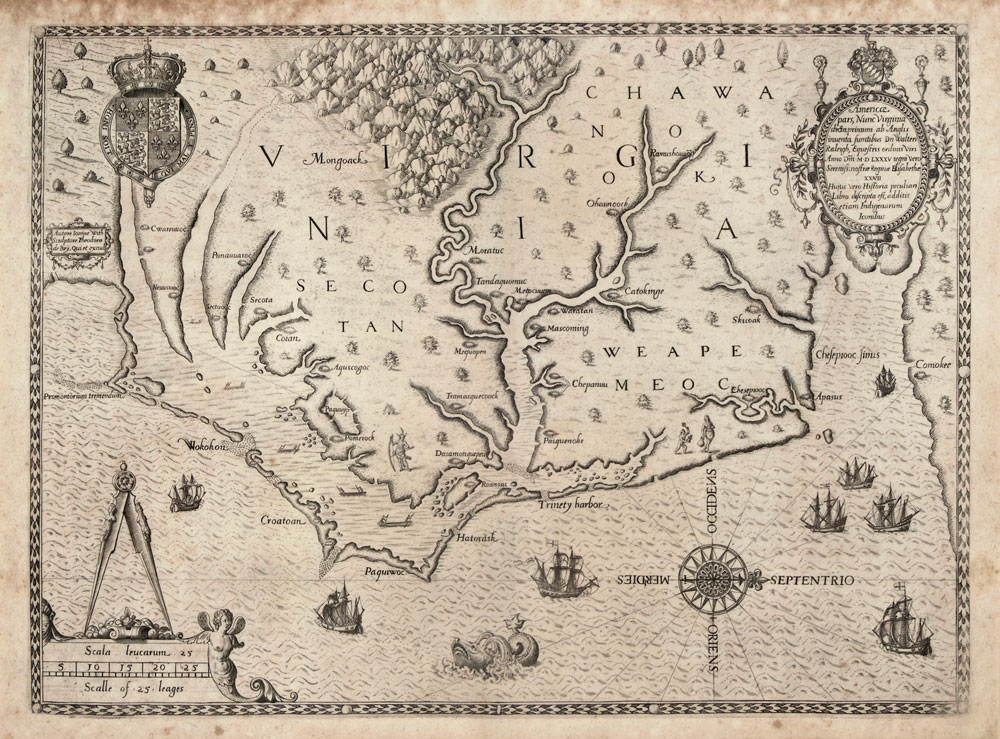
Theodor de Bry after John White, 1591 / Wikimedia Commons (public domain)
When John White finally made it back to Roanoke Island in August 1590, three years after leaving to fetch supplies, he found the colony’s palisade standing and empty, with a single word carved into one of its posts: CROATOAN. That word has been treated for centuries as an unsolved riddle. It wasn’t a riddle to White. Croatoan was the name of a real place and a real, allied Indigenous community roughly 50 miles away, and White’s own written interpretation of the carving was that the colonists had gone there deliberately and safely. What actually happened after that is the genuine mystery — not the word itself.
Two Different Colonies
Sir Walter Raleigh received a royal charter from Queen Elizabeth I in 1584 authorizing English colonization of the region she named Virginia, with a deadline to establish a colony by 1591. Raleigh, barred from personally leaving the queen’s service, ran the project from London through deputies. The first colony, established in 1585 under governor Ralph Lane, was a roughly 100-man military and exploratory outpost, not a permanent settlement meant to include families. That colony deteriorated quickly amid worsening relations with the local Secotan people and serious food shortages, and Lane evacuated the survivors in 1586. The colony people usually mean when they say “the Lost Colony” is the second, entirely separate attempt: roughly 115 settlers, including women and children, who arrived in 1587 under governor John White, intending to settle at Chesapeake Bay but diverted to Roanoke Island instead by their ship’s pilot.
John White and Virginia Dare
White served as both governor and the expedition’s artist, producing detailed watercolor illustrations and a map, known as La Virginea Pars, that remain some of the most valuable surviving documentary records of the region and its people at the time. On August 18, 1587, White’s daughter Eleanor gave birth to Virginia Dare, traditionally described as the first English child born in the Americas — a detail that has given the colony’s eventual disappearance an added, specific human weight in how the story gets told.
The Colonists’ Indigenous Neighbors
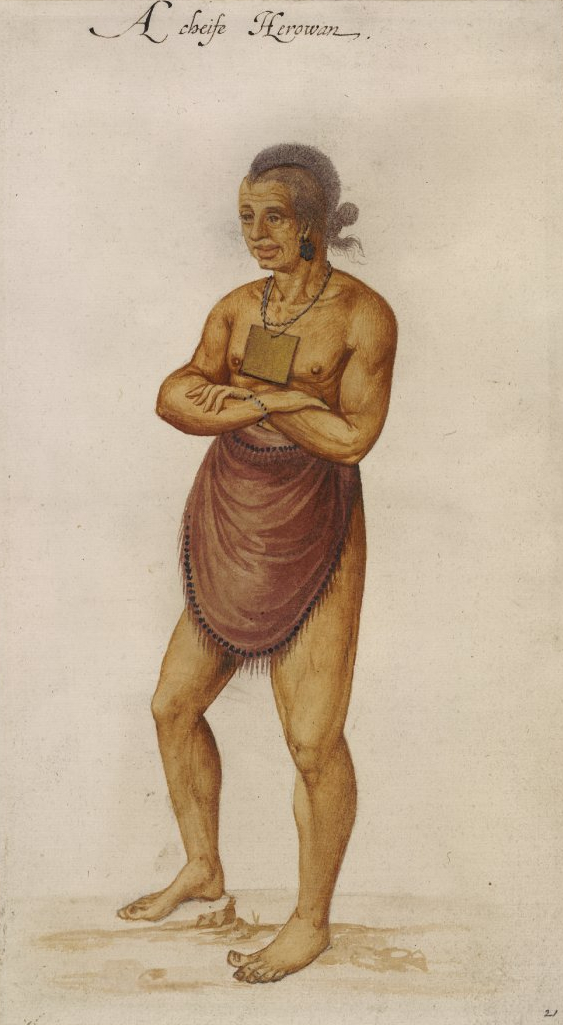
John White’s own watercolor of a weroance (“chief”), generally presumed to depict Wingina, the Secotan leader killed by English forces in 1586. Public domain, via the British Museum and Wikimedia Commons.
It matters that this story doesn’t take place in an empty landscape. The Croatoan people, whose territory included what’s now Hatteras Island, had an established, cooperative relationship with the English colonists, led in significant part by Manteo, a Croatoan man whose mother was a local chieftain. Manteo had traveled to England with earlier expeditions, was baptized, and was formally given the title “Lord of Roanoke and Dasamongueponke” by the English before the 1587 colony was established. The relationship with the neighboring Secotan people was far more strained, worsened by violence during the earlier 1585 colony: English forces under Lane had killed the Secotan leader Wingina (who had renamed himself Pemisapan) in June 1586, a killing that left lasting resentment the 1587 colonists inherited when they arrived the following year.
Why White Left, and Why He Couldn’t Come Back
Facing supply shortages, White sailed back to England on August 27, 1587, intending a quick resupply run. He arrived at the worst possible moment: Queen Elizabeth had barred English ships from leaving port as the country mobilized against the Spanish Armada, and White spent nearly three years unable to secure passage back. A 1588 relief attempt failed when French pirates attacked and looted the supply ships before they ever reached Roanoke. White didn’t manage to return to the colony until August 1590.
What White Actually Found
White arrived to find the settlement’s palisade fortification still standing but the colonists gone, the houses dismantled, and the colonists’ buried chests dug up and looted of the more valuable contents. Carved into one of the palisade posts was the word CROATOAN; a separate tree nearby bore the shorter carving “CRO.” Before leaving in 1587, White and the colonists had reportedly agreed on a specific plan: if they needed to relocate, they would carve their destination, and if they were leaving under distress or attack, they would add a Maltese cross symbol as a duress signal. No cross was found anywhere at the site. White’s own documented conclusion, based on that prearranged plan, was that the colonists had relocated peacefully to Croatoan Island. A sudden storm and a snapped anchor cable prevented his ships from actually sailing to Croatoan to confirm it, and he returned to England without ever finding out for certain.
What Later Explorers Reported
The story doesn’t end with White’s failed follow-up. Decades later, in the early 1700s, English explorer John Lawson visited the Hatteras people, descendants of the Croatoan, and reported that some among them described having white ancestors and specifically noted individuals with gray eyes — details Lawson took as evidence supporting assimilation of at least some of the 1587 colonists into the Croatoan community. Separately, colonial administrator William Strachey later recorded secondhand claims that colonists had lived peacefully among regional tribes for years before being killed on the order of the powerful Powhatan leader Wahunsenacawh — a claim that appears in period writing but that historians, including Helen Rountree, have criticized as unreliable, unsupported anti-Indigenous propaganda rather than documented fact.
Later Searches Turned Up Nothing Conclusive
Raleigh sponsored further expeditions between 1595 and 1602 that nominally aimed to find the colonists, though Raleigh’s own priorities during these voyages appear to have leaned more toward searching for gold and harvesting valuable sassafras than a dedicated rescue search, and weather repeatedly prevented thorough investigation of the Outer Banks. English colonists at Jamestown, established in 1607, separately pursued leads: John Smith recorded reports of “four men clothed” living among regional tribes and produced a map noting a location associated with these reports, but organized search parties sent to investigate found no living colonists.
What Archaeology Has Found, and Its Real Limits
Excavations at the original Fort Raleigh site, ongoing intermittently since 1887, haven’t produced artifacts that can be confidently tied specifically to the 1587 colony rather than the earlier, separate 1585 settlement. On Hatteras Island, storm damage in 1993 exposed a mix of Indigenous and European-style artifacts at a site called Cape Creek, including a signet ring initially thought to belong to a colonist family; later X-ray analysis in 2017 found the ring wasn’t gold as first assumed, weakening that specific identification. A separate research effort beginning around 2011, nicknamed “Site X,” identified a hidden fort symbol beneath a physical patch on White’s own original map, pointing to a possible inland relocation site near Albemarle Sound rather than, or in addition to, Croatoan Island — suggesting the colonists may have split into more than one group rather than moving as a single unit.
Historians are direct about how far this evidence actually goes: confirming any specific site as connected to the colonists would likely require finding human remains buried according to English Christian tradition, datable to before roughly 1650, which hasn’t happened. Significant shoreline erosion at Roanoke Island — documented losses of hundreds of feet of coastline between the 1850s and 1970s — has likely destroyed some physical evidence permanently. Genetic research comparing regional Indigenous communities to possible colonist descendants, as of the most recent published efforts, had not identified a confirmed genetic link either way.
What’s Documented, What’s Theory
Documented: the two separate colonies, the 1587 settlers’ documented plan for a coded relocation message, the actual CROATOAN and CRO carvings White found, and the absence of the agreed distress symbol. Genuinely still open: whether the colonists relocated to Croatoan Island as White believed, split into multiple groups as the “Site X” research suggests, were absorbed into Croatoan or other regional Indigenous communities as later explorer accounts suggest, or met a more violent end that was never independently confirmed. The Powhatan-massacre account in particular rests on secondhand, contested sourcing, not solid evidence, and shouldn’t be treated with more confidence than the assimilation theories it’s often set against.
This is a case where a real, ongoing relationship between English colonists and specific, named Indigenous communities — not a vague, unnamed backdrop — is central to any actual explanation, and treating Croatoan as a mysterious curse word rather than a real place and a real community is itself part of how this story gets flattened in popular retellings. Roanoke fits alongside other genuinely unresolved historical cases on this site, including the Mary Celeste, where a documented disappearance has similarly had to compete against more dramatic invented narratives for public attention, and Dyatlov Pass, another case where an ambiguous outcome has generated more theories than the physical evidence can actually support.
Frequently Asked Questions
What did CROATOAN mean? It was the name of a real Indigenous community and their territory, roughly 50 miles from Roanoke, with whom the colonists had a documented, friendly relationship. The colonists had prearranged this as a possible relocation message before John White left in 1587.
Why couldn’t John White find the colonists? A storm and a broken anchor cable prevented his ships from sailing to Croatoan Island to check after he found the carving in 1590, and he was forced to return to England without confirming what had happened.
Did the Roanoke colonists join the Croatoan? This is the leading theory, supported by White’s own interpretation of the carvings and later explorer reports of Indigenous communities claiming partial English ancestry, but it has never been definitively confirmed by archaeology or genetics.
Was Virginia Dare ever found? No trace of Virginia Dare or any other individual colonist has ever been definitively identified in the archaeological or historical record after 1587.
Is there archaeological evidence? Some, but nothing conclusive. Excavations at the original fort site and on Hatteras Island have produced artifacts and leads, including a hidden map marking discovered in 2011, but nothing has been confirmed with the certainty archaeologists say would be needed, such as datable colonist remains.
Was Roanoke really a supernatural disappearance? No credible evidence supports a supernatural explanation. The documented record points to a group of colonists likely relocating deliberately, possibly splitting into more than one group, under difficult supply and safety conditions — a human story with an unresolved ending, not evidence of the paranormal.