Lore & Explained / Movies
Ghost in the Cell Explained: Why Joko Anwar’s Prison Ghost Is About Deforestation
Joko Anwar connects Ghost in the Cell with deforestation, prison corruption and collective action. Explore his stated themes and the film’s fictional horror.
Topics: Ghost in the Cell, Joko Anwar, Indonesian horror, deforestation, prison horror, environmental horror
Hosted by Well Go USA Entertainment. Loading the player connects your browser to YouTube. If playback is unavailable here, use the direct link.
Video uploaded · Watch on YouTube ↗
© Come and See Pictures / courtesy Well Go USA Entertainment (official press still)
Joko Anwar’s Ghost in the Cell is a supernatural prison horror-comedy, but the director has been unusually explicit about the real-world problem beneath its ghost story: deforestation in Indonesia.
The film opened in North American theaters on October 2, 2026, through Well Go USA. Its official synopsis places a group of inmates inside a high-security prison ruled by rival gangs and an abusive warden. After a new prisoner arrives, gruesome deaths begin, and the inmates are forced to confront an invisible, otherworldly enemy.
Video poster: official press still © Come and See Pictures, supplied by Well Go USA for film coverage; resized and compressed.
That supernatural premise is fiction.
The environmental and political anger behind it is not.
In a director statement published before the film’s Berlin premiere, Anwar said that beneath the supernatural story lies the reality of massive deforestation in Indonesia and the silence or neglect that often surrounds it. He described the ghost not only as a presence haunting the prison but as a reminder of consequences people choose not to face.
That statement gives the film a clearer factual foundation than a viewer would get from the synopsis alone.
It also sets an important boundary: Ghost in the Cell is not claiming that forest destruction literally creates murderous ghosts. It uses supernatural horror to dramatize consequences, complicity and collective responsibility.
What is Ghost in the Cell about?
Well Go USA describes the film as taking place inside a high-security prison dominated by feuding gangs and a tyrannical warden.
A new inmate arrives. Soon afterward, prisoners begin dying in bizarre and grotesque ways. The surviving inmates eventually have to move beyond their rivalries because the threat cannot be solved by the prison’s ordinary power structure.
The film was written and directed by Joko Anwar, whose horror work includes Satan’s Slaves, Impetigore and Grave Torture.
Its ensemble includes Abimana Aryasatya, Lukman Sardi, Bront Palarae, Aming Sugandhi, Rio Dewanto, Morgan Oey and others. The film premiered in the Forum section of the Berlin International Film Festival earlier in 2026 before its Indonesian and North American releases.
For Morbid Index, the useful question is not simply what the ghost does.
It is why Anwar put that ghost inside this particular system.
The deforestation connection comes from Joko Anwar himself
The strongest evidence for the environmental reading is not a fan theory.
It is Anwar’s own director statement.
In his original director statement published by Berlinale Forum / Arsenal, Anwar connects the film’s supernatural surface with large-scale deforestation in Indonesia and the failure to confront it. Bloody Disgusting also reported that statement when the international teaser appeared in January 2026.
That gives the ghost a symbolic function.
The entity represents consequences that have been ignored until they become impossible to contain.
This does not mean every scene should be decoded as a one-to-one environmental allegory. A filmmaker can identify a central concern without providing a dictionary in which each character, death or object equals one real institution.
The reliable claim is narrower and stronger:
Anwar has explicitly connected the film’s supernatural horror to deforestation and to consequences society refuses to face.
The prison is also a metaphor for a system
Anwar has been similarly direct about the setting.
In an April interview reported by ANTARA, he said he developed the story between 2018 and 2025 while observing social conditions around him.
He explained that the prison functions as a metaphor for a system that restricts people’s movement and limits what they can know about what is happening beyond their immediate space.
That idea becomes more concrete in the film’s prison hierarchy.
ANTARA’s April 16 coverage describes sharp inequality between prisoners: wealthy or powerful inmates can receive privileges while others remain trapped by rules that do not apply equally.
The prison therefore does two jobs at once.
It is a horror location where nobody can easily escape the ghost.
It is also a model of a society where power determines who gets freedom, information and protection.
Does the ghost have a named folklore identity?
A horror film made in Indonesia can easily be misdescribed online as “based on Indonesian folklore,” even when no source says that.
The public materials reviewed for this article call the threat a ghost, supernatural entity or otherworldly enemy. Anwar’s own statement explains its thematic relationship to deforestation.
They do not identify it as a traditional kuntilanak, pocong, genderuwo or another established folkloric being.
That distinction matters.
Indonesia has rich and regionally varied ghost traditions. Morbid Index has a separate explainer on the pontianak and kuntilanak precisely because named traditions have histories that should not be used as generic labels for every Indonesian screen ghost.
Until Anwar or another authoritative production source identifies a traditional entity behind Ghost in the Cell, the safest description is the one the filmmakers use: a fictional supernatural threat created for the movie.
The environmental horror is grounded in a real landscape
Anwar’s statement names Indonesian deforestation broadly, but the film’s story also points toward Kalimantan, the Indonesian part of Borneo.
ANTARA’s April 16 report describes a fictional investigative journalist who enters a Kalimantan forest to report a story. The same report connects the film’s entity with the destruction of a protected forest. This remains fictional story material, not a documentary account of one mine, concession or village.
It means the environmental concern has a recognizable real-world setting.
The image below shows actual land clearing connected with coal mining in Central Kalimantan in 2013. It is not a still from Ghost in the Cell, and it does not document the fictional incident depicted in the movie.
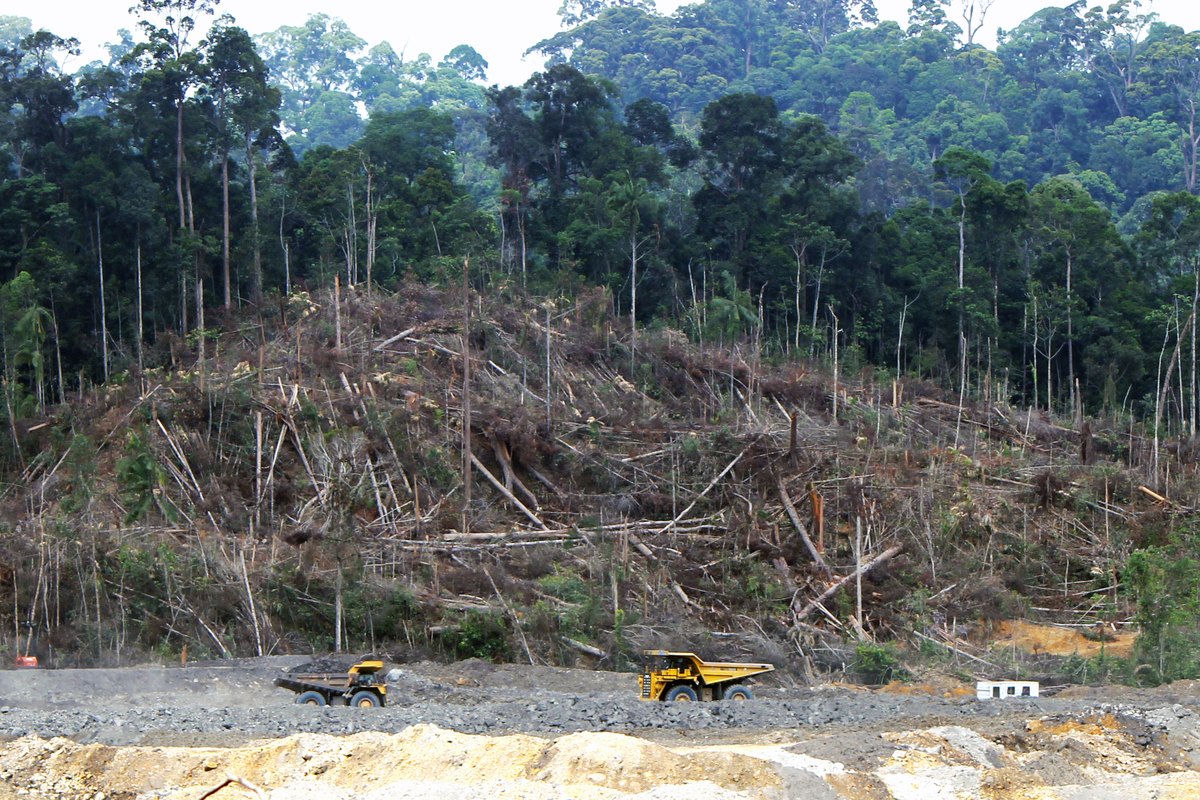
Deforestation and coal mining in Central Kalimantan, Indonesia, photographed in 2013. This is real environmental context, not a location or image from Ghost in the Cell. Photo © Andrew Taylor/WDM, shared by IndoMet in the Heart of Borneo via Wikimedia Commons, resized and compressed under CC BY 2.0.
The distinction is important because environmental horror can become misleading when a fictional story is illustrated as though it were evidence of one particular real incident.
The photograph documents real land clearing.
The movie invents its characters and supernatural consequences.
Why put the story in a prison?
A prison turns abstract ideas about systems into physical rules.
Doors lock.
Movement is controlled.
Information is restricted.
Some people have authority over other people’s bodies.
Escape is difficult even before a ghost enters the story.
Anwar’s public comments show that this is intentional rather than accidental production design. The prison gives him a contained setting for horror while also representing a society where people can be trapped by structures they did not create.
That matters to the film’s idea of collective action.
The official synopsis says the inmates eventually have to overcome their rivalries to confront the threat. The environmental reading makes that more than a survival-movie device: a problem created or enabled by a system cannot necessarily be solved by isolated individuals acting only for themselves.
That is an interpretation supported by the combination of the synopsis and Anwar’s stated themes.
It should not be expanded into a claim that the film endorses a specific political party, policy or environmental program unless Anwar says so directly.
The yellow uniforms are meant to preserve hope
Even the prisoners’ clothing received a deliberate thematic explanation.
In the ANTARA interview, Anwar said the production considered calmer colors such as blue or green before choosing yellow.
He associated the yellow with a remaining possibility of hope inside a very dark world.
The point is small, but it helps explain the film’s tonal contradiction.
Ghost in the Cell is filled with corrupt systems, violence and grotesque deaths, yet it is also a comedy about prisoners who have to cooperate.
The movie’s worldview is not simply “everything is doomed.”
Its horror depends on consequences arriving.
Its survival depends on people doing something together after those consequences can no longer be ignored.
Corruption and environmental destruction are connected in the film’s logic
Anwar’s environmental statement is only one part of the film’s social critique.
ANTARA describes the prison as a place where money and status produce unequal treatment. Other Indonesian reporting around the release likewise emphasizes corruption, privilege and institutional dysfunction.
The film therefore does not isolate deforestation as a problem that exists somewhere far from politics or economics.
Within the fictional story, environmental destruction, unequal power and institutional corruption belong to the same moral landscape.
That is a thematic relationship.
It should not be mistaken for a factual claim that every real case of Indonesian deforestation follows the exact conspiracy or chain of responsibility shown in the movie.
Is Ghost in the Cell based on a true story?
Not in the conventional sense.
There is no public evidence reviewed for this article that Ghost in the Cell reconstructs one documented prison haunting, one murder case or one supernatural incident.
Its prison and ghost story are fictional.
What is real are the social and environmental issues Anwar says he used as the film’s foundation: deforestation, unequal systems, corruption, institutional restriction and the tendency to ignore consequences until they become impossible to avoid.
That is a different kind of relationship to reality than “based on a true case.”
Is the prison in Ghost in the Cell a real prison?
The story takes place in the fictional Labuhan Angsana prison. ANTARA reports that its set was built from scratch, drawing inspiration from Sukamiskin prison in West Java.
In his Berlinale Forum interview, Anwar also identifies Sukamiskin as the real prison that informed his story and its depiction of privileges for wealthy inmates. That is institutional inspiration; it does not establish a real haunting or make the fictional events a documented case.
The lead image is an official still from the film, supplied in Well Go USA’s press kit.
What makes the movie environmental horror?
Environmental horror does not require a monster literally made of trees, smoke or toxic waste.
The genre can also treat ecological damage as a source of buried consequences.
In Ghost in the Cell, Anwar has already supplied the key connection: the ghost embodies consequences people refuse to face, and the real issue beneath the supernatural surface is deforestation.
That allows the film to turn environmental neglect into a haunting without pretending the haunting itself is real.
The supernatural device makes an invisible or ignored cost visible.
When did Ghost in the Cell release in the United States?
Well Go USA lists October 2, 2026 as its theatrical release date and currently marks the film as “In Theaters Now.” Bloody Disgusting’s August 24 announcement identifies Well Go’s distribution territory as North America.
The distributor lists a runtime of 106 minutes and Indonesian as the film’s language, with English subtitles.
The film had already premiered at the Berlin International Film Festival and opened theatrically in Indonesia earlier in 2026.
Frequently Asked Questions
Is Ghost in the Cell based on a real haunting?
No public source reviewed for this article establishes a real prison haunting behind the film. The supernatural story is fiction.
What is the real issue behind Ghost in the Cell?
Joko Anwar has explicitly said that beneath the supernatural story lies the real problem of large-scale deforestation in Indonesia and the failure to confront its consequences.
Is the ghost a kuntilanak or another Indonesian folklore spirit?
The official materials reviewed here do not identify the entity as a kuntilanak, pocong or another named folkloric being. It should not be assigned a folklore identity without a source.
Why is the movie set in a prison?
Anwar has described the prison as a metaphor for a system that restricts people’s movement and their understanding of what is happening around them. The film also uses unequal treatment inside the prison to explore privilege and corruption.
Is the deforestation in the movie real?
Deforestation in Indonesia is real, and Anwar explicitly identifies it as a concern behind the film. The movie’s specific supernatural events, characters and deaths are fictional.
When did Ghost in the Cell open in the U.S.?
Well Go USA released the film in North American theaters on October 2, 2026.
Sources & further reading
- Joko Anwar: original director statement, Long Lingering Truths (Berlinale Forum / Arsenal)
- Arsenal / Berlinale Forum: Ghost in the Cell film credits and programme
- Joko Anwar interview with Lisabona Rahman and Barbara Wurm (Berlinale Forum / Arsenal)
- Well Go USA: Ghost in the Cell official film page
- Bloody Disgusting: Joko Anwar director statement on deforestation (January 20, 2026)
- ANTARA: Joko Anwar on the prison metaphor and hope in Ghost in the Cell (April 10, 2026)
- ANTARA: Ghost in the Cell and Joko Anwar’s social critique (April 16, 2026)
- Bloody Disgusting: North American theatrical trailer and October 2 release
- Netflix Indonesia: Hantu Dalam Sel title listing
- Well Go USA Entertainment: original official theatrical trailer (August 24, 2026)
- Well Go USA: official Ghost in the Cell press kit
- Wikimedia Commons: Deforestation in Borneo, Andrew Taylor/WDM (CC BY 2.0)