The Index
The Great Plague of London: What Happened in 1665 and Did the Fire End It?
Understand London's 1665 plague, the death totals, quarantine orders and Samuel Pepys's diary—and why the Great Fire of 1666 did not end the epidemic.
Topics: Great Plague, London, 1665, Epidemics
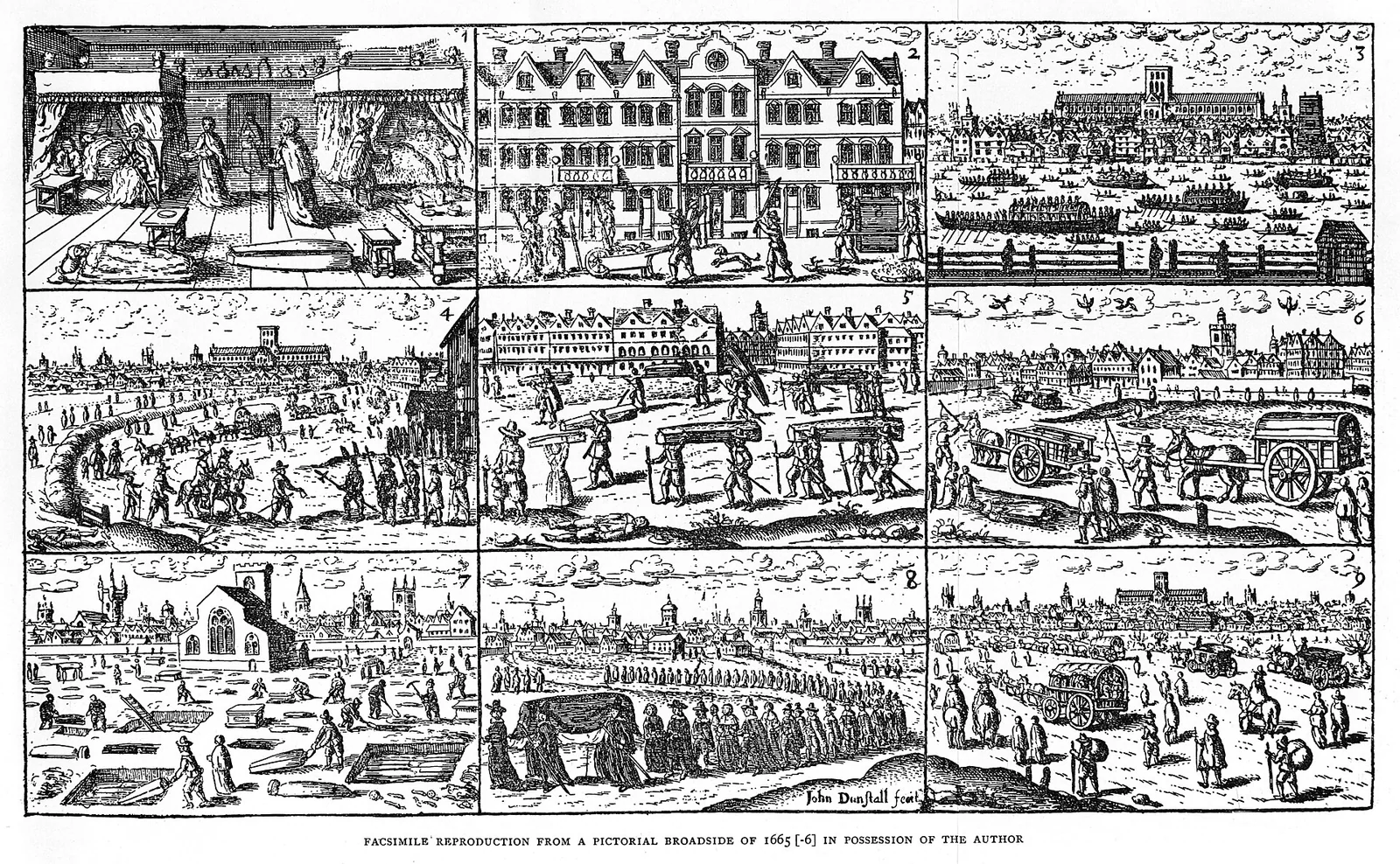
London’s Great Plague peaked in 1665, killing tens of thousands of people. The Great Fire of September 1666 did not bring it to a sudden end. Deaths had already fallen substantially before the fire, and several badly affected districts lay outside the burned area.
The two disasters are close together in chronology, which makes the fire an attractive ending for the plague story. The surviving records do not support that tidy sequence of cause and cure.
How many people died?
The recorded plague total commonly cited for 1665 is 68,596, while the broader estimate is around 100,000 Londoners. These are not two exact counts of the same kind. One is a contemporary recorded total; the other attempts to allow for deaths the records missed or classified differently.
London Museum’s account explains the limitations of the Bills of Mortality and reproduces objects carrying the recorded figure. Its evidence is useful even when the numbers are presented with different degrees of certainty.
The scope matters: these figures concern London. They should not be relabeled as a count for all of England or a percentage of the entire United Kingdom.
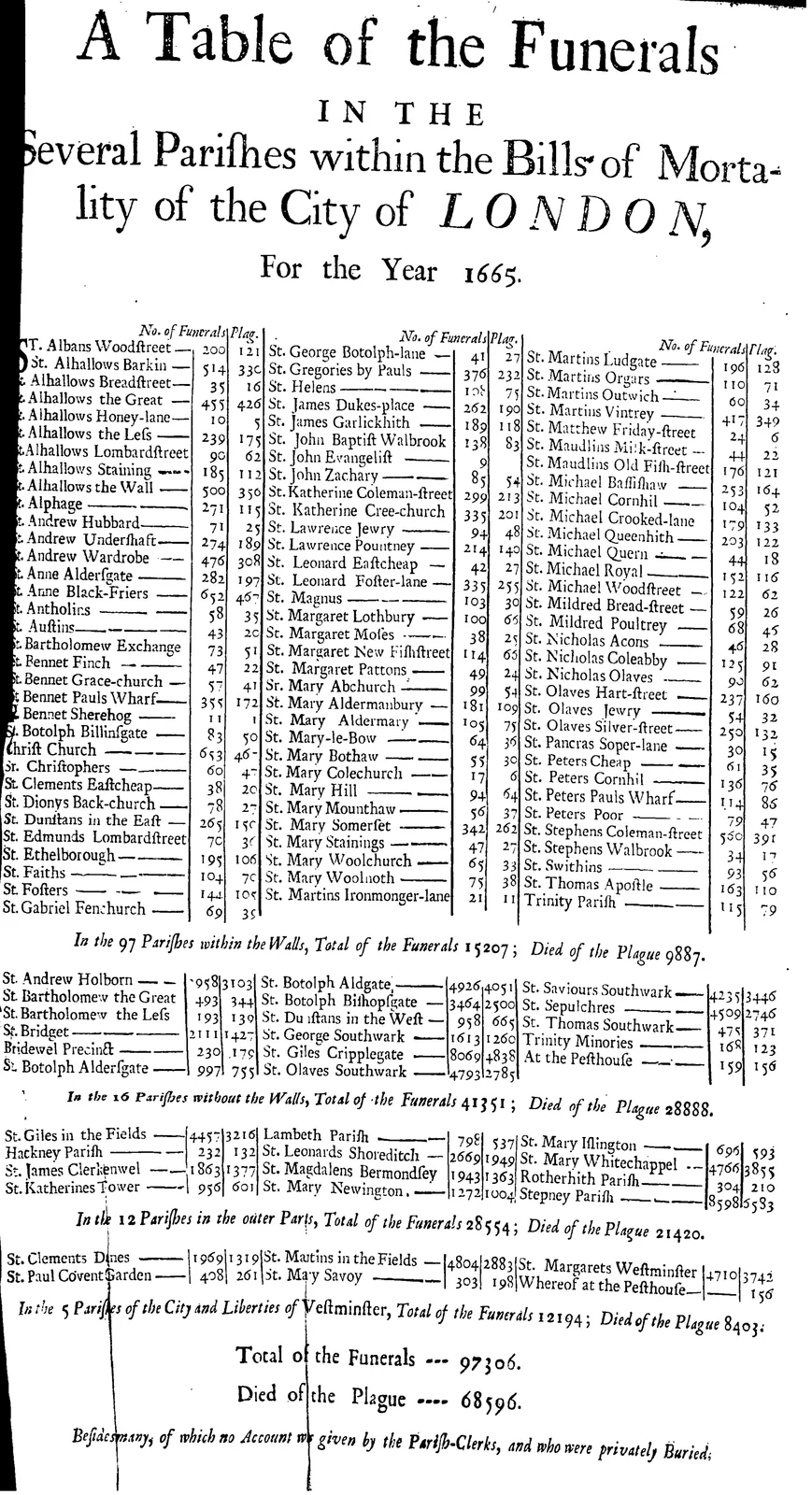
A historical table of funerals for 1665. Recorded totals and later estimates answer different counting questions. Source. Historical mortality table / Wikimedia Commons. Public domain. Resized and converted to WebP.
What can the weekly death bills tell us?
Samuel Pepys’s diary gives a personal view of how the figures were read. On 7 September 1665, he recorded a weekly bill showing 8,252 deaths in all, including 6,878 attributed to plague. He reacted with fear that the epidemic had gained a lasting hold.
Those are weekly figures, not the annual total. They also distinguish all recorded deaths from the subset assigned to plague. Keeping the two columns separate avoids inflating one category with the other.
The September diary moves between public disaster and ordinary concerns: work, money, travel and social visits. That mixture is revealing. Living through an epidemic did not mean that every other obligation stopped, even as fear changed the use of streets and homes.
Pepys was one observer with particular resources and responsibilities. His experience is not a complete survey of how poorer households, servants or the sick managed the crisis.
Why were houses marked and shut?
Orders preserved by The National Archives set out official responses. The 1666 rules describe identifying suspected cases, providing separate accommodation for the sick, shutting infected houses for forty days, and marking doors with a red cross and a plea for mercy.
The orders also assign warders to supply necessities and restrict contact. These details show that isolation created a practical problem as well as a legal command: people still needed food and other support while confined.
Another document in the archive’s teaching collection records official anger when a marked house was opened and its occupants allowed into the street. Regulations tell us what authorities demanded. Records of resistance help show why a rule cannot automatically be treated as a description of universal compliance.
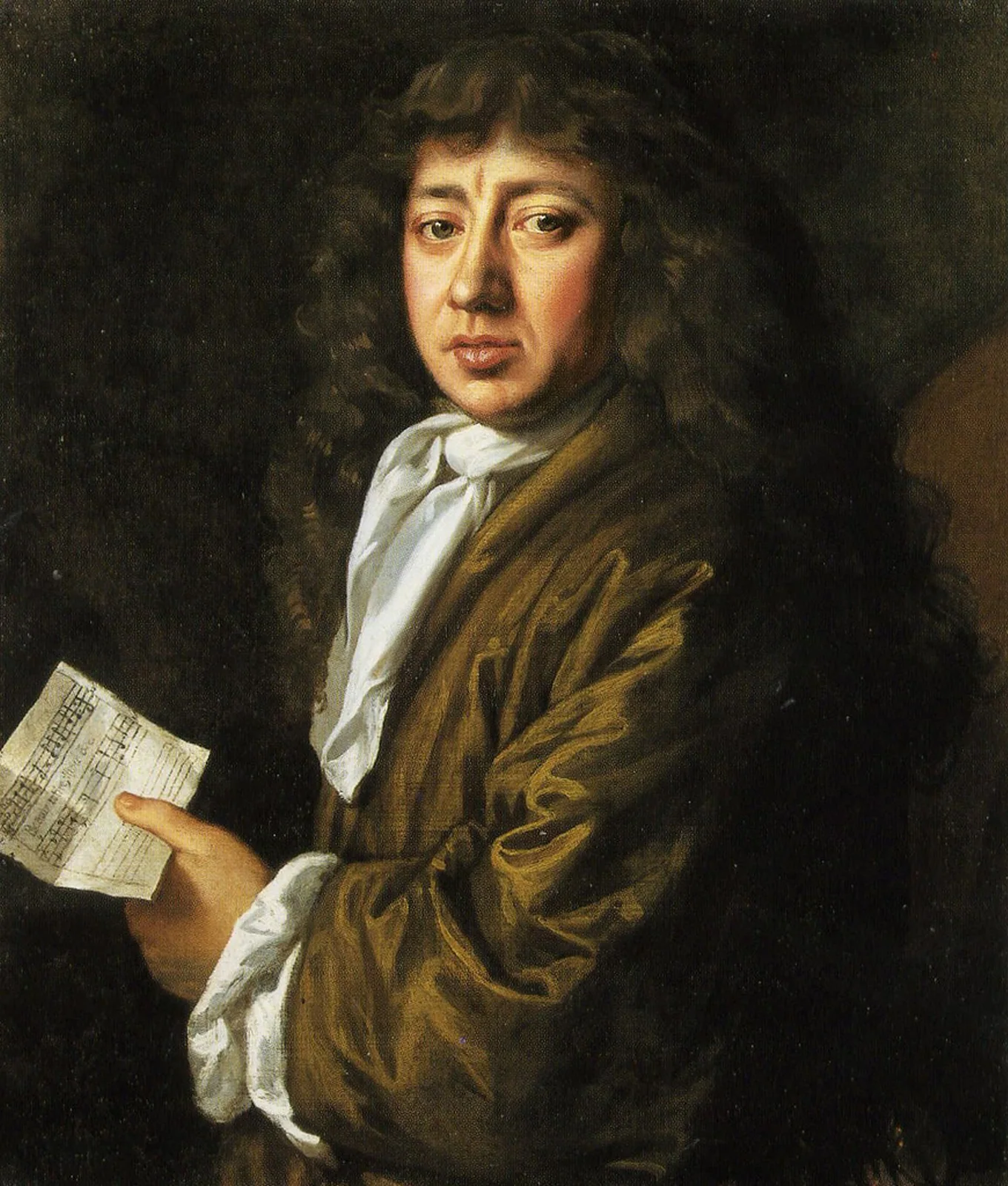
Samuel Pepys, painted by John Hayls in 1666, whose diary records the experience of reading the death bills. Source. John Hayls. Public domain. Resized and converted to WebP.
Why did the Great Fire not end the plague?
Two observations undermine the claim. First, plague mortality was already declining in the winter of 1665, months before the September 1666 fire. Second, areas including Whitechapel, Clerkenwell and Southwark were badly affected by plague but were not destroyed by the fire.
That does not mean every aspect of the epidemic’s disappearance has one simple explanation. It means the dramatic fire story fails a basic comparison of timing and geography. A later event cannot explain a decline already under way, and burning one area cannot be assumed to have cleared every affected district.
The distinction is a useful habit for dark history: establish what changed, when it changed and where it changed before assigning a single cause.
How is this different from the Black Death?
The Great Plague refers here to London’s seventeenth-century epidemic. The Black Death names the much earlier medieval catastrophe of the 1340s and 1350s. They belong to the same long pandemic of plague, but they are not the same outbreak, and the evidence for each is different. What the bacterium, the death toll and the arguments about spread look like for the medieval wave is set out in what caused the Black Death. Treating the two names as interchangeable collapses centuries of different circumstances and evidence.
The beaked mask is a third confusion. The bills, Pepys’s September entries and the shut-house orders discussed above do not describe it. The 1656 prints that created the image, and the reasons they are weak evidence for a working uniform, are in what plague doctors wore.
For another London disaster whose death toll requires careful reading, see the Great Smog of 1952. For an example of epidemic fear taking a supernatural form, read Mercy Brown and Rhode Island’s vampire panic.