The Index
What Did Plague Doctors Wear? The Beak Mask, the 1656 Prints and the Myth
The beaked plague doctor is a seventeenth-century print, not a medieval uniform. What the 1656 broadsides, Charles de Lorme and a 1721 book actually show.
Topics: Plague doctor, Doctor Schnabel, Plague, Rome, 1656, Miasma, Charles de Lorme, Second Pandemic
The figure in the wide hat and the long beak is not a portrait of a medieval doctor on his rounds in 1348. It is a printed costume. The British Museum dates the broadsides that spread it to 1656, during a plague outbreak in Rome, and the medical historians who have compared those sheets with the written record do not treat them as a standard uniform for every plague physician in Europe.
That distinction is the whole subject. Plague was real. Protective clothing of a sort was recommended. The bird mask, the crystal eye and the perfumed beak are a much narrower, and much later, piece of evidence than the costume shops and the medieval fairs suggest.
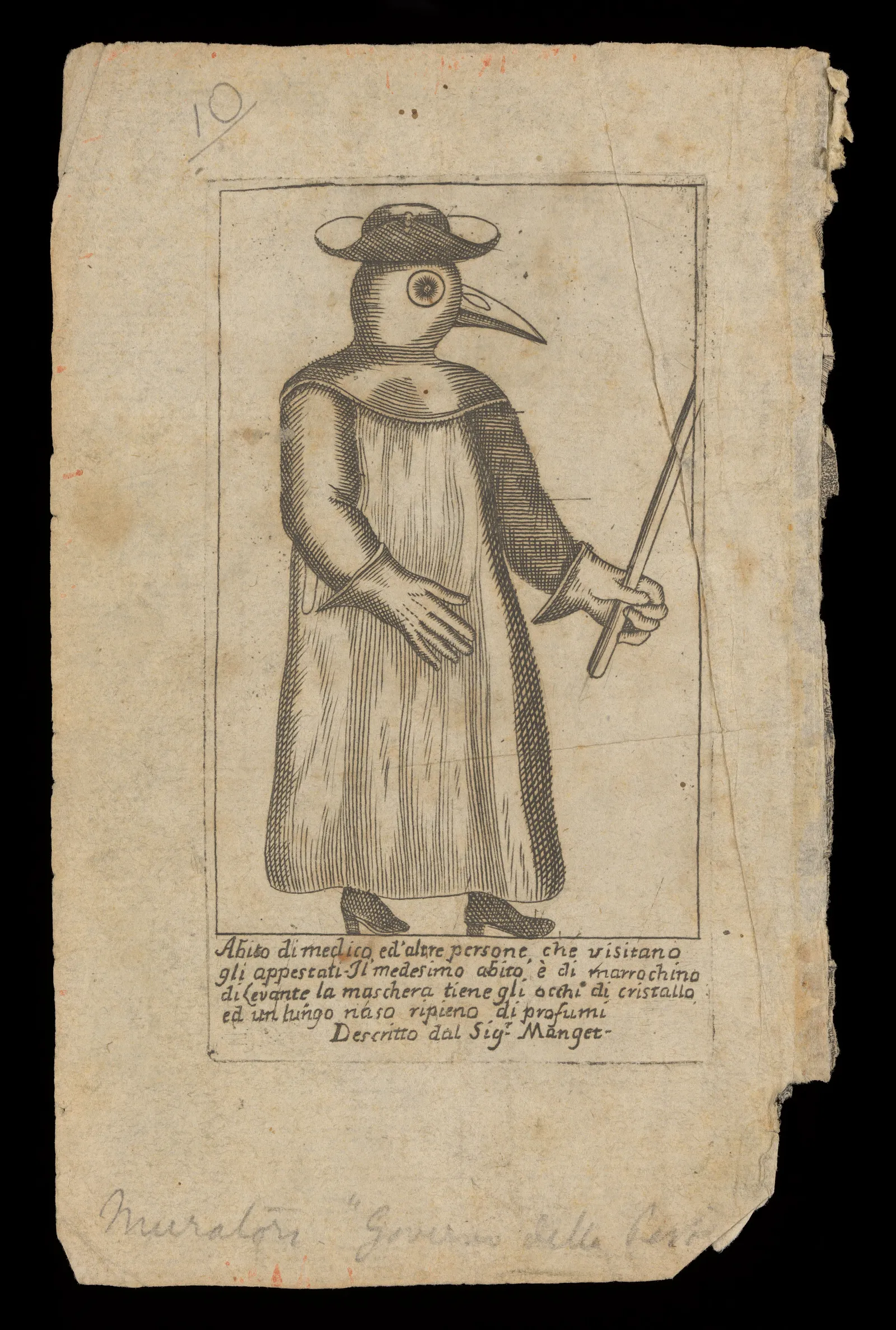
The engraving at the top of this page is an eighteenth-century line engraving catalogued by the Wellcome Collection as after Jean-Jacques Manget, reference 10075i. Wellcome Collection, Public Domain Mark. The scan was resized to 1600 pixels wide and converted to WebP without cropping the sheet. It is a picture of a costume, not a portrait of a named physician.
What is the figure in the beak mask?
A printed type, not an identified man. The sheet shows one standing figure inside a ruled frame: a floor-length coat, a wide-brimmed hat, gloves, a mask drawn in profile, with a round eye and a long beak, and a stick held in one hand. Under the feet, an Italian caption is printed with the image. Wellcome transcribes it as: “Abito di medico, ed’altre persone, che visitano gli appestati. Il medesimo abito è di marrochino di Levante la maschera tiene gli occhi di cristallo, ed un lungo naso ripieno di profumi descritto dal Sigr. Manget.”
A close translation: clothing of a physician, and of other people, who visit those sick with plague. The same clothing is of Levant morocco leather. The mask has crystal eyes and a long nose filled with perfumes, described by Signor Manget.
Two details in that sentence are easy to skip. The caption does not limit the outfit to physicians. It says physicians and other people who visit the sick. And it does not name the wearer. “Doctor Beak” is a type in a print, the way a later cartoon might draw “the doctor” without meaning a particular man on a particular street.
The paper also carries later handwriting, including a numeral at the upper left. Those marks are not part of the printed claim. They show that the sheet has been handled, numbered and annotated since it was made. They do not identify the figure.
When was Doctor Schnabel first printed?
The British Museum dates the broadsides to 1656, in Rome and then in Nuremberg. The museum holds an Italian woodcut broadside titled L’Habito con il quale vanno i Medici per Roma, “the clothing in which the physicians go about Rome.” Its catalogue describes a man in a long coat, gloves, a flat broad-brimmed hat, glasses and a bird-like mask with a long beak, holding a stick. The production date is 1656. The curators note an imprint, “In Roma, & in Perugia, per Sebastiano Zecchini.”
The same entry says a German engraving was copied from that Italian sheet. The German broadside, published by Paulus Fürst in Nuremberg in 1656, is titled Doctor Schnabel von Rom and Kleidung wider den Tod zu Rom: Doctor Beak of Rome, and clothing against death at Rome. The museum describes an engraving of a figure in a long coat, gloves, mask and hat, holding a stick with a winged hourglass, with children running in one part of the background and a view of an Italian city in another. The curators add that both the Italian sheet and Fürst’s engraving appear to copy a Rome sheet signed by someone recorded as J. Columbina, who has not been securely identified.
The Wellcome engraving on this page is not that 1656 Fürst plate. Wellcome dates it to the eighteenth century and describes it as a line engraving after Jean-Jacques Manget. It belongs to the later life of the same image. The 1656 broadsides are the point at which the British Museum can anchor the picture in a year, a city and a publisher.
A broadside is evidence that someone printed a picture and a text. It is not, by itself, evidence that the artist stood next to a Roman physician and drew what he saw. Herbert J. Mattie, in a study published online in November 2023 in the European Journal for the History of Medicine and Health, describes the 1656 prints as broadsides with strong allegorical and satirical tendencies. The Fürst sheet, as the museum describes it, puts a winged hourglass on the stick. That detail belongs to the picture. The caption the museum records does not explain it as a medical tool. Children running from the figure are a scene in a print, not a census of how Roman children behaved. Printers of the period treated real oddities the same way: a 1683 Strasbourg broadsheet turned a genuine rat king into a warning from God.
What was the beak supposed to do?
Hold fragrant material against air that physicians of the time called corrupt. It was not a filter for germs.
Mattie says the captions on the 1656 engravings describe the beak as filled with aromatic substances. The Wellcome sheet says the same thing in Italian: a long nose full of perfumes. The theory underneath that instruction is miasma, the idea that disease travelled in foul air. Mattie notes that the Paris medical faculty’s report of 1348, written as the medieval pandemic arrived, already warned that winds could carry corrupt air from distant places. A long nose stuffed with scent belongs to that theory. It was meant to change the air the wearer breathed in, not to strain out an organism nobody had yet identified.
Calling the beak an early respirator is a modern analogy, and Mattie treats it as an anachronism. The comparison became especially common when people were wearing masks against COVID-19. The analogy imports a later idea of infection, something carried in the air, into a period that was talking about the air itself being malignant. Perfumes, vinegar and herbs were supposed to oppose that malignancy. They were not a prototype of a laboratory test.
Pia Claudia Doering, a literary scholar at the University of Münster, describes an earlier and simpler practice. In her account of the medieval pandemic of 1347–1351, physicians did not wear masks. They held bags of aromatic herbs, soaked in vinegar, in front of the nose when they visited the sick. A beak, if it was used at all, would have been a later way to keep those scents under the nose while leaving the hands free. That is a plausible function. It is not the same as proof that the engraved bird head was ordinary medical equipment in 1348.
The bacterium that causes plague, and the ancient DNA that has identified it in medieval mass graves, are a separate body of evidence. They are set out in what caused the Black Death. Those genomes do not tell us what a Roman physician wore in 1656, and a 1656 engraving does not tell us what killed people in 1348.
Did Charles de Lorme invent the suit in 1619?
He is often said to have done so. The biography that says it does not describe this outfit, and it was written decades later by a writer Mattie does not consider reliable.
Charles de Lorme, also spelled de l’Orme, lived from 1584 to 1678 and served as a physician to French kings. The invention story comes from Michel de Saint-Martin. Mattie uses two of his books. Moyens faciles et éprouvés, published at Caen in 1682, says de Lorme never forgot “his suit of Morocco leather of which he was the author,” a garment “from his feet to the head in the shape of a pantalon,” with a mask of the same leather “to which he had attached a nose as long as a half foot in order to ward off the malignancy of the air.” A shorter biography, Portrait en petit de Monsieur De Lorme, puts a version of the story in the Paris plague of 1619. There, in Mattie’s translation, de Lorme had a morocco-leather suit made because bad air penetrated it with difficulty, put garlic and rue in his mouth, frankincense in his nose and ears, covered his eyes with spectacles, and in that equipment “cured almost everyone to whom he gave remedies.”
Read those sentences against the engraving and they do not match it. Saint-Martin describes a pantalon, a coverall, not the ankle-length coat in the prints. He describes a half-foot nose, not a bird head filled with spices. In one passage the protection for the eyes is spectacles, not the crystal goggles of the later caption. He does not mention the hat, the gloves, the cane or the hood. Mattie’s conclusion is direct: if the biography is trusted at all, de Lorme’s suit “bore hardly any resemblance” to Doctor Beak. The long robe, the gloves, the cane, the hat, the hood, and the shape and contents of the nosepiece “do not form part of the description by Michel de Saint-Martin.”
The cure claim is the biographer’s, not a hospital register. Mattie also notes that the same book credits de Lorme with curing more than 10,000 soldiers of dysentery by having them crouch naked for a few hours over the smoke of old shoes. That is the kind of story the biography tells. It is a reason to treat the “almost everyone” sentence as praise, not as an outcome that can be checked. Saint-Martin was writing four years after de Lorme’s death and more than sixty years after 1619. Mattie finds no second source for the suit, and he describes the biographer as eccentric and given to glorifying his subject.
A Wellcome Collection story from 23 June 2020, by Estelle Paranque, still presents the familiar merged version. It says de Lorme invented the all-enveloping plague-prevention costume because of the 1619 Paris outbreak, and it describes a mask with a nose “half a foot long, shaped like a beak, filled with perfume with only two holes, one on each side near the nostrils.” The half-foot nose is in Saint-Martin. The beak, the perfume and the two holes are the details Mattie traces to the prints and to the text added to a 1721 plague book, not to the 1619 passage. The same Wellcome story says the costume stopped air that “carried dangerous viruses and germs.” That is the anachronism in plain language. De Lorme’s biographer was writing about malignant air, not about viruses.
Doering is more willing to leave a door open. She writes that a holder for fragrances, placed under the nose so the hands stayed free, was developed in the seventeenth century, “possibly based on an idea by Charles Delorme.” She also says the beak is documented only for France and Italy, and only for plague outbreaks from the seventeenth century onward, with no evidence for the German-speaking countries or for the medieval pandemic. Possibility is not the same claim as Paranque’s “he invented the costume that physicians then wore across Europe.”
What did the 1721 book add?
A picture and a description that the named author later disowned, according to Mattie’s reading of the sequel.
Plague in Marseille in 1720–1722 put protective clothing back into print. Mattie describes new broadsides and a frontispiece in a plague treatise by the Genevan physician Jean-Jacques Manget. The Wellcome Collection catalogues a 1721 Geneva edition whose title page names Manget. The catalogue notes that Maurice de Toulon’s name does not appear on the title page but that his authorship is acknowledged in the preface, and that the frontispiece shows a physician in plague costume. The book is a compilation, not a simple eyewitness manual by one doctor who had walked a plague ward in a beak.
Mattie says Manget had never seen the plague, let alone a plague doctor, and that the image looks satirical inside a learned book. He quotes Manget’s clarification in another plague treatise the following year: the print and the description had been added by the publishers without his involvement. Manget then distanced himself from the image. He had seen similar prints when he was young, Mattie reports, and had never taken them seriously.
The inserted description, as Mattie summarizes it, supplied the details that Saint-Martin lacks: a nosepiece shaped like a beak, a hole on each side, boots “more or less à la Polonoise,” the shirt tucked into the breeches, and, in common with the 1656 prints, the cane, the hat and the gloves. Once that description sat inside a treatise readers believed a respectable physician had written, it became the text people used to fill the gaps in de Lorme’s story.
The engraving on this page is one descendant of that moment. Wellcome calls it a line engraving after Manget, gives its date as the eighteenth century, and records the lettering that ends “descritto dal Sigr. Manget,” described by Signor Manget. The catalogue says another version is the frontispiece of the 1721 book. This sheet should be read as that later printed tradition, not as Manget’s own drawing from life, and not as his settled medical advice. His objection, if Mattie has the second treatise right, is part of the evidence.
A further step away from the seventeenth century is visible in a Wellcome watercolour catalogued as about 1910. Its lettering reads, “Costume worn by doctors during an outbreak of plague 17th century.” The catalogue description says the gown, the leather underneath, the beak fitted with aromatic substances and the glass eyeholes are the costume “described by” Manget in 1721. The lettering states a uniform. The publication history behind Manget’s book is an argument about a picture the author said he had not asked for.
Did Roman doctors in 1656 wear it?
Rome had plague in 1656. A waxed coat is better attested, in one diocesan account, than the bird mask. Historians do not agree that the mask was ordinary working dress.
The prints are dated to the year the disease reached the city, which is why they feel like reportage. Alessia Ceccarelli, writing in the Archivio della Società Romana di Storia Patria in 2022 from Venetian diplomatic dispatches, places the start in June 1656 and says the outbreak could not be called over until the following spring. Domenico Rocciolo, in a historical note for the Diocese of Rome, says the infection crossed the city walls at the beginning of June 1656, that the first deaths came in the middle of the month, and that the epidemic ended in the summer of 1657. He describes closed gates, lazarettos, the fencing-in of Trastevere, where he says the first case was recognized, carts of the sick, and barges carrying the dead from Tiber Island to burial pits at San Paolo. Those are public-health measures and burial logistics. They are not a description of a beak.
The death toll is an estimate, and the estimates do not match. Ceccarelli considers it probable that between 10,000 and 14,000 people died in Rome, out of a population of about 125,000. The same note describes a peak a little above 100 deaths a day, and it dates that peak to the end of October and the beginning of November 1657, while also citing Venetian dispatches from October and November 1656. Those two years should not be folded into a single week. Rocciolo says scholars agree on about 9,000 to 14,000. Michael Widener, introducing Cardinal Girolamo Gastaldi’s 1684 quarantine treatise on the Yale Law Library rare-books blog, gives a lower figure: about 4,500 deaths in Rome, which he calls about 8 percent of the population. Those numbers cannot all be a count of the same register. Gastaldi had been commissioner of public health under Alexander VII, so his book is a serious source for the regulations. Widener’s blog is a librarian’s summary of the toll, not a table transcribed from the folio. The careful statement is that Rome’s losses were large and that no single total given in these accounts should be repeated as a census.
The same caution applies outside Rome. Ceccarelli quotes the papal nuncio Giulio Spinola, on 28 July 1656, estimating the dead in Naples at above 200,000. The same nuncio wrote that no register of the dead was being kept, and that the bodies exposed in the streets could not be counted. An estimate made in the middle of an epidemic, by an observer who says the count has failed, is not a final toll. Ceccarelli’s own summary is that Spinola put Naples’s mortality above 60 percent, and that Genoa lost about half its inhabitants. Rocciolo’s diocesan note uses round figures, 150,000 for Naples and 60,000 to 80,000 for Genoa, which sit in the same range and are no more precise. Comparing cities is fair. Pretending the digits are exact is not.
On clothing, Rocciolo quotes an Italian description of one Roman physician, Giovanni Maria Costanzi, who covered himself with a waxed-cloth garment, a hood and gloves to treat the sick at the San Bartolomeo lazaretto on Tiber Island. The words he quotes stop there. It does not mention a beak, crystal eyes or a perfumed nose. Rocciolo does not give the archival citation for that sentence on the diocesan page, so the line should be read as his quotation from a source he does not identify there, not as a document reproduced in full. It is still useful. A named doctor, in the outbreak the prints are about, is described in waxed cloth and gloves. That is protective clothing. It is not Doctor Schnabel.
Mattie makes a similar separation for the written medical record more broadly. Gowns of a smooth material, worn not only by doctors but by clergy, corpse-bearers, disinfectors and officers, are confirmed by sources he considers reliable, mostly Italian and to a lesser extent French, and mostly from the first half of the seventeenth century. He also says this gown was not as widespread as later writers assume. The beak is the part he considers much harder to support from those sources.
Marion Maria Ruisinger, director of the German Museum for the History of Medicine in Ingolstadt, is more specific about geography and about the objects in museum cases. Her 2020 abstract, published in NTM, says the earliest evidence for this particular kind of protective clothing comes from Italy and southern France and dates from the middle of the seventeenth century. For Central Europe, she finds no evidence that such a beak mask was ever used in plague time. She examines the masks at Ingolstadt and at the German Historical Museum in Berlin and concludes that both have details that argue against their having been used as protective clothing. Whether they are later historicizing reconstructions or deliberate forgeries, she writes, has to stay open.
Put those findings next to each other and the honest summary is narrow. There is seventeenth-century evidence, from Italy and southern France, for special protective clothing, and there are prints from 1656 that claim to show a beaked habit in Rome. There is not good evidence that the beak was the working dress of plague doctors in German-speaking Europe, in London in 1665, or in the medieval pandemic. There is a positive argument, from the museum masks Ruisinger studied, against treating every surviving beak as a genuine seventeenth-century tool. “No doctor ever wore anything like this” would be stronger than the abstracts support. “This was the uniform” is stronger than the abstracts support, too.
Why does the Black Death wear this mask in later pictures?
Because a striking print was copied into centuries where it does not belong. The medieval record describes other precautions.
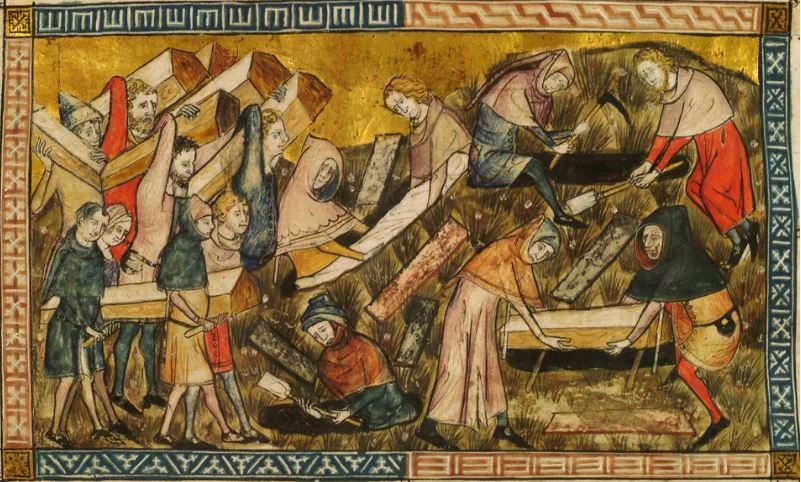
Doering’s account of 1347–1351 is the herb bag held in the hand, not a mask on the face. The pictures made during and just after the medieval wave show burial, flight, penitents and the work of getting the dead into the ground. The Tournai miniature used for the Black Death’s causes is one of those pictures: coffins, a trench, a chronicle image from about 1353. It is not a beak.
London’s epidemic of 1665 is closer in time to the Roman prints, and it still does not supply this costume. The Great Plague of London is documented through the bills of mortality, Samuel Pepys’s diary and the orders for shutting houses. The National Archives teaching resource on 1665–1666 transcribes a newsletter about the weekly bill, orders for prevention, and letters about enforcement. That resource does not mention a beak, a mask or a protective costume. Absence from one teaching set is not a search of every London parish. It does mean the documents usually used to explain 1665 are about quarantine, searchers and counted deaths, not about Doctor Schnabel. Doering’s geographic limit, France and Italy, leaves London outside the region where she finds the beak attested.
Quarantine islands attract the same costume in the imagination. Poveglia, in the Venetian lagoon, has a documented history as a lazaretto and a quarantine station. A lazaretto is an institution for holding people and goods. It is not evidence that its staff wore a bird mask, and the island’s later ghost story about a murderous doctor is a different legend again. Venice did build plague hospitals. The forty-day hold and the lazaretto are part of that history. They are not a photograph of the Fürst engraving.
Lori Jones and Richard Nevell warned in The Lancet Infectious Diseases in 2016 that digitized historical images get mislabeled, and that several medieval pictures circulated as “plague” are not plague at all. Their examples are disease scenes in manuscripts, not the beak. Mattie applies the same caution to pictures of medical practitioners. A label that says “plague doctor, Black Death” on a 1656 or 1721 print is that kind of error. The image loses the year it was made, and the disease gains a uniform it did not have.
How did the mask outlive the epidemics?
It became a character, and then a symbol. That career is cultural history, not a medical supply list.
Doering traces the afterlife. The medico della peste is now one of the familiar masks of the Venetian carnival. She argues that the beak did not originally belong to the commedia dell’arte, and that seventeenth-century productions of Molière’s medical satires dressed doctors in scholarly clothes, hats and wigs, not in this mask. Modern stagings of Monsieur de Pourceaugnac and Le malade imaginaire often add the beak anyway. Medieval markets do the same thing from the other direction, putting a seventeenth-century print onto a fourteenth-century fair. In both cases the mask is being used because it reads instantly as disease and as distrust of the person behind it. Doering’s point is that the visual power is real and the chronology is wrong.
Mattie dates the fusion of de Lorme and the prints to the decades when germ theory made masks a live argument, around the end of the nineteenth century and the start of the twentieth. Advocates of filtering masks acquired a picturesque ancestor. Critics of those masks acquired a ridiculous one. Neither side, in his account, went back to the difference between a 1682 biography and a 1656 satire. Paranque’s Wellcome story in 2020 shows how durable the fusion is. It was published by a major medical-history library, and it still narrates de Lorme as the inventor of the engraved costume.
Fiction uses the same shorthand. On this site, the collaborative horror project documented in the SCP Foundation includes SCP-049, a fictional entity drawn as a plague doctor and convinced it can cure death. That is a wiki character. It is not a source for Rome in 1656. The history of Halloween is a separate subject again. Where the holiday comes from is a question about Samhain, All Hallows and later American customs. A plastic beak in a costume shop does not move any of those dates, and it does not make the 1656 print a medieval survival.
What is documented, and what is a later image?
| Question | What the record supports | What it does not establish |
|---|---|---|
| When does the beak picture appear? | British Museum broadsides of 1656: an Italian sheet on physicians’ clothing in Rome, and Paulus Fürst’s Doctor Schnabel von Rom in Nuremberg | A sketch made beside a named patient in 1348 |
| What did the beak contain, according to the prints? | Aromatic substances in the 1656 captions, as Mattie reads them; perfumes, in the Italian lettering on the Wellcome engraving | A filter designed for bacteria or viruses |
| Did Charles de Lorme invent this costume in 1619? | Saint-Martin, writing in the 1680s, credits him with a morocco-leather coverall and a nose half a foot long | The robe, beak, gloves, hat and stick of the prints. Mattie finds no second source, and the biography exaggerates |
| Did Manget endorse the 1721 picture? | A 1721 Geneva book with his name on the title page includes a plague-doctor frontispiece | His approval. Mattie says a treatise of the next year claims the publishers added the picture without him |
| What did a Roman plague doctor wear in 1656? | Rocciolo quotes a waxed-cloth garment, hood and gloves for Giovanni Maria Costanzi. Mattie finds support for smooth gowns in Italian, and some French, sources | A beak on Costanzi, or a citywide uniform |
| Where is the beak attested? | Ruisinger’s abstract: earliest evidence in Italy and southern France, mid-seventeenth century. Doering: France and Italy, seventeenth-century outbreaks | Central Europe, in Ruisinger’s finding; the medieval pandemic; London’s 1665 orders as transcribed by the National Archives |
| Are museum beak masks the working tools? | Ingolstadt and Berlin hold masks that visitors ask to see | Use as protective clothing. Ruisinger says details argue against that use, and leaves open whether they are later reconstructions or forgeries |
| How many people died in Rome in 1656–57? | Ceccarelli: probably 10,000 to 14,000 of about 125,000. Rocciolo: scholars say about 9,000 to 14,000. Widener’s summary of Gastaldi: about 4,500 | A single audited total |
| Is SCP-049, or a carnival mask, evidence? | The image became a character in carnival, theatre and fiction | What any particular early-modern physician wore |
Frequently asked questions
Did plague doctors during the Black Death wear beak masks?
No evidence has turned up that they did. Doering says physicians in 1347–1351 held vinegar-soaked herb bags in front of the nose. The British Museum’s beak broadsides are dated 1656, three centuries later. The ancient DNA from medieval graves identifies the bacterium. It does not identify a uniform.
Who was Doctor Schnabel?
A figure in a print. Doctor Schnabel von Rom is the title Paulus Fürst published in Nuremberg in 1656. The British Museum describes it as a broadside on doctors in Rome and their protective clothing. It does not name a historical physician under that nickname.
What was put in the beak?
The 1656 captions, in Mattie’s reading, say aromatic substances. The eighteenth-century engraving on this page says perfumes. Saint-Martin’s description of de Lorme, which is not this costume, mentions garlic and rue in the mouth and frankincense in the nose and ears. None of those texts describes a germ filter.
Did the mask work?
The prints are not a clinical trial. They show what image-makers thought a protective habit looked like, under a theory of corrupt air. They cannot show a reduction in infections. Modern plague is a bacterial disease, discussed for the medieval pandemic in the Black Death explainer. Survival in 1656 depended on exposure, the form of the illness, and care that these pictures do not record.
Did Charles de Lorme design the famous mask?
That is the usual claim, and it is poorly supported. His biographer gives him a leather coverall and a long nose in a book from 1682. The robe, the beak full of perfume, the gloves and the stick come from other sources. Mattie argues that joining them produces a costume nobody in those sources actually described.
How many people died in the Rome plague of 1656?
Historians give a range, not a census. Ceccarelli’s probable figure is 10,000 to 14,000 deaths in a city of about 125,000. Rocciolo reports a scholarly consensus of about 9,000 to 14,000. A Yale Law Library note on Gastaldi’s treatise says about 4,500. Use the disagreement. Do not pick the most dramatic digit.
Is the plague-doctor mask just a carnival costume?
It is a carnival costume now. Doering treats the Venetian medico della peste as a later use of the image. The 1656 broadsides are earlier than that carnival type, and they are still prints, not a wardrobe inventory from a Roman lazaretto. A modern mask, in Venice or in a Halloween shop, copies the print. It does not verify it.
Sources & further reading
- British Museum: Paulus Fürst, Doctor Schnabel von Rom / Kleidung wider den Tod zu Rom, Nuremberg, 1656 (1876,0510.512)
- British Museum: anonymous Italian broadside, L'Habito con il quale vanno i Medici per Roma, 1656 (1880,0710.522)
- Herbert J. Mattie, Men in Tights: Charles de Lorme (1584–1678) and the First Plague Costume, European Journal for the History of Medicine and Health, 2024
- Marion Maria Ruisinger, The Plague Doctor's Mask in the German Museum for the History of Medicine, Ingolstadt, NTM, 2020 (author's abstract via Crossref)
- Lori Jones and Richard Nevell, Plagued by doubt and viral misinformation, The Lancet Infectious Diseases, 2016
- Open repository copy of Jones and Nevell, 2016, University of Exeter
- Wellcome Collection: line engraving of a physician in protective plague costume, after J. J. Manget, reference 10075i, Public Domain Mark
- Wellcome Collection catalogue: Traité de la peste, Geneva, 1721, title page naming Manget, frontispiece of a physician in plague costume
- Wellcome Collection: watercolour of a seventeenth-century plague preventive costume, about 1910, reference 2084i
- Estelle Paranque, The celebrity physician and the plague, Wellcome Collection, 23 June 2020
- Pia Claudia Doering, The extraordinary career of the Plague Doctor, University of Münster, Religion and Politics
- Alessia Ceccarelli, La salute di Roma e la gloria del papa: the plague of 1656–57 in the dispatches of Palazzo Venezia, Archivio della Società Romana di Storia Patria, vol. 145 (2022), PDF
- Domenico Rocciolo, The Church of Rome during the plague of 1656/57, Diocese of Rome, 28 July 2020
- Michael Widener, Epidemics and quarantines in 17th-century Rome, Yale Law Library Rare Books Blog, 3 April 2020, on Girolamo Gastaldi's 1684 treatise
- London Museum: The Great Plague of 1665
- The National Archives: The Great Plague of 1665–1666, teaching resource with transcribed orders and letters
- Creative Commons Public Domain Mark 1.0, the license status Wellcome assigns to the engraving