The Index / Dark History
What Caused the Black Death? The Bacterium, the Death Toll and the Rat Debate
Ancient DNA shows the Black Death was plague, caused by Yersinia pestis. The death toll and whether rats spread it remain estimates, not a census.
Topics: Black Death, Yersinia pestis, Plague, Medieval Europe, East Smithfield, Second Pandemic
The Black Death was a pandemic of plague, caused by the bacterium Yersinia pestis, in the years historians usually place between 1346 and 1353. Teeth and bones from dated burials have yielded the bacterium’s DNA. That identification is now the documented cause. It does not supply a single European death count, and it does not settle whether rats, human fleas, body lice, or coughing patients did most of the spreading.
The epidemic belongs to a longer series of plague outbreaks, often called the second pandemic, that continued for centuries. London’s disaster in 1665 was a later chapter, with its own records. It is not this event.
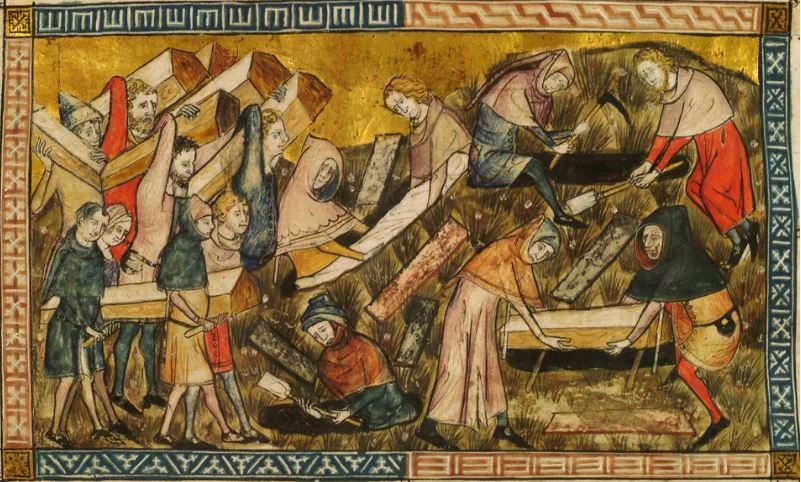
Hero image: Pierart dou Tielt’s miniature, made about 1353 for the chronicle of Gilles li Muisis, shows people in Tournai burying the dead. It is a near-contemporary illustration, not a photograph and not a tally of the dead. Wikimedia Commons. Public domain. Resized and converted to WebP.
What was the Black Death?
It was the first and most lethal wave of the second plague pandemic, not a separate disease with an unknown name.
In a 2022 paper in Nature, Maria A. Spyrou and colleagues date the medieval Black Death pandemic to 1346–1353. Stephanie Haensch and colleagues, writing in PLOS Pathogens in 2010, describe a second pandemic active in Europe from 1347 until about 1750, beginning with the Black Death and followed by repeated epidemics. A 2019 study led by Spyrou reconstructed 34 ancient Y. pestis genomes from ten European sites across the fourteenth to the eighteenth centuries and treated that whole span as one pandemic.
The name itself is younger than the catastrophe. Ole J. Benedictow, in a 2005 History Today essay explaining his mortality calculations, notes that the frightening name came centuries later. Fourteenth-century writers more often spoke of a pestilence or a mortality. London Museum uses “Great Pestilence” for the outbreak that reached London in 1348 and calls the modern label “Black Death.”
Two other pandemics of the same bacterium are easy to fold into this one by mistake. Michaela Harbeck and colleagues reported in 2013 that Y. pestis DNA from a sixth-century cemetery at Aschheim, in Bavaria, confirms the Justinianic plague, the pandemic that began in the 540s, as plague as well. They place it on an earlier branch of the bacterium’s family tree than the strains of the Black Death. The third pandemic is the modern spread that began in the nineteenth century. The World Health Organization’s plague fact sheet, updated on 29 September 2026, still describes plague as a living disease, not a medieval relic.
What caused it?
The bacterium Yersinia pestis. That is a laboratory finding from human remains, not a guess backward from symptoms.
Haensch’s team found DNA and protein signatures specific to Y. pestis in skeletons from mass graves in northern, central and southern Europe that archaeologists associated with the Black Death and later outbreaks. The paper’s conclusion is direct: Y. pestis caused the Black Death, and at least two related variants spread over Europe during the second pandemic.
The clearest single cemetery is East Smithfield in London. Kirsten I. Bos and colleagues reported in Nature in 2011 a draft genome, at high coverage, from victims “securely dated to episodes of pestilence-associated mortality in London, England, 1348–1350.” Historical evidence, they write, indicates that the burial ground was established in late 1348 or early 1349 for Black Death victims. The medieval genome sat close to the ancestor of Y. pestis strains that still infect people. Bos and colleagues also reported no unique derived positions that would make the medieval organism a genetically different super-bug. They argued that the appalling death rate may not have been a matter of bacterial phenotype alone, and that environment, vectors and the condition of the human population belong in the explanation.
The Museum of London Archaeology monograph on the site, excavated in 1986–88, describes East Smithfield as one of two emergency burial grounds founded in 1348/9, and records about 759 burials from the excavated area. London Museum says it cares for the remains of more than 600 people from that cemetery. Those are excavated individuals, not the whole death toll of the city.
Modern medicine divides plague into three main forms, and medieval sources cannot be sorted into those forms with clinical certainty. WHO says bubonic plague, with painful swollen lymph nodes called buboes, is the most common form today and usually follows the bite of an infected flea. Septicaemic plague is infection of the blood. Pneumonic plague infects the lungs and can pass from person to person in respiratory particles. The same page says human-to-human spread of the bubonic form is rare. London Museum makes the historical limit explicit: buboes made one form easier to recognize, “but we don’t know which form was the most common in the 1300s.”
Where did the pandemic start?
The best current genomic evidence points to central Eurasia in the early fourteenth century, not to a single street in Europe.
Spyrou’s 2022 study tested remains from two cemeteries, Kara-Djigach and Burana, in the Chüy Valley near Lake Issyk-Kul, in what is now Kyrgyzstan. Excavations in 1885–1892 had already shown an unusual number of burials dated 1338–1339. Some tombstone inscriptions state that the cause of death was pestilence. The word on the stones does not name a bacterium. The ancient DNA does. The team recovered Y. pestis from individuals buried there. Two reconstructed genomes represent one strain, and the authors identify that strain as the most recent common ancestor of a major diversification associated with the pandemic’s emergence, which they date to the first half of the fourteenth century. Comparing it with plague still found in the extended Tian Shan region, they argue for a local emergence and “an early fourteenth-century source of the second plague pandemic in central Eurasia.”
That is narrower than the older habit of saying “it started in China” and stopping. It is also narrower than a map arrow that begins at one besieged port. A common ancestor in central Eurasia in the 1330s can be true at the same time as a later arrival by ship in the Mediterranean in 1347. The paper does not claim that the Kyrgyz cemeteries contain every person who died in the first season, or that the inscriptions alone proved plague before the DNA was sequenced.
How did it reach Europe, and did a siege start it?
Trade and shipping carried it west. The story that a Mongol army won the siege of Caffa by catapulting infected corpses into the city is one chronicle’s claim, and the chronicler was probably not there.
Mark Wheelis examined that claim in Emerging Infectious Diseases in 2002, using the narrative of Gabriele de’ Mussi, a notary of Piacenza. The text describes illness among the besiegers of Caffa, in Crimea, in the mid-1340s, swellings in the armpit or groin, and an order to hurl corpses into the city. Wheelis notes that de’ Mussi was signing deeds in Piacenza across 1344 and the first half of 1346, and that after describing the East the notary turns to events “which we ourselves have seen.” Wheelis’s own conclusion is carefully split: a biological attack at Caffa is plausible and may explain how plague entered that city, but “the entry of plague into Europe from the Crimea likely occurred independent of this event.” The corpse-catapult story is therefore a documented allegation in a medieval text. It is not an archaeological finding, and it is not the origin identified by the 2022 genomes.
London’s arrival is better attested than any single ship’s name, and even that date is not pinned to one day. London Museum says plague spread from France to Weymouth, in Dorset, in June 1348 and was in London by November 1348, with the worst of the outbreak lasting until the end of spring 1349. Benedictow’s reconstruction puts an outbreak at Melcombe Regis, now part of Weymouth, shortly before 24 June 1348, and has London’s outbreak drawing comment by the end of September. The two published timelines differ by weeks. Both are historical reconstructions from chronicles and administrative traces, not a harbor log reproduced here. What they share is the sequence that matters: southern England in 1348, then London, then a peak into 1349.
The museum quotes a Westminster monk, John of Reading, on the social effect: “There was in those days death without sorrow, marriage without affection, self-imposed penance, want without poverty, and flight without escape.” That is a witness’s judgment of the mood, not a mortality statistic.
Did rats and fleas spread it?
Rats and rat fleas are a real plague pathway. They are not the only one researchers now take seriously, and the medieval mix is not settled.
The black rat at the centre of this debate is also the species behind the rat king, a rare natural tangle that early modern Europeans read as an omen.
WHO describes Y. pestis as a zoonotic bacterium usually found in small mammals and their fleas. People are infected by the bite of infected fleas, by unprotected contact with infectious body fluids or contaminated materials, and by inhaling respiratory particles from a patient with pneumonic plague. The CDC’s overview, reviewed on 24 August 2026, says people usually become infected through the bite of an infected rodent flea or by handling an infected animal. Its symptom page adds that pneumonic plague is the only form spread from person to person. Those are descriptions of plague as it behaves now. They are the right biology to start from. They are not a film of a street in 1348.
For the historical epidemics, Katharine R. Dean and colleagues built a model of spread by human ectoparasites, specifically the human flea Pulex irritans and the body louse, and compared it with models of pneumonic spread and of rodent fleas. In PNAS in 2018 they reported that the human-ectoparasite model fit mortality curves from nine European outbreaks better than the alternatives, and that it was the preferred model in seven of the nine. Their list included the Black Death of 1346–1353. They were explicit about a limit: they did not model mixed routes, so the study cannot say how much pneumonic plague contributed alongside another route. In a reply to critics the same year, they wrote that they were not presenting evidence against rat-borne transmission. Human ectoparasites, they said, are a plausible and likely vector. Rat fleas are not ruled out.
Benedictow’s 2005 essay argued the other way. He described the classic cycle in which plague kills a colony of black rats, and hungry rat fleas then bite people, and he wrote that human fleas and lice did not contribute significantly. That essay also predates both Dean’s comparison and the Kyrgyz genomes. A reader can treat his rat-flea account as one specialist’s mechanism, not as the last word after 2018.
Bos’s genomic result belongs in the same argument. If the medieval bacterium lacks a unique mutation that would explain a uniquely medieval killing power, then housing, nutrition, fleas, lice, weather, and how people moved become part of the reason the first wave was so destructive. None of those factors has been measured street by street for the whole of Europe.
How many people died?
No one counted them. Published estimates for Europe range from roughly a quarter of the population to about three fifths. London has a narrower, still estimated, figure.
WHO’s 2026 fact sheet says the fourteenth-century Black Death caused more than 50 million deaths in Europe. That is an agency summary of the historical scale. It is not a surviving census, and the page does not show the arithmetic. Benedictow, explaining his own calculation, concluded that the Black Death “swept away around 60 per cent of Europe’s population.” He took the population of Europe at the time to be around 80 million, “which implies that around 50 million people died.” He also wrote that researchers had generally agreed, on a thin base of evidence, that the toll was 20 to 30 percent, and that studies published from 1960 onward persuaded him the older estimates should be roughly doubled. His method used tax lists and manorial registers. Most of those lists name householders, often the better-off adult men, so he adjusted upward for poorer households, women and children. The adjustment is an argument, not a recount of bodies.
Wheelis, in 2002, used a lower published range: Europe lost an estimated one quarter to one third of its population, with comparable mortality in North Africa and the Near East. He also warned that severe effects in China, India and the rest of the Far East are commonly asserted with little evidence. Putting WHO, Benedictow and Wheelis side by side is more honest than picking the largest number and calling it the toll. The documented fact is catastrophic mortality. The undocumented fact is a single European percentage.
London is the place where the estimate comes with a stated basis. London Museum says that by 1352 an estimated 35,000 people had died, more than half of those living within the walls and in suburbs including Southwark and Westminster, and that the city’s population did not recover until the 1500s. It also says there was no central record of deaths. The estimate rests on cemetery excavations, the wills of wealthy Londoners, and descriptions of the pestilence. The same page says the other emergency ground, West Smithfield, may have held 20,000 burials. “May have” is doing real work. Sections of that ground were found under Charterhouse Square in 2013. The museum is not claiming that excavators counted 20,000 skeletons.
The museum also says the disease killed rich and poor people, including two archbishops of Canterbury. Rank was not protection. That sentence should not be stretched into “it killed everyone equally,” which is a different claim and a later scientific question.
Did the Black Death kill indiscriminately?
Not according to the skeletons at East Smithfield. It killed a horrifying share of the population, and it still fell harder on people who were already frail.
Sharon N. DeWitte and James W. Wood examined 490 skeletons from East Smithfield and compared them with ordinary, non-epidemic cemeteries in the Danish towns of Viborg and Odense. Their 2008 PNAS paper tested the assumption that the Black Death was so virulent, and Europeans so unused to it, that it killed without regard to age, sex or previous health. The skeletal markers they used, including lesions tied to earlier infection or undernutrition, were associated with a higher risk of death in the London plague cemetery. The same markers were associated with an even higher risk in the Danish cemeteries of normal times. Their conclusion: Black Death mortality was selective for frailty, but probably not as strongly selective as ordinary medieval mortality.
That finding does not make the epidemic gentle, and it does not identify which families were spared. It means the phrase “it killed at random” is too clean for the bones. People who had already been poorly fed or previously ill were more likely to be in that cemetery. People without those markers died there too.
What did authorities and ordinary people do?
They prayed, fled, restricted movement, buried the dead in new cemeteries, and argued about medicine. They did not have a germ theory, and the forty-day quarantine was not yet the system it later became.
London Museum describes an organized burial, not the “plague pits” of later storytelling. There were mass graves, sometimes five layers deep, and the bodies were laid in rows. The Tournai miniature at the top of this article is the same kind of evidence in paint: coffins, tools, and a trench, drawn for a chronicle within a few years of the deaths. It shows what an artist in 1353 thought the work of burial looked like.
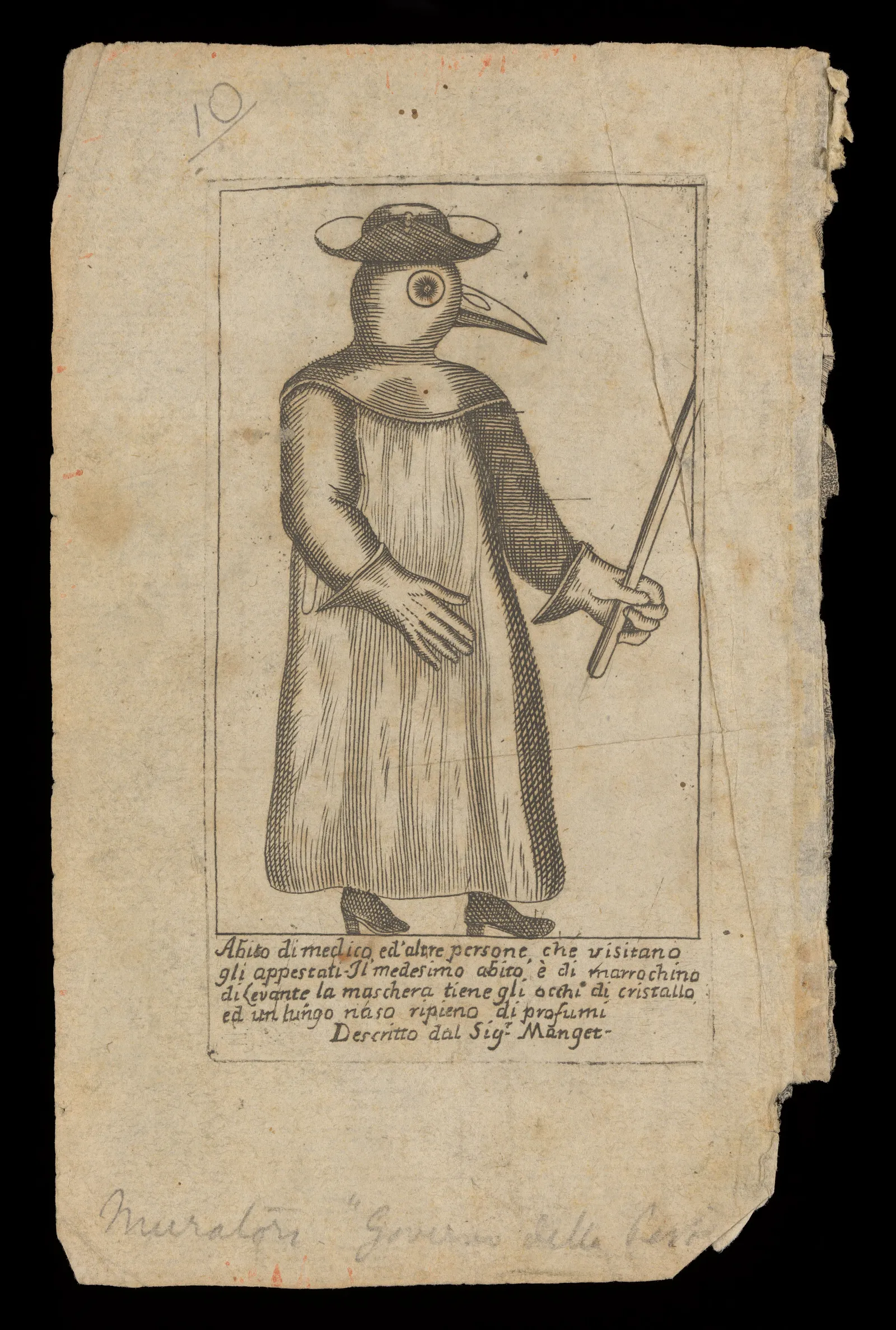
The museum says King Edward III closed London’s port too late to stop the arrival. He postponed Parliament and suspended courts. The museum quotes him blaming the “terrible pestilence of vast deadliness, daily increasing in the city of London and neighbouring parts.” Physicians who treated the wealthy worked from the theory of the four humours. Bloodletting was one treatment. Other people used herbal remedies. Anyone who could leave the city did. None of that was a cure for Y. pestis. Antibiotics were six centuries away. The long coat and beak now used as the picture of a medieval plague doctor are not in these fourteenth-century scenes. That costume is a later print, and the reasons it is weak evidence for what physicians wore are set out in what plague doctors actually wore.
Religious responses were public because the dominant explanation was divine anger. Before the pestilence reached Britain, church authorities called for sermons and processions. In September 1349, the museum says, 120 flagellants arrived in London from Europe and whipped themselves in the streets. A different gathering is pictured below. The miniature, from the same Tournai chronicle tradition, shows hooded penitents. The Latin caption transcribed with the Wikimedia file says that on the feast of the Assumption, 15 August, about 200 people came from Bruges to Tournai and performed what they called a penance. The London number and the Tournai number are two reports about one movement. They are not one crowd counted twice.
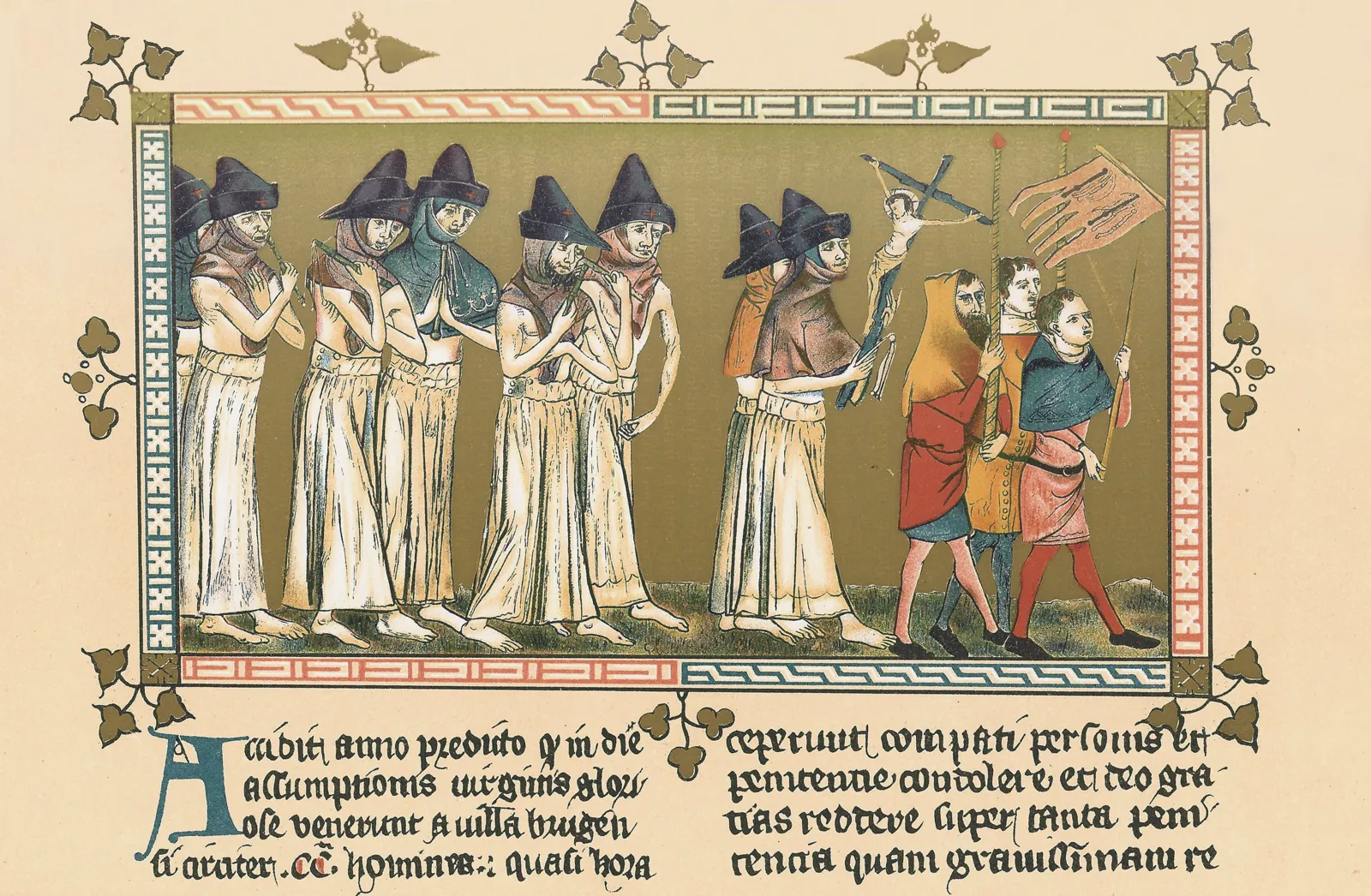
Flagellants at Tournai in 1349, a miniature from the chronicle of Gilles li Muisis, in a public-domain reproduction of the Brussels manuscript. The caption recorded with the image puts about 200 people from Bruges in the city on 15 August. It is not a picture of the group London Museum places in London the following month. Wikimedia Commons. Public domain. Resized and converted to WebP.
Quarantine, in the later sense of a timed hold on ships and goods, was built after this first wave. Eugenia Tognotti, writing in Emerging Infectious Diseases in 2013, traces the word to the Italian quaranta, forty. She dates the first quarantine to 1377 in Dubrovnik, on the Dalmatian coast, and the first permanent plague hospital, or lazaretto, to 1423, when Venice opened one on the island of Santa Maria di Nazareth. Poveglia, later used in Venice’s health system, is part of that longer quarantine history. It is not a documented burial ground of the 1348 wave, and the island’s modern ghost stories do not add a Black Death body count.
Why were Jewish communities blamed?
They were accused of poisoning wells and food. The accusation was false. People were tortured into confessions and killed anyway.
Samuel K. Cohn Jr., in Past & Present in 2007, studies the persecutions of 1348–1351. In anticipation of plague, or just after it arrived, Jews were accused of poisoning food, wells and streams. Confessions were taken under torture. Communities were rounded up and killed. Cohn describes the result, together with the migration that followed, as the near-destruction of the principal Jewish communities of the Rhineland and of many communities elsewhere. That is his judgment from German chronicles and from Hebrew memorial books. It is a historical conclusion about a real atrocity, not a folklore motif.
Cohn also records the papal response. On 26 September 1348, Clement VI issued Sicut Judeis. As Cohn reads the bull, the pope argued that Jews were dying in numbers as great as Christians, that they would not have poisoned themselves, and that Christians were dying in England, from which Jews had been expelled in 1290. The bull did not stop the killings. Cohn’s reading of the chronicles also rejects a simple picture in which a mindless crowd murdered while every ruler tried to protect. In Strasbourg, he writes, a guild government that doubted the charge was overridden, and nobles and patricians took part in forcing the burnings. The useful point for a reader is narrower than any one city’s politics: the poison charge does not survive the evidence the pope already stated in 1348, and the killings were murders committed during an epidemic, not a public-health measure.
How is this different from the Great Plague of 1665?
Same bacterium, later outbreak, different records.
Spyrou’s 2019 genomes include strains from long after 1353 and show that plague persisted and diversified in or near Europe. Some later strains lost a region of the genome that includes virulence-related genes. London Museum treats the Great Pestilence and the Great Plague of 1665 as parts of one long pandemic, and it notes that 1665 killed a smaller share of a much larger city. The seventeenth-century Bills of Mortality, the orders shutting houses, and the myth that the Great Fire ended the epidemic are a separate article: what happened in London in 1665, and why the fire did not end it.
Other famous episodes of mass distress are not this disease under another name. The dancing plague of 1518 is a documented crisis in Strasbourg. Historians argue about stress and social contagion. They are not arguing that those dancers had Y. pestis. Bones arranged in a chapel are not automatically plague victims either. Sedlec Ossuary is a Christian ossuary. Plague in medieval Central Europe does not identify the person behind any one skull.
Does plague still exist?
Yes. It is now a treatable bacterial infection, and it still kills people when treatment is late.
WHO says people often develop symptoms after one to seven days. Bubonic plague is the most common form. The fact sheet gives a case-fatality ratio of 30 to 60 percent for the bubonic type, and says untreated pneumonic and septicaemic plague are always fatal. The same page also gives a broader untreated range, 30 to 100 percent, which is a way of saying that the form of the disease changes the risk. A 2021 CDC review of treatment put the fatality of untreated bubonic plague at 66 percent and the fatality with antimicrobial treatment at 13 percent. Those CDC and WHO figures are not identical, and none of them is a medieval statistic. They describe plague in the antibiotic era and, for the untreated rates, what happens when those drugs are not given in time.
WHO says that from 2019 through 2025 most cases reported to it occurred in the Democratic Republic of the Congo and Madagascar. The CDC says plague remains a rare but persistent illness in rural areas of the western United States and in parts of Africa and Asia, and that antibiotics work if they are given quickly. The bacterium that killed people at East Smithfield is the bacterium in those modern advisories. The conditions of a medieval city are not.
What is documented, and what is still an estimate?
| Question | What the record supports | What it does not establish |
|---|---|---|
| What caused the Black Death? | Y. pestis DNA and proteins from dated mass graves, including a draft genome from East Smithfield, London, 1348–1350 | A unique medieval mutation that, by itself, explains the death rate |
| Where did that strain come from? | A 1338–1339 epidemic near Lake Issyk-Kul, with a Y. pestis strain ancestral to the pandemic’s diversification, in the extended Tian Shan | A single patient zero, or a proven Chinese starting city |
| Did a corpse catapult at Caffa start the European pandemic? | De’ Mussi, probably writing from Italy, describes corpses thrown into Caffa. Wheelis calls a local attack plausible and the European spread independent of it | An eyewitness military record, or the origin found in the 2022 genomes |
| How did it spread between people? | Modern plague spreads by fleas, animal contact and, in the pneumonic form, respiratory particles. A 2018 model favors human fleas and lice for several European outbreaks and does not exclude rats | One vector for every city in 1347–1353 |
| How many died in Europe? | WHO states more than 50 million. Benedictow calculated about 60 percent, or about 50 million. Earlier published ranges were about 20 to 30 percent, and Wheelis cited a quarter to a third | A census |
| How many died in London? | The museum’s estimate is 35,000 by 1352, more than half the city and suburbs, from cemeteries, wills and narratives. East Smithfield’s excavation recovered about 759 burials | A complete burial count for West Smithfield, or a weekly bill of the 1665 type |
| Did it kill at random? | At East Smithfield, prior frailty raised the risk of death, though less sharply than in ordinary Danish cemeteries. Rich and poor both died | A list of who was spared, or a moral ranking of the dead |
| Were Jews responsible? | No. They were accused of poisoning wells, and many were killed. Clement VI’s 1348 bull rejected the logic of the charge | A public-health rationale for the massacres |
| Is the 1665 Great Plague the same event? | It is a later outbreak of the same pandemic and the same bacterium | The same death toll, the same records, or a fire that ended either epidemic |
Frequently asked questions
Was the Black Death really bubonic plague?
It was plague, caused by Yersinia pestis. Bubonic disease, with swollen lymph nodes, is the most common form of plague now and matches symptoms medieval writers described. Septicaemic and pneumonic plague are caused by the same bacterium. No source can say what share of people in 1348 had which form.
How many people died in the Black Death?
Europe has no surviving census. WHO’s fact sheet says more than 50 million deaths in Europe. Benedictow calculated about 50 million, or about 60 percent of the population. Other published estimates have been closer to a quarter or a third. For London, the museum’s estimate is 35,000 deaths by 1352, more than half the population of the city and its suburbs, and it says that figure is reconstructed because no central death register existed.
Did rats cause the Black Death?
Rat fleas can transmit Y. pestis, and that pathway is real. A 2018 study found that human fleas and body lice fit several European mortality curves better than a rat-only model, including for the Black Death, and the authors said they had not ruled rats out. Benedictow has argued for rat fleas as the main mechanism. The responsible statement is that more than one route is biologically possible, and the balance in 1348 is still argued.
Did the Mongols invent biological warfare at Caffa?
A fourteenth-century narrative by Gabriele de’ Mussi says besiegers threw corpses into Caffa. He does not appear to have been there. A CDC journal review calls the attack plausible as a cause of plague inside the city and unlikely as the reason plague then crossed Europe. The 2022 genetic study places an earlier source epidemic in central Eurasia.
Is the Black Death the same as the Great Plague of London?
No. The Black Death is the fourteenth-century wave. The Great Plague is London’s epidemic of 1665, a later outbreak in the same long pandemic. The records, the share of the city that died, and the myth about the Great Fire all belong to that later outbreak.
Can people still catch plague?
Yes. WHO and the CDC describe it as a current bacterial disease, treatable with antibiotics if treatment starts quickly, with most recent cases reported to WHO from the Democratic Republic of the Congo and Madagascar, and with a persistent animal reservoir in parts of the western United States, Africa and Asia. Modern fatality rates are not a way of recounting the medieval dead.
Sources & further reading
- Maria A. Spyrou and colleagues, Nature, 2022: ancient Yersinia pestis from Kara-Djigach and Burana, Kyrgyzstan, and a central Eurasian source for the second pandemic
- Kirsten I. Bos and colleagues, Nature, 2011: a draft Yersinia pestis genome from East Smithfield, London, 1348–1350
- Stephanie Haensch and colleagues, PLOS Pathogens, 2010: Yersinia pestis DNA and proteins from Black Death mass graves across Europe
- Maria A. Spyrou and colleagues, Nature Communications, 2019: 34 historical Yersinia pestis genomes from the second pandemic
- Michaela Harbeck and colleagues, PLOS Pathogens, 2013: Yersinia pestis DNA from sixth-century burials and the Justinianic plague
- Katharine R. Dean and colleagues, PNAS, 2018: human fleas, body lice, and models of spread during the second pandemic
- Katharine R. Dean and colleagues, PNAS, 2018: reply on why human-ectoparasite transmission remains plausible
- Sharon N. DeWitte and James W. Wood, PNAS, 2008: whether East Smithfield deaths were selective for preexisting frailty
- World Health Organization plague fact sheet, updated 29 September 2026
- U.S. Centers for Disease Control and Prevention: About Plague, reviewed 24 August 2026
- CDC: Signs and symptoms of bubonic, septicemic and pneumonic plague
- CDC, MMWR, 2021: antimicrobial treatment of plague, including modern fatality figures
- London Museum: The Great Pestilence in London, 1348–1353
- Museum of London Archaeology monograph record: The Black Death cemetery, East Smithfield, London
- Ole J. Benedictow, History Today, March 2005: how he calculated a European death toll of about 50 million
- Mark Wheelis, Emerging Infectious Diseases, 2002: the Gabriele de' Mussi account of the siege of Caffa
- Eugenia Tognotti, Emerging Infectious Diseases, 2013: quarantine from 1377 Dubrovnik and the Venetian lazaretto of 1423
- Samuel K. Cohn Jr., Past & Present, 2007: the Black Death and attacks on Jewish communities, 1348–1351
- Wikimedia Commons: Tournai burial miniature, Pierart dou Tielt, about 1353 (public domain)
- Wikimedia Commons: flagellants at Tournai, miniature after Pierart dou Tielt, with a transcription of the Latin caption (public domain)