Lore & Explained / Games
Hellraiser’s Puzzle Box Explained: From the LeMarchand Configuration to Revival’s Genesis Configuration
Hellraiser’s LeMarchand, Lament and Genesis Configurations explained, from Barker’s 1986 novella to Revival’s October 8, 2026 game release.
Topics: Hellraiser, Clive Barker, The Hellbound Heart, LeMarchand Configuration, Lament Configuration, Genesis Configuration, Hellraiser: Revival, Cenobites, Pinhead

Steven Friederich via Wikimedia Commons (CC BY 2.0)
Clive Barker at the EMP/Sci-Fi Museum in Seattle, November 5, 2007. Photo “CliveIMG_0690” by Steven Friederich via Wikimedia Commons, licensed CC BY 2.0. Resized and recompressed. This is a creator portrait, not a Hellraiser production still.
Hellraiser has always made a puzzle box look more dangerous than a weapon. On October 8, 2026, Clive Barker’s Hellraiser: Revival turns that idea into a game mechanic.
Saber Interactive’s licensed first-person horror game gives protagonist Aidan a mysterious box called the Genesis Configuration. Official material says he must use its powers while trying to save his girlfriend Sunny from the Labyrinth, survive a bargain with Pinhead and fight enemies devoted to the Cenobites.
The name is new enough to create an obvious question:
Is the Genesis Configuration the same thing as Hellraiser’s famous Lament Configuration?
The safest answer before release is not necessarily.
Saber consistently identifies the game artifact as the Genesis Configuration and calls Revival a new story in Hellraiser canon. The public material reviewed for this article does not establish that Genesis is simply another name for the Lament Configuration, that it replaces it, or that the two objects share an identical history.
That distinction matters because the puzzle-box mythology has already changed across nearly forty years of Hellraiser stories.
It began in Clive Barker’s 1986 novella The Hellbound Heart.
The puzzle box began in The Hellbound Heart
Before Hellraiser was a film franchise, it was a novella.
Barker’s The Hellbound Heart first appeared in the 1986 anthology Night Visions 3. The official Clive Barker bibliography records a corrected manuscript dated 1986 and the Dark Harvest first edition from the same year.
The story introduces Frank, a man obsessed with experiences intense enough to overcome his boredom with ordinary pleasure.
Frank seeks a legendary mechanical puzzle named Lemarchand’s Configuration in the novella.
He does not buy it because he wants a difficult toy.
He believes solving it will open a path to experiences beyond normal human sensation.
He is right about the doorway.
He is disastrously wrong about what waits on the other side.
The beings who answer the Configuration are the Cenobites, whose understanding of pain and pleasure is so far removed from Frank’s expectations that his fantasy becomes a contract he cannot comfortably escape.
That makes the box more than a supernatural key.
It is an invitation.
And in Barker’s original story, the person solving it bears responsibility for asking what lies beyond the door.
Lemarchand’s Configuration is the novella’s name
The publisher-authorized novella preview uses Lemarchand’s Configuration, named after its maker. LeMarchand Configuration is a familiar later form of the name.
Later Hellraiser stories expanded Lemarchand’s name into an entire mythology around the box’s creator and descendants.
The core idea, however, predates that later family history.
In The Hellbound Heart, the Configuration is already an intricate mechanical object capable of opening contact with the Cenobites.
The later movies did not invent the concept of solving a puzzle to summon them.
They visualized and expanded it.
The 1987 film made the box an icon
Barker wrote and directed Hellraiser, released in 1987, adapting his own novella.
The movie gave the puzzle box the visual identity that became inseparable from the franchise: a small dark cube covered in elaborate gold patterns that changes configuration as it is manipulated.
That physical design did something the prose did not need to do.
It made the gateway recognizable from across a room.
The audience did not need a character to explain what was happening every time the box appeared. The object itself became a warning.
By the time later sequels, comics, merchandise and games expanded the franchise, the box had become almost as recognizable as Pinhead.
But the terminology also became more complicated.
Where the Lament Configuration fits
Lament Configuration became the best-known franchise name for the puzzle box associated with the Cenobites.
The original film’s score includes a cue titled “The Lament Configuration,” as listed on Christopher Young’s authorized anniversary reissue of the 1987 recordings.
Later franchise stories developed the name and the object much more explicitly.
Hellraiser: Bloodline is especially important because it turns the box’s maker into the center of a family history.
Archived production material on the official Clive Barker site shows the film building its mythology around Lemarchand, his descendants and multiple supernatural configurations. A March 1995 Fangoria interview with Doug Bradley describes an 18th-century Paris storyline about the box’s creation. Peter Atkins’s surviving fifth screenplay draft, dated May 1994, also names a later device: the Elysium Configuration. These are production accounts and draft evidence, not proof that every detail survived into the released film.
That creates an important rule for reading Hellraiser lore:
“Configuration” is not necessarily the proper name of only one object.
The franchise has used the idea for multiple designed mechanisms with different purposes.
That makes the new Genesis Configuration less strange than it first appears.
What is the Genesis Configuration?
The Genesis Configuration is the puzzle box at the center of Clive Barker’s Hellraiser: Revival.
Saber Interactive says protagonist Aidan must use it while trying to help Sunny escape the Labyrinth.
The official game page describes it as a mysterious puzzle box with unique hellish abilities.
Unlike the earliest version of Barker’s puzzle, which is primarily something to solve and thereby make contact with the Cenobites, Genesis is also an active gameplay tool.
Pre-release material says its powers include abilities such as:
- telekinesis;
- pyrokinesis;
- the franchise’s Hell Chains;
- changes to parts of the Labyrinth;
- puzzle-solving and environmental interaction.
That is a major mechanical change.
The box is no longer only the thing that starts the nightmare.
It is something the player carries through the nightmare.
Is Genesis the same box as the Lament Configuration?
Official pre-release material does not give us enough evidence to say that.
Saber calls it the Genesis Configuration.
That may eventually be explained as:
- a separate Configuration;
- a related device;
- a variant of an older design;
- a renamed version with a specific history;
- or something more complicated revealed during the game.
Until the story establishes the relationship, the responsible answer is to preserve the names the source uses.
LeMarchand Configuration is a familiar form of the name rooted in the novella’s Lemarchand’s Configuration.
Lament Configuration is the franchise’s famous name for the classic Cenobite puzzle box.
Genesis Configuration is the specifically named box in Hellraiser: Revival.
Those labels should not be collapsed just because all three labels belong to the same franchise mythology.
Why “Configuration” matters
The word configuration describes arrangement.
That is a perfect word for Barker’s central object because the horror depends on transformation through manipulation.
A person does not simply possess the box.
They rearrange it.
That interaction creates the sense that the user participates in opening whatever comes next.
Later franchise mythology pushed that idea further by introducing Configurations designed for different ends.
In the archived May 1994 fifth draft of Bloodline, an Elysium Configuration is intended to trap the forces connected with the earlier box.
Revival now gives Genesis powers that can alter the environment and function in combat.
The underlying idea remains consistent even when the rules change:
geometry has consequence.
The box is not simply a key to “Hell”
It is easy to describe the Configuration as a box that “opens Hell.”
That shorthand is useful but loses part of Barker’s original strangeness.
The Cenobites in The Hellbound Heart are not introduced as ordinary Christian demons waiting in a conventional biblical Hell.
They are beings devoted to extremes of sensation, and Frank’s mistake is assuming their promise of pleasure means what he wants it to mean.
The later movies increasingly use the language and imagery of Hell, demons, damnation and a Labyrinth.
Revival openly calls its setting the Labyrinth and places Pinhead and the Cenobites inside a hellish cosmology.
But the franchise’s oldest idea is more unsettling than a simple cursed key:
the box answers desire.
A person wants to know what is on the other side.
The Cenobites answer.
Barker’s box is fictional
There are real mechanical puzzle boxes.
There is no evidence that solving one opens a supernatural dimension or summons Cenobites.
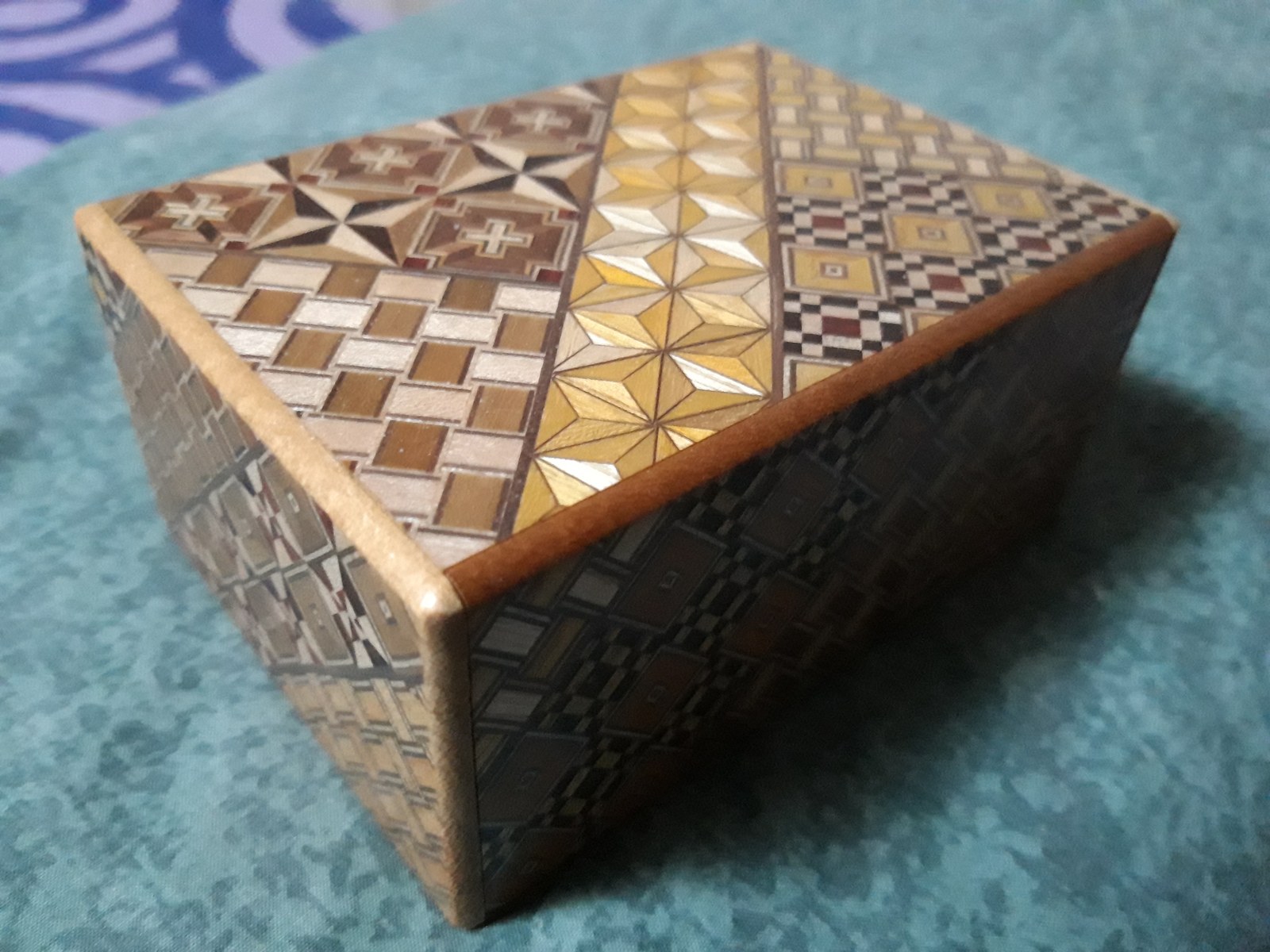
A real closed Japanese yosegi mechanical puzzle box. This is contextual imagery: not a Hellraiser prop, not the LeMarchand, Lament or Genesis Configuration, not evidence of occult powers, and not a documented Barker inspiration. © Eugene Alvin Villar, 2021, via Wikimedia Commons, licensed CC BY-SA 4.0. Resized and recompressed; the image remains available under the same license.
The distinction is worth making because fictional occult objects often acquire false histories online. Morbid Index’s Necronomicon explainer traces a different example of that fiction-to-occult confusion.
A replica of the Lament Configuration can be a collectible.
A real puzzle box can be an intricate piece of craftsmanship.
Neither becomes paranormal because Hellraiser uses puzzle-solving as a doorway to horror.
This article also does not claim that Japanese puzzle boxes inspired Barker’s design. The image above illustrates real-world puzzle-box mechanics, not a documented creative source for The Hellbound Heart.
Why Revival turns the box into a weapon
Games require repeated interaction.
A movie can build an entire sequence around a character slowly solving one puzzle.
A first-person action-horror game needs systems the player can use again and again.
The Genesis Configuration solves that design problem by taking an object traditionally associated with summoning and consequence and making it part of moment-to-moment survival.
That creates a thematic risk for Hellraiser.
If the box becomes only a superpower dispenser, it loses the danger that made it compelling.
Saber’s official description suggests the game knows that.
Aidan is not simply given magical abilities with no cost. He has entered a bargain with Pinhead, triggered a ritual and is navigating a world controlled by Cenobite logic.
The interesting question is therefore not only what Genesis can do.
It is what using it ultimately costs.
That answer should come from the finished game rather than pre-release speculation.
Does Revival belong to Hellraiser canon?
Saber explicitly calls Revival “A New Story in Hellraiser’s Canon.”
The official site names Lament GameCo, LLC as the video-game licensee of rights granted by Clive Barker and Park Avenue Entertainment, LLC. That company name does not establish that Genesis and Lament are the same fictional object.
That makes this an authorized new Hellraiser story, not a fan game or unofficial reinterpretation.
It still does not mean every previous film, comic, novel and game has been merged into one perfectly consistent continuity.
Hellraiser has accumulated different versions of its mythology over decades.
Canon claims are safest when kept specific to the work making them.
For Revival, the clearest statement is that the game presents its own licensed canonical story built around Aidan, Sunny, Pinhead, the Labyrinth and the Genesis Configuration.
Doug Bradley’s Pinhead returns
Another link to the earlier films is Doug Bradley, who returns as Pinhead in the game.
Bradley originated the role in Barker’s 1987 film and played the character across multiple sequels.
That does not automatically make Revival a direct chronological sequel to every Bradley film.
It does make his performance a deliberate connection to the franchise’s screen history.
The game’s puzzle box works similarly: familiar enough to signal Hellraiser, new enough to carry its own name and mechanics.
What Revival changes — and what it keeps
Based on official pre-release material, the Genesis Configuration changes the role of the box in several ways.
It is:
carried and used during combat and exploration.
used actively rather than only solved at a threshold moment.
connected to combat powers.
used to alter or navigate the Labyrinth.
But it keeps the franchise’s core relationship between puzzle-solving and dangerous access.
Aidan uses the box because he needs something from the world beyond ordinary reality.
That is exactly the kind of transaction Hellraiser has always distrusted.
The Configuration timeline, simplified
For readers trying to keep the names straight:
1986 — Lemarchand’s Configuration
Clive Barker’s The Hellbound Heart introduces the puzzle that brings Frank into contact with the Cenobites.
1987 — Hellraiser
Barker adapts the novella and the puzzle box becomes a visual horror icon. “Lament Configuration” becomes the franchise’s best-known label for the classic box.
1996 — Bloodline expands the box mythology
Hellraiser: Bloodline builds a larger history around Lemarchand and his descendants. Its production archive preserves a May 1994 screenplay draft that names an Elysium Configuration; draft details should not automatically be treated as finished-film canon.
2026 — The Genesis Configuration
Clive Barker’s Hellraiser: Revival introduces Genesis as Aidan’s supernatural puzzle box and gives it active powers used in combat, exploration and manipulation of the Labyrinth.
That is the documented evolution.
The exact in-universe relationship between Genesis and the classic Lament Configuration should be left to the game unless Saber or the creators define it more explicitly.
What is confirmed before the October 8 release?
As of October 3, 2026, Saber has confirmed:
- Clive Barker’s Hellraiser: Revival releases October 8, 2026;
- Aidan is the playable protagonist;
- Sunny is the person he is trying to save;
- Pinhead and the Cenobites are central to the story;
- the Genesis Configuration is the game’s supernatural puzzle box;
- the box has active powers rather than functioning only as an opening mechanism;
- Saber describes the game as a new story in Hellraiser canon.
What is not safe to declare from the public material alone:
- that Genesis and Lament are literally the same physical object;
- that Genesis replaces Lament in all continuity;
- that every earlier film’s box history applies unchanged to the game;
- the final cost or complete rules of the Genesis Configuration.
Those are questions the released story can answer.
Frequently Asked Questions
What is the puzzle box in Hellraiser called?
In Clive Barker’s 1986 novella The Hellbound Heart, the publisher-authorized preview names the puzzle Lemarchand’s Configuration, also familiar as the LeMarchand Configuration. The classic film-franchise box is widely known as the Lament Configuration.
What is the Genesis Configuration?
The Genesis Configuration is the named puzzle box in the 2026 game Clive Barker’s Hellraiser: Revival. Saber says protagonist Aidan uses its supernatural powers while navigating the Labyrinth and fighting enemies connected to the Cenobites.
Is the Genesis Configuration the Lament Configuration?
The official pre-release sources reviewed here do not establish that they are the same physical object. They should be treated as separately named Configurations unless the game clarifies their relationship.
What does the Genesis Configuration do?
Pre-release material describes powers including telekinesis, pyrokinesis, Hell Chains, environmental manipulation and puzzle-solving functions.
Did Clive Barker invent the Hellraiser puzzle box?
Yes. The supernatural puzzle that became the foundation of Hellraiser originates in Barker’s novella The Hellbound Heart.
Is the Hellraiser puzzle box based on a real occult object?
No documented evidence reviewed for this article establishes the LeMarchand or Lament Configuration as a real occult artifact. It is fictional.
Are real puzzle boxes connected to Cenobites?
No. Mechanical puzzle boxes are real objects and crafts. Cenobites and supernatural Configurations belong to Hellraiser fiction.
Does Hellraiser: Revival release in 2026?
Yes. Saber Interactive lists October 8, 2026 as the release date.
Is Hellraiser: Revival official canon?
Saber’s official site describes it as a new story in Hellraiser’s canon and identifies the relevant Hellraiser and The Hellbound Heart material as officially licensed for video games.
Sources & further reading
- Clive Barker, The Hellbound Heart (1986): publisher-authorized HarperCollins preview, 2009 edition, page 11
- Official Clive Barker site: The Hellbound Heart bibliography
- Saber Interactive: Clive Barker’s Hellraiser: Revival
- Saber Interactive: Hellraiser: Revival announcement, July 22, 2025
- Saber Interactive on Steam: Genesis Configuration abilities, May 20, 2026
- Christopher Young / Lakeshore Records: Hellraiser anniversary score and track list
- Gematsu: Hellraiser: Revival launches October 8
- Official Clive Barker site: Hellraiser IV — Bloodline archive
- The Guardian: How we made Hellraiser
- Wikimedia Commons: CliveBarker.jpg
- Wikimedia Commons: Japanese puzzle box (yosegi) - closed





_-_closed.jpg)