Lore & Explained
Jorogumo Explained: Japan's Spider Woman and Her Changing Legends
Jorogumo is more than a spider-woman with one fixed origin. Explore historical artwork, waterfall legends and the uncertain source of a familiar story.
Topics: Japanese Folklore, Yokai, Jorogumo, Monsters
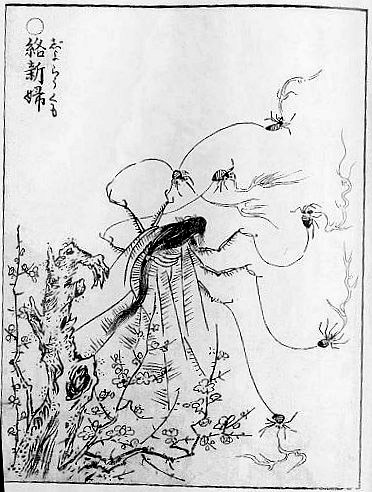
Toriyama Sekien, from Gazu Hyakki Yagyo, 1776 (Public Domain)
Jorogumo is a supernatural spider-woman figure in Japanese folklore and art. The name appears in older sources, but the familiar modern summary of a beautiful woman luring men to their deaths is not a complete, fixed biography. Different pictures and stories give the spider different roles.
That is part of her appeal. The danger can begin with a woman, a dream, a waterfall or something as small as a strand of silk. The uncertainty about what the person is seeing often does more work than a spectacular transformation.
An old figure, not one unchanging story
Toriyama Sekien included Jorogumo in Gazu Hyakki Yagyo, first published in 1776. The National Diet Library’s record of the collected English edition identifies that volume among Sekien’s four illustrated supernatural collections.
The surviving Jorogumo image joins a robed female figure with unmistakably arachnid elements. It is a striking image to encounter before reading any accompanying modern explanation: the ordinary shape of a person and the shape of a spider are made difficult to separate.
An illustration can establish that an artist represented the figure in a particular way. It cannot supply a missing paragraph of narrative. A viewer may imagine what happens next, but that imagined scene should not quietly become something Sekien supposedly wrote.
The distinction becomes especially useful when an online account gives the creature a precise age, a universal hunting method and an elaborate set of powers without naming the text those details come from. Some may belong to particular retellings. They do not automatically belong to every jorogumo.
The biwa story has a source problem
A widely circulated version describes a beautiful spider-woman who plays a biwa, captivates a man with the music, binds him and eats him. That exact combination received unusually thorough scrutiny in a Doshisha University library reference investigation.
The library’s 2008 inquiry found older spider stories and related musical-entrapment tales, but could not locate the precise version requested. Its notes distinguish different instruments, characters and endings. Finding a story about a spider and music did not establish a match for every element of the modern account.
This is not proof that nobody ever told the biwa version. It is a reason not to call it a securely identified Edo-period original. The more accurate description is a familiar retelling whose exact historical source remains uncertain in that investigation.
That leaves plenty of room for the story as a story. It simply changes the label attached to it.
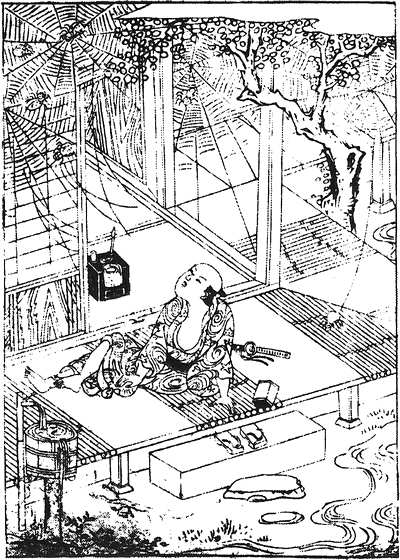
Jorogumo depicted in Taihei Hyakumonogatari*, a separate historical print from Sekien’s — a different artist’s treatment of the same named figure, showing webs strung across a veranda around a seated man. Source. Public domain.*
Why a waterfall belongs in the legend
Joren Falls on the Izu Peninsula provides a different setting for spider folklore. A firsthand visitor’s account from 2014 recounts a tale associated with the falls in which spider silk threatens to drag a person into the water. Transferring the thread to nearby wood allows the person to escape while revealing the force behind it.
That account documents a travel writer’s retelling, not an archival proof of the event. Its value here is the contrast with the musical seductress story. The menace is tied to a pool and a nearly invisible connection between something small and something dangerously strong.
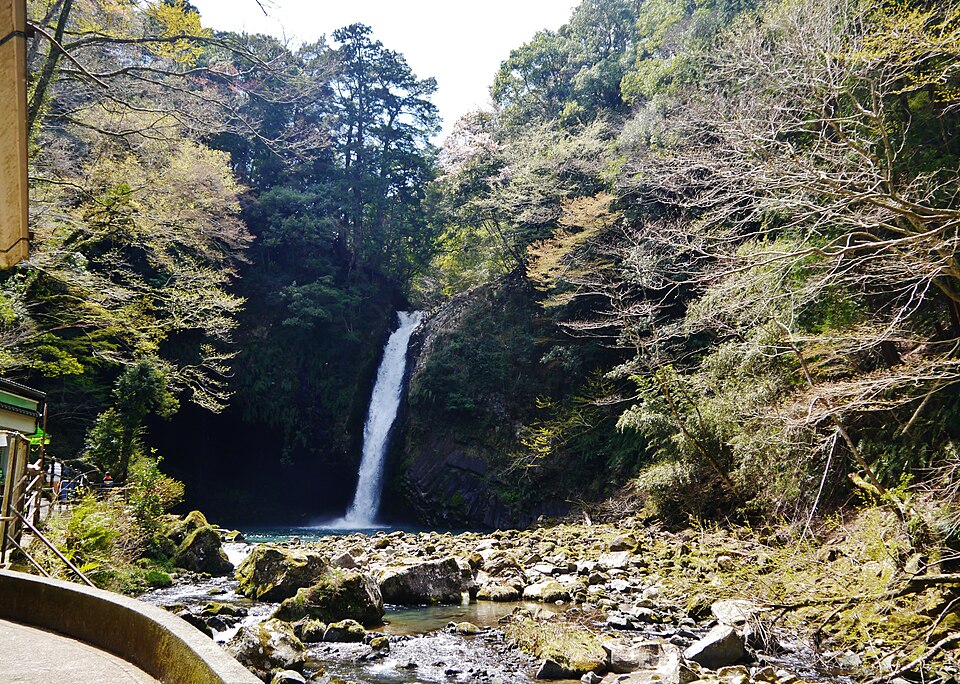
Joren Falls, on the Izu Peninsula in Shizuoka Prefecture, the setting for a local legend in which spider silk pulls a visitor toward the water. Source. Licensed CC BY-SA 4.0.
In this kind of encounter, the spider does not need to become a giant monster in front of the witness. The pull of the thread makes the hidden danger legible. A person survives by noticing the connection before the water takes them.
The setting changes the horror. In a room, attention may be caught by music or a human disguise. At a waterfall, the eye follows the thread toward a place whose depths remain unseen. Those are different narrative mechanisms, even when a modern encyclopedia files both under the same name.
What makes the spider-woman frightening?
A spider already offers a ready-made language for suspense: a trap that can be difficult to see, a structure built around a victim’s movement, and a hunter that may wait rather than pursue. Combining those features with a human appearance makes recognition itself the problem.
The reader knows that the encounter may not be what it seems. The person inside the story does not necessarily have that advantage. Every apparently ordinary action can then acquire a second meaning: hospitality might be an invitation into a trap; an attractive performance might hold attention while something else happens unnoticed.
This is an interpretation of the stories’ effect, not a claim that all spider-woman tales were invented to teach one historical lesson. A folklore figure does not need a single social purpose to remain recognizable across different stories.
The distinction also leaves room for retellings that are more ambiguous than a straightforward attack. A dream, illusion or unsettling appearance can work without ending in a meal.
Not every Japanese spider monster is Jorogumo
A giant spider in a Japanese print should not be identified from its appearance alone. The artwork may depict a different named being, such as the earth-spider figure tsuchigumo, a theatrical scene, or an episode with its own characters. The title and collection description are better guides than a resemblance to modern fantasy artwork.
Likewise, the half-woman, half-spider body familiar from some modern illustrations is a design choice, not a requirement that every older image must satisfy. Sekien’s composition is worth looking at on its own terms rather than treating it as an unfinished version of a contemporary creature design.
This is the same distinction that helps with Yuki-Onna: a recognizable name can gather different accounts without acquiring one compulsory set of rules.
Where to begin with Jorogumo
Start with an identified historical image, then read a named version of a story. That approach keeps the attractive uncertainty of the figure while avoiding a false certainty about her origins.
The strongest thread connecting the material is not a precise age or a guaranteed method of killing. It is the possibility that a small, ordinary-looking thing has already drawn a person into a relationship they do not understand. By the time the thread becomes visible, the trap may already be there.
Sources & further reading
- Doshisha University Imadegawa Library: reference investigation into the Jorogumo biwa story, 2008
- National Diet Library: Japandemonium Illustrated bibliographic record and original publication dates
- Wikimedia Commons: Toriyama Sekien Jorogumo print and source metadata
- Tokyobling: firsthand Joren Falls visit and associated folklore retelling, August 4, 2014