Lore & Explained
Oni Explained: Japan's Demons, Ogres and Bean-Throwing Tradition
What are oni in Japanese folklore? Horns, clubs and Setsubun tell only part of the story of figures that can be terrifying, comic or easily outwitted.
Topics: Japanese Folklore, Oni, Yokai, Demons
The Metropolitan Museum of Art (Public Domain)
Oni are powerful supernatural figures in Japanese folklore and art, often translated as demons or ogres. Horns, a large body, a club and fierce red or blue features make a familiar image, but they do not describe every oni in every setting. Some are terrifying opponents. Others become comic, frightened or surprisingly small.
The translation matters. “Demon” can make an English-language reader imagine a Christian fallen angel, while “ogre” suggests a particular sort of fairy-tale brute. Neither word supplies the whole Japanese context. The safest starting point is the story, artwork or observance in which the oni appears.
How to recognize the familiar oni image
A horned head, exaggerated teeth and a heavy club create an immediate impression of force. Tiger-patterned clothing and boldly colored skin also belong to familiar representations discussed in Nippon.com’s account of Setsubun.
Those details work as a visual language. The viewer does not need an accompanying biography to understand that a figure with a club may be dangerous. At the same time, an artist can exaggerate those features until the danger becomes comic.
A mask is a good example of the difference. On a threatening figure, horns can suggest an adversary. Worn during a family observance, the same basic shape can become a role someone temporarily plays. The recognizable image survives even when the emotional register changes completely.
Color alone is not a reliable classification system. A red oni and a blue oni do not automatically belong to separate species with fixed powers. A modern game may make that distinction for its own purposes; it should not be mistaken for a rule governing the full tradition.
Why people throw beans at Setsubun
Setsubun marks a seasonal turning point before the traditional beginning of spring. In the observance commonly described today, roasted beans are thrown while participants call for oni to leave and good fortune to enter. The Nippon.com festival guide describes domestic as well as shrine and temple celebrations.
The point is not that a real creature has been trapped in a house. It is a ritualized rejection of misfortune and an invitation to a better season, expressed through an encounter with a recognizable figure.
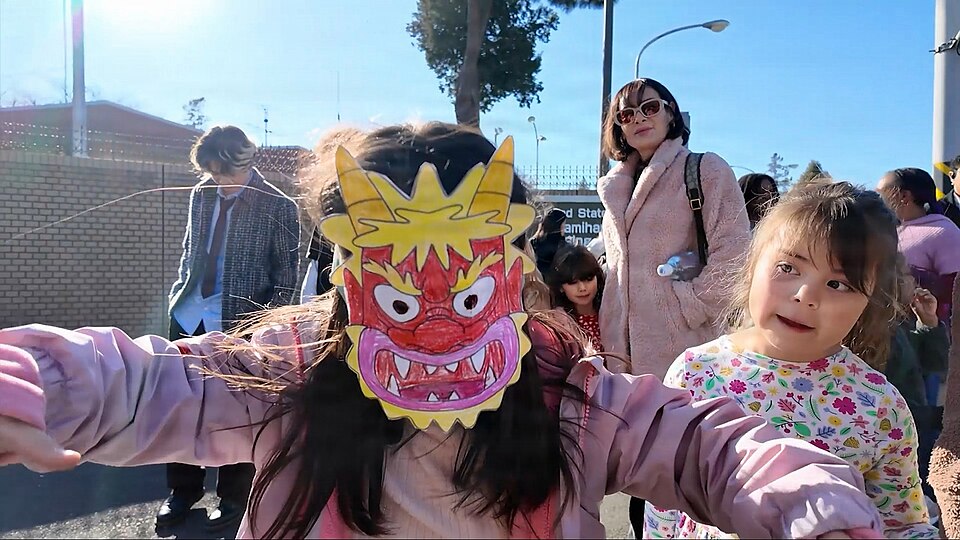
A homemade paper oni mask worn at a Setsubun bean-throwing event — the familiar horned face reused as a family activity rather than a monster to be feared. Source. Public domain.
It also helps explain why an oni can be both frightening and familiar. The figure is not confined to a remote haunted place. It can appear in a household performance where everyone knows the part it is expected to play.
The date is often described casually as February 3, but it can shift. That makes “before the traditional beginning of spring” a better explanation of the observance than treating one modern calendar date as its entire meaning.
Shoki and the oni he overpowers
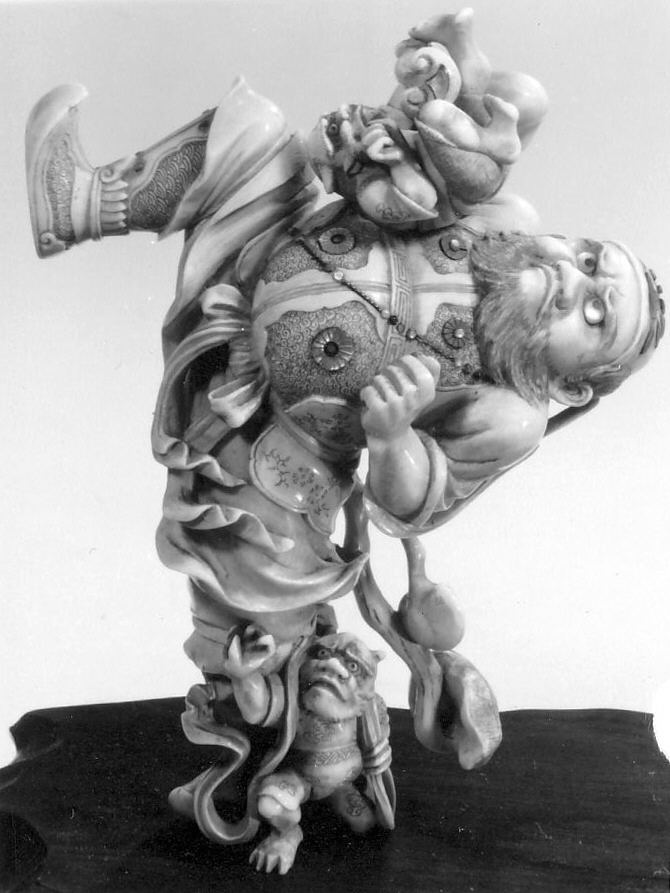
Two objects at the Metropolitan Museum of Art offer a different way into the subject. A late nineteenth-century sculpture, Standing Figure (Shoki) with Two Demons (Oni), places the demon-queller and his opponents together in one compact composition.
Another object, Shoki Comes to Life from a Hanging Scroll, turns the protective figure into an event: Shoki emerges from an image as an oni reacts. The museum identifies the small carving as a netsuke and dates it to the first half of the nineteenth century.
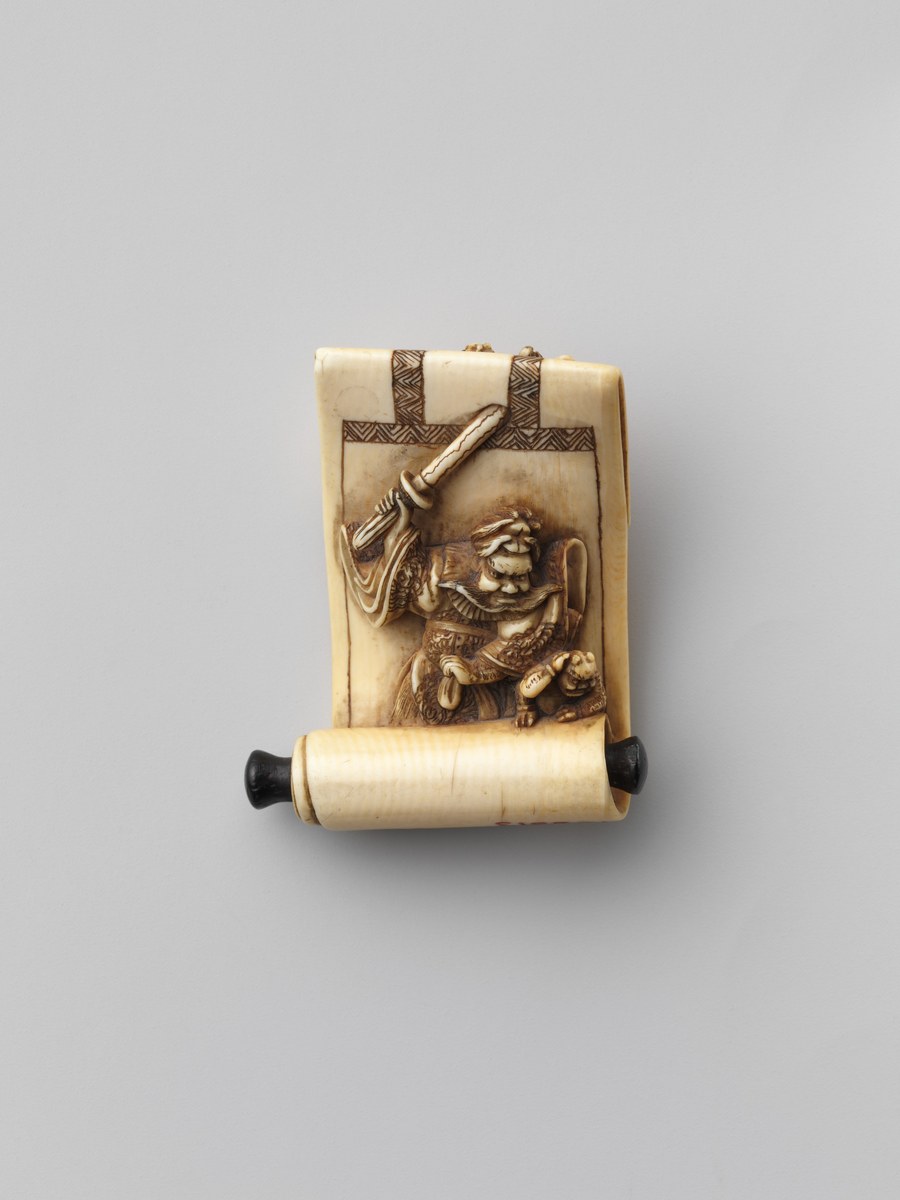
A netsuke carved in the shape of a hanging scroll, showing Shoki raising his sword as an oni cowers below him, first half of the 19th century. Source. Public Domain.
The reversal is part of the pleasure of the scene. A being that might normally frighten a human has something to fear itself. The artist can make the viewer enjoy that change in status without denying the oni’s recognizable identity.
That is a broader range than “evil monster.” In one context, an oni embodies a threat; in another, it is the target of someone else’s power. A collection of stories or images can use both roles without being inconsistent.
Are oni the same as yurei?
Not in ordinary use. A ghost story generally raises a question about the dead and their relationship to the living. An oni does not have to be the returning spirit of a particular deceased person.
That difference is useful when comparing images. An artist may give both figures frightening faces, but the narrative questions are different. With a ghost, we may ask who has returned and why. With an oni, we may ask what sort of force the figure represents, whom it threatens, or how it can be overcome.
The terms are not a scientific family tree. Japanese supernatural language has a long and varied history, and a specific text can complicate any introductory definition. Our guide to yurei and onryo looks more closely at ghost stories centered on attachment and resentment.
Why “Japanese demon” can mislead
Calling an oni a demon is not automatically wrong. The problem begins when the translation imports details that the source never supplied: a fall from Heaven, a place in a hierarchy ruled by Satan, or the assumption that every encounter must involve possession.
Compare an oni in a Setsubun scene with a spirit listed in a European grimoire. The two images may both look alarming, but they arise from different practices and kinds of writing. A shared English label does not erase those differences.
The distinction also protects the variety within Japanese material. Folklore, ritual, theater and a modern character design are not interchangeable sources, even when all four use the same familiar horns.
What horror gains by keeping that variety
A large, violent opponent creates one kind of suspense: can the protagonist survive its force? A comic oni introduces another possibility: apparent power may be vulnerable to humiliation, intelligence or a stronger protector.
The Met’s small carvings make that shift visible. They reward looking at relationships between figures, not simply isolating the monster’s face. Who is advancing? Who is shrinking back? Where has the artist placed the viewer’s sympathy?
Those questions are useful when approaching contemporary adaptations as well. A story can make an oni monstrous, sympathetic or ridiculous. None of those choices alone tells us what all earlier stories meant.
Oni remain recognizable because the imagery is strong. They remain interesting because the imagery does not lock them into a single role.

.jpg)