Lore & Explained
Yuki-Onna Explained: Japan's Snow Woman and the Broken Promise
Who is Yuki-Onna? Explore the snow woman through Lafcadio Hearn's Kwaidan, from a deadly winter encounter to the promise that destroys a family.
Topics: Yuki-Onna, Japanese Folklore, Yokai, Kwaidan, Lafcadio Hearn
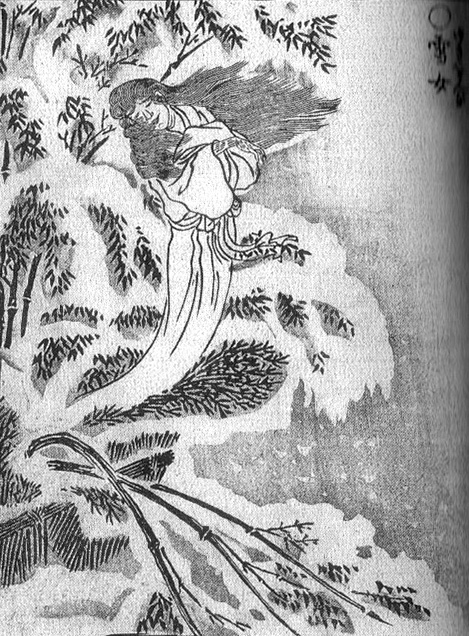
Toriyama Sekien, from Konjaku Hyakki Shui, 1781 (Public Domain)
Yuki-onna means “snow woman”: a supernatural female figure in Japanese storytelling, associated with winter and dangerous encounters in snow. One particularly influential version appears in Lafcadio Hearn’s Kwaidan (1904). In it, the woman who nearly kills a young woodcutter later becomes his wife, and an old promise makes their shared life impossible.
That story is an excellent introduction, but it is not a universal biography of every yuki-onna. Hearn himself describes the account as a village legend told to him, not an incident he witnessed. The discussion below follows his published version and reveals its ending.
Where Hearn says the story came from
In the preface to Kwaidan, Hearn says that a farmer from Chōfu in Musashi province told him “Yuki-Onna” as a legend of the farmer’s native village. He also says he did not know whether that particular account had been written down in Japanese.
Those statements give the story a traceable publication context while leaving limits around its earlier history. They do not establish that Hearn invented the snow woman. Nor do they allow us to reconstruct an unchanged story extending back to a precise ancient date.
The distinction is useful when a retelling confidently supplies a single origin, such as a particular woman who died in the snow. Such a version needs its own source. Hearn’s tale does not begin with a human death explaining how the snow woman was created.
The two woodcutters in the storm
Hearn introduces Mosaku, an older woodcutter, and Minokichi, his eighteen-year-old apprentice. A severe storm prevents their normal return home, and they shelter in a ferryman’s hut.
During the night, Minokichi sees a woman dressed in white. She bends over Mosaku, whose death is connected in the story with her freezing breath. She then turns to the younger man.
Instead of killing him, she decides to spare him. The reprieve has a condition: he must never tell anyone what he has seen. The command converts a frightening night into a danger that can follow him into the rest of his life.
The storm ends, and the ferryman finds the young man beside Mosaku’s frozen body. Minokichi is cared for and eventually returns to work. He remains uncertain about how to understand what he saw, but he keeps the encounter secret.
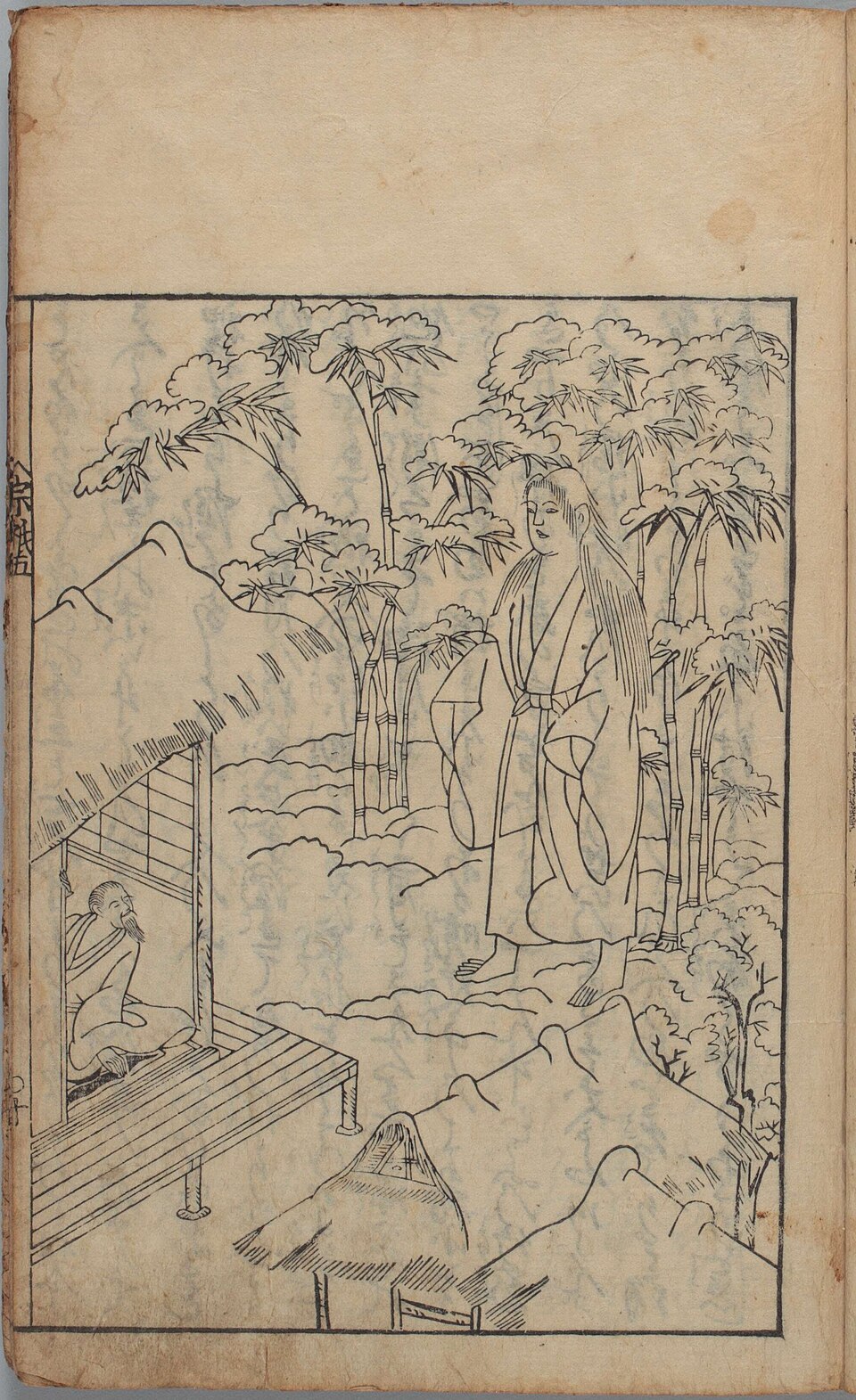
A traveler approaches a roadside hut in this 17th-century woodblock illustration — the same basic setting of shelter, snow and an uninvited visitor found in Hearn’s tale, though this particular print illustrates an unrelated story. Source. Public domain (CC0).
Who is O-Yuki?
During the following winter, Minokichi meets a young woman on the road. She calls herself O-Yuki. Their conversation becomes a visit to his home, and she eventually stays as his wife.
The story does not immediately present domestic life as another attack. O-Yuki is loved by Minokichi’s mother, and the couple have ten children. She remains remarkably youthful while years pass. The reader can recognize that detail as uncanny before Minokichi fully understands its significance.
That long interval matters. The snow woman is not merely a disguise worn for a few minutes to lure a victim. Hearn lets her become part of an actual household within the fiction. Whatever else she is, she has relationships that complicate the threat she once made.
What breaks the promise?
One night, Minokichi watches his wife sewing by lamplight. Her appearance reminds him of the woman he saw in the hut, and he begins to tell the story. O-Yuki asks him about her, and he describes the night he had promised never to discuss.
O-Yuki then reveals that she was the woman in the snow. He has told his secret to the very being who forbade him to speak of it.
This is not a matter of an outsider discovering her identity and forcing an explanation. The recognition happens through intimacy: a husband sees a resemblance in his wife’s face and shares a memory. What might ordinarily bring two people closer instead exposes the impossible condition beneath their marriage.
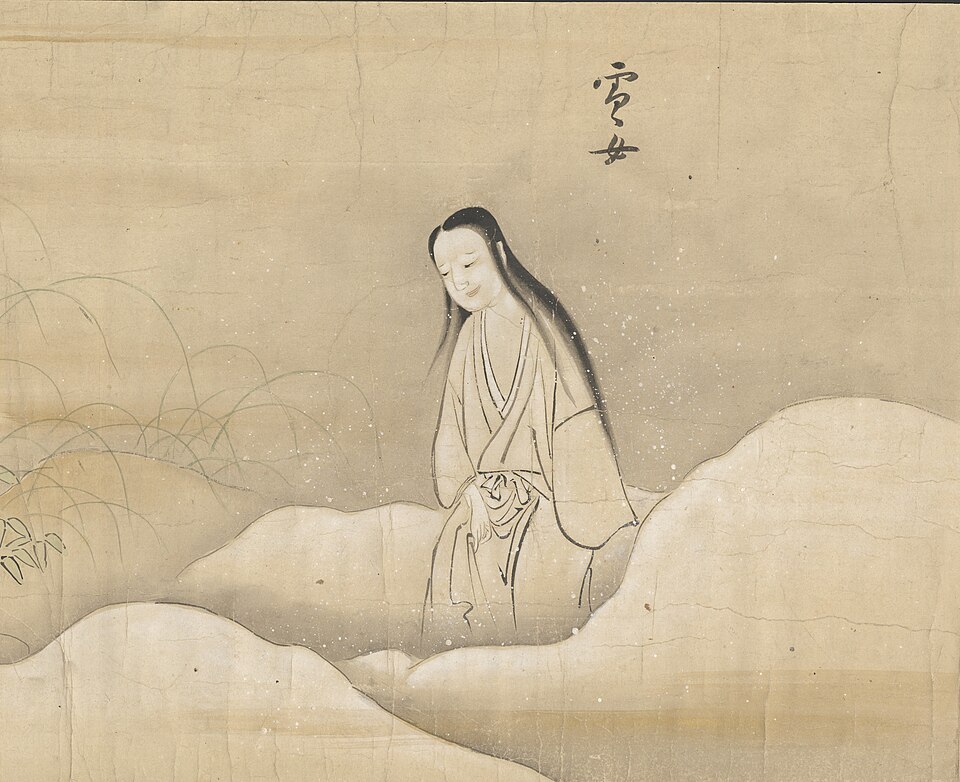
A painted yuki-onna figure, labeled with the characters for “snow woman,” from a Japanese scroll of supernatural beings. Source. Public domain (CC0).
Why does she spare him again?
O-Yuki says she would kill him, but their children prevent her from doing so. She warns him to take good care of them, then dissolves into white mist and disappears. Hearn’s account says she is not seen again.
She does not kill the children, and she does not simply forgive the broken promise and remain at home. The ending removes her while leaving Minokichi with a responsibility toward the family they made.
Her mercy also prevents a flat explanation that she is incapable of attachment. The warning is frightening, but it explicitly concerns the children’s welfare. The same figure can cause death, offer reprieve, sustain a household and finally abandon it. Reducing her to a list of ice attacks misses the part of the story that makes the ending painful.
Is Yuki-Onna a ghost or a yokai?
“Yokai” is a useful broad label for this sort of supernatural figure, but it should not encourage readers to imagine a biological species with standardized powers. Calling the snow woman a ghost can also imply an origin as a particular dead human that a given story may never supply.
In Hearn’s version, the important facts are what she does and the identity she reveals. Her full origin remains outside the tale. The story does not need a genealogy or a detailed explanation of her powers to make the encounter work.
That makes her different from a ghost narrative centered on a named person’s grievance after death. For that distinction, see yurei and onryo. The terms help compare traditions; they should not erase the individual stories.
The horror after the snow has melted
The opening danger is easy to understand: two people are trapped in a winter storm. The deeper disturbance arrives years later, when the survivor discovers that the threat has been sharing his home.
Yet the wife is not only the threat. She is also the person whose loss changes that home. Hearn’s version keeps both truths in play, leaving an ending about fear, secrecy and attachment rather than a clean victory over a monster.
That is why the promise deserves as much attention as the freezing breath. The snow woman can leave the storm behind. The condition under which she spared Minokichi cannot be left there with it.