Lore & Explained / Literature
The King in Yellow Explained: The Book, the Play and Carcosa
What is The King in Yellow? Separate Robert W. Chambers's real collection from its fictional forbidden play, and understand Carcosa and the Yellow Sign.
Topics: The King in Yellow, Robert W. Chambers, Carcosa, Cosmic Horror
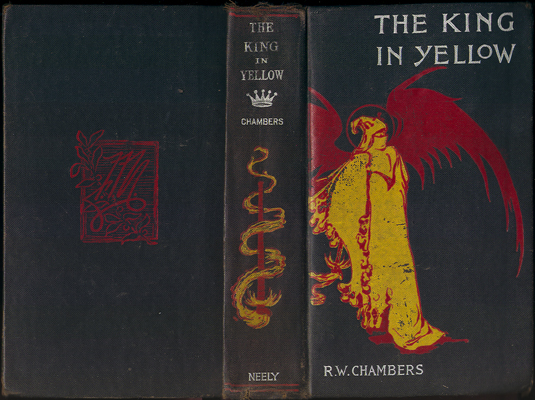
F. Tennyson Neely, 1895 (Public Domain)
The King in Yellow is a real collection of stories by Robert W. Chambers, published in 1895. Inside the collection, it is also the title of a fictional play whose contents can shatter the lives of people who read it. The King, Carcosa and the Yellow Sign belong to that deliberately incomplete fictional world.
The distinction solves much of the confusion. You can read Chambers’s book. You cannot recover the complete supposedly forbidden play from it, because Chambers gives fragments and references rather than a full script.
Spoilers follow for the collection’s supernatural stories.
What is actually in the book?
Chambers’s collection contains ten stories. The opening four, “The Repairer of Reputations,” “The Mask,” “In the Court of the Dragon” and “The Yellow Sign,” are the core reading for the mysterious play and its effects. The whole volume is not a single continuous novel about a monster in a yellow robe.
That difference can surprise someone who comes to the book through modern artwork. The collection shifts in subject and tone, including stories whose concerns are much closer to romance and the lives of artists.
The unevenness of its connection to the King is part of the actual book, not a missing chapter. A useful first reading can concentrate on the opening four stories, while remembering that they sit inside a broader collection.
The forbidden play inside the stories
The fictional King in Yellow is a work whose reputation and fragments travel between characters. Its later act is associated with a devastating revelation, but readers of Chambers’s collection are never given a complete explanation of what that revelation contains.
Instead, the book creates effects around an absence. People read, recognize, dream and become frightened. A small quotation or a reference to a place carries more weight because it seems to point toward a much larger text just outside our view.
That is not the same technique as describing a cursed book’s rules in detail. There is no reliable manual telling a character which page is safe or exactly how the danger operates. Chambers leaves room for uncertainty about perception, obsession and supernatural intrusion.
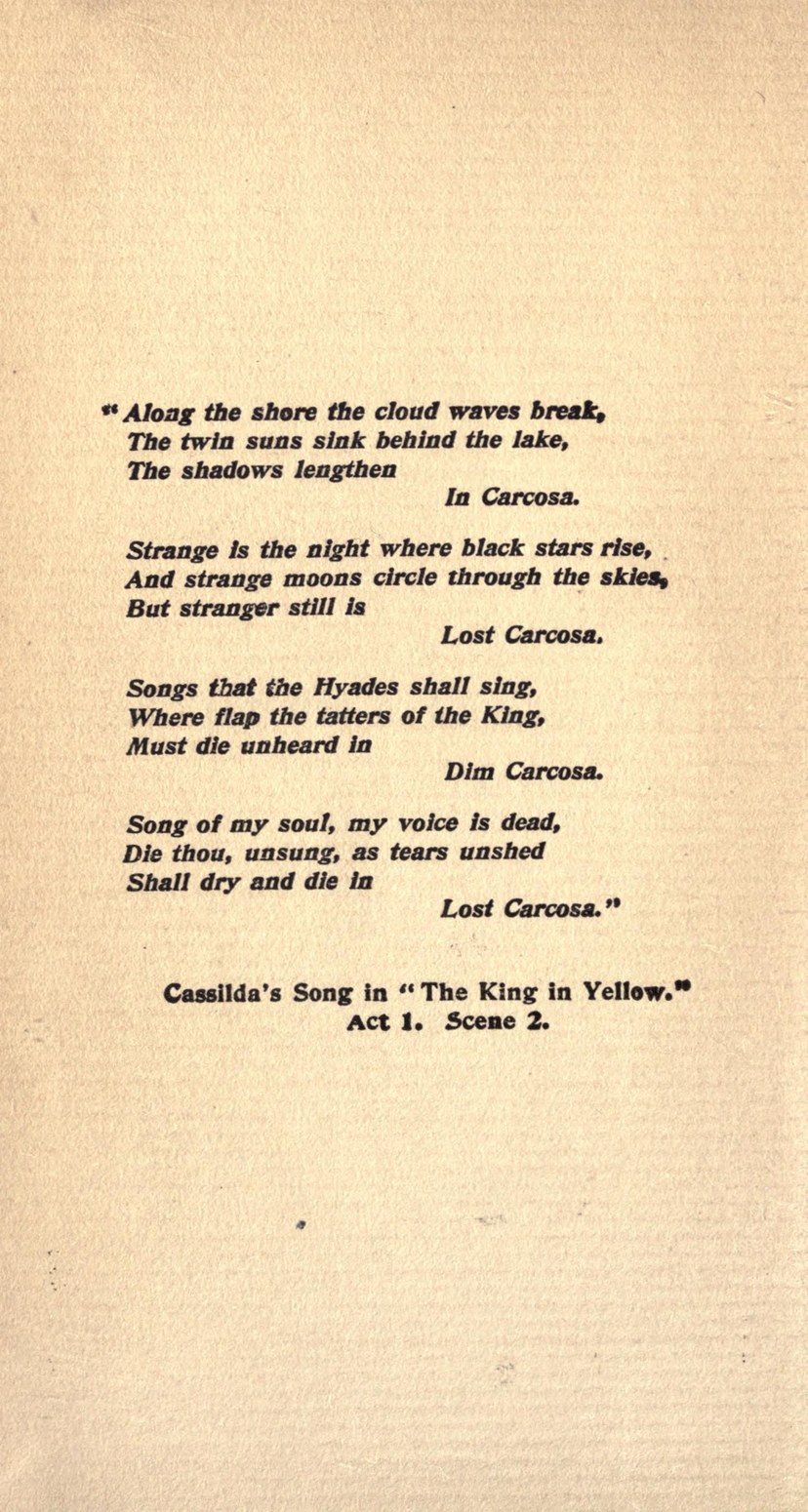
“Cassilda’s Song,” the fragment of the fictional play that Chambers actually prints in the 1895 first edition — the source of “Carcosa,” “the Hyades” and “the tatters of the King,” reproduced here exactly as the book gives it. Source. Public domain.
Who is the King?
The King is a threatening presence associated with the play and its strange imagery, but Chambers does not supply a straightforward biography. There is no definitive chapter laying out his origins, physical statistics and complete powers.
Readers encounter suggestions: yellow tatters, masks, unfamiliar places and the unsettling possibility that a performance is not merely a performance. Those fragments do not amount to a fixed anatomical description of a giant tentacled ruler.
Later artists and writers are entitled to give the figure a clear form. Their versions need to be labeled as interpretations or adaptations. The absence of a complete original portrait is part of what gives them that freedom.
What is Carcosa?
Carcosa is an evocative fictional place, not a lost city historians have identified. Chambers uses its name alongside other suggestive locations and celestial references to create a geography that feels connected without becoming fully mapped.
The name also has an earlier literary life. Ambrose Bierce’s “An Inhabitant of Carcosa,” collected in Can Such Things Be?, presents a man moving through an unfamiliar landscape and gradually confronting what has happened to his world and to himself.
Chambers’s use of Carcosa therefore participates in literary borrowing. It does not establish that the two authors documented the same real location. Nor does every reference to the name in later fiction have to describe precisely the same city with precisely the same rules.
A map can be an interesting modern interpretation. It is not something the collection requires readers to possess before they can understand its fear.
What is the Yellow Sign?
In the story named after it, the Yellow Sign is an ominous emblem connected with the forbidden play and the characters’ encounter with a disturbing figure. Its recognition carries a sense that the danger has already reached the characters’ private lives.
Chambers does not give the now-familiar modern graphic designs as an official illustration with the force of a canonical diagram. A contemporary three-armed emblem may have a specific later origin. It should not be presented as a symbol drawn by Chambers in the first edition unless that claim can actually be documented.
This is an important image distinction. An original title page or decorative illustration can show how the real book looked. A modern Yellow Sign design shows how someone later visualized an idea from it. Both can be discussed, but they are not the same evidence.
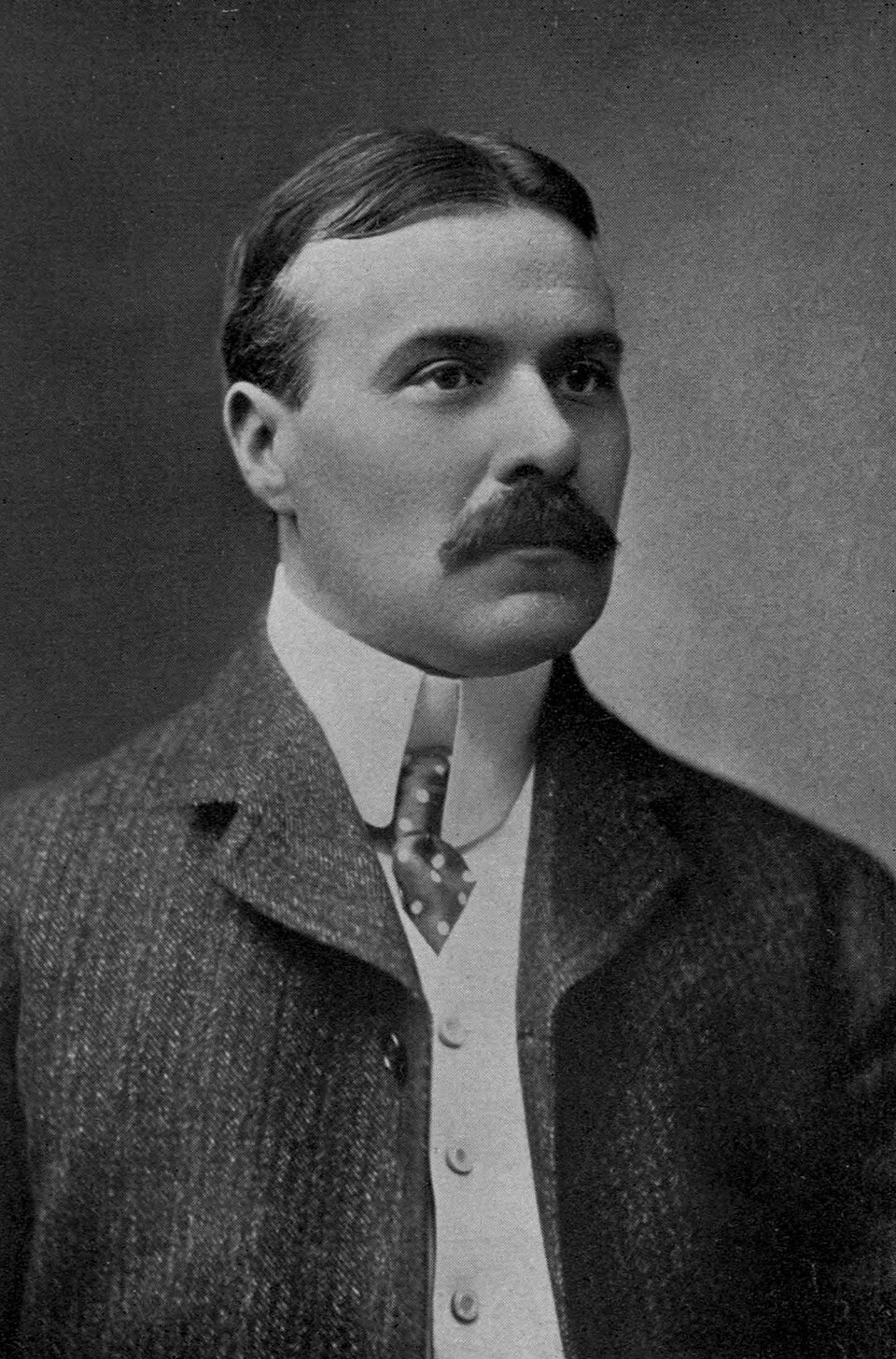
Robert W. Chambers, the American author who wrote The King in Yellow and its embedded fictional play. Source. Public domain.
Why the narrators cannot always be trusted
“The Repairer of Reputations” makes unstable perception central to its effect. Its narrator builds an elaborate account of status, conspiracy and destiny. The story gives the reader reasons to question his confidence rather than accept his entire world-picture as settled fact.
That creates a problem for summaries that extract every statement as lore. Some details tell us what a narrator believes, not necessarily what the fictional world objectively contains. A complete explanation has to retain that difference.
The other early stories use their own combinations of art, desire, fear and uncertainty. The mysterious text is frightening partly because it changes how people interpret the world around them. A face, an object or a place can become unbearable once it seems connected to the play.
Is this part of Lovecraft’s Cthulhu Mythos?
Chambers’s collection predates The Call of Cthulhu. The King did not begin as a character invented by Lovecraft. Later weird fiction creates connections and reuses names, but those developments should be separated from the 1895 collection.
The same caution applies to identifying the King as one specific later being in a fixed hierarchy. That may be how a game or subsequent author organizes the material. It is not a complete answer to what Chambers originally wrote.
For comparison, Cthulhu shows another way an invented name and a deliberately incomplete text can acquire the appearance of an older, shared history.
Where to begin reading
Start with the first four stories, in their published order. Notice who is speaking, what they actually encounter and what they merely believe. Treat a fragment of the play as a fragment, rather than forcing it to support a complete cosmology.
The book’s central trick is not that it secretly contains a dangerous text. It is that a handful of imagined references can make the reader feel the pressure of a text that does not exist. The missing play remains just beyond reach, and that is where much of its horror lives.