The Index
The Parabita Double Burial and the Evidence Behind the ‘Lovers’ Name
Two people shared a Paleolithic grave at Grotta delle Veneri. Their bones, pierced deer teeth and a later disturbance explain what archaeologists can reconstruct.
Topics: Parabita, Grotta delle Veneri, Gravettian, Archaeology, Burial Practices, Italy
About 28,000 years ago, two people were laid in the same grave at Grotta delle Veneri, a cave near Parabita in southern Italy. Their position gives archaeologists a reason to think they were buried together. The familiar nickname “the lovers of Parabita” goes further than the bones can take us. Sharing a grave tells us something about how the dead were treated, but it cannot establish a romance.
The burial is the subject of a new display at the University of Salento’s historical and archaeological museum, MuSA, in Lecce. On November 3, Puglia Review reported that the opening was scheduled for November 5 at 5:30 p.m. local time. The museum project brings together the remains, an illustrated reconstruction and a video on the excavation. Local report on the exhibition
How do archaeologists read an incomplete grave?
Giuliano Cremonesi found the burial in 1968. A later, Neolithic burial had disturbed the older grave. The skulls and parts of the upper bodies were missing by the time excavators reached them. Drawings and other records from the excavation therefore matter as much as a modern view of the surviving bones.
Two people in one pit could have been buried at different times. Researchers studying Parabita examined the arrangement of the preserved bones relative to one another. Their positions supported a single burial event. That conclusion concerns the sequence of the burial. It cannot supply a cause of death or establish how the two people knew each other. Account of the archaeological studies
What the deer teeth help date
Excavators found 26 deer canine teeth with holes at their roots and traces of red ochre. They lay close to where the heads would have rested. The holes and their grouping suggest that the teeth had been attached to something, possibly a head covering. The material that held them together has perished.
A radiocarbon measurement on one of the teeth placed it at roughly 28,800 to 28,300 calibrated years before present. Its association with the burial is what makes it evidence for the grave’s age. A date on an ornament cannot establish the exact moment either person died.
Why the cave’s figurines are a separate find
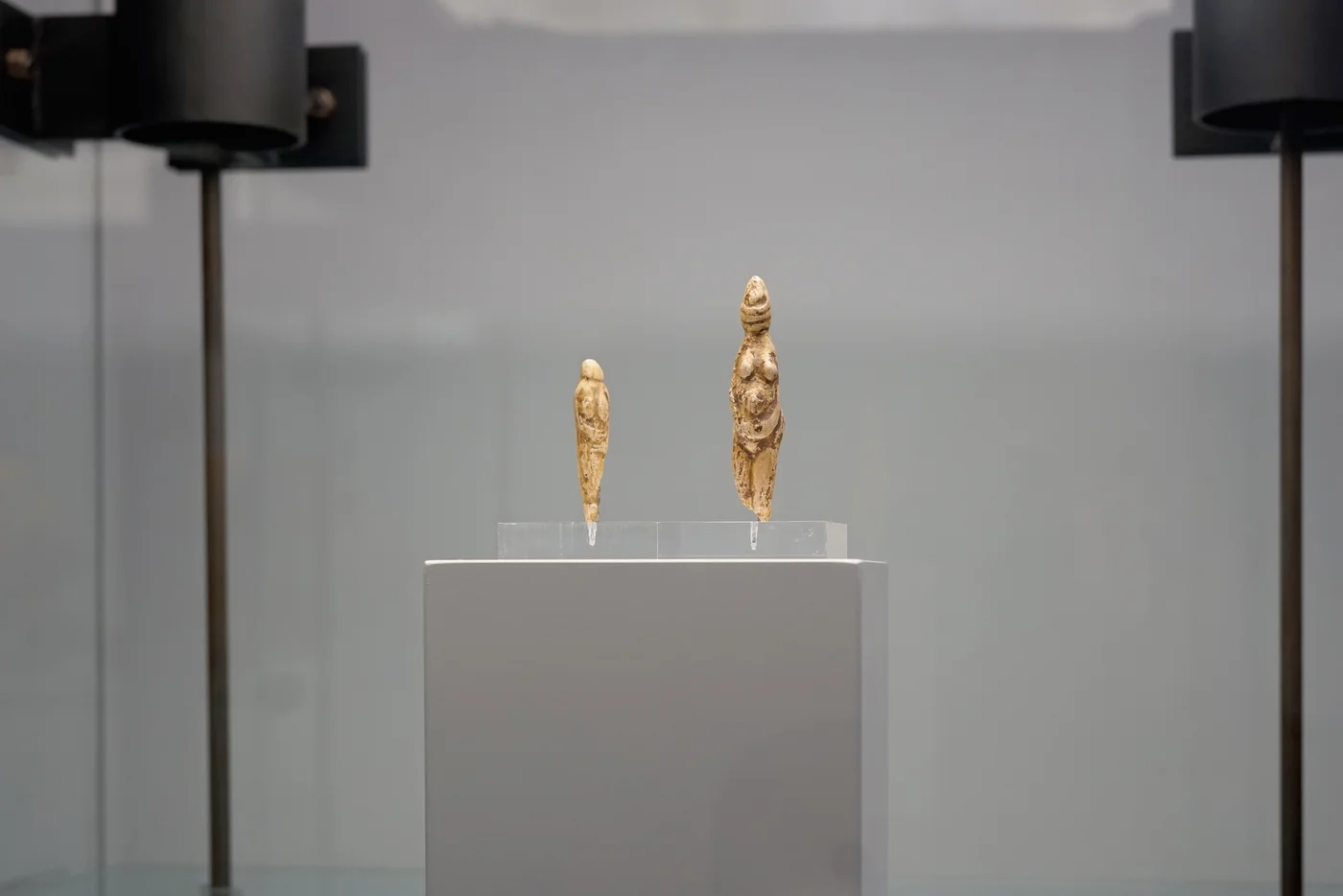
The two small bone figures that gave the cave its name are easy to confuse with the burial goods. The originals form part of the National Archaeological Museum of Taranto’s prehistoric collection. The museum dates them to about 20,000 years ago. The photograph above shows copies on display at a different museum in Lecce. Neither the photograph nor the Taranto collection date identifies the figurines as objects placed beside the two people. Taranto museum collection
For another example of how archaeologists interpret objects found alongside human remains, see the bronze rings and animal bones from the Celtic grave at Senden.