The Index
Rødhals Man: Why a Seafood Diet Complicated the Date of His Burial
A new study places a Danish coastal forager alongside early farmers. Here is how marine carbon affected the date and what his burial can—and cannot—prove.
Topics: Rødhals Man, Sejerø, Burial Archaeology, Radiocarbon Dating, Neolithic
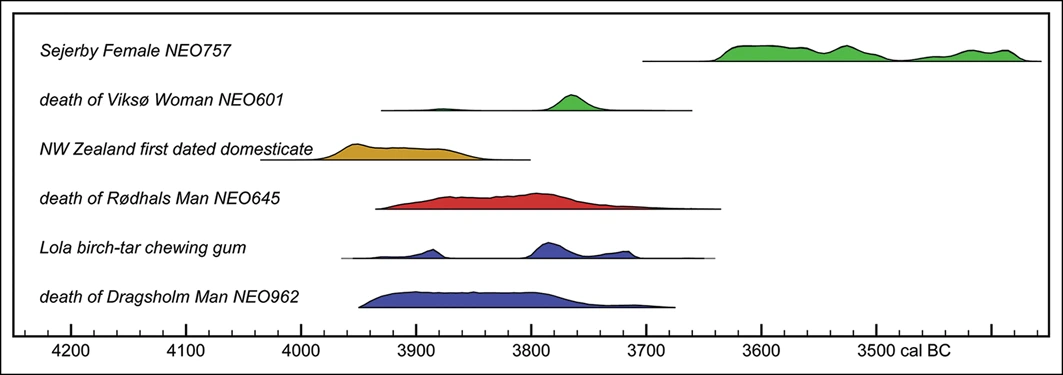
John Meadows / Fischer et al., Antiquity (2026), CC BY 4.0. Resized and converted to WebP.
Rødhals Man’s seafood-heavy diet made his radiocarbon results appear older than his actual lifetime. A new Antiquity study, published on November 16, corrects for that effect and places the Danish coastal forager around the arrival of farming. See also documented dark history.
The study re-examines remains found on Sejerø in 1956.
Why the dates needed correction
Marine food can introduce older carbon into human tissues. The team combined radiocarbon measurements with dietary estimates and the different ages represented by the sampled tissues.
Its model gives a 3930–3710 cal BC range at 95% probability, with 3890–3770 cal BC at 68% probability. These are estimated intervals, not an exact year of death. The chart above compares the result with other people and early evidence of domestic animals.
Hero figure: John Meadows, Figure 8 in Fischer and colleagues’ study, Antiquity (2026), CC BY 4.0. Resized and converted to WebP.
What changed during his lifetime?
The University of Gothenburg’s research account explains that isotope analysis points to stronger reliance on marine food in childhood, followed by more terrestrial food in adolescence and adulthood. He did not abandon the sea.
The researchers combine this with ancient DNA indicating hunter-gatherer ancestry. Their interpretation is that he lived through the arrival of farmers and interacted with them.
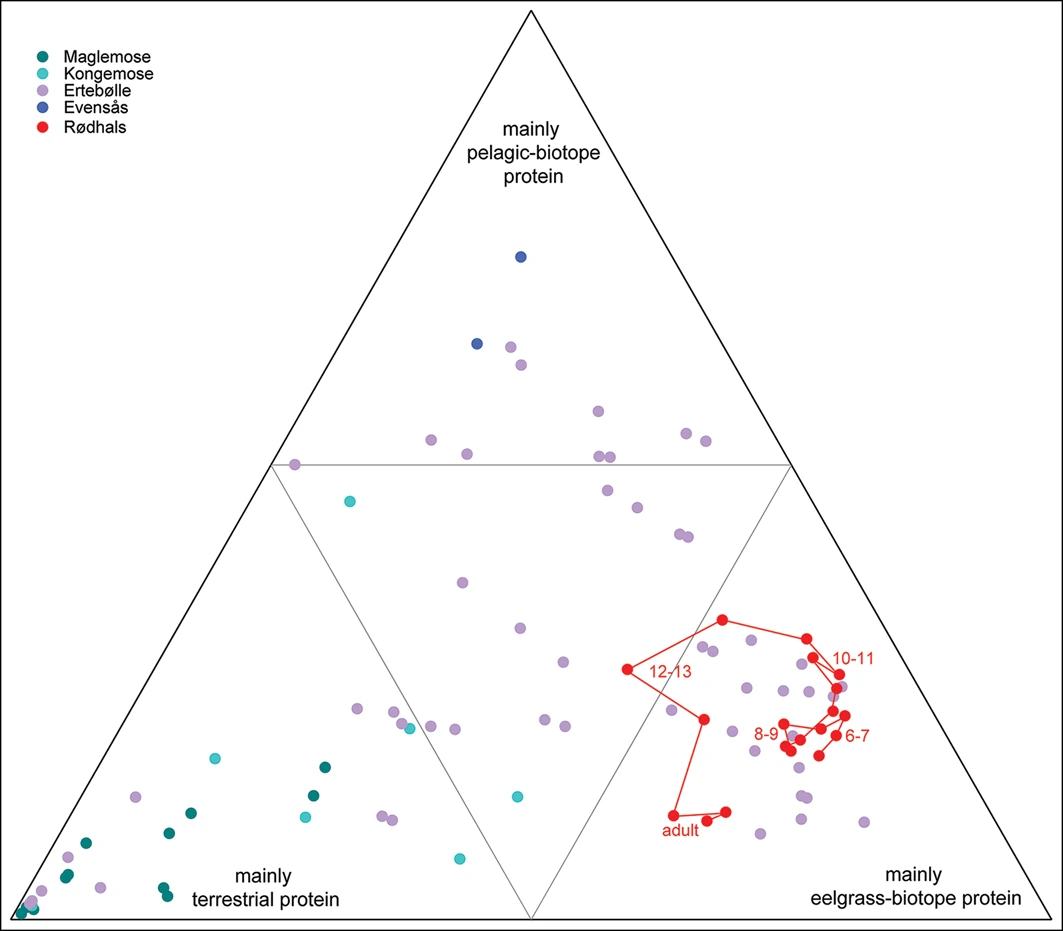
The red points trace estimated dietary changes through his life. John Meadows, Figure 7 in Fischer and colleagues, Antiquity (2026), CC BY 4.0. Resized and converted to WebP.
What the burial cannot settle
The paper is more cautious than a simple conversion-to-farming story. The isotope evidence alone cannot distinguish more hunting and gathering of terrestrial resources from consuming farmed food. His stone-framed grave resembles some early farmers’ burials, which supports the interaction hypothesis without revealing his beliefs.
The skeleton shows no signs of violence. The findings do not establish a cause of death. See also Fallward’s Boat Burial: What the Leprosy DNA Really Shows.
What this one burial adds
Rødhals Man offers evidence about one life during a broader transition. His diet, ancestry and burial are different kinds of evidence; none supplies a written account of his choices.
For another example of separating burial objects from assumptions about a person, see our Griffin Warrior tomb guide.
Frequently asked questions
What changed during his lifetime?
The University of Gothenburg’s research account explains that isotope analysis points to stronger reliance on marine food in childhood, followed by more terrestrial food in adolescence and adulthood. He did not abandon the sea.