The Index / Dark History
The Salem Witch Trials Explained: What Really Happened in 1692?
Nineteen people were hanged, one was pressed to death, and no one was burned. Here's the documented history of the Salem witch trials, separated from The Crucible.
Topics: Salem Witch Trials, Witchcraft, Colonial America, Dark History, 1692
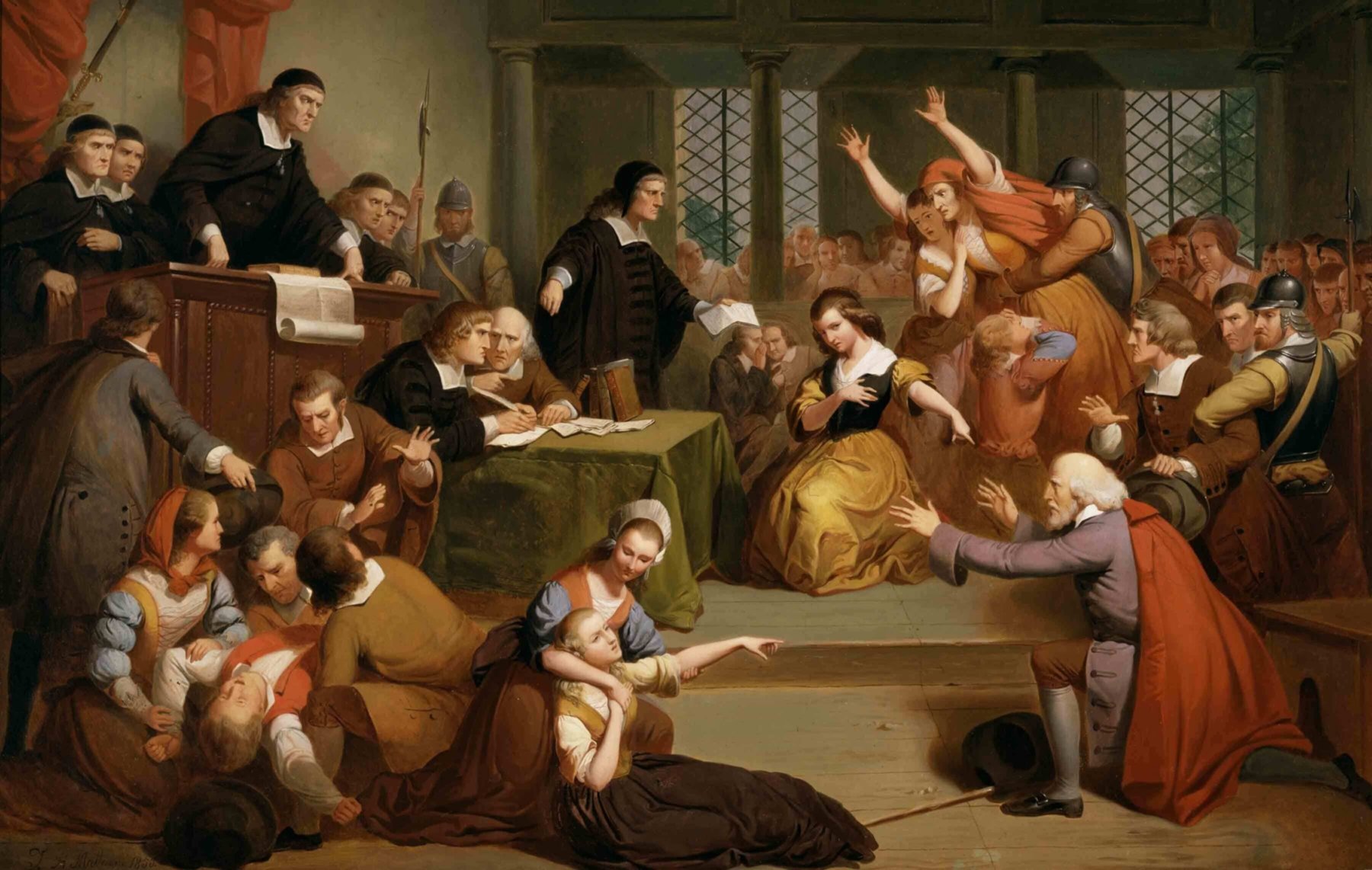
Tompkins H. Matteson (1855) / Wikimedia Commons (Public Domain)
Nineteen people were hanged in Salem, Massachusetts, in 1692. One man was pressed to death under stones. At least five more died in jail. None of them were witches, and none of them were burned at the stake — that detail belongs to European witch persecutions, not colonial New England, where the standard method of execution was hanging.
Those two corrections matter because so much of what people think they know about Salem comes from later retellings rather than the trial record: Arthur Miller’s The Crucible, tourist branding, and a century of horror imagery that has very little to do with what a Puritan magistrate in 1692 actually believed he was prosecuting. The documented history is stranger and more specific than the folklore that grew up around it.
Salem Village and Salem Town
The Salem of 1692 wasn’t one place. Salem Town, on the coast, was a prosperous port community built on maritime trade. Salem Village, several miles inland — the area is now the separate town of Danvers — was a poorer farming community that had spent years trying, and failing, to gain full independence from Salem Town’s government and taxation. That tension between an inland farming community and a wealthier coastal one runs underneath almost everything that happened that year.
Salem Village had also just endured a bruising fight over its own ministry. Samuel Parris became the village’s first ordained minister in 1689, and by most contemporary accounts he was a demanding, litigious figure who quickly alienated a meaningful share of his own congregation. Add in the aftershocks of King William’s War, which had sent refugees fleeing south from fighting in Maine and the Canadian border region into an already strained Essex County, and Salem Village in early 1692 was a community under real, compounding stress before a single accusation of witchcraft was made.
How the Accusations Began
In January 1692, Betty Parris, the minister’s nine-year-old daughter, and Abigail Williams, his eleven-year-old niece, began experiencing fits: screaming, contorted postures, and behavior a local doctor couldn’t explain medically, which led him toward a diagnosis of witchcraft. Ann Putnam Jr., twelve, began showing similar symptoms shortly afterward, and the circle of “afflicted” girls grew from there.
Under pressure from local magistrates, the girls named three women on February 29: Tituba, an enslaved woman in the Parris household; Sarah Good, an impoverished, largely homeless woman with a reputation for bitterness toward neighbors; and Sarah Osborne, an elderly widow already unpopular locally over a property dispute. All three were, in different ways, marginal figures in the village — exactly the kind of people who had the least social power to push back against an accusation.
Tituba’s testimony on March 1 became the turning point. Rather than deny the charge, as Good and Osborne did, she confessed — describing a tall, white-haired man who pressured her to sign his book and other witches conspiring against the Puritan community. Whether her confession was genuine belief, coerced strategy, or some mixture of both is something historians still debate; what’s certain is that it transformed a local dispute into something the community understood as a conspiracy, and the number of accusations began climbing quickly afterward.
Spectral Evidence and the Court
What made Salem’s prosecutions procedurally unusual was the court’s heavy reliance on spectral evidence — testimony that a witch’s spirit or specter had appeared to a witness and caused them harm, even while the accused’s physical body was demonstrably somewhere else entirely. Only the afflicted could supposedly see these specters, which meant the accused had almost no way to mount a physical defense against the accusation.
Governor William Phips established a special Court of Oyer and Terminer on May 27, 1692, to hear the backlog of witchcraft cases across Essex, Suffolk, and Middlesex counties. Bridget Bishop, tried first, was convicted and hanged on June 10 — the first of nineteen executions. Bishop reportedly told the court, “I am as innocent as the child unborn,” a plea that made no difference against spectral testimony.
Five more were hanged in July, five more in August — including George Burroughs, a former Salem Village minister whose case drew particular attention because reciting the Lord’s Prayer perfectly at the gallows was popularly believed to be impossible for an actual witch, and he did it anyway, to no effect on the outcome — and eight more in September, the single largest group executed on one day in the colony’s history.
Not everyone accused was executed by hanging. Giles Corey, an eighty-one-year-old church member, refused to enter any plea at all when charged, which under English common law of the period blocked the court from proceeding to trial. In response, authorities had him pressed under an increasing weight of stones over two days in September 1692, in an attempt to force a plea. He never gave one. His last recorded words were reportedly “more weight.”
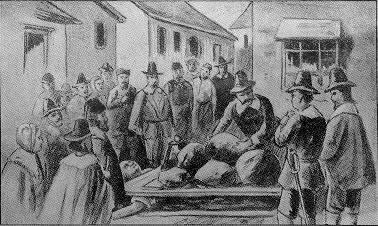
A later illustration of Giles Corey’s pressing, published in John Clark Ridpath’s history in 1892 — two centuries after the event, not a contemporary depiction. Public domain, via Wikimedia Commons. Rebecca Nurse, a respected, elderly church member whose conviction shocked much of the community and briefly produced a not-guilty verdict the judges sent the jury back to reconsider, was hanged in July. At least five more accused people, including infants, died from the conditions inside Salem’s jails rather than from execution.
Cotton Mather, Increase Mather, and the Turn Against Spectral Evidence
The two most prominent Puritan ministers of the period did not hold identical positions, and collapsing them into one voice misrepresents both. Cotton Mather wrote to the court shortly after it was established, urging caution about spectral evidence specifically — advice the court largely ignored through the worst months of the executions. His father, Increase Mather, then president of Harvard, went considerably further on October 3, 1692, publishing an argument that spectral evidence should not be admitted at all, on the grounds that the devil could plausibly assume the shape of an innocent person: “It were better that ten suspected witches should escape than one innocent person be condemned.”
That argument, circulating alongside growing public unease and, according to several accounts, suspicion reaching close enough to touch Governor Phips’s own wife, gave Phips the cover he needed. He barred further arrests, began releasing prisoners, and dissolved the Court of Oyer and Terminer on October 29, 1692. Its replacement, the Superior Court of Judicature, excluded spectral evidence and convicted only 3 of the 56 people it tried. By May 1693, Phips had pardoned everyone still held on witchcraft charges.
What Puritans Actually Meant by Witchcraft
It’s worth being precise about the underlying belief system, because it wasn’t superstition detached from religion — it was an extension of it. Puritan theology held that Satan operated in the world through human agents who had entered into a real, binding compact with him, granting them supernatural power to harm neighbors, livestock, and children in exchange for service. Witchcraft, under that framework, wasn’t fantasy; it was a capital crime under Massachusetts law, prosecuted with the same seriousness as murder, because harming someone through diabolical means was considered exactly as real and exactly as punishable as harming them by ordinary violence.
That context doesn’t excuse what happened. It does explain why educated ministers, trained judges, and ordinary jurors participated in good faith in a process that, from the outside, looks like mass persecution of the powerless. Within their own framework, they believed they were prosecuting an actual, active criminal conspiracy.
What Ergot Poisoning Does and Doesn’t Explain
In 1976, behavioral psychologist Linnda Caporael proposed that the afflicted girls’ convulsions and hallucinations might have been caused by ergotism — poisoning from a fungus, ergot, that can contaminate rye grain and produce symptoms including muscle spasms and hallucinations. It’s a genuinely interesting hypothesis, and it gets repeated constantly as a tidy scientific explanation for the entire episode.
It’s also been strongly disputed by other researchers. Psychologists Nicholas Spanos and Jack Gottlieb published a detailed rebuttal, also in Science, arguing that the documented symptoms don’t line up cleanly with convulsive ergotism: the trial and witness records show little of the vomiting, diarrhea, and skin discoloration typically associated with ergot poisoning, and the region’s fish- and dairy-heavy diet likely provided enough vitamin A to reduce the risk of the convulsive form entirely. Very few children under ten showed the kind of documented convulsive symptoms the theory would predict.
Ergot poisoning remains a proposed explanation, not an accepted one. It shouldn’t be presented as the scientific answer to Salem, because the scholarship most directly engaging with the theory has found it doesn’t fit the documented symptoms particularly well.
What The Crucible Added
Arthur Miller’s 1953 play The Crucible is a powerful piece of theater, written as an allegory for McCarthyism, and it has done more than any single source to shape the popular image of Salem — while inventing or dramatically altering a substantial amount of what actually happened. Miller aged several real participants up or down for dramatic purposes, invented a romantic affair between John Proctor and Abigail Williams that has no basis in the historical record, and compressed a multi-year, many-victim legal process into a tighter dramatic arc.
Similarly, popular claims that the girls danced naked in the woods, that Tituba actively taught them witchcraft or divination, or that the events involved organized “black magic” practice trace more to later dramatization and folklore than to the surviving depositions and court records, which describe fits, accusations, and testimony rather than documented occult ritual.
How Salem Ended and What Came After
Massachusetts’s Colonial government moved, slowly, toward acknowledging the trials as a miscarriage of justice. The General Court ordered a formal day of fasting and reflection in 1697. In 1702, the court declared the trials had been unlawful. By 1711, the colony passed legislation restoring the good names of many of the accused and granting £600 in restitution to their heirs — though it took until 1957 for Massachusetts to issue a formal state apology covering everyone convicted, and until 2022 for the last name to be cleared. Elizabeth Johnson Jr., convicted in 1693 but never executed, remained legally guilty of witchcraft on paper for 329 years until a Massachusetts eighth-grade civics class successfully lobbied the state legislature for her exoneration.
Was Anyone Later Connected to Salem Falsely?
The Salem “expelled witch” story has occasionally been recycled to add false weight to unrelated hauntings elsewhere. In the Amityville case, for instance, Jay Anson’s 1977 book invented a colonial figure supposedly “expelled from Salem, Massachusetts, for practicing witchcraft” and buried on the Long Island property — a claim later genealogical research showed was chronologically impossible for the real family it borrowed a name from. That’s a useful reminder of how much cultural weight “Salem” still carries: attaching the name to an unrelated legend has remained a reliable way to make a story sound older and more credible than it actually is, more than three centuries later.
The trials’ legacy of coerced or exaggerated confession under communal and religious pressure also echoes in far more recent cases — including the Anneliese Michel exorcism, where sincere religious conviction likewise steered a community past medical explanations that were available at the time.
Frequently Asked Questions
What caused the Salem Witch Trials? A combination of factors: a bitter dispute over Salem Village’s ministry, economic and political strain from King William’s War refugees, longstanding tension between Salem Village and the wealthier Salem Town, and a genuine Puritan religious belief that witchcraft was a real, prosecutable crime — set off by a group of girls’ unexplained fits and the accusations that followed.
How many people died? Nineteen were hanged, one man was pressed to death, and at least five more died in jail from the conditions of imprisonment, including infants.
Were witches burned in Salem? No. All nineteen executed were hanged. Burning at the stake was a European practice; it was not used in the Salem trials or elsewhere in colonial New England.
Who was the first person executed? Bridget Bishop, hanged on June 10, 1692, after being the first person tried before the newly formed Court of Oyer and Terminer.
What was spectral evidence? Testimony that a witch’s spirit had appeared to and harmed a witness, even though the accused’s physical body was elsewhere. Only the afflicted could supposedly see it, making it nearly impossible for the accused to mount a defense.
Was Tituba really a witch? No credible historical evidence supports that she practiced witchcraft. She confessed under pressure during interrogation, and her confession helped trigger the wider panic, but confession under those conditions isn’t evidence of actual practice.
Did ergot poisoning cause the trials? It’s a proposed but disputed theory. Other researchers have argued the documented symptoms don’t match convulsive ergotism closely enough to support it as the primary explanation.
Why did the trials end? Growing public doubt, the Mathers’ published arguments against spectral evidence, and suspicion reaching close to Governor Phips’s own household led him to dissolve the Court of Oyer and Terminer in October 1692 and pardon the remaining prisoners by May 1693.
Were the accused later pardoned? Most were restored to good standing by 1711 legislation with restitution paid to heirs. The very last name, Elizabeth Johnson Jr., wasn’t formally cleared until 2022.